Open Access Publisher and Free Library
CRIME+CRIMINOLOGY.jpeg

CRIME

Violent-Non-Violent-Cyber-Global-Organized-Environmental-Policing-Crime Prevention-Victimization

Posts tagged online markets
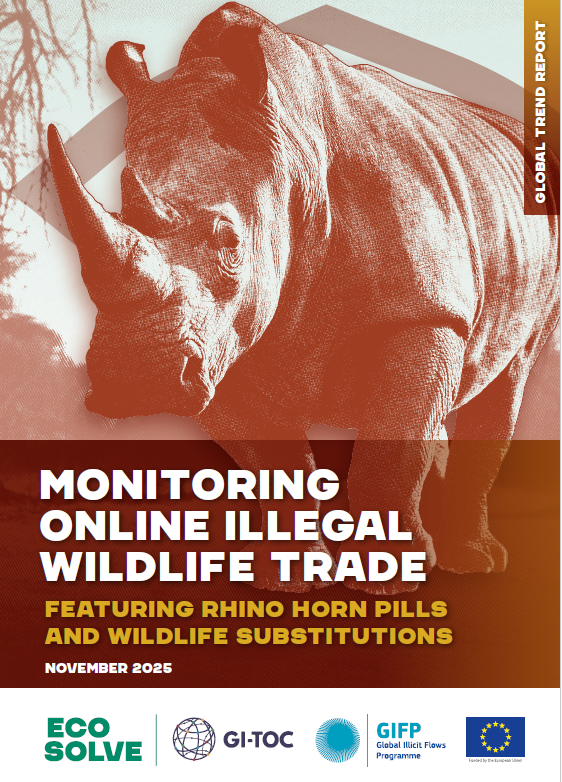
 MONITORING ONLINE ILLEGAL WILDLIFE TRADE. Featuring rhino horn pills and wildlife substitutions

By The Global Initiative Against Transnational Organized CrimeGlobal Initiative Against Transnational Organized Crime,Global Initiative Against Transnational Organized Crime,

Online illegal wildlife trade (IWT) continues to expand across social media and e-commerce platforms, with 13,254 wildlife advertisements detected between April 2024 and August 2025 across Africa, the Americas, Asia and the Middle East. Our monitoring shows a persistent concentration on Facebook, which accounts for 83.8% of all detections, alongside growing activity on e-commerce and business-to-business platforms. The rise in both volume and geographic coverage underscores how sellers exploit online environments, regulatory loopholes and shifting demand to reach consumers and adapt rapidly to enforcement efforts.

Drawing on structured monitoring by ten regional data hubs, this new iteration of the Global Trend Report highlights how species, platforms and market drivers differ widely across regions. Mammals dominate detections, led by elephants, big cats and African grey parrots, and many adverts involve species listed under CITES Appendix I or II without accompanying permit information. Hubs recorded diverse tactics: Facebook Stories designed for 24-hour visibility, coded emojis in Colombia, claims of official registration in Mexico, children’s YouTube channels in South Asia that normalize protected wildlife as pets, and loopholes around legally owned lions in Thailand.

A central focus of the report is North Korea’s Angong Niuhuang Wan (ANW) pills, whose packaging explicitly lists “rhinoceros horn” as an ingredient. Open-source intelligence shows these pills are produced in Pyongyang and moved through Sinuiju and Namyang into China before circulating across markets in Japan, Hong Kong, Singapore, Malaysia, Cambodia, Thailand, Laos, Vietnam and Myanmar. Embedding small amounts of rhino horn into labelled traditional medicine significantly amplifies value and demand, while illustrating how the rhino horn trade intersects with conservation and security concerns, including sanctions evasion and illicit revenue streams linked to North Korean entities.

The report also documents how markets pivot when supply declines or regulations tighten. After all pangolin species were uplisted to CITES Appendix I in 2016, Mexican export data shows an exponential rise in pirarucu leather exports, with pirarucu now positioned as a visually similar substitute. Online markets show mislabelled and misidentified leathers, such as pirarucu sold as pangolin and vice versa, revealing laundering risks along supply chains. Traceability gaps, especially once skins are processed, make verification difficult and complicate enforcement.

Taxidermy and leatherworking form another blind spot. In Mexico, highly active social-media groups advertise mounted specimens, ivory figurines and worked products derived from rhinos, elephants, manta rays, crocodilians, jaguars, pangolins, pirarucu and primates. Adverts frequently lack documentation, rely on coded language and misspellings, and exploit enforcement priorities that remain focused on live trade rather than processed parts.

Finally, declining availability of tiger products has driven substitutions such as lion canines in Thai amulet Facebook groups and jaguar parts sourced from Latin America. Cross-border movements of lion bones and skeletons, and online offers for jaguar skins, teeth and paste show how big-cat parts circulate as substitutes, shaped by availability and legal risk.

Across all hubs and product types, the report demonstrates how online IWT can be linked to global security and sanctions evasion issues, and how it adapts through substitutions, processed wildlife products and regulatory loopholes, reinforcing the need for coordinated monitoring, enforcement and policy responses.

Geneva: Global Initiative Against Transnational Organized Crime, 2025. 35p.

Digital Transformations of Illicit Drug Markets: Reconfiguration and Continuity

Edited by Tzanetakis, Meropi and South, Nigel

The ebook edition of this title is Open Access and freely available to read online. Transnational illicit markets have been transformed by the digital revolution. They take advantage of encryption technologies, smartphones, social media applications and cryptocurrencies that protect the digital traces of buyers and sellers, posing new challenges to drug control policies and public health alike. Digital Transformations of Illicit Drug Markets: Reconfiguration and Continuity considers how the digital revolution has changed the selling and buying of illicit substances through increased convenience and anonymisation. Providing a uniquely interdisciplinary perspective, chapters show how the digital transformation of illicit drug markets combines a reconfiguration of how sellers and buyers interact in new markets. Emphasising that illicit digital markets are embedded in societal structures and power relations in general, contributors also recognise the importance of critical perspectives on inequalities between the Global North and South as well as issues of gender. Digital Transformations of Illicit Drug Markets: Reconfiguration and Continuity challenges the field of criminology to recognise the limits of its traditional knowledge and move beyond the preoccupations that restrict crime to certain fixed spaces in order to develop new explanations.

Bingley: Emerald, 2023. 198p.

Market Structure and Extortion: Evidence from 50,000 Extortion Payments

By Zach Y. Brown & Eduardo Montero & Carlos Schmidt-Padilla & Maria Micaela Sviatschi

How does gang competition affect extortion? Using detailed data on individual extortion payments to gangs and sales from a leading wholesale distributor of consumer goods and pharmaceuticals in El Salvador, we document evidence on the determinants of extortion payments and the effects of extortion on firms and consumers. We exploit a 2016 nonaggression pact between gangs to examine how collusion affects extortion in areas where gangs previously competed. While the pact led to a large reduction in competition and violence, we find that it increased the amount paid in extortion by approximately 20%. Much of this increase was passed through to retailers and consumers: retailers experienced an increase in delivery fees, leading to an increase in consumer prices. In particular, we find an increase in prices for pharmaceutical drugs and a corresponding increase in hospital visits for chronic illnesses. The results point to an unintended consequence of policies that reduce competition between criminal organizations.

Cambridge, MA: National Bureau of Economic Research, 2023. 67p.

Cryptomarkets and the returns to Criminal Experience

By Marie Ouellet, David Décary-Hétu, and Andréanne Bergeron

Criminal capital theory suggests more experienced offenders receive higher returns from crime. Offenders who accrue skills over their criminal career are better able to minimize detection, increase profits, and navigate illegal markets. Yet shifts in the offending landscape to technologically-dependent crimes have led some to suggest that the skills necessary to be successful in conventional crimes no longer apply, meaning ‘traditional’ criminals may be left behind. The recent turn of drug vendors to online markets provides an opportunity to investigate whether ‘street smarts’ translate to success in technologically-dependent crimes. This study surveys 51 drug vendors on online drug markets to compare individuals who began their drug-selling career in physical drug markets with vendors whose onset began on digital platforms. The focus is on their criminal earnings while comparing the scope and management of their networks. The results inform potential spillover effects from offline drug-selling into online marketplaces.

GLOBAL CRIME. 2022, VOL. 23, NO. 1, 65p

Technology-facilitated Drug Dealing via Social Media in the Nordic Countries

By Jakob Demant and Silje A. Bakken

Use of the internet has changed drug dealing over the past decade. While there is a growing understanding of the role of darknet drug markets, little is known about how drug dealing works on public online services such as social media. This study reports findings from a Nordic comparative study of social media drug dealing, which represents the first in-depth study of increasing levels of digitally mediated drug dealing outside cryptomarkets.

Lisbon, Portugal: European Monitoring Centre for Drugs and Drug Addiction (EMCDDA)m 2019. 22p.

An EU-focused Analysis of Drug Supply on the Online Anonymous Marketplace Ecosystem

By Nicolas Christin

Online anonymous marketplaces are a relatively recent technological development that enables sellers and buyers to transact online with far stronger anonymity guarantees than on traditional electronic commerce platforms. This has led certain individuals to engage in transactions of illicit or illegal goods.

This report presents an analysis of the online anonymous marketplace data collected by Soska and Christin [13] over late 2011–early 2015. In this report, we focus on drug supply coming from the European Union. Keeping in mind the limitations inherent to such data collection, we found that, for the period and the marketplaces considered.

Lisbon, Portugal: European Monitoring Centre for Drugs and Drug Addiction, 2017. 25p.

Exploring Drug Supply, Associated Violence and Exploitation of Vulnerable Groups in Denmark

By Thomas Friis Søgaard, Marie Højlund Bræmer, and Michael Mulbjerg Pedersen

This report provides an analysis of current drug supply models and the related violence and exploitation of vulnerable groups in Denmark. Recent years have seen a growth in criminals’ exploitation of vulnerable groups for drug-related crimes. This development appears to be driven by several structural factors, including increased drug market competition and a proliferation of more labour-intensive supply models. Based on the findings of this study, we identify some priorities for future research to understand the impact of digital developments in retail-level drug distribution on vulnerable individuals and to inform responses to reduce criminal exploitation.

Lisbon: European Monitoring Centre for Drugs and Drug Addiction (EMCDDA); Luxembourg: Publications Office of the European Union, 2021. 55p.

Digest of Cyber Organized Crime

By United Nations Office on Drugs and Crime (UNODC)

The present case digest contains an analysis of cases of cyber organized crime. The digest is global in scope and attempts, to the extent possible, to ensure an equitable representation of cases from different geographical regions and legal systems. On the basis of more than 100 cases from more than 20 jurisdictions, observations are made about the ways in which cyber organized crime is identified in case law and how this illicit activity is investigated, prosecuted and adjudicated across jurisdictions. The case digest examines the structure and organization of cyber organized criminal groups, tools used by perpetrators of cyber organized crime, types of cyber organized crime and procedural issues relating to the investigation, prosecution and adjudication of cyber organized crime cases. The case digest contains summaries of relevant judicial proceedings concerning cyber organized crime, organized according to theme. The ultimate goals of the digest are to identify cases involving cyber organized crime and the manner in which such crime has been investigated, prosecuted and adjudicated in different areas of the world. The digest concludes by identifying challenges to investigating, prosecuting and adjudicating cases involving cyber organized crime, as well as the lessons learned for criminal justice professionals, including some of the challenging aspects of criminal justice responses to such crime.

Vienna: UNODC, 2021.144p.

Child sex tourists: A review of the literature on the characteristics, motives, and methods of (Dutch) transnational child sex offenders [English translation]

By Anneke Koning and Lina Rijksen-van Dijke

Child sex tourism is a growing problem and a relatively new challenge for the Dutch national police, which is faced with the task of combatting child sexual abuse by Dutch citizens abroad. Little is known about travelling child sex offenders. In this literature review, information from (international) scientific research, Dutch policy reports, and other documents is analyzed to investigate the characteristics, motives and techniques (modus operandi) of (Dutch) child sex tourists. We conclude that this offender group is not homogeneous, and that different motivations (preferential/situational) and modus operandi (short stay/long stay/online) apply. The diversity of the offender group requires a variety of initiatives which are well-adjusted to the different offender types. The scarcity of research on this topic furthermore illustrates the necessity to gather more intelligence and conduct follow-up research.

Leiden: Leiden University, 2017. 47p.