Open Access Free Library
CRIME+CRIMINOLOGY.jpeg

CRIME

Violent-Non-Violent-Cyber-Global-Organized-Environmental-Policing-Crime Prevention-Victimization

Posts in Financial Crimes
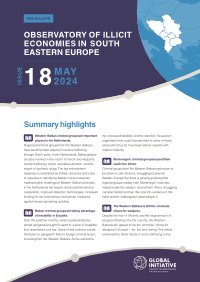
Observatory of Illicit Economies in South Eastern Europe

By Global Initiative Against Transnational Organized Crime’s Observatory of Illicit Economies in South Eastern Europe.

In this issue, we focus on three cases where criminal groups from the region have been active in recent years: the Netherlands, Ecuador and parts of Africa.

These examples illustrate the growing involvement of Balkan criminal groups in some of the world’s hotspots for illicit activity. Research for these articles is facilitated by the Global Initiative’s network of contacts with local investigative journalists, as well as close cooperation between regional observatories of illicit economies, namely South Eastern Europe, West Africa and Latin America.

As part of the GI-TOC’s analysis of the risks of firearms trafficking from Ukraine, in this issue we show that the Western Balkans remain the main source of illegal weapons in Europe. At present, weapons are still cheap and plentiful in the region, and stockpiles have been augmented by inflows from Turkey via Bulgaria, particularly of gas and alarm guns. More on this topic can be found in a forthcoming GI-TOC report on trends in arms trafficking from the Ukraine conflict.

In this issue, we also report on a major crackdown by Serbian authorities in late 2023 on increasingly violent smugglers operating along the border between Serbia and Hungary, and examine how this has displaced migration flows towards Bosnia and Herzegovina.

Risk Bulletin No. 18. Geneva, SWIT: Global Initiative Against Transnational Organized Crime, 2024. 25p.

The Swedish Crime Paradox. A Brief on Challenges Posed by Organised Crime in Sweden

By Amir Rotami

In this policy brief, based on published and forthcoming studies, author Amir Rostami outlines the changing nature of crime in Sweden, with a focus on organised crime, specifically lethal violence and fraud. What are the lessons learned from the Swedish crime paradox, namely the rise in organised crime, but not an equivalent rise in general crime, and what needs to be implemented to counter organised crime? The reaction to the question can be divided into two components: local and global/

European Liberal Forum Policy Paper . Brussels: European Liberal Forum, 2021. 19p.

Oil Theft, Energy Security and Energy Transition in Mexico

By Vlado Vivoda, Ghaleb Krame and Martin Spraggon

Oil theft refers to the exploitation of crude oil or refined petroleum products for criminal purposes. In Mexico, oil theft—referred to as huachicolero—is endemic and widespread. By framing it within the energy security and transition context, this paper offers a new perspective on the problem of oil theft in Mexico. Focusing on crude oil and refined petroleum, the paper demonstrates that Mexico’s energy security—as framed around the 4As (availability, accessibility, affordability, and acceptance)—has deteriorated over the past decade. Application of the 4As framework in the Mexican context shows that the increasing frequency of oil theft has contributed to this deterioration. The proposed solution to the energy security and oil theft problems is centred on Mexico moving from gasoline and diesel to electrification in the transportation sector. The paper demonstrates that, while transport electrification in Mexico has been lagging behind other countries, recent developments in the country point to growing momentum among the country’s political and business elites, in tandem with US partners, in support for the energy transition. Areas where further emphasis should be placed to accelerate Mexico’s energy transition in the transportation sector are identified. Finally, the feasibility of and potential limitations associated with implementing the transition are evaluated.

Resources 202312(2), 30; https://doi.org/10.3390/resources12020030

Money Laundering Risks in Commercial Real Estate: An Analysis of 25 Case Studies

By Global Financial Integrity, FACT Coalition, and the Anti-Corruption Data Collective

Today Global Financial Integrity, in conjunction with the FACT Coalition and the Anti-Corruption Data Collective, is releasing a report with identifies 25 cases in which illegal, allegedly illicit or suspicious funds were funneled into commercial property in the United States over approximately the last 20 years. With a total value of property exceeding $2.6 billion, California, Florida and New York are some of the most favored locations for these illegal investments, but criminals stashed money across some 20 different states. This money originated from around the globe and includes suspicious funds from 14 countries, including Iran, North Korea, Kazakhstan, Russia and Mexico. As varied as the sources of funds were, so too were the types of properties involved. Hotels, shopping malls, supermarkets, a music studio and an equestrian facility in addition to more pedestrian office high-rise

It should be noted that our research represents only known cases involving U.S. commercial real estate: the actual number is likely much higher. Our data definitively shows, however, that commercial property in the U.S. offers criminal syndicates, cartels, kleptocrats and fraudsters an easy path to hide and launder their ill-gotten gains. Russian oligarchs facing international sanctions have also invested in U.S. commercial real estate. Shockingly, eight of the 25 cases involve foreign government officials or their relatives, yet the links to these Politically Exposed Persons were only uncovered long after the purchases.In recent years it has become increasingly clear that the combination of complex financing schemes and a lack of transparency mean commercial real estate provides a unique opportunity for laundering huge amounts of cash with a relatively low risk of detection. Identifying who is behind the purchase of commercial property often presents a significant challenge given large financial flows from real estate investment trusts and private investment groups, in addition to funds from shell companies formed and operated by registered agents, proxies and/or attorneys. Key Findings – More than $2.6 billion in suspicious funds were invested in commercial real estate in 22 U.S. states over approximately the last 20 years. The actual figure is likely much higher.– Funds used to buy commercial real estate in the United States originated in 14 different countries including Russia (4 cases), Mexico (4 cases), China, Malaysia, Iran and Kazakhstan (see Map 2). – Of the 25 cases reviewed for this study, 14 involved either politically exposed persons or oligarchs who typically have especially close relationships with foreign government officials. – The types of properties appearing in cases fall into four broad categories: land/buildings, business facilities (e.g. music studios, health facilities), retail spaces (e.g. supermarkets, hotels) and industrial sites (e.g. steel plants). – Weak or non-existent reporting requirements by professions involved in the purchase of commercial real estate contributed to the ease with which illicit funds were laundered.Recommendations 1.FinCEN should adopt a reporting obligation for multiple real estate professionals in a cascading order to ensure the requirement falls on at least one U.S.-based entity involved in the transaction, from both the buyer and the seller. As attorneys are legally required to be part of the closing process in almost 20 states, attorneys should be included with specific reference to the function they perform in the transaction.The rule should cover transfers of ownership that do not constitute a sale. Current rules only refer to purchases of real property by a legal entity. However, numerous cases of real estate money laundering simply involve the transfer of ownership or creation of equitable interest in the property without an actual sale. FinCEN should expand the types of transactions covered to include direct/indirect transfers of ownership or creation of equitable interest in the property.The rule should cover transactions by trusts: An increasing proportion of housing is now owned by legal entities and arrangements, including trusts. In Los Angeles, for example, 23% of rental units are owned by trusts. Both foreign and some domestic trusts are excluded from the purview of the Corporate Transparency Act. We recommend that transactions by all different classes of legal entities and legal arrangements be included in any prospective rule.

Washington, DC: Global Financial Integrity, 2024. 21p.

Illicit Financial Flows in the Mekong

By Kristina Amerhauser

Illicit financial flows (IFFs) are a serious concern in the Mekong region, which includes Cambodia, Lao People’s Democratic Republic (PDR), Myanmar, Thailand and Vietnam. Facilitated by state-embedded actors, each year vast amounts of illicit proceeds are generated, moved and laundered across the region and beyond in offshore tax havens. This distorts the local economies; deprives the state of income needed for health, education and infrastructure; and deepens inequality. This paper is part of a comparative research project that tests and applies the ‘IFFs pyramid’, a new framework of analysis of IFFs proposed by Reitano (2022), in the context of the Mekong region. Based on a review of secondary literature, it provides an overview of financial flows, trade flows and informality – the three main means by which IFFs are enabled, moved and held according to the ‘IFFs pyramid’ – and discusses how IFFs manifest across the Mekong. It finds that: • There is widespread evidence that each flow is significant in the Mekong and that flows converge and intersect. Nevertheless, current responses to IFFs almost entirely focus on the formal financial system. • Porous borders and strong trade relationships, including with neighbouring China, offer abundant and diverse opportunities for trade-based money laundering (TBML). Lack of capacity to identify misclassified goods and low cross-border collaboration are key impediments to its response. • There are a large number of special economic zones (SEZs), some of which are treated as ‘lawless zones’ where national governments have no authority. This creates widespread opportunities for value to be extracted, under-reported and comingled with legitimate flows. They have also been linked to other illicit markets, such as drug trafficking, the illegal wildlife trade (IWT), human trafficking and financial crimes, and provide the space to generate and launder illicit proceeds in a multitude of ways. • The big informal economy, coupled with the large number of people who remain outside the formal financial system, limits the efficiency of regulatory and oversight instruments. • Political will to tackle IFFs in the Mekong appears to be limited, in large part due to the involvement of Chinese actors. In fact, some actors in charge of the response to IFFs seem to have created loopholes to their own benefit. State-embedded actors are part of the problem, both as a source of IFFs as well as by further enabling them. This research shows that the IFFs pyramid proposed by Reitano (2022) is a helpful tool for organising information related to IFFs in the Mekong and for improving understanding of the major negative impact and harms that IFFs exert on societies and economies of the region  

SOC ACE Research Paper No. 30. University of Birmingham. 2023, 32pg