Open Access Publisher and Free Library
CRIME+CRIMINOLOGY.jpeg

CRIME

Violent-Non-Violent-Cyber-Global-Organized-Environmental-Policing-Crime Prevention-Victimization

Posts in Violence & Oppression
The Real "Long War": The Illicit Drug Trade and the Role of the Military

By Geoffrey Till.

The 21st century has seen the growth of a number of nontraditional threats to international stability on which, trade, and thus U.S. peace and security, depends, and for the moment at least a reduced likelihood of continental scale warfighting operations, and something of a de-emphasis on major involvement in counterinsurgency operations. These nontraditional threats are, however, very real and should command a higher priority than they have done in the past, even in a period of budgetary constraint. The military have cost-effective contributions to make in countering the manufacture and distribution of illicit drugs, and in many cases can do so without serious detriment to their main warfighting role. Successfully completing this mission, however, will require the military to rethink their integration with the nonmilitary aspects of a whole-of-government approach, and almost certainly, their institutional preference for speedy victories in short wars.

Carlisle, PA: U.S. Army War College Press, 2020. 81p.

Cartel Car Bombings in Mexico

By John P. Sullivan and Robert J. Bunker.

Contemporary Mexican cartel use of car bombs began in mid-July 2010 and has since escalated. Given the proximity to the United States, some literally within miles of the border, the car bombings, with about 20 incidents identified over the last 2 1/2 years, should be of interest to local, state, and federal U.S. law enforcement, the U.S. Army, and other governmental institutions which are providing increasing support to Mexican federal agencies. An historical overview and analysis of cartel car bomb use in Mexico provides context, insights, and lessons learned stemming from the Medellin and Cali cartel car bombing campaigns. In order to generate insights into future cartel car bombings in Mexico, the identification of such potentials offers a glimpse into cartel “enemy intent,” a possible form of actionable strategic intelligence. For Mexico, steady and both slowly and quickly increasing car bomb use trajectories may exist. The prognosis for decreasing car bomb deployment appears unlikely. If cartel car bombs were to be deployed on U.S. soil or against U.S. personnel and facilities in Mexico, such as our consulates, we could expect that a pattern of indications and warnings (I&W) would be evident prior to such an attack(s). In that case, I&W would be drawn from precursor events such as grenade and improvised explosive device (IED) attacks (or attempted attacks) on our personnel and facilities and on evolving cartel car bomb deployment patterns in Mexico. The authors conclude with initial recommendations for U.S. Army and defense community support to the military and the federal, state, and local police agencies of the Mexican state, and the various U.S. federal, state, and local police agencies operating near the U.S.-Mexican border. The extent of support in intelligence, organization, training, and equipment is highlighted, as well as the extent that these forms of support should be implemented to counter cartel vehicle-borne IEDs and overall cartel threats.

Carlisle, PA: U.S. Army War College Books, 2013. 72p.

Understanding Violence: Classic reprint edition

By Graeme R. Newman.

This vintage text, first published in 1978, on the causes, consequences and distribution of violence is as relevant today as it was over 4 decades ago.. Though limited to research of the 1970s, the explanations, exposition and reviews of data and theories of violence are staggeringly similar to the research of the 21st century. The organization of the material is unequaled, and will help any student of violence, or anyone who seeks answers and understanding, with its well organized exposition and clear, down-to-earth style. The new preface by the author identifies what he would add if he were doing a new edition, and why in the end he chose not to write one.

NY. Harrow and Heston Classic Reprint. 2021.

The Crime of the Congo

By Arthur Conan Doyle .

Sir Arthur Conan Doyle came to the fore to publicize the dreadful massacres and genocidal crimes of Belgium’s King Leopold, who, fraudulently bought up all the land that he could then call it his Congo. He actually “owned” his own country. He then proceeded to exploit the indigenous peoples of the Congo to rob the Congo of its “riches.” He treated all the Congolese peoples as his personal slaves and used them to produce sugar, rubber and whatever else he could export and build his own riches and the lavish mansion in France and Belgium. An influential writer like Conan Doyle was needed to expose Leopold for the evil tyrant that he was, because, incredibly, Leopold achieved all his horrible gains under the guise of “humanity” and “charity” in helping the Congo people to become civilized.

NY. Doubleday. (1909) 156 pages.

A Walk in the Park

By Robin Clarke.

Join Robin Clarke, world class naturalist, on his dramatic venture in Bolivia, to establish the Amboró national park along with his friend and Bolivian zoologist Noel Kempff Mercado, who was eventually murdered by a drug cartel. Clarke battled for decades to save the beautiful rain forests, terminate the trafficking in endangered species, and grappled with the Californian mafia’s drug cartel. And he risked his life to save hikers lost in the wilds of the Bolivian mountains. Though this book is essentially a very personal memoir, it reads like a suspense story.

New York. Harrow and Heston, A Read-Me.Org Imprint. 2022. 391p.

How to Make A Human: Animals and Violence in the Middle Ages

By Karl Steel.

How to Make a Human: Animals and Violence in the Middle Ages tracks human attempts to cordon humans off from other life through a wide range of medieval texts and practices, including encyclopedias, dietary guides, resurrection doctrine, cannibal narrative, butchery law, boar-hunting, and teratology. Karl Steel argues that the human subjugation of animals played an essential role in the medieval concept of the human. In their works and habits, humans tried to distinguish themselves from other animals by claiming that humans alone among worldly creatures possess language, reason, culture, and, above all, an immortal soul and resurrectable body. Humans convinced themselves of this difference by observing that animals routinely suffer degradation at the hands of humans. Since the categories of human and animal were both a retroactive and relative effect of domination, no human could forgo his human privileges without abandoning himself.Medieval arguments for both human particularity and the unique sanctity of human life have persisted into the modern age despite the insights of Darwin. How to Make a Human joins with other works in critical animal theory to unsettle human pretensions in the hopes of training humans to cease to project, and to defend, their human selves against other animals.

Columbus, OH: Ohio State University Press, 2011. 292p.

Carnival of Crime

By Mark Twain.

The Facts Concerning The Recent Carnival Of Crime In Connecticut. “Straightway the door opened, and a shriveled, shabby dwarf entered. He was not more than two feet high. He seemed to be about forty years old. Every feature and every inch of him was a trifle out of shape; and so, while one could not put his finger upon any particular part and say, “This is a conspicuous deformity,” the spectator perceived that this little person was a deformity as a whole—a vague, general, evenly blended, nicely adjusted deformity. There was a fox-like cunning in the face and the sharp little eyes, and also alertness and malice. And yet, this vile bit of human rubbish seemed to bear a sort of remote and ill-defined resemblance to me! “

Atlantic Monthly June (1876) 17 pages.

The Story of Crime

By Hargrave Lee Adam.

From the Cradle to the Grave. “Some years ago I set myself the task of studying crime and prison life in all its phases. Not merely to accept hearsay evidence, but to see and hear with my own eyes and ears all that was significant on the subject that I could. Therefore, whereever anything was to be learned concerning crime I there prosecuted and observed for my inquiries myself what transpired.”

London: T. Werner Laurie, 346p.

Unseen Victims

By Inka Lilja, Elina Kervinen, Anni Lietonen, Natalia Ollus, Minna Viuhko, Anniina Jokinen.

The HEUNI report "Unseen Victims" presents the manifestations and consequences of gender-based violence and the challenges in assisting victims of violence in the migration context. With this report we aim to increase the understanding of policymakers on the structural challenges asylum-seeking and refugee women who have experienced gender-based violence face.

Helsinki: European Institute for Crime Prevention and Control (HEUNI), 2020. 100p.

Victims in the criminal justice system: A study into the treatment of victims and its effects on their attitudes and behaviour

Edited by J.A. Wemmers.

In the last fifteen to twenty years, criminal justice policy-makers and government in the Netherlands have begun to realize that victims of crime are often seriously affected by their experience and that reactions by criminal justice authorities are not always supportive. This realization was in part stimulated by the women's movement which drew attention to violence against women and the position of these victims in the criminal justice system. Other developments which have contributed to the increased attention for victims of crime include the rise in the registered crime rate which was at its peak during the seventies and early eighties. Also in the early seventies, the victim survey was introduced. It revealed that the registered crime statistics are incomplete and that only a fraction of crimes are brought to the attention of authorities. At the same time, police were finding it increasingly difficult to solve the crimes which were brought to their attention and the clearance rate began to drop. Authorities realized that they can only do their work if victims are prepared to report crime to them and that their willingness to report crimes is in part dependent on the quality of the relationship between citizens and the justice system.

The Hague: WODC, Ministry of Justice ; Amsterdam : Kugler Publications. 1996. 252p.

Fair and Appropriate? Compensation of Victims of Sexual Violence in EU Member States: Part II

By N Elbers; A Akkermans; H Soleto Muñoz; Fiodorova; A Grané; J Maria Tamarit; L Arantegui; P Patrizi; GL Lepri; E Lodi; D Chirico; I Lāce; L Vaivode; J Dilba; A Brekasi; N Zoidou Saripapa; N Spetsidis.

The second eBook of the FAIRCOM Project, available as download on this page, presents the results of an investigative study on State Compensation and Offender Compensation in the current five partner countries: Greece, Italy, Latvia, the Netherlands and Spain. It identifies good practices and offers recommendations.

The last 20 years, victims of crime have received increased attention in the criminal trial process. Various EU legislation, in specific the Victims’ Rights Directive 2012/29/EU,1 has established important victims’ rights, such as the right to receive information, respectful treatment, legal support, victim support and compensation. Most EU member states have implemented the legislation and the position of victims has clearly been strengthened. Now that victims of crime are in the spotlight, it is a good opportunity to also focus on specific vulnerable groups of victims in criminal law: victims of sexual crimes. Victims of sexual crimes require special attention for several reasons. Firstly, the scale in which sexual violence occurs is significant: according to a report of the European Agency for Fundamental Rights (FRA), it is estimated that 3.7 million women in the EU are subjected to sexual violence every year. 2 In total 11% of women have experienced some form of sexual violence since they were 15 years old. 5% of women have been raped since the age of 15. 3 The FRA did not include sexual violence to men. What is known about men is that 10% of victims of violent sexual crimes are men, the majority (90%) of the victims are women. 4 Of the perpetrators, 99% are men, 1% are women. 5 Secondly, victims of sexual crimes need support in their search for justice. Only 14% of victims of sexual violence report their offense to the police.6 Sexual crimes are often associated with shame and stigma and often mentioned in relation to secondary victimisation. About 25% of victims of sexual crimes do not dare to report the crime because of shame and 12% does not report because they think they will not be believed. Victims of physical violence also do not report because of shame or not being believed but the percentages are much lower, respectively 8% and 2%.7 Of the victims of sexual crimes who report to the police, about 46% are not satisfied with the treatment received by the police.

Amsterdam: Free University of Amsterdam, 2020. 94p.

Challenge Of Crime In A Free Society

By the President’s Commission of Law Enforcement and Administration of Justice.

“This report is about crime in America — about those who commit it, about those who are its victims, and about what can be done to reduce it….The existence of crime, the talk about crime, the reports of crime, and the fear of crime have eroded the basic quality of life of many Americans.” From the Summary.

Harrow and Heston Classic reprint. (1967) 342 pages.

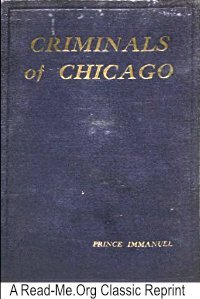
Criminals of Chicago

By Prince Emmanuel of Jerusalem.

“ History shows that hanging did not prevent petit larceny. So we have abandoned the policy of frightfulness in punishment and cannot revert to it even though it still has some few supporters. And yet we feel that the theory of punishment being deterrent is philosophically sound. …The first news from the Laboratory revealed the prevalence of feeble-mindedness among delinquents. “

Rosburgh Publishing (1921) 247 pages.

Criminal Intelligence

By Carl Murchison.

“This material is offered for the special consideration of lawyers, psychologists, siociologists, social workers, and all those who have to do with the formulation of criminal law, the treatment of criminals, and the molding of public opinion concerning the enemies of organized society…”

A Read-Me.Org Classic Reprint (1926) 483 pages.

Crimes Against Criminals

By Robert J. Ingersoll.

In addition to these, nations have relied on confiscation and degradation, on maimings, whippings, brandings, and exposures to public ridicule and contempt. Connected with the court of justice was the chamber of torture. The ingenuity of man was exhausted in that would surely the construction the most reach of instruments sensitive nerve. All this was in the interest protection of virtue, and done of civilization — for the states. the well-being of how Curiously enough, the fact is that, no matter severe the punishments were, the crimes increased.

NY. Farrell (1892) 49 pages.

Mob Rule

By Ida Well-Barnett.

“Immediately after the awful barbarism which disgraced the State of Georgia in April of last year, during which time more than a dozen colored people were put to death with unspeakable barbarity, I published a full report showing that Sam Hose, who was burned to death during that time, never committed a criminal assault, and that he killed his employer in self- defense.”

Harrow and Heston Classic Reprint (1892) 63 pages.

The Complete Celebrated Crimes

By Alexander Dumas.

“The Crimes were published in Paris, in 1839-40, in eight volumes, comprising eighteen titles…. The success of the original work was instantaneous. Dumas laughingly said that he thought he had exhausted the subject of famous crimes, until he became deluged with letters from every province in France, supplying him with material upon other deeds of violence! The subjects which he has chosen, however, are of both historic and dramatic importance.

Harrow and Heston Classic Reprint. (1910) 1,565 pages.

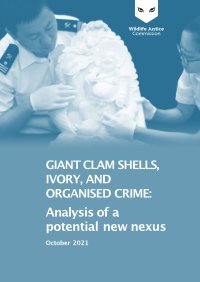
Giant clam shells, ivory, and organised crime: Analysis of a potential new nexus.

By Jenny Feltham and Luciana Capdepon

Giant clams are a traditional source of subsistence protein for coastal communities across Asia and Pacific regions. In recent decades, however, giant clams have been subject to poaching and commercial harvesting. Now viewed as high-value luxury food item, giant clams are also in demand in the international aquarium trade, and their shells are sought after for the ornamental carving industry. The Wildlife Justice Commission is concerned that giant clam shells are being used as a substitute for elephant ivory. Since China’s 2017 ban on the domestic elephant ivory trade, giant clam shells are an increasingly popular ivory alternative. These factors are likely to have contributed to the overexploitation and rapid decline of giant clam populations throughout many of their natural habitats. This not only puts increased pressure on the vulnerable giant clam, but also perpetuates demand for “premium” ivory products, sustaining the threat to elephant populations in the wild. Giant clams may not be as immediately charismatic as, say, elephants or rhinos, but they play a valuable role in maintaining healthy coral and oceans. Preventing biodiversity loss and preserving ocean eco-systems are crucial in the fight against catastrophic climate change.

The Hague: Wildlife Justice Commission, 2021. 41p.

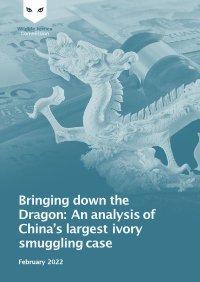
Bringing Down the Dragon: An analysis of China’s largest ivory smuggling case

By Jenny Feltham and Hendelene Prinsloo.

Bringing down the Dragon: An analysis of China’s largest ivory smuggling case, provides an in-depth case study of the inner workings of a wildlife crime syndicate and how Chinese authorities took it down by targeting the key facilitators and following the money. It also highlights how complex trafficking is and offers useful insights for law enforcement. The Chen organised crime group was a successful organised crime network, the kingpins, the untouchables. For several years they trafficked huge quantities of ivory by flying under the radar and eluding authorities through their corrupt connections. That all changed in late 2018 when Chen Chenzong, son of the Big Boss Chen Jiancheng, was arrested whilst dining out at a restaurant in China. Chinese authorities caught onto the network and the key players. They targeted the corrupt facilitators, in this instance a corrupt Customs Officer. Then followed the money, eventually seizing the assets of the Chen organised crime group. By December 2020, 17 members of the group had been convicted for their roles in trafficking 20.22 tonnes of ivory – equivalent to approximately 2000 elephants – from Nigeria to China. This case is a blueprint for law enforcement agencies investigating transnational organised wildlife crime.

The Hague: Wildlife Justice Commission, 2022. 56p.