
Open Access Free Library
CRIME+CRIMINOLOGY.jpeg

CRIME

Violent-Non-Violent-Cyber-Global-Organized-Environmental-Policing-Crime Prevention-Victimization

Posts in criminal law
Understanding variation in juvenile life without parole legislation following Miller

By Leah Ouellet, Daphne M. Brydon, Laura S. Abrams, Jeffrey T. Ward, Dylan B. Jackson, Rebecca Turner, J. Z. Bennett, Reese Howard, Ashley Xu
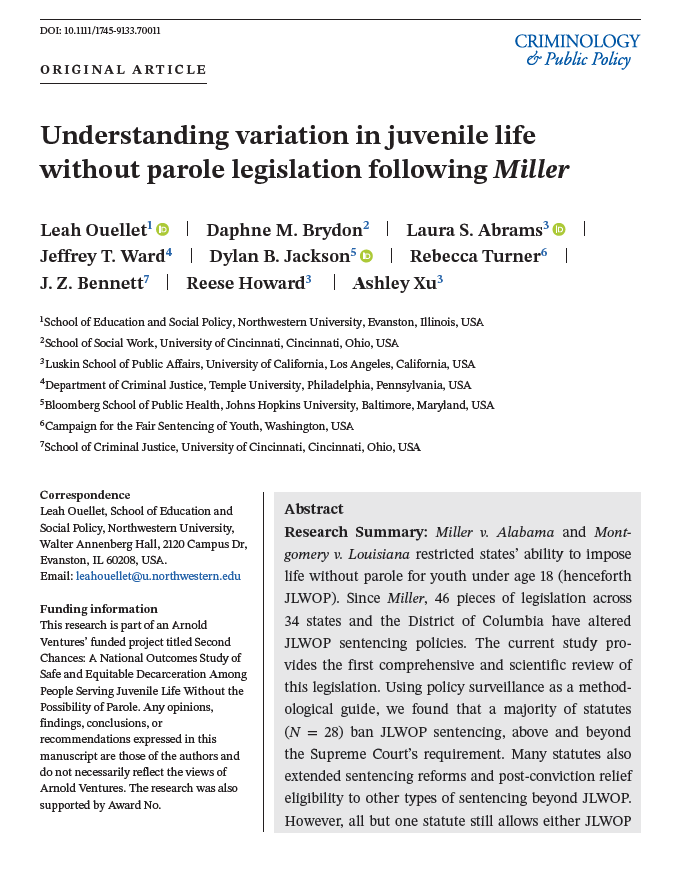


Miller v. Alabama and Montgomery v. Louisiana restricted states’ ability to impose life without parole for youth under age 18 (henceforth JLWOP). Since Miller, 46 pieces of legislation across 34 states and the District of Columbia have altered JLWOP sentencing policies. The current study provides the first comprehensive and scientific review of this legislation. Using policy surveillance as a methodological guide, we found that a majority of statutes (N = 28) ban JLWOP sentencing, above and beyond the Supreme Court's requirement. Many statutes also extended sentencing reforms and post-conviction relief eligibility to other types of sentencing beyond JLWOP. However, all but one statute still allows either JLWOP or life with parole as a sentencing option for minors convicted of homicide crimes and requires between 15 and 40 years, at minimum, to be served before being eligible for release. Grounding our analysis in institutional theory, we argue that the relative punitivity of the JLWOP reforms enacted was associated with measures of JLWOP institutionalization across states (i.e., pre-Miller JLWOP population and pre-Miller sentencing schema), suggesting that states where JLWOP was more routinely used were more resistant to policy reform.

Policy Implications

The current study provides implications for future decarceration efforts. Findings suggest that state legislatures are willing to enact post-conviction relief measures (e.g., judicial review or “second look” measures) for individuals convicted of violent crimes to address over-incarceration, deviating from previous decarceration efforts focused on non-violent, low-level offenses. In spite of the promising window for juvenile justice reform that Miller provided, however, these reforms have taken a relatively modest, incremental approach toward altering extreme youth sentencing practices in the United States. Policy makers and advocates seeking to promote sentencing reform efforts should factor in how highly institutionalized a sentencing practice is in each state, as this might inform effective strategies for policy change.

The role of UK policing in economic growth

By Crest Advisory with RSM UK Consulting

Economic growth is the number one mission of the Government in the UK, seeking to restore stability, increase investment and reform the economy to improve productivity, prosperity, and living standards. This commitment has been made in the context of a sustained period of economic stagnation, throughout which there has been an ongoing conversation as to whether the right levers are being pulled to achieve economic growth. The Office of the Chief Scientific Adviser for the National Police Chiefs’ Council (NPCC) commissioned us to understand the role of policing as a lever - our research seeks to collate existing evidence as well as identify where there are opportunities to develop this evidence in the future. This research also falls within the wider discussion on police funding, police productivity and police reform which is particularly relevant given that the Home Office will be looking to find savings ahead of this year’s spending review as an unprotected government department, ongoing debate about the police funding formula and growing financial pressures on police forces. Science and technology has a significant role to play in police efficiency and effectiveness, but also growth. The NPCC’s Science and Technology Strategy sets a clear ambition for policing “to deliver the most science and technology led police service in the world”. Often, our understanding of policing impact is focused on implementation and public safety outcomes, but economic outcomes have the potential to shift the narrative in terms of how we define an effective and efficient police response. Our work, in partnership with RSM UK Consulting, has sought to understand the evidence between policing and economic outcomes, from which we have produced a logic model to understand these relationships (a logic model conceptualises the links between activities and key outcomes). While we have not been able to estimate the scale of impact of UK policing on economic growth, we hope this logic model can act as a framework for partners to use to further develop the evidence base around the impact of policing on economic outcomes, specifically designing evaluations with these outcomes in mind. In time, this evidence may begin to change how we understand the positive impact of policing on individuals, businesses and communities in England and Wales - with the potential for positive economic outcomes influencing future decisions on funding allocations and commitments to specific policing initiatives and operational interventions. Furthermore, growth could sit alongside efficiency and effectiveness as key metrics for success in policing.

London: Crest Advisory, 2025. 69p.