Open Access Free Library
CRIMINAL JUSTICE.jpeg

CRIMINAL JUSTICE

CRIMINAL JUSTICE-CRIMINAL LAW-PROCDEDURE-SENTENCING-COURTS

Posts in Community Safety
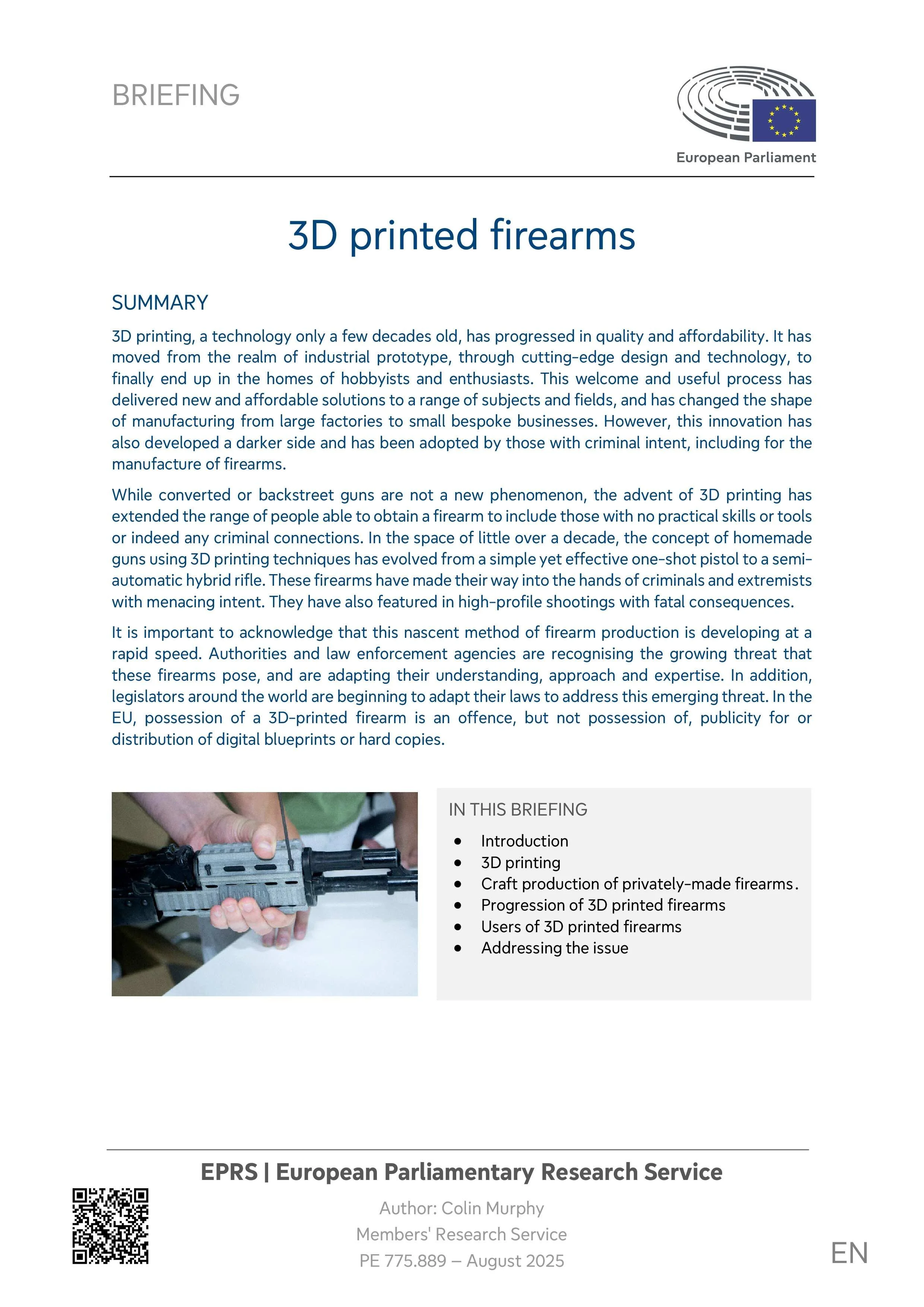
3D Printed Firearms

By: Colin Murphy

3D printing, a technology only a few decades old, has progressed in quality and affordability. It has moved from the realm of industrial prototype, through cutting-edge design and technology, to finally end up in the homes of hobbyists and enthusiasts. This welcome and useful process has delivered new and affordable solutions to a range of subjects and fields, and has changed the shape of manufacturing from large factories to small bespoke businesses. However, this innovation has also developed a darker side and has been adopted by those with criminal intent, including for the manufacture of firearms. While converted or backstreet guns are not a new phenomenon, the advent of 3D printing has extended the range of people able to obtain a firearm to include those with no practical skills or tools or indeed any criminal connections. In the space of little over a decade, the concept of homemade guns using 3D printing techniques has evolved from a simple yet effective one-shot pistol to a semi automatic hybrid rifle. These firearms have made their way into the hands of criminals and extremists with menacing intent. They have also featured in high-profile shootings with fatal consequences. It is important to acknowledge that this nascent method of firearm production is developing at a rapid speed. Authorities and law enforcement agencies are recognising the growing threat that these firearms pose, and are adapting their understanding, approach and expertise. In addition, legislators around the world are beginning to adapt their laws to address this emerging threat. In the EU, possession of a 3D-printed firearm is an offence, but not possession of, publicity for or distribution of digital blueprints or hard copies. IN THIS BRIEFING • Introduction • 3D printing • Craft production of privately-made firearms . • Progression of 3D printed firearms • Users of 3D printed firearms • Addressing the issue

Members' Research Service PE 775.889 – August 2025
POLICING EUROPE 1915–2026: A Retelling of Fosdick's European Police Systems

by Graeme Newman (Author)

How did Europe police its cities before the First World War, and what can those systems teach us today?

In Policing Europe: A Retelling of Fosdick's Classic, criminologist and policing scholar Graeme R. Newman presents a concise, modernized edition of Raymond B. Fosdick's landmark 1915 study of European policing. Based on nearly two years of firsthand research across England, Scotland, Germany, Austria-Hungary, France, Italy, Holland, and Belgium, Fosdick's original work remains one of the most comprehensive comparative examinations of police systems ever written. [Policing_Europe Word]

Traveling through the great capitals and industrial cities of Europe on the eve of World War I, Fosdick interviewed commissioners, detectives, patrol officers, judges, and government officials to answer questions that remain deeply relevant today:

  • Should policing be controlled locally or by the national government?

  • How much authority should police possess?

  • What creates public trust in law enforcement?

  • How should police leaders be selected and trained?

  • What prevents corruption and abuse of power?

  • Which organizational structures produce effective and accountable policing?

This edition preserves Fosdick's remarkable firsthand observations while updating the language for contemporary readers. It explores the contrasting traditions of British "policing by consent" and Continental state-centered policing, compares police organizations in London, Paris, Berlin, Vienna, Budapest, and Rome, and examines detective methods, recruitment, training, leadership, forensic science, and police integrity. [Policing_Europe Word]

More than a historical document, Policing Europe offers a fascinating window into the origins of many modern debates about public safety, civil liberties, professionalization, surveillance, police accountability, and the relationship between citizens and the state. Written just before a world war transformed Europe forever, it captures a vanished world while illuminating issues that continue to shape policing in the twenty-first century. [Policing_Europe Word]

Ideal for:

  • Students of criminology and criminal justice

  • Police professionals and policymakers

  • Historians of law, government, and public administration

  • Readers interested in comparative policing and European history

  • Anyone seeking a deeper understanding of how modern police systems evolved

A century after its original publication, Fosdick's pioneering study remains essential reading for anyone interested in the enduring challenge of balancing order, authority, liberty, and public trust. [Policing_Europe Word]

Read-Me.Org Inc. New York-Philadelphia-Australia. 2026. p172.

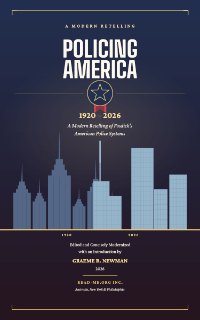
Policing America:1920–2026:: A Modern Retelling of Fosdick's American Police Systems

by Graeme Newman (Author)

In 1920, an investigator toured seventy-two American cities and concluded that the police in every one of them were failing — not from a lack of good men, but from a century of political interference, organizational chaos, and a refusal to let any competent leader keep the job long enough to matter. A hundred years later, the argument still lands.

Raymond B. Fosdick's American Police Systems was one of the most ambitious studies of policing ever produced in the Progressive Era — a firsthand, city-by-city comparison of American departments against the professional, politically insulated forces of London, Paris, and Berlin. Fosdick found American policing outmatched at nearly every turn: murder rates that dwarfed Europe's, police chiefs who rotated out with every election, civil-service rules that protected the incompetent as readily as the honest, and city after city that tore up its own police governance and started over, never once letting a good structure — or a good leader — mature.

This edition brings that argument back, rewritten for a modern reader.

This is not a facsimile reprint. Every chapter has been surveyed against Fosdick's original text — including its extensive footnotes — and rewritten fresh, in modernized prose, at roughly a fifth of the original length. The topic structure, the argument, and the great majority of Fosdick's specific facts, cases, and comparisons survive intact; the discursive, footnote-heavy academic style of 1920 does not. Readers get the substance of a landmark study without the apparatus of a century-old monograph.
A substantial new introduction places Fosdick's argument in conversation with policing today: the persistence of American police fragmentation across eighteen thousand separate agencies, the technology Fosdick could only gesture toward (national fingerprint databases, predictive policing, body-worn cameras), the surprising afterlife of "heterogeneity" as European cities have grown as demographically diverse as the American ones Fosdick once contrasted them against, the diversity of police workforces themselves in the U.S. and U.K. today, and where Fosdick's own instincts do — and don't — anticipate contemporary arguments over the scope and funding of policing.
What's inside:
- All eleven chapters of Fosdick's original argument, modernized and condensed
- A new, extensive introduction connecting the book to policing in 2026
- The original seven city police-organization charts, reproduced as images
- Modern 5x8 trade formatting with a full table of contents
Policing America, 1920-2026 is for readers of policing history, criminal justice students, and anyone following today's debates over police reform who wants to see how far back — and how little changed — those debates actually go.
A Read-Me.Org Modern Adaptation. Modernized and edited, with an introduction, by Graeme R. Newman. Based on the 1920 original by Raymond B. Fosdick.

Read-Me.Org Inc. New York-Philadelphia-Australia. 2026. p111.

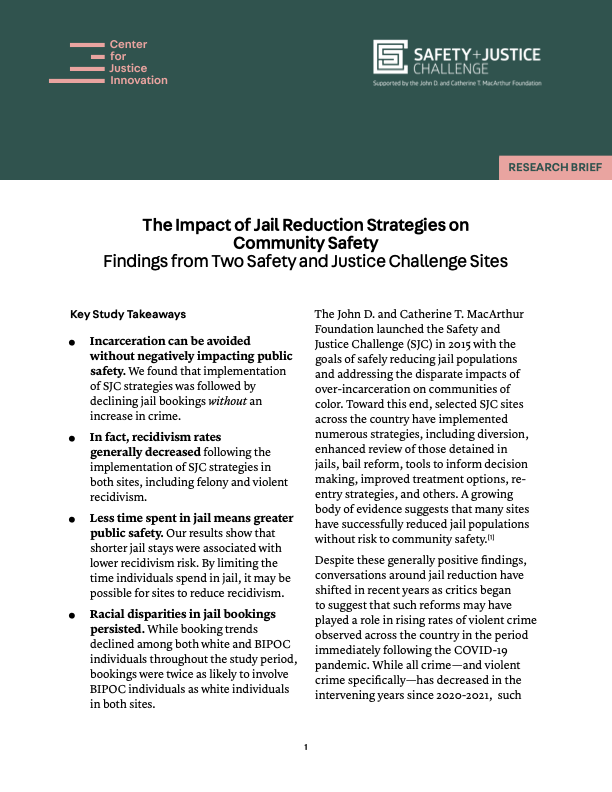
The Impact of Jail Reduction Strategies on Community Safety: Findings from Two Safety & Justice Challenge Sites

By Fred Butcher and Amanda Cissner

This study examined whether the jail reduction strategies implemented in two SJC sites reduced jail populations without increasing crime or sacrificing community safety. Findings suggest that incarceration can be avoided without negatively impacting public safety, with recidivism rates declining after SJC implementation. Further, less time in jail resulted in greater public safety; shorter jail stays were associated with lower recidivism risk.