Open Access Publisher and Free Library
SOCIAL SCIENCES.jpeg

SOCIAL SCIENCES

Social sciences examine human behavior, social structures, and interactions in various settings. Fields such as sociology, psychology, anthropology, and economics study social relationships, cultural norms, and institutions. By using different research methods, social scientists seek to understand community dynamics, the effects of policies, and factors driving social change. This field is important for tackling current issues, guiding public discussions, and developing strategies for social progress and innovation.

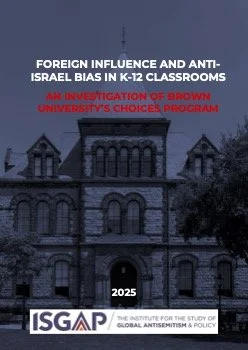
Foreign Influence and Anti-Israel Bias in K-12 Classrooms: An Investigation of Brown University’s Choices Program

By The Institute for the Study of Global Antisemitism and Policy (ISGAP)

This report examines the Choices Program, a national education initiative for K-12 social studies curriculum housed at Brown University that combines licensed curriculum units, free online content, and professional education workshops to provide a range of resources for secondary school classrooms.17 The program, used by 8,000 schools in all fifty states, reaches over one million students. Our investigation reveals significant concerns regarding the program’s ambiguous structure, lack of transparency, ideological content shifts, and external influences. Organizational structure and transparency issues The report starts by documenting the structure of the Choices Program. Our investigation has uncovered troubling discrepancies in how the Choices Program presents itself: • While operating under Brown University’s umbrella and reputation, the program describes itself both as “a self-funded organization affiliated with Brown University” and as a separate “non-profit organization” based at Brown University. • Brown University enters into contracts “on behalf of” the Choices Program, suggesting a distinct legal structure with actors that are unknown to the schools that purchase the curriculum with no clear understanding of the true organizational structure. • The program’s financial structure and revenue streams remain opaque, with significant discrepancies between reported budgets and apparent revenue. Systematic content changes and ideological shifts that are reinforced by schools’ lack of oversight or content control The report next examines the Choices Program’s shift in narrative with respect to Israel and the fact that its structure impedes meaningful oversight and review of the curriculum. In particular, we demonstrate that the Choices Program has over many years become increasingly anti-Israel and anti-democratic in its approach, reflecting a particular pedagogical change in strategy and application that either went unnoticed by the schools purchasing the curriculum or was not disclosed by Brown University. Analysis of program materials, particularly those concerning the Middle East, reveals concerning patterns: • progressive delegitimization of Israel through content changes across editions; • elimination of key historical context and balanced perspectives; • downplaying of significant diplomatic achievements like the Abraham Accords; • introduction of increasingly partisan theoretical frameworks; • systematic changes in terminology and map presentations. This content and ideological shift has been bolstered by the proprietary system put in place by the Choices Program, which raises additional concerns: • schools lose the ability to track or review content changes; • schools receive no notification clarifying curriculum modifications; • restricted access prevents oversight by school boards and parents; • the limited transparency of the program’s privacy policies and third-party data sharing arrangements raises concerns about conflicts of interest and the potential exposure of students or teachers to external sources not approved by schools. External influence and misrepresentation Our investigation identified significant discrepancies between Brown University’s public statements and documented evidence regarding external influence over the Choices Program, including: • the understated relationship with QFI; • the misrepresentation of the nature and extent of QFI’s involvement in workshop content, teacher engagement, and curriculum distribution; • the lack of transparency concerning donor influence on content development Key implications This report raises serious concerns about: 1. potential violations of educational transparency requirements; 2. oversight failures by educational institutions adopting the curriculum; 3. compromised academic integrity through undisclosed external influences; 4. impact on student learning and perspective formation; 5. broader implications for K-12 educational content oversight. These findings suggest an urgent need for increased transparency, improved oversight mechanisms, and clearer guidelines for foreign influence in K-12 educational materials. The report concludes with specific policy recommendations to address these systemic issues.

Miami Beach; New York: The Institute for the Study of Global Antisemitism and Policy (ISGAP) 2025. 41p.
Well-Being, Isolation, and Lockdowns in the UK

By José Ignacio, Giménez-Nadal, José Alberto Molina, Jorge Velilla

Social connection is a key determinant of emotional well-being, yet the role of solitude in shaping both momentary affect and overall life satisfaction remains understudied. This paper investigates how being alone while engaging in daily activities relates to subjective well-being, using rich time-use diary data from the UK covering four distinct periods: pre-pandemic (2015–2016), the Covid-19 lockdowns (2020–2021), the relaxation phase (2021), and the post-pandemic period (2023). We find that being alone is negatively associated with momentary enjoyment, particularly in the post- pandemic period, but not during lockdowns or the initial relaxation phase, suggesting that the emotional cost of solitude depends on its perceived voluntariness and social norms. The enjoyment penalty is strongest for leisure and unpaid work episodes, and most pronounced among remote workers. We also document a negative association between full-day solitude and overall life satisfaction, but only during the relaxation phase, suggesting that solitude can impose both short-term and longer-term costs of well-being, depending on the social context and type of activity. Our results contribute to the literature on experienced utility, labor supply, and remote work, highlighting the need to account for the emotional toll of isolation in welfare analysis and policy design.

IZA DP No. 17932

Bonn: IZA – Institute of Labor Economics, 2025. 37p.

Race, Racism, and the Crisis of Democracy in Political Science

By Robbie Shilliam and Lester Spence

Over the past decade, autocratization has increased worldwide, and the United States itself has seen its own democracy erode.While political scientists have begun to study both phenomena in earnest, with exceptions, they have been unable to fully wrestle with either. We suggest that this incomplete understanding is the result of the discipline’s problematic racial history. At the time of its founding in the late nineteenth century, political science provided a eugenicist justification for the very hierarchies and segregations that are now under scrutiny. Race was understood to be the quintessential subject of social scientific inquiry. After World War II, political scientists rejected eugenics and instead focused on defending democracy against totalitarianism. In doing so, they relegated racism to an ideological/irrational phenomenon and thus as extraneous to the core concern of the discipline. In this Annual Review of Political Science article, we refract the discipline’s contemporary and historical concerns with democracy through the lens of racial politics to better equip scholars with tools to examine and critically diagnose contemporary politics.

Annu. Rev. Political Sci. 2025. 28:195–211

White Supremacy and the Making of Anthropology

By Aisha M. Beliso-De Jesús, Jemima Pierre, and Junaid Rana

This review presents a historical and contemporary view of white supremacy as an entrenched global system based on presumed biological and cultural difference, related practices of racism, the valorization of whiteness, and the denigration of non whiteness. We center the role of the discipline of anthropology, and contend that the discipline is shaped by, and shapes, structures of white supremacy. In this article, we detail anthropology’s role in the development of racial science and the subsequent placement of whiteness at the top of the world’s global political and cultural systems of power. We examine the early critiques of anthropology’s racializing practices by Black and Indigenous anthropologists, which set the stage for an anti-imperial analysis that addressed how white power was entrenched within the discipline and broader society. Last, we discuss emerging scholarship on the anthropology of white supremacy and the methodological and theoretical shifts that push the discipline and refine the concept.

Annu. Rev. Anthropol. 2023. 52:417–35

The Politics of Racist Dehumanization in the United States

By Ashley Jardina1 and Spencer Piston

Abstract The concept of racist dehumanization is essential for political scientists who seek to understand the nature, scope, and consequences of white racial prejudice in the United States today. Racist dehumanization consists of a variety of processes that construct, refashion, and maintain race by coding some people as white and therefore fully human and others as other than white and therefore less than fully human. In this review, we focus on the racist dehumanization of Indigenous people and Black people, arguing that processes of dehumanization have long been implicated in both the practice of racemaking and concurrent efforts to exploit and dominate racialized groups. We posit that contemporary white racial prejudice can be understood, in part, as the residue of these processes, and we conclude by describing how accounting for racist dehumanization can transform the study of white racial prejudice.

Annu. Rev. Political Sci. 2023. 26:369–88

Critical Race Theory: Confronting, Challenging, and Rethinking White Privilege

By Kalwant Bhopa

The term “White privilege” has been used to denote specific privileges that White groups possess due to their Whiteness and White identity. In this article, firstly, I outline how, as a conceptual tool,White privilege can only be understood in relation to Critical Race Theory, specifically the notion that racism is central and endemic, through Whiteness as property and interest convergence. Secondly, I analyze the development of White privilege and provide ways forward for the use of the term, and thirdly, I use examples from higher education to outline how White privilege works in terms of the construction of knowledge, the prioritization of gender above race, and the fact that policy making is designed to protect White identities to uphold a hegemonic system of White supremacy.

Annu. Rev. Sociol. 2023. 49:111–28

The Economics of Healthcare Fraud

By Jetson Leder-Luis and Anup Malani

Healthcare fraud imposes a sizable cost on U.S. public healthcare budgets and distorts health care provision. We examine the economics of health care fraud and enforcement using theory and data and connect to a growing literature on the topic. We first offer a new economic definition of health care fraud that captures and connects the wide range of activities prosecuted as fraud. We define fraud as any divergence between the care an insurer says a patient qualifies for, the care a provider provides, and the care a provider bills for. Our definition clarifies the economic consequences of different categories of fraud and provides a framework for understanding the slate of existing studies. Next, we examine the incentives for committing and for prosecuting fraud. We show how fraud is driven by a combination of inadequate (expected) penalties for fraud and imperfect reimbursement rates. Public anti-fraud litigation is driven by the relative monetary, political or career returns to prosecuting fraud and by prosecutorial budgets. Finally, we examine the prevalence of health care fraud prosecutions across types of fraud and types of care, and across the US, by machine learning on text data from Department of Justice press releases.

WORKING PAPER · NO. 2025-45

Chicago: University of Chicago, Becker Friedman Institute for Economics 2025. 45p

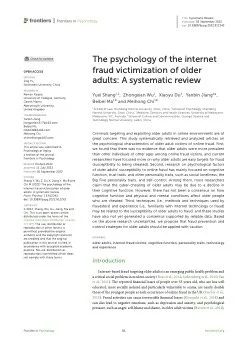
The Psychology of Internet Fraud Victimization of Older Adults: A Systematic Review

By Yuxi Shang , Zhongxian Wu , Xiaoyu Du3, Yanbin Jiang , Beibei Ma , Meihong Chi

Criminals targeting and exploiting older adults in online environments are of great concern. This study systematically retrieved and analyzed articles on the psychological characteristics of older adult victims of online fraud. First, we found that there was no evidence that older adults were more prevalent than other individuals of other ages among online fraud victims, and current researchers have focused more on why older adults are easy targets for fraud (susceptibility to being cheated). Second, research on psychological factors of older adults' susceptibility to online fraud has mainly focused on cognitive function, trust traits, and other personality traits, such as social loneliness, the Big Five personality traits, and self-control. Among them, most researchers claim that the cyber-cheating of older adults may be due to a decline in their cognitive function. However, there has not been a consensus on how cognitive function and physical and mental conditions affect older people who are cheated. Third, techniques (i.e., methods and techniques used by fraudsters) and experience (i.e., familiarity with internet technology or fraud) may be related to the susceptibility of older adults to fraud, and these studies have also not yet generated a consensus supported by reliable data. Based on the above research uncertainties, we propose that fraud prevention and control strategies for older adults should be applied with caution.

Front Psychol. 2022 Sep 5;13:912242. doi: 10.3389/fpsyg.2022.912242. PMID: 36132192; PMCID: PMC9484557

Rape Culture and the Bible: Scholars Reflect

Edited by Barbara Thiele

Rape Culture and the Bible: Scholars Reflect offers readers the opportunity to hear from prominent and influential biblical scholars and scholar activists as they reflect on their work on sexual violence vis-a-vis the Bible. This book covers major points of inquiry in the field, focusing primarily on the Hebrew Bible and the New Testament. It explores debates on appropriate terminology; intersectionality of sexual violence, gender, and race; how survivor perspectives inform the reading of violent texts; male-on-male sexualized violence in biblical literature; and the connections of Judeophobia with sexual violence in early Christian literature. The introductory chapter establishes methodology, purpose, and aims of this volume. The final chapter reflects on the ethical concerns governing the field, challenges scholars have faced in their discipline, and the tasks ahead. Along the way, Rape Culture and the Bible demonstrates how rape and rape culture in the Bible impact real lives across time and the globe.  

Oxford: Routledge, 2025.

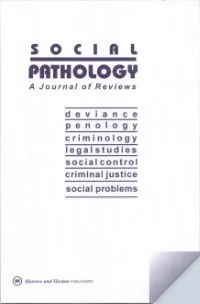
Social Pathology: A Journal of Reviews

Social Pathology: A Journal of Reviews (ISSN 1073-7855) was a small, specialist U.S. journal founded and published by Harrow and Heston (Guilderland/Albany, NY) in the mid-1990s. It focused on long review essays, critical syntheses, and thematic special issues in criminology, criminal justice, and “social problems” broadly construed (crime, punishment, race, inequality, environmental justice, end-of-life issues, etc.). Early volumes featured substantial review essays such as Gary Kleck’s “Guns and Violence: An Interpretive Review of the Field” in 1(1), January 1995. Later volumes included special issues, notably:

  • “Assisted suicide” (guest-edited by Marvin Zalman) as 5(1), Winter 1999

  • “New Directions in Criminological Research: Theoretical and Empirical Implications” (guest-edited by Wilson R. Palacios) as 6(3), 2000

By about 2000 (volume 6) the Harrow-and-Heston incarnation appears to end; an online record shows Social Pathology: A Journal of Reviews continuing under Sage in 2001, but the original criminology-oriented review journal is effectively defunct.(ZDB Catalogue)

Volumes and Issues

Volume 1 (1995)

Volume 2 (1996)

  • 2(1) – Spring 1996

    • Todd R. Clear, “Science and the Punishment/Control Movement,” Social Pathology: A Journal of Reviews2(1): 1–22.(Office of Justice Programs)

  • 2(2) – Summer 1996

  • 2(3) – Fall 1996

    • Williams, Cullen & Wright, “Labor Market Participation and Youth Crime: The Neglect of ‘Working’ in Delinquency Research,” 2(3): 195–217.(Office of Justice Programs)

    • David Kauzlarich, “State Criminality and Nuclear Weapons,” Social Pathology 2(3): 242–246.(Society and Justice Studies)

    • Paul Stretesky, “Environmental Equity? A Response to Clark, Lab and Stoddard’s Review of the Literature,” Social Pathology 2: 293–298 (same volume; issue not always given but context indicates late 1996).(SpringerLink)

Volume 3 (1997)

  • 3(1) – implied by pagination and later issue numbering but I couldn’t locate a citation explicitly labelled “3(1)”.

  • 3(2) – 1997

    • Victoria E. Titterington, book review (“Female Crime, Criminals and Cellmates”), Social Pathology: A Journal of Reviews 3(2) (issue number and volume given in her CV).(CJCenter)

  • 3(3) – 1997

    • David Kauzlarich, “Nuclear Weapons on Trial: The Battle at the International Court of Justice,” Social Pathology 3(3): 157–164.(Society and Justice Studies)

  • 3(3) – 1997

Volume 4 (1998)

  • 4(1) – 1998

    • M. Barrett, “The Imprisoned Subject: Agency and Identity in Prison,” Social Pathology: A Journal of Reviews 4(1): 48–54.(Dokumen)

  • Other 1998 content, issue not specified

    • Wilson R. Palacios & Dorothy L. Taylor, “Up close and personal: Using non-traditional textbooks in teaching a course on minorities, crime, and social policy,” Social Pathology 4: 87–94.(University of Massachusetts Lowell)

So volume 4 definitely has an issue 1, and likely additional issues, but the publicly accessible citations I can see don’t give the full issue breakdown.

Volume 5 (1999)

  • 5(1) – Winter 1999 – “Assisted Suicide” special issue

    • Guest editor Marvin Zalman; described as “Assisted suicide [Special issue]. Social Pathology: A Journal of Reviews, 5(1)”.(SAGE Journals)

    • Reviews and essays on assisted suicide/end-of-life, e.g.:

Volume 6 (2000)

  • 6(1) – 2000

    • Lynne M. Vieraitis, “Income Inequality, Poverty, and Violent Crime: A Review of the Empirical Evidence,” Social Pathology: A Journal of Reviews 6(1): 24–45.(University of Texas at Dallas)

  • 6(2) – 2000

    • Michael Welch, “Deconstructing the Flag-Burning Controversy: Contributions of Robert J. Goldstein in Review,” Social Pathology: A Journal of Reviews 6(2): 149–156.(CRW Flags)

  • 6(3) – 2000 – “New Directions in Criminological Research” special issue

    • Guest editor: Wilson R. Palacios; his CV describes “New Directions in Criminological Research: Theoretical and Empirical Implications” as a special issue, Social Pathology 6(3).(University of Massachusetts Lowell)

    • Includes, for example, “Reopening the debate: A reexamination of the need for a Black criminology,” Social Pathology: A Journal of Reviews 6(3): 182–198.(Taylor & Francis Online)

  • 6(4) – 2000

    • S. Moloney, review essay on The Ghost Dance and prison gangs, Social Pathology 6(4): 264–283 (cited in later work on gangs and cultural conflict).(greencriminology.org)

    • Late-volume book reviews such as Venessa Garcia’s review (cited only as 6: 312–315, but clearly at the back of volume 6).(New Jersey City University)

Read-Me.Org
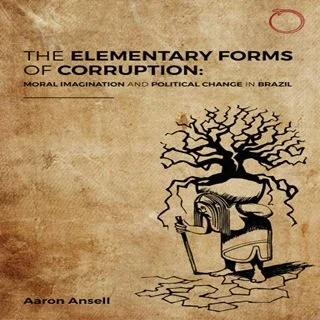
The Elementary Forms of Corruption: Moral Imagination and Political Change in Brazil

By Aaron Ansell

Seeks to better understand the nature of corruption through a case study of a rural Brazilian community’s response to the country’s political fraud. The Elementary Forms of Corruption is an ethnographic history of rural Brazilians’ shifting moral imagination in the context of their country’s recent corruption scandals and political crises. The book explores how Brazil’s cosmopolitan models of corruption, both left-wing and right-wing varieties, found their way to a small sertanejo (hinterland) municipality in the northeast, where people understood corruption very differently. Reckoning with both the leftist Workers’ Party, which sought to liberate sertanejos from patron-client relations, and the New Right populists who sought to stamp out the “communists” threatening the patriarchal family, the people of the sertanejo made recourse to older ideas about corruption—such as the betrayal of kinship obligations and communal trust—to decipher and shape national politics. Challenging the discipline’s current aversion to generalizable, analytic categories that are useful for comparison across cultures or historical periods, The Elementary Forms of Corruption posits a general framework for understanding corruption at its most elementary level: the degradation of a moral gradient through the transgressive rechanneling of those currencies (e.g., gifts, favors) that sustain communal bonds when properly directed.

Chicago: HAU Books, 2025.

Policing Higher Education:  The Antidemocratic Attack on Scholars and Why It Matters

By Eve Darian-Smith

On the essential role of higher education and academic freedom in thriving democracies. Higher education is facing an existential crisis. Students and staff are surveilled with cameras and facial recognition software. Police zip-tie and arrest students during protests. As universities across the United States become epicenters of ideological warfare, Policing Higher Education contextualizes these skirmishes within a broader global framework. From the contentious debates surrounding free speech and curriculum control to the denial of tenure for outspoken faculty, Eve Darian-Smith examines the myriad ways higher education has become a battleground. Darian-Smith highlights the intersecting global trends of rising authoritarianism and declining academic freedom, revealing how the United States is part of a larger pattern seen in democracies worldwide, including Brazil, Hungary, Germany, India, and the Philippines. This book challenges readers to view educational conflicts not merely as culture wars but as intense and connected struggles over economic, political, and social power. Drawing from extensive scholarship, Darian-Smith humanizes the impacts of these attacks on scholars and students, offering poignant stories of persecution and resilience. With a critical eye on the historical and structural drivers of antidemocracy, this book pushes for new, meaningful conversations about academic freedom that transcend national borders. It emphasizes the vital role of universities in fostering social responsibility and combating the global drift toward authoritarianism.

Baltimore: Johns Hopkins University Press. 2025. 

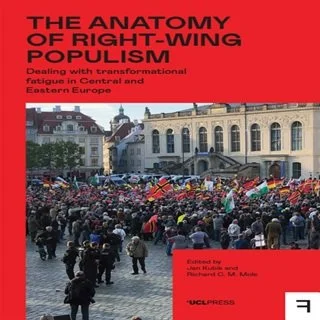
The Anatomy of Right-Wing Populism: Dealing with transformational fatigue in Central and Eastern Europe

Edited by Jan Kubik and Richard C. M. Mole

Over the past two decades, populist politicians and parties have enjoyed remarkable success across the globe. The rise of right-wing populism is perhaps most noticeable in post-communist Europe, especially in Hungary and Poland, where politicians subscribing to this ideology have come to power and weakened media pluralism, the protection of minorities, the sovereignty of civil society and the independence of the judiciary. To develop a multidisciplinary understanding of the rise and functioning of right-wing populism in Central and Eastern Europe, The Anatomy of Right-wing Populism examines the two original concepts of neo-traditionalism (to capture the construction of the pure people in opposition to the corrupt elites and the threatening others) and neo-feudalism (to capture an economic strategy whereby a relatively small elite controls the apex of political power and a sizable portion of the country’s economy). This book argues that the causes and consequences of populism cannot be fully understood without a multidisciplinary analysis, drawing on the theories and approaches of politics, history, economics, sociology and anthropology. Grounded in empirical research, this volume provides theoretical insights into how populism became such a powerful political force and formulates policy recommendations on how to resist illiberalism, thereby appealing not only to academics but also to activists and policy makers.

London: UCL Press, 2025

The Scope of Racial Bias in Policing: Behavioral Science’s Role in a Systemic Problem

By John F. Dovidio and Phillip Atiba Solomon

There are substantial and persistent racial disparities in policing in the United States. Although disparities do not necessarily indicate discrimination, there is significant evidence that racism, operating in various forms, is a major factor. We adopt a multilevel perspective in our review and analysis of the empirical literature. We consider five levels of processes relating to racial biases in policing and public safety to identify ways of achieving equity. These levels are the nano-level (intrapersonal), the micro-level (interpersonal), the meso-level (organizational), the macro-level (pan-organizational, institutional, or systemic), and the megalevel (cultural, societal, or narrative). We conclude by discussing the theoretical and practical promise of adopting a multilevel perspective and highlighting the pressing need to reconceive policing in the United States to meet the needs of contemporary society.

RSF: The Russell Sage Foundation Journal of the Social Sciences 11(3): 22–85.

“We're Basically Just Naked Therapists”: Sex Work, Stigma, and Psychological Empowerment

By Kurt W. Fowler,  Heidi Grundetjern

The criminalization of sex work continues to stigma-tize people who sell sex. Nevertheless, people who sellsex are not a monolith. In this study, we draw from semi structured interviews with 50 active sex workers,most of whom were white and from middle-class back-grounds, to show how they experienced empowerment in their work. We use Zimmerman’s concept of psy-chological empowerment to unpack how empowerment was both a process and an outcome for the workers.Empowered processes included business acumen, soft skills, and risk management, allowing for empowered outcomes: money and autonomy, self-esteem and pride,and deeper meanings related to helping others. Access To digital platforms played a key role in facilitating this empowerment. The workers in our study were wellaware of the prevailing stereotypes and stigma applied to their work, but they mitigated the risks associated with stigma through the use of digital technology to access helpful virtual communities. Although sex workers empowerment was largely enabled by their socioeco-nomic privilege, stigma played a key role in their sense of empowerment. 

Criminology. 2025;63:614–638.

The Origins of White Power Music: The Co-Opting of Punk and Oi! By a Parasitical Social Movement

By James Windle  & Clara Schenk

This paper challenges the common portrayal of White Power music as evolving from, or being an element of, Oi! punk. The paper traces the histories of White Power music and Oi!, and analyses a sample of 268 Oi! songs for racist or fascist lyrics. It shows that, while some Oi! artists and audience members were involved in far-right activism, the subculture was not itself fascist or overtly racist. Many of those involved in Oi! took action against racism and far-right movements, and almost no songs included racist lyrics. The paper proposes two arguments. First, drawing from Worley, media and scholarly portrayals of Oi! as racist or fascist may represent the demonization of the working-class. Second, that White Power co-opted elements of Oi! does not mean that White Power music emerged from Oi!. Rather it likely emerged from first-wave punk at roughly the same time as Oi!. The central argument being that the White Power music scene, and the far-right more generally, is parasitical. It feeds upon the resources of larger scenes and subcultures, often harming them in the process

DEVIANT BEHAVIOR, 2025, VOL. 46, NO. 10, 1329–1345

Fruit of the Family Tree

By Albert Edward Wiggam. Introduction by Colin Heston.

Albert Edward Wiggam’s The Fruit of the Family Tree (1924) occupies a distinctive place in the intellectual landscape of early 20th-century America, where science, social reform, and cultural optimism converged. Wiggam, a prominent science writer and lecturer, sought to popularize the principles of heredity and evolution for a general audience, framing them as tools for personal and societal improvement. His work reflects the era’s fascination with genetics and its implications for human progress—a fascination that often intersected with the controversial discourse of eugenics.

At its core, Wiggam’s book argues that the family is not merely a social institution but a biological continuum, transmitting physical, mental, and moral traits across generations. He contends that understanding these hereditary forces is essential for shaping character, guiding marriage choices, and fostering the “betterment” of humanity. This perspective resonated with contemporary movements advocating scientific approaches to social problems, yet it also raises critical questions about determinism, individual agency, and the ethical boundaries of applying biological principles to human affairs.

Historically, The Fruit of the Family Tree emerged during a period of optimism about science’s capacity to engineer progress. The rediscovery of Mendelian genetics and the rise of evolutionary psychology fueled public interest in heredity, while the eugenics movement—then regarded by many as progressive—sought to apply these insights to improve population quality. Wiggam’s writings, widely read and influential, exemplify this cultural moment: they blend scientific exposition with moral exhortation, urging readers to consider the long-term consequences of their choices for future generations.

Upon its publication, The Fruit of the Family Tree was warmly received by a public eager for accessible scientific knowledge. Wiggam’s engaging style and ability to translate complex biological concepts into practical advice made him a popular figure on the lecture circuit and in print. The book was praised for its clarity and its alignment with contemporary ideals of progress and rational planning. Many readers embraced its message as a guide to responsible parenthood and social improvement.

However, the legacy of Wiggam’s work is more complex. While his writings contributed to the popularization of genetics and the notion of “scientific living,” they also reinforced ideas that later came under ethical scrutiny. His advocacy of selective breeding and emphasis on hereditary “quality” aligned with mainstream eugenics discourse, which would eventually be discredited due to its association with coercive policies and discriminatory practices. Today, scholars view Wiggam’s work as emblematic of a historical moment when optimism about science blurred into prescriptive social engineering.

Despite these controversies, The Fruit of the Family Tree remains significant as a cultural artifact. It illuminates the interplay between science and social ideals in the early 20th century and invites reflection on the enduring tension between biological determinism and human freedom. In revisiting Wiggam’s text, modern readers confront not only the aspirations and anxieties of a bygone era but also the cautionary lessons about the ethical use of scientific knowledge in shaping human destiny

Read-Me.Org Inc. New York-Philadelphia-Australia. 2025. p.234.

Perceived Neighborhood Safety, Crime Exposure, and Chronic Diseases Among Older Indians: The Role of Functional Disabilities

By Manacy Pai, T. Muhammad, Adedayo Adeagbo, and Waad Ali

We examined the associations between perceived neighborhood safety, crime exposure, and the prevalence of chronic conditions and multimorbidity among older adults in India. Moreover, we examined whether these associations varied by functional disabilities measured by difficulties in activities of daily living (ADLs) and instrumental activities of daily living (IADLs). Data came from the World Health Organization’s Study on Global AGEing and Adult Health (SAGE), India Wave 2, conducted in 2015. Neighborhood safety was measured by perceptions of safety at home and while walking after dark, whereas crime exposure was assessed through reports of household victimization by violent crime in the past year. Chronic conditions were self-reported physician diagnoses of hypertension, diabetes, stroke, arthritis, angina, asthma, and lung disease, with multimorbidity defined as the presence of more than two chronic diseases. Multivariable regression analyses were used to examine the main associations and interaction terms to test the moderating role of ADL/IADL disabilities. The mean score of neighborhood safety (on a scale of 0–10) was 7.72 (SD: 2.05). Approximately 6% of the participants reported that they or someone in their household had been victims of violent crime in the previous year. Older adults with perceived neighborhood safety reported a lower number of chronic conditions (adjusted beta: -0.03, confidence interval [CI]: -0.04 to 0.01) and lower odds of multimorbidity (adjusted OR: 0.95, CI: 0.91 – 0.99). Those with crime exposure reported a higher number of chronic conditions (adjusted beta: 0.10, CI: 0.02 – 0.19). These associations were significantly more pronounced among those with ADL/IADL disabilities. Perceived neighborhood safety and crime exposure were significantly linked to chronic diseases and multimorbidity among older adults in India, particularly among those with functional disabilities. These findings underscore the need for targeted strategies to improve neighborhood safety and support among older Indians with functional disabilities

PLOS Global Public Health 2025,

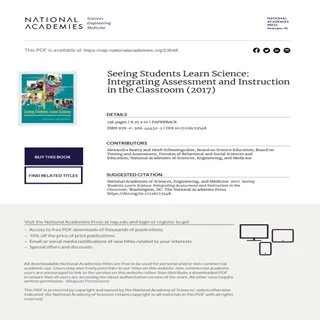
Seeing Students Learn Science: Integrating Assessment and Instruction in the Classroom

By: Alexandra Beatty and Heidi Schweingruber

Science educators in the United States are adapting to a new vision of how students learn science. Children are natural explorers and their observations and intuitions about the world around them are the foundation for science learning. Unfortunately, the way science has been taught in the United States has not always taken advantage of those attributes. Some students who successfully complete their K–12 science classes have not really had the chance to "do" science for themselves in ways that harness their natural curiosity and understanding of the world around them.

The introduction of the Next Generation Science Standards led many states, schools, and districts to change curricula, instruction, and professional development to align with the standards. Therefore existing assessments—whatever their purpose—cannot be used to measure the full range of activities and interactions happening in science classrooms that have adapted to these ideas because they were not designed to do so. Seeing Students Learn Science is meant to help educators improve their understanding of how students learn science and guide the adaptation of their instruction and approach to assessment. It includes examples of innovative assessment formats, ways to embed assessments in engaging classroom activities, and ideas for interpreting and using novel kinds of assessment information. It provides ideas and questions educators can use to reflect on what they can adapt right away and what they can work toward more gradually.

National Academies of Sciences, Engineering, and Medicine. 2017. Seeing Students Learn Science: Integrating Assessment and Instruction in the Classroom. Washington, DC: The National Academies Press

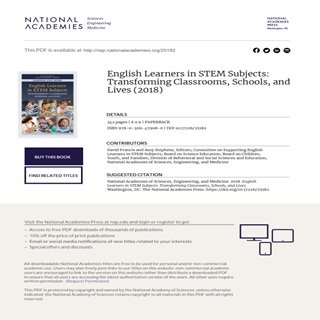
English Learners in STEM Subjects: Transforming Classrooms, Schools, and Lives

By David Francis and Amy Stephens

The imperative that all students, including English learners (ELs), achieve high academic standards and have opportunities to participate in science, technology, engineering, and mathematics (STEM) learning has become even more urgent and complex given shifts in science and mathematics standards. As a group, these students are underrepresented in STEM fields in college and in the workforce at a time when the demand for workers and professionals in STEM fields is unmet and increasing. However, English learners bring a wealth of resources to STEM learning, including knowledge and interest in STEM-related content that is born out of their experiences in their homes and communities, home languages, variation in discourse practices, and, in some cases, experiences with schooling in other countries.