Open Access Publisher and Free Library
CRIME+CRIMINOLOGY.jpeg

CRIME

Violent-Non-Violent-Cyber-Global-Organized-Environmental-Policing-Crime Prevention-Victimization

Posts in Criminal Justice
China’s exploitation of scam centers in Southeast Asia

By U.S.-CHINA ECONOMIC AND SECURITY REVIEW COMMISSION

Summary:

This Commission Spotlight examines how China-linked scam centers are fueling corruption and violence in Southeast Asia, paving the way for greater Chinese influence in the region, and directly harming Americans in the process. Its findings are based on the Commission’s March 2025 hearing on “Crossroads of Competition: China in Southeast Asia and the Pacific Islands”; fact-finding trips to the Philippines, Indonesia, Vietnam, and Cambodia; and open source research.

Key Findings:

Chinese criminal networks operate industrial-scale scam centers across Southeast Asia that steal tens of billions of dollars annually from people around the world—a massive criminal enterprise that rivals the global drug trade in scale and sophistication.

The Chinese criminals behind scam centers have built ties—some overt, some deniable—to the Chinese government by embracing patriotic rhetoric, supporting China’s Belt and Road Initiative (BRI), and promoting pro-Beijing propaganda overseas. As a result, Chinese crime syndicates have expanded across Southeast Asia with, at a minimum, implicit backing from elements of the Chinese government.

The spread of China-linked scam compounds in Southeast Asia is fueling corruption and violence, promoting human trafficking, undermining the ability of governments in the region to control what happens in their territory, and promoting human trafficking.

China is exploiting the problem of scam compounds to increase its leverage over Southeast Asian governments, conduct intelligence and influence operations, and expand its security footprint in the region.

Beijing has selectively cracked down on scam centers that target Chinese victims, leading Chinese criminal organizations to conclude that they can make greater profits with lower risk by targeting citizens of wealthy countries such as the United States.

Americans are now among the top global targets of China-linked scam centers, with an estimated $5 billion lost to online scams in 2024 alone—a 42 percent increase over the previous year.

Washington, DC:

U.S.-CHINA ECONOMIC AND SECURITY REVIEW COMMISSION

2025. 12p.

Organized Crime and National Security in Spain: Challenges and Responses

Organized Crime and National Security in Spain:

Challenges and Responses

Edited by Andrés de Castro

This book offers an analysis of how organized crime operates in Spain and the security apparatus designed to contain it. Organized crime is currently one of the most serious security threats facing democratic societies. Despite its intense presence and the responses that states have articulated in recent decades, little attention has been paid to the measurement of the effectiveness of the means adopted to combat it. Thus, this volume delves into this issue and performs an analysis of the police dimension of the response to organized crime in Spain. Firstly, this volume describes the international phenomenon of organized crime and its evolution in Spain, and continues by analyzing the profile and the characteristics of the different police forces and their resources and capabilities. This book then discusses the consequences of the measures at international level, European Union level, and local level, in relation to other police forces. Finally, the volume addresses the legal and public policy efforts that Spanish Law Enforcement Agencies have made in supervising or regulating their own police forces, which is necessary to carry out a detailed analysis of the consequences on the presence and strength of organized crime in the structures, strategies and decisions that Spain adopted over the last decades. As a result, this book builds on and updates the previous work by international scholars and proposes an interesting methodology that can contribute to the advancement of security studies.

London; New York: Routledge, 2025. 265p.

Visions of Global Environmental Justice: Comunidades Negras and the War on Drugs in Colombia

Visions of Global Environmental Justice:

Comunidades Negras and the War on Drugs in Colombia

By Alexander Huezo

Focusing on the lived experiences of Afro-Colombians processing and resisting violence against their ecological communities, Visions of Global Environmental Justice employs accounts of the supernatural narratively and analytically to frame a contemporary struggle for environmental justice. The book applies Achille Mbembe’s theorization of necropolitics to the environmental racism of the US War on Drugs in Colombia, specifically the aerial eradication of coca in the comunidades negras of the Pacific Coast. Through critical examination and deconstruction of transnational mythmaking and local oral tradition, Visions of Global Environmental Justice illustrates that non/humans rendered expendable by US-driven drug (necro)politics are indispensable to both the conceptualization and the realization of environmental justice globally. Far from being a study singularly focused on the symptoms of environmental issues, this book creatively guides us toward a broader understanding of environmental racism and justice across geographic scales and non/human agencies.

Oakland, CA; University of California Press, 2025

Digital Surveillance in Africa: Power, Agency, and Rights

Edited by Tony Roberts and Admire Mare

Media coverage and scholarly research on digital surveillance has focused primarily on the USA and Europe. Everyone knows about Cambridge Analytica’s social media surveillance; Edward Snowden’s revelations of the West’s mass internet and phone surveillance; and Pegasus Spyware’s mobile phone surveillance of activists, journalists, judges, and presidents across the world. Comparatively little is known about the millions of dollars now being spent on digital technologies for use in the illegal and illegitimate surveillance of citizens in Africa. In this open-access third volume of Bloomsbury’s Digital Africa series, a broad range of African and European scholars and practitioners map the development, procurement and (mis)use of the ever-expanding suite of digital surveillance and policing technologies across the continent. Drawing on the empirically rich, theoretically sophisticated research of the African Digital Rights Network, this book examines how public and private actors in Africa use spyware, mobile phone extraction, biometric and face recognition systems, and other technologies for smart-city and other social, and social-control, applications. Eight chapters examine eight African countries, and each of these begins with a thorough political history of the nature of surveillance there under colonial and post-liberation political settlements. This enables new analyses of the socio-cultural, political, and economic drivers and characteristics of contemporary digital surveillance in each country, all of which ultimately leads to concrete policy recommendations at local, national, and international levels. For its empirical richness and breadth, as well as its theoretical sophistication, Digital Surveillance in Africa is essential reading for anyone interested in contemporary African studies, and it is of keen interest to anyone concerned with how digital surveillance affects everyday lives across the world. The ebook editions of this book are available open access under a CC BY-NC-ND 4.0 licence on bloomsburycollections.com.

London: Zed Books, 2025. 240p.

The Digital Courtroom: Participation, Attendance, Engagement and Consumption

By Lisa Flowers

The digitalisation of courtrooms brings both opportunities and challenges to the judicial process, shaping our understandings of trials and their participants in a myriad of, at times, unexpected ways, and transforming how we participate in, attend, engage with, and consume trials. While digital tools offer potential benefits, they can also impact core aspects of judicial integrity, such as the conduct of legal proceedings and participants’ experiences, as well as introducing additional layers of complexity – sometimes problematic – in how trials are portrayed in popular culture. By exploring these developments, the book highlights the importance of a thoughtful approach to digital integration – one that carefully considers its implications for procedural fairness, public trust, and the perceived legitimacy of the legal system. The author examines the social construction of courts in the digital age, arguing that digitalisation is not merely transforming the tools of justice but also redefining the very essence of the justice experience and reshaping our perceptions of trials and their participants. The work will be a valuable resource for scholars and students in the social sciences, law and all those interested in digitalisation and society.

London; New York: Routledge, 2025. 166p.

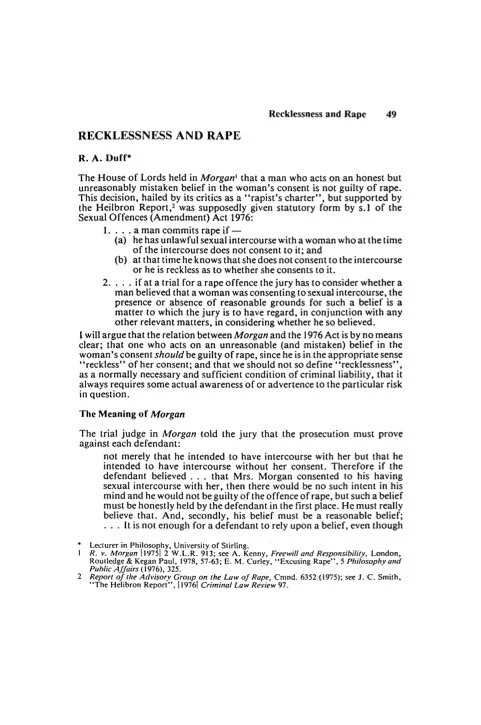
RECKLESSNESS AND RAPE

By R.A.Duff*

Both the trial judge and the Court of Appeal seemed to base their view that a mistaken belief in consent must be reasonable if it is to secure an acquittal on evidential principles, not on the substantive principle that one who acts on an unreasonable belief really has the mens rea of rape. That mens rea consists, they agreed, in "the intention to do the prohibited act":" it involves an awareness of the woman's lack of consent, and is in principle negatived by any honest belief in consent. But proof of the fact of non-consensual intercourse creates a presumption that the defendant knew she did not consent, and casts on him the evidential burden of adducing evidence to rebut that presumption. "before any issue as to his state of mind can arise for the jury's consideration".' This burden is not discharged by "a bald assertion of belief for which the accused can indicate no reasonable ground"," but only by evidence of a reasonable belief: if such evidence is adduced, the prosecution must prove either that that belief was not honestly held or that it was not reasonable.

The Liverpool Law Review VoJ. III (2) 119811, 16p.

Meanings of ‘Sex’ and ‘Consent’: The Persistence of Rape Myths in Victorian Rape Law

By Dr Anastasia Powell, Dr Nicola Henry, Dr Asher Flynn and Dr Emma Henderson

Since the 1980s, laws regulating the meaning and interpretation of sexual consent have been substantially reformed across Australian and international jurisdictions. Of particular note in an Australian context are the significant changes to the definition of consent introduced in Victoria in 2006 and 2007, which were primarily informed by the Victorian Law Reform Commission’s review of legislative provisions relating to sexual offences. In this article, we explore the persistence of traditional rape discourses in the courtroom following the 2007 Victorian reforms by examining meanings of ‘sex’ and ‘consent’ in a pilot sample of rape trials. Our analysis suggests that although deeply entrenched societal myths or discourses about rape continue to pervade Victorian courtrooms, there is some evidence of a shift towards a legal focus on the accused’s state of mind, in addition to that of the victim-complainant. This shift, however, is only prominent in cases in which the accused testifies. In light of these preliminary findings, we suggest that further comparative analyses of the qualitative impact of law reform on discursive constructions of ‘sex’ and ‘consent’ in rape trials may provide alternative measures of the impact of rape law reform.

Powell, A., Henry, N., Flynn, A. and Henderson, E. (in press, 2014). ‘Meanings of “Sex” and “Consent”: The Persistence of Rape Myths in Victorian Rape Law’, in Griffith Law Review, (accepted 10 January 2014), 1-38.

THE CRIME Volume 3.

BY Richard Grelling.. Translated By Alexander Gray. Introduction by Colin Heston.

Richard Grelling’s The Crime (Das Verbrechen), translated into English by Alexander Gray and published in London and New York between 1917 and 1919, is conceived as both a moral successor and completion to his earlier pacifist landmark, J’Accuse!, written between August 1915 and November 1916. In creating this extended work, Grelling sought to underscore the causes of World War I and dissect the self-justifying rhetoric that sustained the conflict long after its outbreak. Volumes I and II lay foundational groundwork, tracing the immediate antecedents of the war: imperialist tendencies within Germany and, on the part of the opposing Entente powers, ostensibly defensive motives followed by trait protectionism.

Never before in the annals of humankind has a crime of such sweeping magnitude been committed—and seldom has its perpetration been met with denial so unashamed. Within the very citadels of reason and culture, a proud civilization unleashed catastrophe under the guise of necessity—only to scramble afterward in self-exculpation. It is in this spirit of moral defiance—standing firm against voices of dissent, even from one’s own kin—that The Crime is offered to you. In the trilogy’s third volume, Grelling moves beyond the origins of war into the heart of wartime rationalization, exposing the “war-aims” that enabled aggression to persist under the cloak of purpose. May this work cast a clear light upon the structures of self-deception that allowed the world’s descent, and may it stir an unyielding clarity in us to recognize—and reject—such patterns again.

Read-Me.Org Inc. New York-Philadelphia-Australia. 2025. 261p.

Emerging Technology and Risk Analysis: Metaverse Concerns About Crimes That Involve Targeting and Exploitation of Children

By Daniel M. Gerstein

his report is one in a series of analyses on the effects of emerging technologies on U.S. Department of Homeland Security (DHS) missions and capabilities. As part of this work, the research team was charged with developing a technology and risk assessment methodology for evaluating emerging technologies and understanding their implications in a homeland security context. The methodology and analyses provide a basis for DHS to better understand the emerging technologies and the risks presented.

This report describes the implications that the metaverse could have on digital crimes that involve the targeting and exploitation of children. These digital crimes are already occurring and have affected and endangered many victims and families. In an immersive online environment, such as the metaverse, opportunities for criminal activity and exploitation aimed at children could expand further.

Key Findings

Metaverse technologies — which encompass artificial intelligence systems, immersive technologies, and enabling digital technologies — will likely continue to become more available, have greater capabilities, and cost less to obtain and use. As has been the case with other digital technologies, metaverse technologies likely will have few policy, legal, ethical, or regulatory impediments constraining their development or use.

The metaverse concept is at an inflection point. How it will expand, how large it will become, and whether will it become an expansive virtual world that directly competes with the physical world remain unanswered questions. The timelines for expansion of the metaverse also remain speculative and will largely depend on use case, demand, and market forces.

Both non-metaverse and metaverse platforms have been and will continue to be used effectively to target children. Furthermore, an overlap exists between non-metaverse and metaverse platform use in luring and victimizing children, which makes it impossible to delineate the share of these abhorrent behaviors ascribable to each.

The lack of legal frameworks for crimes involving the targeting and exploitation of children in online applications will likely continue to be an issue. Clear definitions for what constitute attacks in the metaverse are not available as they are in the physical world, which hinders investigations and prosecutions. Despite the known vulnerabilities and consequences, these platforms continue to be aggressively marketed to children.

As the metaverse grows, the potential of these platforms for targeting, luring, exploiting, and victimizing children through targeted criminal activity or child exploitation will likely also grow.

Santa Monica, CA: RAND, 2025. 24p.

Researching a Problem

By Ronald V. Clarke and Phyllis A. Schultze

This guide, one of the Problem-Solving Tools Series, summarizes knowledge about information gathering and analysis techniques that might assist police at any of the four main stages of a problem-oriented project: scanning, analysis, response, and assessment. This tool takes the mystery out of conducting research on problems by helping the user to define their problem, use technology to conduct Internet searches, get advice from experts, visit libraries, and evaluate their primary sources of information. The guide offers helpful hints to understanding and identifying responses to problems based on the research gathered.

Problem-oriented policing focuses, one-by-one, on specific problems of crime and disorder with the intention of identifying and altering the particular factors giving rise to each problem. The problems addressed in problem-oriented policing tend not to be confined to just a few police jurisdictions, but are more widely experienced. It is therefore likely that some other agency has tried to solve the kind of problem that you are dealing with now. Or perhaps some researcher has studied a similar problem and learned things that might be useful to your work. You could save yourself a lot of time and effort by finding out what they did and why. In particular, you can learn which responses seemed to be effective and which were not. So long as they made available a written report of their work, this guide will help you discover what they did. Having found out what others have done, you cannot simply copy what they did. You will have to adapt any successful responses they used to your own situation. This guide does not tell you how to analyze and understand your own problem.† It will only help you to profit from the work of those who have dealt with a similar problem. It is designed to take you as quickly as possible to the information you need and to help you evaluate and make the best use of this information. In doing this, it assumes: • You are familiar with problem-oriented policing. The guide assumes that a problem-solving model, such as SARA (Scanning, Analysis, Response, Assessment), is guiding your project. The guide will assist you at the Analysis and Response stages by pointing you to the possible cause of the problem you are tackling and to the ways you might respond. • You are willing to consider new responses to the problem. Rarely does police enforcement alone solve a persisting problem. To bring a lasting improvement, it is almost always necessary to modify the conditions giving rise to the problem, such as a lack of security or surveillance. Whatever measures you adopt must be carefully matched to the nature of your problem. Many of the measures are likely to be outside your experience and, indeed, that of most police officers. So, you need to learn about the ones that have been successfully used before in dealing with the kind of problem you face. While it is not usually recommended that a police agency blindly adopt another agency's responses to a problem, neither is it a good idea to be blind to what others have done. The key is to understand whether lessons learned elsewhere would apply under the conditions that exist for your problem. • You have limited time. The guide assumes that you have limited time to research best practice and that you want results quickly. You are not writing an academic paper where you might be faulted for missing a particular article or book. You are simply trying to find information that will help you with the practical task of dealing with your problem. For this reason, the guide does not provide a comprehensive description of all information sources, whether on the Internet † or in libraries. † Comprehensive descriptions are provided by Benamati et al. (1998) and Nelson (1997). Rather, it is intended to help you find two main categories of information relevant to your task: (1) articles by researchers who have studied the problem you are facing and, (2) reports of police projects dealing with the problem. The first category of information will help you understand the factors giving rise to your problem; the second will help you find effective responses. Later in the project, you might wish • You have Internet access. Nowadays, it is very difficult to research a problem without having access to the Internet. The guide assumes that you have this access and that you are familiar with searching for information on the Internet. (Indeed, you might have found this guide on the Internet.) The computer you use will need † a copy of Adobe Reader, which allows you to read and download articles in portable document format (.pdf) that you find at websites on the Internet. Unless your computer has a high speed connection, this process of visiting websites and reading and downloading material can be slow and frustrating. Most computers in libraries have high speed connections and you can usually pay to obtain print copies of the material you have downloaded

Problem-Oriented Guides for Police Problem-Solving Tools Series No. 2

Washington, DC: U.S. Department of Justice Office of Community Oriented Policing Services, 2005. 72p.

A scoping study: crime and connected and autonomous vehicles

By Ashley Brown, Shane D. Johnson & Nilufer Tuptuk

Connected and Autonomous Vehicles (CAVs) integrate advanced communication and autonomous driving technologies, enabling them to operate independently or with minimal human intervention. Despite the anticipated benefits for transportation, CAVs could be vulnerable to a wide variety of crimes unless security and crime prevention measures are proactively integrated into the technologies enabling their operation. To understand the potential crime threats, an extensive scoping review was conducted, covering incidents reported in the news and media, along with academic articles from crime and cybersecurity research. A total of 70 news articles related to crime incidents were identified, along with 12 academic articles on crimes. In addition, the findings from 35 survey papers addressing security attacks against CAVs, along with 29 additional papers covering security attacks not addressed in those surveys were synthesised. A total of 22 crime threats were identified. A 2-day workshop with experts was then held to present the findings from the review, conduct a crime scenario development exercise to identify any crime threats that were not identified in the review, and to assess the identified crimes. During the workshop, experts generated 6 new crime scenarios, bringing the total to 28 crime threats. To identify and prioritise high-risk crimes for future work, the experts were then asked to rate the threats based on their anticipated harm, achievability, frequency, and defeat-ability. The crime threats with the highest risk ratings included illegal transportation, vehicle theft, vehicle part theft, ransom for financial gain, and vandalism. The implications of our findings for research, policy and practice are discussed. Crime Science, 2025. https://crimesciencejournal.biomedcentral.com/articles/10.1186/s40163-025-00245-x

Crime Science, 14, Article number: 2 (2025), 39p.

Redefining Missing in the Third Space of Sovereignty: Collaborative Governance

By Melanie Fillmore

This three-article dissertation addresses how Indigenous and non-Indigenous state and non-state policy actors collaborating on Idaho missing and murdered Indigenous persons (MMIP) policy shift the Integrative Framework for Collaborative Governance (IFCG) policy context to the ‘third space of sovereignty’ (Bruyneel, 2007). In a space of competing narratives of authority across time, and space, paper one addresses how Indigenous and non-Indigenous policy actors are shaped by the “drivers” of collaboration. The second paper addresses three key configurations of collaborative governance regimes. The third paper reassesses the scope of Idaho MMIP through a comparison of MMIP cases in 2021 and 2023 as a policy impact. Findings suggest Indigenous policy actors develop consequential incentives, collaborative governance regimes, and assess the scope of MMIP to redefine missing within the‘third space of sovereignty’.

Boise, ID: Boise State University 2024. 179p.

Between the aisles: A closer look at shoplifting trends.

By E. Lopez

With the holiday season upon us, shopping at store locations throughout the nation will increase. Bigger crowds are a welcome sight for retailers, but they also amplify concerns about shoplifting and the safety of the shopping experience for consumers and employees alike.

This report builds on a previous Council on Criminal Justice (CCJ) shoplifting report and CCJ’s ongoing crime trends reports by exploring recent trends in shoplifting for the nation’s three largest cities—Chicago, Los Angeles, and New York. It also examines seasonal trends for a sample of 23 cities and takes a closer look at shoplifting data available from the FBI.

Key Takeaways

Data collected through the fall of 2024 for Chicago, Los Angeles, and New York suggest that shoplifting levels remain higher than pre-2020 rates. Chicago, in particular, experienced notably elevated rates of reported shoplifting through the first 10 months of this year. In 2023, rates were 10% lower in Chicago, 87% higher in Los Angeles, and 55% higher in New York than in 2019.

Over the past several years, shoplifting rates were higher in November and December than they were during earlier months of the year, coinciding with increased in-person retail activity. Because shoplifting rates in a 23-city sample for the first half of 2024 are higher than in 2023, it is likely that the reported shoplifting rate for the full year will rise from 2023 to 2024.

Two national sources of law enforcement data on reported shoplifting—both available from the FBI—show different trends. Statistics from the Summary Reporting System (SRS) suggest that reported shoplifting in 2023 was the same level as in 2019. However, rates from the National Incident-Based Reporting System (NIBRS), show that shoplifting was 93% higher in 2023 than it was in 2019.

It is unclear why there is a sizable difference between these two sources. One possibility is that law enforcement agencies recently added to the group providing data through NIBRS reported disproportionally higher levels of shoplifting, even after adjusting for an increase in population coverage. Clear guidance from the FBI on the limitations of the data and the implications of using certain sources of FBI crime data is needed

Washington, DC: Council on Criminal Justice. 2024. 9p.

Applying Routine Activity Theory to Crimes Against Vulnerable Adults and the Elderly 

By Robin Joy

Routine Activity Theory, a criminological theory that describes the circumstances in which crime occurs, can be applied to crimes against vulnerable adults and the elderly. Using a variety of data sources this report examines this theory and finds: 1. Vulnerable Adults are more likely to be victimized by someone they know. 2. People charged with violating the Vulnerable Adult statutes have criminal histories that indicate a specialization in criminal activity, compared to those of the general offending population. 3. People charged with violating the Vulnerable Adult statutes are significantly older than the general offending population. 4. Most crimes against the vulnerable and the elderly take place in a private home. 5. The elderly are more likely to be victims of larceny, while the vulnerable adults are more likely to be victims of fraud. Routine Activity Theory can explain the victimization against the vulnerable and elderly. Using this framework, policy makers and stakeholders can begin to create policies and programs that can help keep vulnerable and elderly Vermonters safe.   

Montpelier, VT: Crime Research Group, 2022. 17p.

Retail theft in Vermont Using Court Data

By Monica Weeber and Robin Joy

Summary • The 2023 retail theft charge filings are consistent with pre-COVID years. There is an increase in the number of felony retail theft charges filed. • Most felony retail theft charges are disposed as a felony. • Case backlogs can occur at all stages of the process, including apprehension, scheduling, and disposition. • 57.6% of repeat retail theft offenders re-offend with a new retail theft offense within 30 days of their first offense. • Restitution is ordered in approximately 8% of all retail theft cases.
 

• Straight sentences were the most common sentence for both misdemeanor and felony retail theft. The average minimum time for misdemeanor retail theft was .03 years (11 days) and for felony was .64 years (7.6 months).

Montpelier VT: Crime Research Group, 2024.   12p.

Vermont Crime Analysis Using National Incident Based Reporting System (NIBRS) Data on Domestic Violence, 2015-2019

By Megan Novak

Domestic violence (DV) refers to a particular subset of offenses committed by household members, spouses (including ex- and common law spouses), children/stepchildren, or family members. While some domestic incidents involve non-violent offenses (e.g., identity theft, forgery, motor vehicle theft), this report focuses on violent offenses (e.g., murder, rape, assault) that occur during domestic incidents. Rather than report crimes as DV, NIBRS requires law enforcement to record the relationship of the victim to the offender. Incidents included in this report can be categorized as intimate partner violence (IPV) (i.e., violent offenses committed against a boyfriend/girlfriend, homosexual partner, spouse, ex-spouse, or common law spouse) and DV against children aged 18 and younger (i.e., violent offenses against a biological child, child of a boyfriend/girlfriend, or a stepchild). Annual reports will monitor trends related to the number of incidents each year, types and number of offenses committed, victim and offender demographics, victim-offender relationships, and arrestee information. 

Montpelier, VT: Crime Research Group, 2021. 9p.

Vermont Crime Analysis Using National Incident Based Reporting System (NIBRS) Data on Property Crime, 2015-2019 

By Megan Novak

Property offenses refer to crimes in which the object is “to obtain money, property, or some other benefit” (NIBRS User Manual, p. 9).1 Between 2015 and 2019, property offenses accounted for 70.88% of all crimes committed in Vermont. Given the prevalence of property offenses, criminal justice stakeholders and legislatures have a vested interest in monitoring trends related to these types of crime. The National Incident Based Reporting System (NIBRS) is a data source in which law enforcement record information about 26 property offenses. Annual reports will monitor Vermont’s NIBRS data for trends related to the number of incidents each year, types and number of offenses committed, victim and offender demographics, and arrestee information. 

Montpelier, VT: Crime Research Group, 2021. 13p.

Vermont Crime Analysis Using National Incident Based Reporting System (NIBRS) Data Top Five Crimes by County 

By Christopher C. Louras 

As part of Crime Research Group’s (CRG) stakeholder engagement process associated with the National Incident Based Reporting System (NIBRS) data-driven Vermont Crime Analysis project, CRG’s law enforcement partners asked: “How do our agencies spend our time? And to what offenses do we respond?” This report seeks to use NIBRS data to help Vermont’s state, county, and municipal policing agencies answer those questions. This report will delve into the most common reported offenses within the state and the individual counties, which law enforcement agencies respond to the reported crimes, and the distribution of the offenses in individual counties. Given that most of Vermont is comprised of rural areas, an aggregate view of the data on offenses committed in the state might be skewed by more urbanized areas like Burlington. As such, this report will examine the top five offenses reported in each county and will include a list of the top ten crimes. A county-level examination can help inform how law enforcement agencies and policymakers develop strategies to address each jurisdiction’s particular needs. This report by no means describes all the incidents to which law enforcement responds. NIBRS data captures crimes while quality of life incidents such as noise complaints, issues with animals, and suspicious activity, etc., are not captured in NIBRS data. Once Vermont law enforcement are all using the new computer aided dispatch/records management system (CAD/RMS), the quality-of-life incidents will be available for a more comprehensive review as to how law enforcement spends their time.

Montpelier, VT: Crime Research Group, 2021. 33p.

Vermont Crime Analysis Using National Incident-Based Reporting System (NIBRS) Data Review of Day of Week and Time of Day

By Christopher Louras

A series of interviews with criminal justice stakeholders conducted by Crime Research Group (CRG) in 2020 concluded that policymakers at both the state and local levels rely on access to accurate data to fully understand the scope of criminal incidents that occur within Vermont generally and within communities specifically. Without timely and accurate information, those policymakers recognize the inherent challenge in developing both short- and long-term effective strategies to address the needs of the constituencies they serve. To that end, this report analyzes five years of National Incident Based Reporting System (NIBRS) data for incident trends related to law enforcement agencies’ recording day(s) of the week and time of day for criminal events. While this study by no means provides a comprehensive summary of how law enforcement agencies spend their time in response to calls for service, it provides a glimpse into one critical component, when crimes occur and/or are recorded within Vermont’s data systems, that is needed to effectively and efficiently serve the public. 

Montpelier, VT: Crime Research Group, 2021. 11p.

Vermont's National Criminal Justice Reform Project Data Integration Report (2022) 

Within the state of Vermont, there is a history of following a traditional approach of relying on transaction- based information systems for data capture and reporting. This model relies on disparate silos of data and functionality, resulting in numerous problems ranging from the inability to access the right data to lengthy delays in obtaining much needed data for analysis and decision making. This perpetuates inefficiencies and compromises the effectiveness of criminal justice practitioners as they try to navigate these systems. Obtaining relevant data in Vermont can also be challenging due to a lack of information-sharing or the inability to share data. Not only are there challenges in identifying data but there are also nuances in data fields that make it difficult and, in some cases, harmful to draw conclusions from the data. For example, it is harmful to assume that a defendant intended to avoid justice in the case of failure to appear, when in actuality the defendant incarcerated at the time of the hearing. The Data Integration Planning Process The National Criminal Justice Reform Project (NCJRP) helped focus the process on strategic planning that furthered the integration of data systems and the use of measurable, high fidelity evidence-based programs. The long-term vision of this effort has been to develop a data system that allows data sharing and the integration of disparate information technology systems between and among all partners across the criminal justice system in the state. Such a system would provide practitioners at all levels with a comprehensive set of query and analytics tools for improved decision making. Foundational to this work is the need for access to integrated data from criminal justice and human services. Access to integrated data is critical for the decision-making processes and for measuring the results being achieved. Currently the data systems are siloed with some data flowing through one system to the next. (See AttachmentA) Technology is needed that is scalable to all systems within the Vermont criminal justice system, allowing for the comprehensive collection and assessment of data across the criminal justice processes. Through the NCJRP, the Advisory Committee recognized the importance of including data from other agencies beyond that of law enforcement, including courts and corrections. They identified the need to engage stakeholders, conduct a thorough technology and systems assessment, develop a comprehensive strategic plan, and establish a governance structure and staffing to oversee this work. The long-term vision is to have a single point of reference for the integration of all criminal justice data in Vermont. A system is needed that provides query capabilities, as well as system integration services, allowing for the use of a single, open-source standards-based data portal to facilitate state-wide justice information sharing. The next steps called for bringing the criminal justice community together to develop a strategy that looked beyond the NCJRP. To do this, the NCJRP technical assistance team engaged SEARCH, the premiere justice sharing organization, to help with operationalizing the vision. To help convey the complexity and number of software systems involved in the various functions and roles of the stakeholders expecting to be integrated, Attachment B exists as a flowchart representation overlayed with the software engaged at each phase of the process. Three objectives were identified: 1. To develop and deliver a data infrastructure implementation plan and framework for strengthening governance and multi-agency information sharing among criminal justice and other stakeholders with an initial focus on racial disparities. 2. To establish a process to routinely communicate stakeholder technology plans, changes to information sharing needs, policies and practices, and capabilities and gaps. These activities will promote coordination and integration solutions that collectively enhance strategic policy and operational decision making among justice partners within the state. 3. To establish a consensus among partners to define the relevance, need, purpose, participating agencies, objectives, and responsibilities of the governance structure. Identify leadership, support, and resources to effectively manage progress toward the defined objectives. In 2019, the Vermont Department of Public Safety (DPS), as outlined in their Modernization Plan, was in the process of implementing a new computer-aided dispatch and records management system (CAD/RMS) for all law enforcement agencies within the state. This would allow more data to be collected and stored at DPS and help ensure the data is collected effectively and integrated with other systems within the criminal justice system. To further the data integration work, the Vermont NCJRP team proposed utilizing the funds initially allocated for personnel to support a position within the Agency of Digital Services (ADS). Scheduling meetings, agenda/minutes preparation and distribution, managing deliverables, and participating in committee meetings all takes time and effort – resources which most stakeholders had very little to spare. The support and management function of this initiative was a key component to maintain the project’s initial momentum and continue making progress toward the objectives. 

Montpelier, VT: Crime Research Group, 2022. 27p.