Open Access Free Library
CRIME+CRIMINOLOGY.jpeg

CRIME

Violent-Non-Violent-Cyber-Global-Organized-Environmental-Policing-Crime Prevention-Victimization

Posts in Economic Policy
A Framework for Countering Organised Crime: Strategy, Planning, and the Lessons of Irregular Warfare

By David H. Ucko and Thomas A. Marks

Organised crime is not going well. According to the 2021 Global Organized Crime index, ‘the global illicit economy simply continue[s] along the upward trajectory it has followed over the past 20 years, posing an ever-increasing threat to security, development and justice – the pillars of democracy’ (Global Initiative, 2021, p. 8). Wherever governments seek to draw the line, criminal actors find profitable ways of crossing it; wherever governments fail to deliver on human need, criminal actors capitalise on citizens’ desire or despair. As of now, more than three-quarters of the world’s population ‘live in countries with high levels of criminality, and in countries with low resilience to organized crime’ (Global Initiative, 2021, p. 12). On aggregate, the associated activity amounts to an illicit form of governance, furnishing alternative services to a wide range of clients, be they the vulnerable and weak or a covetous elite. The breadth of organised crime, its clandestine nature, and its blending of creative and destructive effects make it difficult to counter. In past SOC ACE research, we argued that the response to organised crime often shares certain pitfalls with counterterrorism, at least since 9/11 (Ucko & Marks, 2022c). Both efforts have been stymied by 1) conceptual uncertainty of the problem at hand; 2) an urge to address the scourge head on (be it violence or crime), without acknowledging its socioeconomic-political context; and, therefore, 3) unquestioned pursuit of strategies that miss the point, whose progress is difficult to measure, and which may even be counterproductive. This convergence is based on the common features of the two phenomena, which are both concerned with i) collective actors, who ii) use violence and coercion among other methods; and who have iii) corrupting, or outright destructive effects on society. Though organised crime is not consciously political in its ideological motivation, it is – like terrorism – deeply political in its origins, activities, and effects. Given the conceptual overlap, and the common pathologies that undermine response, the lessons from countering terrorism are relevant also to the countering of organised crime. Focusing on the concept of ‘irregular warfare’, our past research identified six key lessons, touching upon 1) the socio-political embeddedness of the problem, 2) the tendency to militarise the response, 3) the mirror-imaging of state assistance programmes, 4) the invaluable role of community mobilisation, 5) the dearth of strategy, and 6) the need to engage more closely with questions of political will. As argued elsewhere, these challenges point to a need for greater strategic competence both in assessing the problem of organised crime and in designing a response (Ucko & Marks, 2022c).

To generate this strategic competence, this follow-on report sets out an analytical toolkit to assist planners and policymakers with the crafting of strategy. This ‘Framework of Analysis and Action’ builds upon lessons – negative and positive – learned via years of experience with irregular warfare, defined by the Department of Defense as ‘a violent struggle among state and non-state actors for legitimacy and influence over the relevant population(s)’ (U.S. Department of Defense, 2007, p. 1).1 It is a framework that finds its origins within the U.S. National Defense University’s College of International Security Affairs (CISA), where for two decades it has been used to teach strategic planning for complex and intensely political challenges (Ucko & Marks, 2022a). The framework consists of two parts: the Strategic Estimate of the Situation (which maps the problem, explores its drivers, frames, and methods, and critiques the current response) and the Course of Action (which uses the strategic estimate to design an appropriate strategy, guided by a theory of success). The framework is in this report adapted for organised crime, to enable the mapping of relevant actors and the crafting, thereby, of a viable response. By design, the framework responds to the six key lessons identified in our earlier work. This report goes through the framework and explains its adaptation to organised crime. Appendix A provides a summation of the toolkit, a ‘user’s guide’, that will facilitate application of the framework. Testing to date suggests great potential and we look forward to sustaining a dialogue with those engaged with countering organised crime to further evolve this toolkit. Indeed, since the beginning, this framework has been a living product, enriched by theoretical application in the classroom and practical use in the field.

SOC ACE Research Paper No. 19. Birmingham, UK: University of Birmingham, 2023. 45p.
Observatory of Illicit Economies in South Eastern Europe

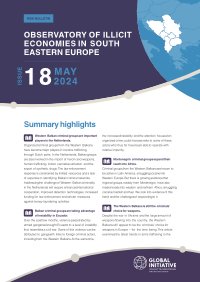
By Global Initiative Against Transnational Organized Crime’s Observatory of Illicit Economies in South Eastern Europe.

In this issue, we focus on three cases where criminal groups from the region have been active in recent years: the Netherlands, Ecuador and parts of Africa.

These examples illustrate the growing involvement of Balkan criminal groups in some of the world’s hotspots for illicit activity. Research for these articles is facilitated by the Global Initiative’s network of contacts with local investigative journalists, as well as close cooperation between regional observatories of illicit economies, namely South Eastern Europe, West Africa and Latin America.

As part of the GI-TOC’s analysis of the risks of firearms trafficking from Ukraine, in this issue we show that the Western Balkans remain the main source of illegal weapons in Europe. At present, weapons are still cheap and plentiful in the region, and stockpiles have been augmented by inflows from Turkey via Bulgaria, particularly of gas and alarm guns. More on this topic can be found in a forthcoming GI-TOC report on trends in arms trafficking from the Ukraine conflict.

In this issue, we also report on a major crackdown by Serbian authorities in late 2023 on increasingly violent smugglers operating along the border between Serbia and Hungary, and examine how this has displaced migration flows towards Bosnia and Herzegovina.

Risk Bulletin No. 18. Geneva, SWIT: Global Initiative Against Transnational Organized Crime, 2024. 25p.

Oil Theft, Energy Security and Energy Transition in Mexico

By Vlado Vivoda, Ghaleb Krame and Martin Spraggon

Oil theft refers to the exploitation of crude oil or refined petroleum products for criminal purposes. In Mexico, oil theft—referred to as huachicolero—is endemic and widespread. By framing it within the energy security and transition context, this paper offers a new perspective on the problem of oil theft in Mexico. Focusing on crude oil and refined petroleum, the paper demonstrates that Mexico’s energy security—as framed around the 4As (availability, accessibility, affordability, and acceptance)—has deteriorated over the past decade. Application of the 4As framework in the Mexican context shows that the increasing frequency of oil theft has contributed to this deterioration. The proposed solution to the energy security and oil theft problems is centred on Mexico moving from gasoline and diesel to electrification in the transportation sector. The paper demonstrates that, while transport electrification in Mexico has been lagging behind other countries, recent developments in the country point to growing momentum among the country’s political and business elites, in tandem with US partners, in support for the energy transition. Areas where further emphasis should be placed to accelerate Mexico’s energy transition in the transportation sector are identified. Finally, the feasibility of and potential limitations associated with implementing the transition are evaluated.

Resources 2023, 12(2), 30; https://doi.org/10.3390/resources12020030

Illicit Financial Flows in the Mekong

By Kristina Amerhauser

Illicit financial flows (IFFs) are a serious concern in the Mekong region, which includes Cambodia, Lao People’s Democratic Republic (PDR), Myanmar, Thailand and Vietnam. Facilitated by state-embedded actors, each year vast amounts of illicit proceeds are generated, moved and laundered across the region and beyond in offshore tax havens. This distorts the local economies; deprives the state of income needed for health, education and infrastructure; and deepens inequality. This paper is part of a comparative research project that tests and applies the ‘IFFs pyramid’, a new framework of analysis of IFFs proposed by Reitano (2022), in the context of the Mekong region. Based on a review of secondary literature, it provides an overview of financial flows, trade flows and informality – the three main means by which IFFs are enabled, moved and held according to the ‘IFFs pyramid’ – and discusses how IFFs manifest across the Mekong. It finds that: • There is widespread evidence that each flow is significant in the Mekong and that flows converge and intersect. Nevertheless, current responses to IFFs almost entirely focus on the formal financial system. • Porous borders and strong trade relationships, including with neighbouring China, offer abundant and diverse opportunities for trade-based money laundering (TBML). Lack of capacity to identify misclassified goods and low cross-border collaboration are key impediments to its response. • There are a large number of special economic zones (SEZs), some of which are treated as ‘lawless zones’ where national governments have no authority. This creates widespread opportunities for value to be extracted, under-reported and comingled with legitimate flows. They have also been linked to other illicit markets, such as drug trafficking, the illegal wildlife trade (IWT), human trafficking and financial crimes, and provide the space to generate and launder illicit proceeds in a multitude of ways. • The big informal economy, coupled with the large number of people who remain outside the formal financial system, limits the efficiency of regulatory and oversight instruments. • Political will to tackle IFFs in the Mekong appears to be limited, in large part due to the involvement of Chinese actors. In fact, some actors in charge of the response to IFFs seem to have created loopholes to their own benefit. State-embedded actors are part of the problem, both as a source of IFFs as well as by further enabling them. This research shows that the IFFs pyramid proposed by Reitano (2022) is a helpful tool for organising information related to IFFs in the Mekong and for improving understanding of the major negative impact and harms that IFFs exert on societies and economies of the region  

SOC ACE Research Paper No. 30. University of Birmingham. 2023, 32pg