
Open Access Publisher and Free Library
Fiction+Mediajpg.jpg

FICTION and MEDIA

CRIME AND MEDIA — TWO PEAS IN A POD

Posts tagged Russia
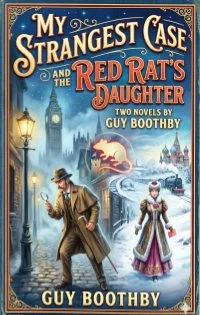
My Strangest Case & The Red Rat's Daughter


by Guy Boothby (Author), Colin Heston (Introduction)

To step into the world of Guy Boothby is to step into a whirlwind. At the turn of the 20th century, few authors could match Boothby's sheer velocity. A man who famously dictated his novels into a phonograph to keep pace with his imagination, Boothby was the architect of the "sensation novel," bridging the gap between the gothic mysteries of the past and the fast-paced thrillers of the future. This volume brings together two of his most gripping works: My Strangest Case and The Red Rat's Daughter. While different in setting, they share the quintessential Boothby hallmarks—exotic locales, high-stakes intrigue, and the relentless pursuit of justice (or survival).

The George Fairfax Mystery: My Strangest Case
In My Strangest Case, we are introduced to George Fairfax, a detective who stands in the long shadow of Sherlock Holmes but operates with a flair all his own. Originally published at the dawn of the 1900s, this story takes the reader from the high society of London to the rugged landscapes of the East. It is more than a simple whodunit; it is a globe-trotting adventure that explores the consequences of a long-hidden secret. Boothby’s talent for atmosphere ensures that the mystery feels as much a part of the environment as the characters themselves.

Intrigue in the East: The Red Rat's Daughter
The Red Rat's Daughter showcases Boothby’s obsession with the "Far East" and the political tensions of the era. Set against the backdrop of imperial Russia and the vast Siberian frontier, it is a tale of romance entangled with international conspiracy. The title itself—alluding to the mysterious "Red Rat"—promises a level of melodrama that Boothby delivers in spades. It captures a specific moment in literary history when the world felt both dangerously large and increasingly interconnected.
Why Boothby Matters Today
Reading Guy Boothby in the 21st century offers more than just nostalgia. It provides a window into the Victorian psyche:

  • The Pace: Boothby’s narrative drive is modern; he rarely lets a chapter end without a hook.

  • The Scope: He was an early pioneer of the "international thriller," refusing to keep his protagonists tethered to English soil.

  • The Style: His prose is unapologetically bold, designed to entertain the masses of the Edwardian era.

Whether you are a devotee of classic detective fiction or a newcomer to the "sensation" genre, these two novels represent a master storyteller at the height of his powers. Turn the page and prepare for a journey that spans continents and decades.

Read-Me.Org Inc. New York-Philadelphia-Australia. 2026. 350p.
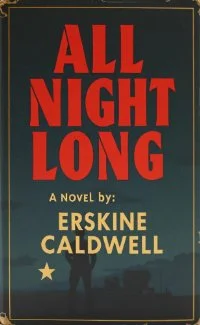
All Night Long: A Novel of Guerrilla Warfare in Russia

By Erskine Caldwell. Designed and Edited with an Introduction  by Colin Heston

When All Night Long appeared in 1942, Erskine Caldwell was already one of the most widely read—and most controversial—American novelists of his generation. Known primarily for his unsparing portrayals of poverty, violence, and moral stress in the American South, Caldwell here turned his attention outward, to a global conflict unfolding at unprecedented scale. Subtitled A Novel of Guerrilla Warfare in RussiaAll Night Long represents Caldwell’s direct literary engagement with the Second World War at the moment when its outcome remained deeply uncertain and when the Soviet Union, newly allied with the United States, had become a central symbol of resistance to fascist aggression.

Caldwell’s Russia is not a romanticized abstraction nor a detailed ethnographic portrait. Instead, it functions as a stark moral landscape shaped by occupation, deprivation, and constant threat. Villages, forests, and frozen terrain become arenas of endurance rather than scenery. The emphasis falls on night operations, secrecy, hunger, exhaustion, and the psychological toll of living in a perpetual state of danger. The title itself—All Night Long—signals this temporal and emotional register: war as an unbroken vigil, a continuous strain that erodes the boundary between action and survival.

For modern readers, the novel occupies an intriguing position in Caldwell’s body of work and in twentieth-century war literature more broadly. It stands apart from his Southern novels in geography but not in theme. As in Tobacco Road or God’s Little Acre, Caldwell examines how extreme conditions strip life down to its essentials and expose the structures—economic, political, or military—that govern human behavior. In All Night Long, the setting is international, but the underlying concerns remain consistent: power, exploitation, resilience, and the cost of endurance.

Read today, All Night Long also invites reflection on the evolving representation of guerrilla warfare itself. Long before such conflicts became a dominant feature of late-twentieth- and early-twenty-first-century military discourse, Caldwell recognized the strategic and moral complexity of irregular resistance. His novel anticipates later debates about asymmetrical warfare, civilian involvement, and the blurred lines between combatant and noncombatant—issues that continue to shape global conflicts.

Ultimately, All Night Long is less a novel about Russia per se than a novel about resistance under occupation. It captures a historical moment when global war demanded new forms of solidarity and new narrative frameworks to explain them. Caldwell’s achievement lies in his ability to translate that vast struggle into an intimate, unrelenting account of human persistence, sustained through darkness, danger, and the long hours of night.

NY.Book League of America. 1942. Read-Me.Org Inc. Australia, New York & Philadelphia. 2025. 161p.