Open Access Free Library
CRIMINAL JUSTICE.jpeg

CRIMINAL JUSTICE

CRIMINAL JUSTICE-CRIMINAL LAW-PROCDEDURE-SENTENCING-COURTS

Vom Geist der Strafe. Andreas Gryphius’ Carolus Stuardus und die englischen Debatten über den Tod Karls I.

Maximilian Bergengruen

17.1 Einleitung

Meine Überlegungen setzen an den Debatten für und wider das Todesurteil gegen den englischen König Karl I. in Andreas Gryphius’ Carolus Stuardus an; einer Debatte, die ursprünglich in England geführt wurde, aber nicht zuletzt durch ver- schiedene Übersetzungen Auswirkungen auf und in ganz Europa hatte (3). Im Mittelpunkt steht die Austauschbarkeit der Argumente in Bezug auf die göttliche Legitimation von Herrschaft, die sowohl die royale wie auch die independente Position für sich beanspruchen.

Read-Me.Org
Violence (Crime and Punishment)

Rastko Vuković,

There is no valid evidence that the extension of legal penalties reduces the percentage of crime in society. It is known that saturation of society by laws reduces the chances of development, so the question arises as to why we are striving to more and more durable laws? Why are we extinguishing out the fire with the oil in the alleged fight for justice?

May 30, 2019

Read-Me.Org
Using SPSS® to Solve Statistical Problems: A Self -Instruction Guide

David M. Shannon with Mark A. Davenport

The motivation for writing this text comes from ten years of experience with students en- rolled in beginning statistics classes. Students in these classes have had to deal with the chal- lenges of learning not only statistical concepts, but also how to use the computer software (SPSS) that will guide them through their statistical analyses. Whether you are a student learning about statistics for the first time or an experienced researcher who has used sta- tistics throughout your career, you are likely to have many encounters with software such as SPSS® for Windows.

Library of Congress Cataloging-in-Publication Data

Read-Me.Org
Undergraduate’s Perception toward Corporal Punishment

Nurhidayat , Danarti , Habib Al Fattah

Abstract. This study is conducted to find out the undergraduate’s perception toward the corporal punishment that may happens in the school. The subjects of the research are sixth semester students of English Department of Teacher Training and Education of Universitas Muhammadiyah Surakarta. The data were collected through close and open questionnaire and analysed using content analysis. Based on the analysis of the data, it is concluded that most undergraduates experienced corporal punishment in the previous education before studying in the university. The experience of suffering corporal punishment leads the undergraduate’s perception toward the corporal punishment.

1Universitas Muhammadiyah Surakarta, Surakarta, Indonesia 2SMP N 6 Surakarta, Surakarta, Indonesia 3MTs AL Kahfi, Surakarta, Indonesia

Read-Me.Org
Uma outra pena de morte: a violência letal do sistema penal brasileiro

Another capital punishment: the lethal violence of the Brazilian penal system

By Luiz Phelipe Dal Santo

Introdução Costuma-se compreender o monopólio sobre o uso legítimo da violência como uma das principais características dos Estados Modernos.1 Conforme denotado pela palavra “legítimo”, isso não significa que os Estados têm (ou deveriam ter) liberdade para dispor da violência contra seus cidadãos como bem entenderem. A despeito do desenv

Universidade de Oxford – Inglaterra, Reino Unido. 1.

Read-Me.Org
Justice on Trial

By Arthur Train (Author) and Graeme Newman (Editor and Introduction)

Arthur Train was not merely a novelist of crime and courtroom intrigue—he was an Assistant District Attorney in New York County who understood the hidden machinery of American justice from the inside. In Justice on Trial, two of his most compelling works—Prisoner at the Bar and McCallister’s Double—are brought together in a powerful new edition edited and introduced by Graeme R. Newman.

Part legal exposé, part philosophical inquiry, part classic crime fiction, this volume explores questions that remain disturbingly relevant today: How is guilt really determined? Do courts discover truth—or construct it? Why are prisons hidden from public view? Do criminals receive justice, or merely punishment? And what of the victims left behind by the machinery of law?

In Prisoner at the Bar, Train offers a rare insider’s account of the criminal justice system of early twentieth-century America. Drawing upon his own prosecutorial experience, he exposes the realities behind arrests, grand juries, trials, sentencing, police practices, courtroom performance, and the uneasy relationship between law and morality. The result is one of the earliest and most penetrating critiques of modern criminal justice ever written.

Complementing this work is McCallister’s Double, a brilliant collection of courtroom and criminal tales filled with deception, mistaken identity, legal maneuvering, and moral ambiguity. These stories reveal Train’s remarkable ability to combine suspense with sharp observations about the fictions upon which justice itself often depends.

Graeme R. Newman’s extensive new introduction places Train’s work within the larger history of crime, punishment, and legal power, comparing the courts and prisons of Train’s era with those of the twenty-first century. The introduction examines the secrecy of prisons, the hidden social functions of trials, the mythology of “justice,” and the enduring question of whether criminal justice systems truly deliver fairness—or merely preserve authority.

Blending classic legal writing, detective fiction, social criticism, and courtroom drama, Justice on Trial is both a fascinating historical document and a strikingly modern meditation on crime, punishment, truth, and power.

For readers of true crime, legal history, courtroom drama, criminology, and classic detective fiction, this volume offers a rare and unsettling look behind the curtain of justice itself.

Read-Me.Org Inc. New York-Philadelphia-Australia. 2026. p.362.

The Kid And The Camel: Stories Of The Court And Criminality

By Arthur Train (Author) and Graeme Newman (Editor and Introduction)

Before modern courtroom thrillers and television crime dramas, Arthur Train was bringing readers inside the strange, unpredictable, and deeply human world of criminal law. The Kid and the Camel: Stories of the Court and Criminality collects some of Train’s most memorable tales from the New York courts, blending legal realism, sharp humor, and penetrating social observation.

At the center of the volume is the celebrated story “The Kid and the Camel,” a bizarre and unforgettable courtroom case involving immigrants, conflicting testimony, cultural misunderstanding, and a camel hidden in a city attic. Around it unfolds a wider panorama of criminal justice in early twentieth-century America: ambitious lawyers, eccentric witnesses, cunning swindlers, ethical dilemmas, jury manipulation, and the uncertain search for truth inside crowded urban courtrooms.

This collection also features the famous Tutt & Tutt stories, introducing one of American fiction’s earliest and most sophisticated lawyer-heroes. Through the clever, theatrical, and psychologically astute attorney Ephraim Tutt, Train explores the law not merely as a system of rules, but as a human drama shaped by persuasion, ambiguity, and competing notions of justice.

Far more than period entertainment, these stories remain strikingly relevant today. Issues of immigration, courtroom spectacle, prosecutorial strategy, media influence, unequal justice, and the power of lawyers continue to dominate modern criminal justice systems. Train’s fiction reveals how little the essential tensions of law and society have changed.

Edited and introduced by Graeme Newman, this new Read-Me.Org edition restores an important classic of American legal literature for contemporary readers interested in true crime, courtroom drama, criminology, legal history, and the enduring complexities of justice itself.

Read-Me.Org Inc. New York-Philadelphia-Australia. 2026. p.367.

The Lost Stradivarius: And Other True Crime Classics

By Arthur Train (Author) and Graeme Newman (Editor and Introduction)

tep into the shadowed world of early twentieth‑century justice, where truth is elusive, appearances deceive, and a single misjudgment can alter lives forever. The Lost Stradivarius and Other True Crime Classics by Arthur Train brings together some of the most compelling real cases ever drawn from the files of a New York prosecutor. Written with the authority of firsthand experience and the narrative power of a master storyteller, these accounts reveal the drama, tension, and human complexity behind headline crimes. At the heart of the collection is The Lost Stradivarius, a haunting tale of a priceless violin whose disappearance sets in motion a troubling chain of suspicion, error, and unintended injustice. Around it unfold other striking cases—of ingenious frauds, daring deceptions, and courtroom battles in which certainty proves fragile and truth stubbornly resists easy conclusions. Throughout, Train explores not only crime itself, but the deeper forces of character, ambition, and fallibility that shape the pursuit of justice. This new edition features a fresh introduction by Graeme R. Newman, placing these enduring stories in modern perspective and highlighting their continuing relevance. Timeless, unsettling, and richly human, this collection reminds us that truth is often stranger—and far more unsettling—than fiction.

Read-Me.Org Inc. New York-Philadelphia-Australia. 2026. p.187..

Confessions of a Prosecutor

By Arthur Train (Author) and Graeme Newman (Editor and Introduction)

Step inside the courtroom—and beyond it—through the eyes of a man who knew both the practice of law and the art of storytelling.

Arthur Train, a former New York prosecutor and celebrated author, offers a vivid and deeply reflective account of life in the criminal courts. Drawing on real cases, personal experience, and keen psychological insight, Confessions of a Prosecutor reveals the drama, uncertainty, and moral complexity behind the pursuit of justice. These are not merely stories of trials—they are portraits of human nature under pressure, where truth, perception, and judgment are rarely simple.

More than a legal memoir, this book is a masterclass in understanding how justice is truly administered. Train exposes the hidden tensions of courtroom life: unreliable witnesses, circumstantial evidence, the burden of decision, and the immense responsibility borne by those who prosecute in the name of society. His reflections remain strikingly relevant today, offering timeless lessons on fairness, doubt, and the ethical challenges of wielding authority.

What makes this work especially compelling is Train’s dual perspective as both practitioner and writer. With the skill of a seasoned storyteller, he shapes real events into engaging narratives—blending fact and interpretation to illuminate the deeper truths behind the law. The result is a work that is as absorbing as it is instructive, where the boundary between reality and narrative art invites thoughtful reflection.

In its later chapters, Train turns to another side of his life: the craft of writing and the realities of building a career beyond the courtroom. He offers a fascinating glimpse into the world of early twentieth-century publishing—writing for popular magazines, reaching a wide audience, and transforming professional experience into stories that endure. His journey underscores the discipline, adaptability, and persistence required to succeed as an author.

Confessions of a Prosecutor is an essential read for anyone interested in law, justice, and the power of storytelling. It is a book for lawyers and readers alike—for those who seek to understand not only how the law works, but how it feels to live within it.

Experience the courtroom as it truly is: human, uncertain, and endlessly compelling.

Read-Me.Org Inc. New York-Philadelphia-Australia. 2026. p.381.

A Popular Account Of Criminal Justice

By Arthur Train (Author) and Graeme Newman (Editor and Introduction)

Before true crime became entertainment and courtroom drama became television spectacle, Arthur Train took readers directly inside the machinery of American criminal justice. Drawing on his experience in the New York District Attorney’s Office, Train produced one of the first and most compelling insider accounts of how criminal law actually worked—from arrest and indictment to jury trial, sentencing, and the uneasy pursuit of justice itself.

In A Popular Account of Criminal Justice from the District Attorney’s Office, Train strips away the myths surrounding crime and punishment to reveal a system shaped as much by human judgment, politics, error, and improvisation as by law. Murder cases, frauds, police practices, courtroom tactics, unreliable witnesses, legal absurdities, and the psychology of criminals all come under his sharp and often surprisingly modern scrutiny.

Far ahead of his time, Train questions whether criminal law truly reflects morality, whether prisons reform offenders, and whether society punishes the most dangerous forms of wrongdoing at all. His observations on violent crime, corruption, prosecutorial discretion, media sensationalism, and unequal justice remain startlingly relevant in the twenty-first century.

This new edition, edited and introduced by Graeme R. Newman, situates Train’s classic work within today’s debates over mass incarceration, overcriminalization, white-collar crime, police power, and the continuing struggle to balance public safety with individual rights. More than a historical curiosity, this book is a penetrating exploration of the enduring contradictions of criminal justice—then and now.

Combining legal history, criminology, courtroom drama, and social criticism, A Popular Account of Criminal Justice will appeal to readers interested in true crime, law, policing, criminology, criminal procedure, and the evolution of modern justice systems.

Read-Me.Org Inc. New York-Philadelphia-Australia. 2026. p.334.

Bridging the Gap: Aligning Policy with Lived Experience to Strengthen Reentry in North Carolina

By Samantha Richter

A new report from the Wilson Center for Science and Justice at Duke Law draws on more than a dozen in-depth interviews with formerly incarcerated individuals across North Carolina to uncover the real experiences of people returning from prison and where the system falls short.

Based on interviews conducted across urban and rural counties, this report, Bridging the Gap: Aligning Policy with Lived Experience to Strengthen Reentry in North Carolina examines the experience of people navigating the transition from incarceration to community life and makes recommendations to strengthen the process. Each year, approximately 18,000 people return to North Carolina communities from state prisons. While the state has joined the national initiative to improve reentry success through Reentry 2030, participants in this report described reentry as a critical and vulnerable period, where fragmented services and limited planning times can undermine support, creating a gap between available services and what people need to successfully rebuild their lives.

“What we heard consistently is that reentry isn’t a short-term process,” said report author Samantha Richter (A.B. ‘25). “People need support that is personalized, coordinated, and sustained—and they need systems that listen to their experiences and respond to what helps them succeed.”

Key Findings

Five major themes emerged from participant interviews:

  1. Reentering community members need personalized, ongoing support: One-size-fits-all services often left participants feeling unsupported, while peer mentors with lived experience were described as especially effective.

  2. Location shapes access and opportunity: Urban areas offered more resources, while limited flexibility around release locations sometimes forced individuals back into environments that undermined their stability.

  3. System disconnects create difficulty in navigating resources: Even when resources existed, participants often struggled to access them due to confusion, poor communication, or lack of coordination between agencies

  4. Timely, attentive, and thorough pre-release planning is critical for success: Participants consistently emphasized that meaningful preparation requires more than the standard 30-day planning window

  5. Reentry services must support long-term stability: Participants repeatedly stressed that reentry challenges did not end in the first few weeks, and sustained support was necessary to build long-term stability.

Policy Recommendations

Grounded in participant experiences, the report outlines six priorities for policymakers and practitioners:

  1. Increase flexibility in release location

  2. Begin pre-release planning earlier and expand its scope

  3. Strengthen employment readiness and employer connections

  4. Expand targeted housing supports

  5. Improve continuity between prison and community-based services

  6. Invest in peer support programs led by people with lived experience

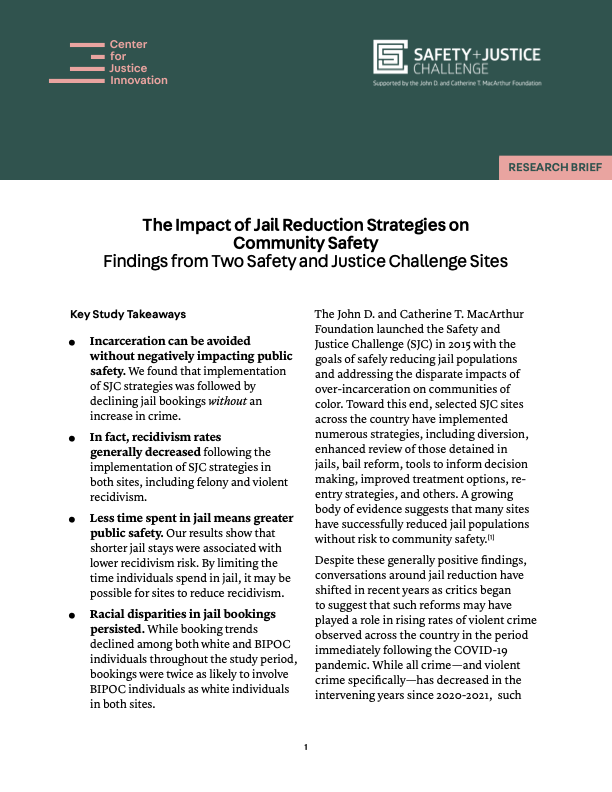
The Impact of Jail Reduction Strategies on Community Safety: Findings from Two Safety & Justice Challenge Sites

By Fred Butcher and Amanda Cissner

This study examined whether the jail reduction strategies implemented in two SJC sites reduced jail populations without increasing crime or sacrificing community safety. Findings suggest that incarceration can be avoided without negatively impacting public safety, with recidivism rates declining after SJC implementation. Further, less time in jail resulted in greater public safety; shorter jail stays were associated with lower recidivism risk.

The United Nations Special Rapporteur on Contemporary Forms of Slavery on the Labour Rights of Incarcerated People: A Case Study of England and Wales

By Virginia Mantouvalou

This article presents the 2024 Report of the United Nations Special Rapporteur on Contemporary Forms of Slavery, entitled ‘Contemporary Forms of Slavery as Affecting Currently and Formerly Incarcerated People’, and assesses the regime in England and Wales on the basis of the Rapporteur's recommendations. It suggests that the Report is a welcome development for it sheds light on an issue that is not frequently investigated by human rights bodies and institutions and has the potential to influence the development of national, European and international standards in the field. Against this background, this piece argues that prison labour in England and Wales falls short of the standards set out by the Rapporteur. Working prisoners often lack meaningful work opportunities and are excluded from labour rights that other workers have. The issues raised in the Report should be considered and addressed as a matter of urgency for the United Kingdom to comply with its human rights obligations

Rikers Island and Mental Health: Pathways Toward Community-Based Diversion and Jail Population Reduction

By Michael Rempel, Krystal Rodriguez, and Kellyann Bock from the Data Collaborative for Justice at John Jay College, and Yonah Zeitz, gabriel sayegh, and Melanie Dominguez from the Katal Center for Equity, Health, & Justice.

The New York City Council established a legal deadline of August 31, 2027 for closing the jails on Rikers Island and building smaller modern jails in the City’s four large boroughs. The replacement jails, when combined with over 300 secure hospital beds for people with serious medical or mental health conditions, will hold a citywide capacity of about 4,200 people on any given day. However, since reaching a low watermark of 3,809 in April 2020, the City’s daily jail population has grown to nearly 7,000—alongside a ballooning sub-population in need of mental health treatment.  Today, Rikers is the largest mental health facility in New York City and among the largest in the country.5 The goals of the current research and policy brief are threefold: 1. Present updated data about the mental health needs of people held in the NYC jails. 2. Reveal the individuals behind these facts through select case studies. 3. Identify a continuum of safe and effective jail diversion strategies for this population. Latest Facts About Mental Health in NYC Jails Currently, close to 7,000 people are held in the City’s jails, of whom 85% have been detained before trial. Black people make up 58% of the jail population, compared to 23% of the City’s general population. In absolute terms, over twice as many Black people as the next highest racial/ ethnic group are in jail while flagging for mental health. ■ Mental Health Prevalence: Over the same 2020-to-2025 timeframe that saw a significant jail increase, overall, the fraction of the jail population receiving mental health services climbed from 44% to 60%, 6 and the fraction diagnosed with a serious mental illness rose from 17% to 22%. 7 The latest health data also indicates that 25% have an opioid use disorder, 30% have an alcohol use disorder, and 28% are homeless or “likely to be homeless” when released,8 a figure that rises to 42% for those with a serious mental illness.9 ■ Medical Conditions: As of September 2025, 28% of people held in jail were diagnosed with lung disease, 15% with cardiovascular disease, 8% with neurologic disease (e.g., epilepsy or stroke history), 6% with diabetes, 4% with hepatitis B or C, 3% with stage 3+ chronic kidney isease, 3% with HIV/AIDS, and 1% with a malignancy.10 ■ Missed Appointments: In September 2025, there were 15,823 missed medical appointments compared to 3,626 in September 2020.11 A recent monitors’ report indicated that from July to September 2024, people were produced for only 53% of scheduled mental health appointments and 77% of reentry planning appointments.12 ■ Disproportionate Gender Impact: Of close to 500 women jailed at Rikers as of October 2025, 87% have needed mental health services, compared to 58% of men.13 ■ Disproportionate Length of Stay: On average, as of October 31, 2025, people in the latest jail population needing mental health services had been held for 281 days, compared to 212 days for people not needing such services. Controlling for people’s background characteristics, a recent analysis found that flagging for mental health within ten days of jail intake predicted a total length of stay 34 days longer than people who never flagged.

RATIONAL CHOICE AND INMATE DISPUTES OVER PHONE USE ON RIKERS ISLAND 

By Nancy G. La Vigne

In an attempt to reduce the high costs of illicit inmate telephone use, a high-security, computerized phone system/or Inmates was introduced on Rikers Island in 1993. A Jew months after implementation, correction officers observed that the system had the beneficial side effect of reducing fights over phone use. This paper confirms the anecdotal evidence, finding that the new phone system reduced both phone costs and inmate violence related to phone use by 50%. There was little evidence of displacement to other forms of violence. These results demonstrate that violent crime may often be precipitated by situational factors and may be prevented by reducing opportunities for disputes.

Tackling Drug Misuse in Prisons. 

By Lucy Strang, Elle Wadsworth

RAND Europe was commissioned by the Ministry of Justice in 2022 to conduct a study exploring the lived experiences of two interventions in prisons in England and Wales: drug testing regimens and incentivised substance free living (ISFL) wings. Mandatory drug testing is routinely conducted in prisons to monitor drug trends, deter drug consumption (through sanctions), and identify individuals in need of further support. ISFLs are dedicated wings for prisoners who want to live in a drug-free environment, whether that be free from the consumption of drugs, the violence related to drugs, or the culture of drug use. Drug testing regimens and ISFLs feed into the delivery of His Majesty’s Prisons and Probation Service’s (HMPPS) drug policy for prisons, which is guided by three key aims: restrict supply, reduce demand and build recovery. This study aimed to understand how drug testing regimens are delivered, experienced, and perceived. Findings will shape the ISFL model by understanding the lived experience of staff and prisoners both on existing ISFL wings and elsewhere in the prison. Findings from this report will also be used to inform the design of a randomised controlled trial and process evaluation on ISFLs and a larger qualitative piece of work on implementation of drug testing.

SOUTHWEST BORDER CBP Should Improve Oversight of Medical Care for Individuals in Custody

By The U.S. Government Accountability Office

U.S. Customs and Border Protection (CBP), through its components U.S. Border Patrol and Office of Field Operations, detains individuals who unlawfully enter the U.S. at short-term holding facilities. CBP personnel process individuals and determine the next course of action, such as transferring them from custody or removing them from the country. For the past decade, CBP has used contracted medical personnel at facilities along the southwest border to provide health screenings and treatment of basic medical conditions to individuals in custody. 

GAO found that CBP developed policies and guidance for providing medical care to individuals in custody but has not consistently implemented them. For example, CBP requires some populations, such as children, pregnant individuals, and adults who indicated they might have an illness or injury, to receive a basic physical exam known as a medical assessment. Although CBP introduced new guidance and improved the percentage of individuals who received medical assessments, GAO found that some individuals still did not receive assessments, as required. For example, 57 percent of adults with a potential illness or injury and 20 percent of pregnant individuals did not receive medical assessments from August 2023 to August 2024, as required. Without an oversight mechanism to ensure that people in custody receive the required medical assessments, CBP may not be aware of medical needs and cannot ensure it takes the appropriate next steps for any necessary medical care. GAO also found that CBP and contracted medical personnel did not consistently implement additional care requirements for individuals in custody who had serious injuries or illnesses (i.e., those who were medically high-risk). For example, from August 2023 to August 2024, contracted medical personnel did not conduct medical monitoring checks required for medically high-risk adults and children approximately 40 percent of the time. In July 2025, CBP developed new tools to inform its oversight efforts, but did not explain how it will use them to systematically assess whether medically high-risk individuals received their medical monitoring checks on time. Developing and implementing a mechanism to monitor this requirement and others would help CBP better ensure these individuals receive required care, and personnel are monitoring their conditions. CBP did not consistently provide medical records and prescriptions—referred to as medical summary forms—as required, to individuals with medical issues leaving CBP custody. By not providing the medical summary forms, CBP can create challenges with continuity of care. GAO also found CBP’s oversight reports did not include data from facilities that do not have contracted medical personnel. These facilities send individuals to local hospitals or urgent care facilities for medical care, including medical assessments. Without these data, CBP cannot ensure all individuals in custody received required medical assessments to decrease the risk of adverse medical outcomes. Moreover, GAO’s analysis showed that CBP did not consistently manage or oversee its medical services contracts.

Standing in prisoners’ shoes: a randomized trial on how incarceration shapes criminal justice preferences

By: Arto Arman, Andreas Beerli, Aljosha Henkel, Michel André Maréchal

We study how incarceration experience shapes preferences for criminal justice policies. In collaboration with a newly opened prison, we conducted a randomized field experiment that offered citizens the opportunity to experience up to two days of incarceration, closely replicating the real-life journey of inmates. Providing citizens with a chance to gain firsthand incarceration leads to a significant shift in punitive attitudes, with participants becoming less supportive of harsh criminal justice policies and donating more money to organizations advocating more moderate justice policies. Although individuals overestimated the wellbeing of actual prisoners, the intervention did not alter these beliefs. This suggests that the observed changes in policy preferences are driven more by personal experience than by revised beliefs about the burden of confinement. By randomizing institutional exposure outside the laboratory, our study highlights the causal role of personal experience in the formation of policy preferences.

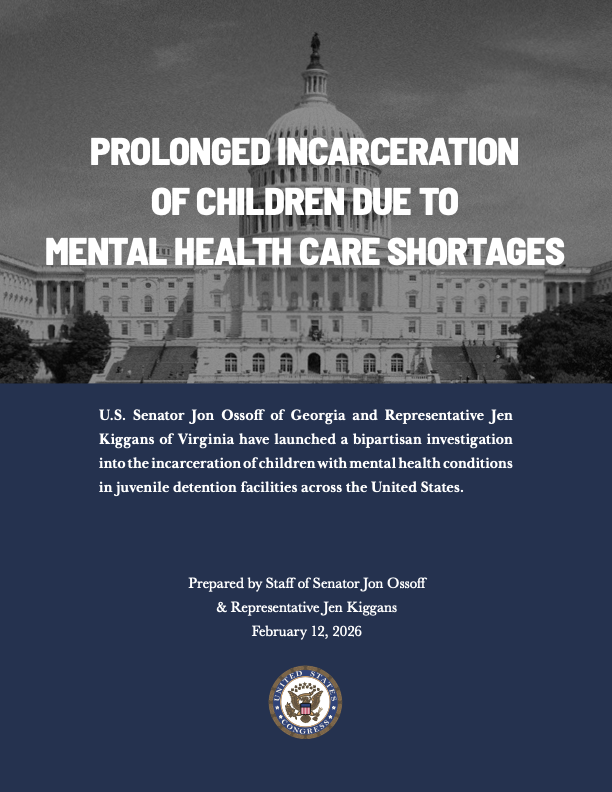
PROLONGED INCARCERATION OF CHILDREN DUE TO MENTAL HEALTH CARE SHORTAGES

By the staff of Democratic Sen. Jon Ossoff and Republican Rep. Jen Kiggans

U.S. Senator Jon Ossoff of Georgia and Representative Jen Kiggans of Virginia have launched a bipartisan investigation into the incarceration of children with mental health conditions in juvenile detention facilities (“facilities”)—centers designed to detain children charged with or sentenced for delinquent offenses—across the United States. As part of this investigation, beginning in May 2024, Sen. Ossoff and Rep. Kiggans surveyed facilities about what circumstances lead to the prolonged detention of children with mental health conditions and children who have not been charged with offenses. In survey responses, 75 facilities across 25 states reported incarcerating children who could be eligible for release to mental health care programs outside the facility but remained incarcerated because the care they needed was not yet available. More than half of these facilities reported incarcerating children in these circumstances for at least one month, and some reported incarcerating children in these circumstances for up to a year. Facilities reported incarcerating children who are on the autism spectrum, who have general neurodevelopmental issues, or who engage in severe self-harm, who could be eligible for release to an external program or health facility. One facility in North Dakota reported that children “with neurodevelopmental issues sometimes are held the longest, while waiting on forensic evaluations of competency.” Twenty responding facilities in 13 states reported incarcerating children either with no charges or with charges that would not ordinarily lead to placement in juvenile detention. Many of these facilities reported incarcerating these children because they needed mental health services outside of the facility that were not yet available or needed mental health care available at the facility and not outside. One facility reported that, in the year before the survey was administered, it held as many as 29 children without charges or with charges that would not ordinarily lead to detention due to a lack of available offsite mental health care. Another facility reported that, in the year before the survey was administered, it held 10 children in these circumstances solely so that they could access internal mental health services not available outside the facility. Another reported incarcerating children in these circumstances for more than a year due to lack of offsite mental health care. Six facilities reported incarcerating children beyond their expected release dates after their charges were dropped or sentences completed, due to lack of available offsite mental health care. One facility reported that it had held roughly 50 children under these circumstances in the year before the survey was administered alone.According to experts in pediatric care, incarcerated children have high rates of physical, mental health and developmental needs that may be undiagnosed or under-addressed in custodial facilities. Incarcerated children also face limited access to evidence-based medical care and a lack of educational opportunities. Other experts warn that incarcerating children can cause adverse lifelong medical and mental health outcomes including higher rates of depression, and suicidality.

A tale of “second chances”: an experimental examination of popular support for early release mechanisms that reconsider long-term prison sentences

By Colleen M. Berryessa

Objectives This study examines US popular support for mechanisms that provide early release and “second chances” for individuals serving long-term prison sentences. Methods An experiment using a national sample of US adults (N=836). Results Data showed moderate, consistent levels of general support for using a range of commonly available “second chance” mechanisms that also extended to offenders convicted of both violent and non-violent offenses. Levels of support significantly varied by race, gender, and age. There was significantly more support for using certain mechanisms in response to the trafficking of serious drugs, which was fully mediated by participants’ views on the importance of the cost of incarceration. Conclusions Members of the public appear open and supportive to utilizing “second chance” mechanisms in a variety of contexts. Yet the cost of incarceration to taxpayers appears to particularly motivate increased public interest in using such mechanisms for offenders convicted of the trafficking of serious drugs.