

CAUSES AND CURES OF CRIME
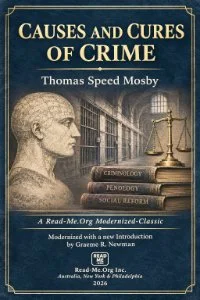
By Thomas Mosby (Author), Graeme Newman (Introduction)
n 1913, Thomas Speed Mosby, who had served as Pardon Attorney to Missouri Governor Joseph W. Folk, set out to explain to the general reader why people commit crimes and what society should do about it. Drawing on years of reviewing convicts’ petitions for clemency, and on the leading criminologists of his day, he organized his answer like a medical textbook. Crime was a disease of the social body, to be understood through its causes, its prevention, and its cure.
Part I, Etiology, examines the “cosmic,” social, and individual factors of crime. These range from climate and season to corrupt prosecutors, sensational newspapers, poverty, alcoholism, and Lombroso’s theory of the born criminal. Part II, Prophylaxis, turns to prevention through eugenics, the sterilization laws then spreading across the states, trade education, and social reform. Part III, Therapeutics, traces the history of punishment and argues forcefully against the death penalty. It includes a remarkable state-by-state survey of American parole laws in 1912 and 1913, and closes with a program for “the new penology.”
Causes and Cures of Crime is a vivid record of American criminal justice reform before the First World War. It shows both the movement’s humane ambitions and its dangerous enthusiasms. Its photographic plates of “criminal types,” supplied by the St. Louis and Kansas City police departments, and its illustrations of anthropometric instruments show how early criminologists hoped to read criminality in the human face and body.
This Read-Me.Org Modernized-Classic edition corrects and modernizes the original text while retaining Mosby’s arguments, statistical tables, all fourteen photographic plates, and the text figures. A new introduction by Colin Heston places the book in historical context, including the later discrediting of eugenics and compulsory sterilization. Review and Discussion Questions for each chapter make the edition well suited to courses in criminology, criminal justice history, and the history of social science.
Read-Me.Org Inc. New York-Philadelphia-Australia. 2026. p.207.