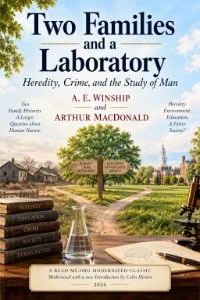
A. E. Winship and Arthur MacDonald. Introduction nad Review Questions, Graeme Newman.
Are people born to crime and poverty, or made by their surroundings? This volume brings together two influential American works from the turn of the twentieth century that tried to answer that question.
In Jukes–Edwards: A Study in Education and Heredity (1900), educator A. E. Winship sets the infamous “Jukes” family against the descendants of the great colonial theologian Jonathan Edwards. The Jukes were the subject of Richard Dugdale’s famous study of crime and pauperism. Edwards’s descendants included college presidents, judges, physicians, senators, and a vice-president of the United States. Winship’s vivid portraits, from Sarah Edwards’s household to the troubled brilliance of Aaron Burr, make a case for the combined power of inheritance, training, and education.
In A Plan for the Study of Man (1902), Arthur MacDonald of the U.S. Bureau of Education urges Congress to establish a national laboratory for the scientific study of “the criminal, pauper, and defective classes.” He wanted it to study ordinary people as well. His wide-ranging survey covers anthropometry, measurements of schoolchildren, instruments for gauging sensitivity to heat, touch, and pain, and hypnotism and suggestion. It also takes in the Mafia and the Camorra, alcoholism, moral education, prison reform, and a detailed case history of a young murderer. His original illustrations of laboratory instruments are reproduced.
The new introduction places both works in historical context. It traces their influence on the eugenics movement, the later criticism of their methods, and their surprising anticipation of modern child development and criminological research. Spelling and wording have been modernized throughout, tables have been summarized in prose, and review and discussion questions are included. The book will interest students and general readers in criminology, sociology, education, and the history of science.
Read-Me.Org Inc. New York-Philadelphia-Australia. 2026. p.196.