

Open Access Free Library
CRIME+CRIMINOLOGY.jpeg

CRIME

Violent-Non-Violent-Cyber-Global-Organized-Environmental-Policing-Crime Prevention-Victimization

Posts in Judicial System
LEGAL TECHNOLOGIES OF PRIMITIVE ACCUMULATION: Judicial Robbery and Dispossession-by-Restitution in Warsaw

Joanna Kusiak

Among the ‘extra-economic means’ that facilitate primitive accumulation, or accumulation by dispossession, the law plays a prominent role. But works on neoliberal urban restructuring rarely engage with concrete legal technologies. Analysing judicial property restitution (‘reprivatization’) in Warsaw, this article grasps the machine of accumulation by dispossession at a moment of faltering and exposes the distinctive legal technologies behind its troubleshooting. It makes three contributions to critical urban studies. First, it demonstrates how judicial systems can steal political conflicts that obstruct the cycle of accumulation by dispossession. It thus introduces the notion of ‘judicial robbery’, a non-legislated expropriation of common property through judicial engineering that simultaneously deprives the public of political agency. Second, it shows that seemingly neutral legal technicalities, usually sheltered from political debate, can become a key locus of urban politics. Third, it examines the agency, scope and spatial patterns of ‘dispossession by restitution’, the term I use for a locally specific form of accumulation by dispossession in Warsaw. Lastly, I raise the question of political struggle against primitive accumulation. Is the judicial robbery reversible? If we can reclaim property, can we also reclaim political conflicts that have been stolen by the law?

INTERNATIONAL JOURNAL OF URBAN AND REGIONAL RESEARCH DOI:10.1111/1468-2427.12827
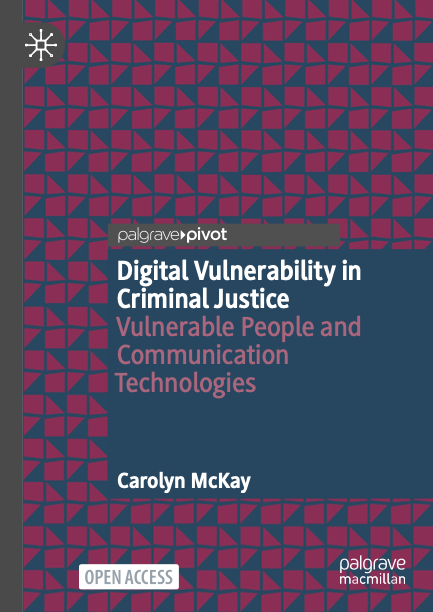
Digital Vulnerability in Criminal Justice: Vulnerable People and Communication Technologies

By Carolyn McKay

This open access book examines the impact of digitalisation processes on fair, accessible and inclusive criminal justice for vulnerable individuals. Based on original empirical data from an Australian Research Council funded national study, the book evaluates digitalised criminal justice, specifically, the increasing use of remote hearings and virtual courts, and the interrelationship with vulnerability. It asks: in what ways do remote communication technologies, such as videolinks, videoconferencing, and pre-recorded evidence, assist or disadvantage vulnerable witnesses, complainants, victims and defendants in the criminal justice system? By interviewing and surveying 175 Australian judicial officers, prosecutors, defence lawyers and affiliated professionals, the book examines the impact of digitalised criminal justice on all vulnerable individuals. Themes include the benefits and challenges to human connection, communication, comprehension and confidentiality, as well as court authority, cross-examination, and emotional expression. While there are certain universal and non-contentious experiences of videolinks, the key practical findings are sharply delineated between vulnerable witnesses versus vulnerable defendants. Theoretically, the book merges digital criminology with vulnerability theories to contribute understandings of ‘digital vulnerability’, that is, the interplay between digital technologies and vulnerable individuals in criminal justice. Digital Vulnerability in Criminal Justice provides critical and contemporary insights, and forward-looking recommendations for ensuring fair digitalised criminal justice into the future.