Open Access Free Library
CRIME+CRIMINOLOGY.jpeg

CRIME

Violent-Non-Violent-Cyber-Global-Organized-Environmental-Policing-Crime Prevention-Victimization

Posts in Stigmatization
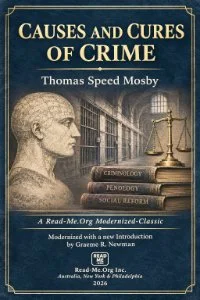
CAUSES AND CURES OF CRIME

By Thomas Mosby (Author), Graeme Newman (Introduction)

n 1913, Thomas Speed Mosby, who had served as Pardon Attorney to Missouri Governor Joseph W. Folk, set out to explain to the general reader why people commit crimes and what society should do about it. Drawing on years of reviewing convicts’ petitions for clemency, and on the leading criminologists of his day, he organized his answer like a medical textbook. Crime was a disease of the social body, to be understood through its causes, its prevention, and its cure.

Part I, Etiology, examines the “cosmic,” social, and individual factors of crime. These range from climate and season to corrupt prosecutors, sensational newspapers, poverty, alcoholism, and Lombroso’s theory of the born criminal. Part II, Prophylaxis, turns to prevention through eugenics, the sterilization laws then spreading across the states, trade education, and social reform. Part III, Therapeutics, traces the history of punishment and argues forcefully against the death penalty. It includes a remarkable state-by-state survey of American parole laws in 1912 and 1913, and closes with a program for “the new penology.”

Causes and Cures of Crime is a vivid record of American criminal justice reform before the First World War. It shows both the movement’s humane ambitions and its dangerous enthusiasms. Its photographic plates of “criminal types,” supplied by the St. Louis and Kansas City police departments, and its illustrations of anthropometric instruments show how early criminologists hoped to read criminality in the human face and body.

This Read-Me.Org Modernized-Classic edition corrects and modernizes the original text while retaining Mosby’s arguments, statistical tables, all fourteen photographic plates, and the text figures. A new introduction by Colin Heston places the book in historical context, including the later discrediting of eugenics and compulsory sterilization. Review and Discussion Questions for each chapter make the edition well suited to courses in criminology, criminal justice history, and the history of social science.

Read-Me.Org Inc. New York-Philadelphia-Australia. 2026. p.207.
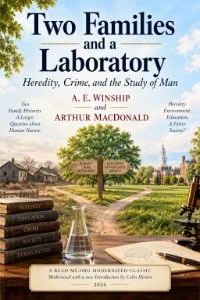
Two Families and a Laboratory: Heredity, Crime, and the Study of Man

A. E. Winship and Arthur MacDonald. Introduction nad Review Questions, Graeme Newman.

Are people born to crime and poverty, or made by their surroundings? This volume brings together two influential American works from the turn of the twentieth century that tried to answer that question.

In Jukes–Edwards: A Study in Education and Heredity (1900), educator A. E. Winship sets the infamous “Jukes” family against the descendants of the great colonial theologian Jonathan Edwards. The Jukes were the subject of Richard Dugdale’s famous study of crime and pauperism. Edwards’s descendants included college presidents, judges, physicians, senators, and a vice-president of the United States. Winship’s vivid portraits, from Sarah Edwards’s household to the troubled brilliance of Aaron Burr, make a case for the combined power of inheritance, training, and education.

In A Plan for the Study of Man (1902), Arthur MacDonald of the U.S. Bureau of Education urges Congress to establish a national laboratory for the scientific study of “the criminal, pauper, and defective classes.” He wanted it to study ordinary people as well. His wide-ranging survey covers anthropometry, measurements of schoolchildren, instruments for gauging sensitivity to heat, touch, and pain, and hypnotism and suggestion. It also takes in the Mafia and the Camorra, alcoholism, moral education, prison reform, and a detailed case history of a young murderer. His original illustrations of laboratory instruments are reproduced.

The new introduction places both works in historical context. It traces their influence on the eugenics movement, the later criticism of their methods, and their surprising anticipation of modern child development and criminological research. Spelling and wording have been modernized throughout, tables have been summarized in prose, and review and discussion questions are included. The book will interest students and general readers in criminology, sociology, education, and the history of science.

Read-Me.Org Inc. New York-Philadelphia-Australia. 2026. p.196.

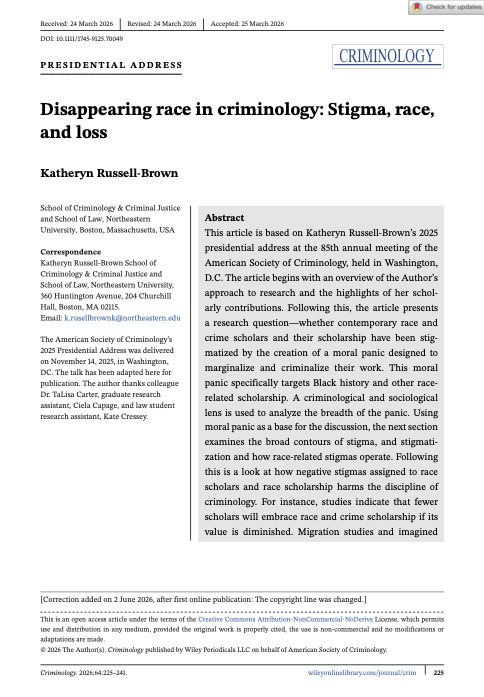
Disappearing race in criminology: Stigma, race, and loss

By Katheryn Russell-Brow

This article is based on Katheryn Russell-Brown's 2025 presidential address at the 85th annual meeting of the American Society of Criminology, held in Washington, D.C. The article begins with an overview of the Author's approach to research and the highlights of her scholarly contributions. Following this, the article presents a research question—whether contemporary race and crime scholars and their scholarship have been stigmatized by the creation of a moral panic designed to marginalize and criminalize their work. This moral panic specifically targets Black history and other race-related scholarship. A criminological and sociological lens is used to analyze the breadth of the panic. Using moral panic as a base for the discussion, the next section examines the broad contours of stigma, and stigmatization and how race-related stigmas operate. Following this is a look at how negative stigmas assigned to race scholars and race scholarship harms the discipline of criminology. For instance, studies indicate that fewer scholars will embrace race and crime scholarship if its value is diminished. Migration studies and imagined futures are included in the assessment of how racial stigmas impact race scholarship. Academic disciplines benefit from rigorous engagement regarding their core principles and perspectives. The absence or diminishment of critical research creates a void in the criminology literature. This raises questions about the representativeness, integrity, and comprehensiveness of criminological scholarship. The article concludes with a charge to the discipline to ensure that race and crime scholarship remain a robust part of the criminological canon.