Open Access Free Library
CRIME+CRIMINOLOGY.jpeg

CRIME

Violent-Non-Violent-Cyber-Global-Organized-Environmental-Policing-Crime Prevention-Victimization

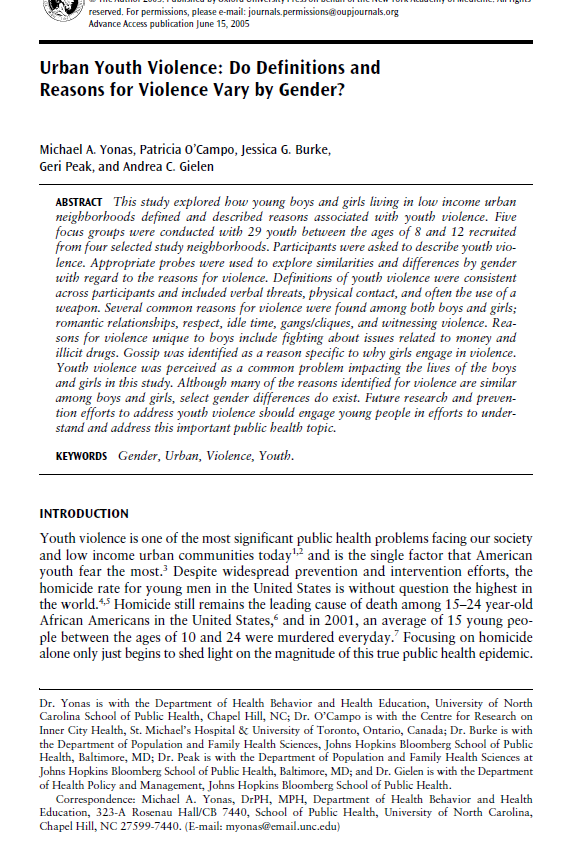
Urban youth violence: Do definitions and reasons for violence vary by gender?

By Michael A Yonas ,, Patricia O’Campo , Jessica G Burke , Geri Peak , Andrea C Gielen 

This study explored how young boys and girls living in low income urban neighborhoods defined and described reasons associated with youth violence. Five focus groups were conducted with 29 youth between the ages of 8 and 12 recruited from four selected study neighborhoods. Participants were asked to describe youth violence. Appropriate probes were used to explore similarities and differences by gender with regard to the reasons for violence. Definitions of youth violence were consistent across participants and included verbal threats, physical contact, and often the use of a weapon. Several common reasons for violence were found among both boys and girls; romantic relationships, respect, idle time, gangs.cliques, and witnessing violence. Reasons for violence unique to boys include fighting about issues related to money and illicit drugs. Gossip was identified as a reason specific to why girls engage in violence. Youth violence was perceived as a common problem impacting the lives of the boys and girls in this study. Although many of the reasons identified for violence are similar among boys and girls, select gender differences do exist. Future research and prevention efforts to address youth violence should engage young people in efforts to understand and address this important public health topic.

J Urban Health

. 2005 Dec;82(4):543–551.

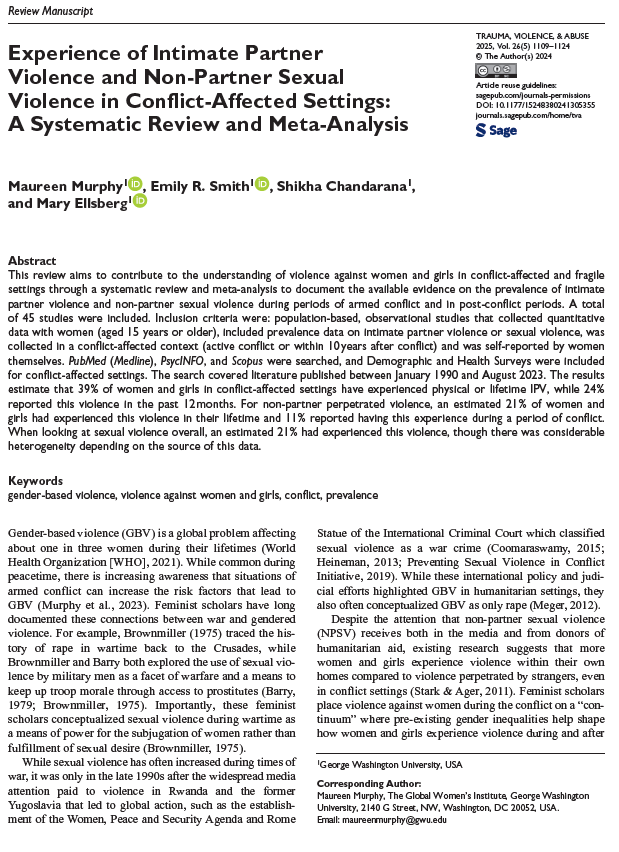
Experience of Intimate Partner Violence and Non-Partner Sexual Violence in Conflict-Affected Settings: A Systematic Review and Meta-Analysis

By Maureen Murphy , Emily R Smith , Shikha Chandarana , Mary Ellsberg 

This review aims to contribute to the understanding of violence against women and girls in conflict-affected and fragile settings through a systematic review and meta-analysis to document the available evidence on the prevalence of intimate partner violence and non-partner sexual violence during periods of armed conflict and in post-conflict periods. A total of 45 studies were included. Inclusion criteria were: population-based, observational studies that collected quantitative data with women (aged 15 years or older), included prevalence data on intimate partner violence or sexual violence, was collected in a conflict-affected context (active conflict or within 10 years after conflict) and was self-reported by women themselves. PubMed (Medline), PsycINFO, and Scopus were searched, and Demographic and Health Surveys were included for conflict-affected settings. The search covered literature published between January 1990 and August 2023. The results estimate that 39% of women and girls in conflict-affected settings have experienced physical or lifetime IPV, while 24% reported this violence in the past 12 months. For non-partner perpetrated violence, an estimated 21% of women and girls had experienced this violence in their lifetime and 11% reported having this experience during a period of conflict. When looking at sexual violence overall, an estimated 21% had experienced this violence, though there was considerable heterogeneity depending on the source of this data.

Trauma Violence Abuse. 2024 Dec 24:

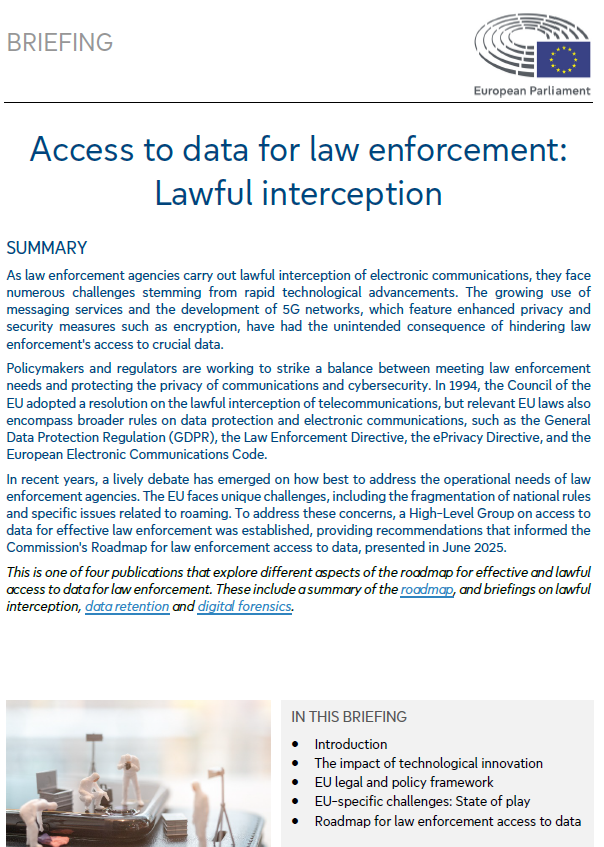
  Access to data for law enforcement: Lawful interception

By Piotr Bąkowski

 As law enforcement agencies carry out lawful interception of electronic communications, they face numerous challenges stemming from rapid technological advancements. The growing use of messaging services and the development of 5G networks, which feature enhanced privacy and security measures such as encryption, have had the unintended consequence of hindering law enforcement's access to crucial data. Policymakers and regulators are working to strike a balance between meeting law enforcement needs and protecting the privacy of communications and cybersecurity. In 1994, the Council of the EU adopted a resolution on the lawful interception of telecommunications, but relevant EU laws also encompass broader rules on data protection and electronic communications, such as the General Data Protection Regulation (GDPR), the Law Enforcement Directive, the ePrivacy Directive, and the European Electronic Communications Code. In recent years, a lively debate has emerged on how best to address the operational needs of law enforcement agencies. The EU faces unique challenges, including the fragmentation of national rules and specific issues related to roaming. To address these concerns, a High-Level Group on access to data for effective law enforcement was established, providing recommendations that informed the Commission's Roadmap for law enforcement access to data, presented in June 2025. This is one of four publications that explore different aspects of the roadmap for effective and lawful access to data for law enforcement. These include a summary of the roadmap, and briefings on lawful interception, data retention and digital forensics.   

Brussels:  EPRS | European Parliamentary Research Service, 2025.

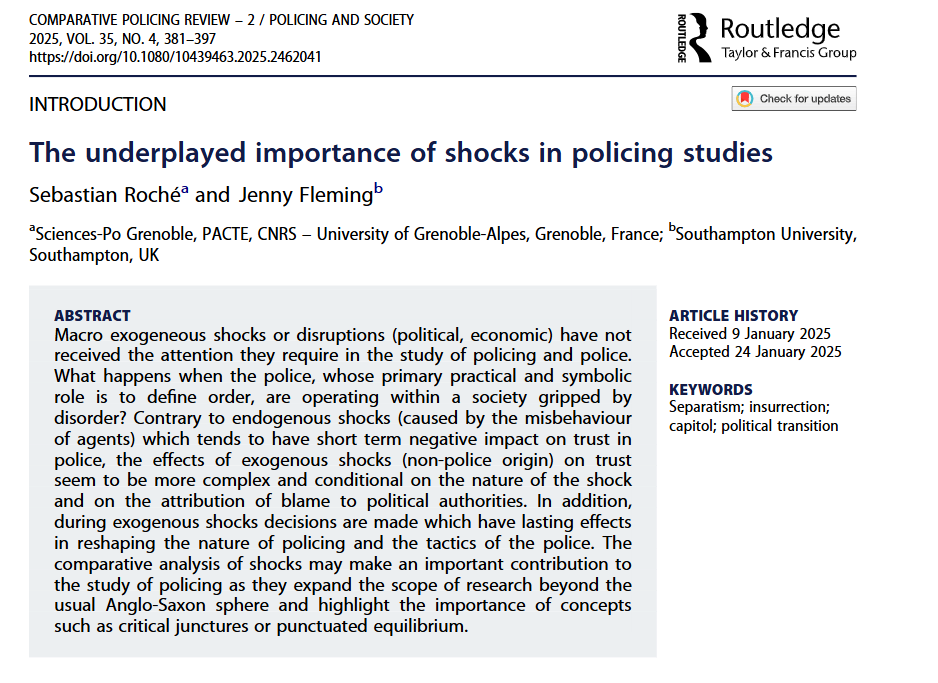
The underplayed importance of shocks in policing studies

By Sebastian Rochéa and Jenny Fleming


Macro exogeneous shocks or disruptions (political, economic) have not received the attention they require in the study of policing and police.What happens when the police, whose primary practical and symbolic role is to define order, are operating within a society gripped by disorder? Contrary to endogenous shocks (caused by the misbehaviour of agents) which tends to have short term negative impact on trust in police, the effects of exogenous shocks (non-police origin) on trust seem to be more complex and conditional on the nature of the shock and on the attribution of blame to political authorities. In addition, during exogenous shocks decisions are made which have lasting effects in reshaping the nature of policing and the tactics of the police. The comparative analysis of shocks may make an important contribution tothe study of policing as they expand the scope of research beyond the usual Anglo-Saxon sphere and highlight the importance of concepts such as critical junctures or punctuated equilibrium


COMPARATIVE POLICING REVIEW – 2 / POLICING AND SOCIETY2025, VOL. 35, NO. 4, 381–397

Examining the Role of Police-Led Diversion in the Youth Crime Decline in Australia: A Macro-Level Longitudinal Analysis

By Molly McCarthy,Shaun McLaws,Troy Allard,Dominique de Andrade & Ben Matthews


While the causes of the international youth crime decline have been disputed, it has been proposed that changing policing responses may have contributed. This study examines whether increased rates of police-led diversion have contributed to the youth crime decline in Australia. Fixed effects panel regressions were undertaken to examine the association between police diversion rates and youth offending prevalence and reoffending across regions in New South Wales and Victoria from 2005 to 2019. A significant decline in youth offending prevalence in this period was found but also a decline in police diversion rates for young people, and there was a lack of association between diversion rates and youth offending prevalence. In contrast, youth reoffending increased during this period. Notably, regions with higher diversion rates had significantly lower levels of youth reoffending. Findings suggest that police-led diversion is unlikely to have played a primary role in the Australian youth crime decline but may have reduced growth in reoffending in regions where it was used more frequently. Findings also indicate that youth offending declines have been socioeconomically conditioned. Implications for the causes of the youth crime decline and policing responses to young people are discussed.


VICTIMS & OFFENDERS

Esmeralda Martinez
Pennsylvania State Police Traffic Stop Study January 1 – December 31, 2024

By Robin S. Engel, Jennifer Calnon Cherkauskas

The 2024 Annual Report of the Pennsylvania State Police (PSP) Traffic Stop Study presents a comprehensive analysis of member-initiated traffic stops conducted between January 1 and December 31, 2024. It continues a multi-year initiative to collect, audit, and analyze traffic stop data. In 2021, the Pennsylvania State Police (PSP) revitalized its effort to collect traffic stop data This initiative builds on a voluntary traffic stop data collection system created by the PSP twenty-five years ago in partnership with the current research team, which was operational from 2001 to 2010 and served as a national model for traffic stop data collection (Engel & Cherkauskas, 2022). The report provides a detailed breakdown of traffic stop characteristics and outcomes at the department level, as well as across PSP’s four Areas, 16 Troops, and 89 Stations. PSP’s voluntary data collection and analysis align with best practices, showcasing its commitment to transparency and accountability to its communities and reinforcing its dedication to evidence-based policing practices. The objectives of the traffic stop data collection and analysis are to: (1) identify patterns and trends in traffic stops and their outcomes, specifically documenting any racial/ethnic disparities; (2) utilize data analysis to promote effective and fair law enforcement practices that enhance public and traffic safety; (3) foster public trust through transparent documentation of traffic stop data and findings; (4) identify opportunities for improvement in PSP policies, training, and supervisory oversight concerning traffic stops. 

Harrisburg: Pennsylvania State Police, 2025. 139p.

Body-Worn Camera Model Policy

By The New York State Division of Criminal Justice Services

  The Body-Worn Camera Model Policy is intended to allow for the individual needs of each of the police departments in New York State regardless of size or resource limitations. Law Enforcement are encouraged to customize these protocols to meet their regional needs, while being mindful of the intent of the policy. As with all model policies adopted by the Municipal Police Training Council (MPTC), this policy is non-binding upon agencies within New York State and is meant to serve as a guide to be used in developing a department’s individual policy. The Municipal Police Training Council (MPTC) approved an updated version of the model policy in June 2025.    

Albany: NYSCJS, 2025. 15p.

Policing in an online world - relevance in the 21st century,

By Europol, Innovation Lab


This report from Europol's Innovation Lab explores how the police can adapt to the increasingly digital lives of European citizens. Online worlds are increasingly perceived as lawless, and while community police officers play a key role in the physical world, community policing equivalents are often in their infancy or absent in virtual worlds.

Discover an overview of online policing principles and current initiatives across Europe, including case examples from specific countries to facilitate learning for similar initiatives


Publications Office of the European Union, Luxembourg, 2025. 21p.

Investigation of the Lexington Police Department and the City of Lexington, Mississippi

By The  United States Department of Justice Civil Rights Division and United States Attorney’s Office For the Southern District of Mississippi

  • Hours after the Department of Justice announced its investigation of the Lexington Police Department (LPD) on November 8, 2023, officers chased a Black man through a field and tased him nine times. The man began foaming at the mouth. One officer pointed to a Taser probe lodged in the man’s hat and said, “Damn, one of my probes hit him in the head.” The man, who has a behavioral health disability, had been accused of disturbing a business. This was not the man’s first encounter with LPD. Earlier that year, LPD officers had jailed him for ten days for trespassing; four days for stealing a cup of coffee; and twelve days for stealing packets of sugar. Each time they arrested him, LPD unlawfully refused to release the man until he paid money towards old fines and fees he owed from misdemeanors and traffic tickets. But each arrest added more fines and fees to the ledger. By November 2023, the man— who has no job, no assets, and no bank account—owed more than $7,500. In encounter after encounter with the man, LPD violated his rights. But like countless people in Lexington, the man had little recourse. Through a combination of poor leadership, retaliation, and a complete lack of internal accountability, LPD has created a system where officers can relentlessly violate the law. FINDINGS The Department of Justice has reasonable cause to believe that the City of Lexington and the Lexington Police Department engage in a pattern or practice of conduct that deprives people of their rights under the Constitution and federal law. Specifically, we find that LPD unlawfully: • Arrests, jails, and detains people who cannot pay fines or fees, without assessing their ability to pay; • Uses excessive force; • Conducts stops, searches, and arrests without probable cause, including jailing people on illegal “investigative holds” and arresting people solely because they owe outstanding fines; • Imposes money bail without justification or assessment of ability to pay; • Jails people without prompt access to court; • Violates the rights of people engaged in free speech and expression, including by retaliating against people who criticize the police; • Discriminates against Black people; and • Operates under an unconstitutional conflict of interest because LPD’s funding depends on the money it raises through its enforcement. 

Washington, DC: U.S. Department of Justice 2024. 42p.

Factors influencing the spatial distribution of police stops and their efficacy in crime prevention and control

By Zhuoying Fan, Xuewei Zhang, Guangwen Song &Chunxia Zhang 

  • Targeted police stops are frequently carried out by police in response to real-world needs. The effectiveness of various purpose-driven police stop tactics on crime prevention and control varies. However, existing research has neither identified the associated factors of police stops nor explored their impact on crime with different factors. Therefore, this study focuses on the main urban areas of megacities along the southeast coast of China. The space is partitioned using hierarchical clustering after applying the XGBoost and SHAP algorithms to determine the factors related to police stops. Lastly, this study explores the causal effects of police stops with different associated factors on crime, using causal forests within double machine learning. There are three conclusions. First, there is a strong correlation between police stops and four variables: alarm, visiting population, criminal, and government agencies. Second, by clustering based on different associated factors of police stops, existing police stops can be classified into five categories according to their purposes: (i) composite stops positively associated with “Alarm, Visiting Population, Criminals” (AVC-CPS); (ii) composite stops positively associated with “Alarm, Visiting Population, Bus Station” (AVB-CPS); (iii) random stops with no significant positive association (NA-RPS); (iv) single police stops positively associated with “Alarm” (A-SPS); and (v) single stops positively associated with “Visiting Population” (V-SPS). AVC-CPS corresponds to the highest number of grids in the study area. Third, the influence of police stops on crime varies significantly depending on the factors that are associated with them. Among all categories, AVC-CPS has the best overall inhibitory effect on crime, while single police stops and random police stops have minimal or insignificant effects. In summary, the conclusions of this study can provide a basis for optimizing the spatial deployment of police forces, aiming to improve the effectiveness of stop operations and crime prevention and control capabilities.

    • Humanit Soc Sci Commun 12, 1026 (2025)

Police Misconduct: Combatting the Complicity Crisis

By Eric Arnold

This Comment explores the current state of police reform in the city of Chicago, with a special focus on the various oversight agencies currently in force. Chicago has a long history of police misconduct, and the city has tried to make changes over the years to restore the community’s trust in policing. The police reform movement became especially prevalent in recent years following the fatal shooting of Laquan McDonald by a Chicago Police Officer in 2014. This Comment will show why the current mechanisms in place are insufficient to bring the needed change to the Chicago Police Department, and that the Chicago Police Department has shown time and time again they are unable to police themselves. While there have been some effective changes to the city’s policing efforts in recent years, considerable room for improvement remains.

This Comment will evaluate some of the recent measures taken to change the Chicago Police Department, specifically looking at measures targeted at changing the culture of the Chicago Police Department by increasing transparency and accountability. These measures include mandatory body-camera footage and a ban on officers being affiliated with extremist groups. This Comment will explore and evaluate the effectiveness of these changes and how they could be further enhanced. This Comment will also propose additional solutions that Chicago could consider to increase police accountability and transparency and thus improve overall officer performance. This includes using more objective tools to measure police officers’ day to day performance, which can be done using tools similar to those being used in New Orleans and in Miami. This Comment will conclude with additional policy considerations and measures for enforcement, specifically focusing on ways to incentivize more responsible policing.

 115 J. Crim. L. & Criminology 205 (2025).

AUDITING CRIMINAL JUSTICE MINIMALISM

By Trevor George Gardner

 If criminal justice minimalism is a shared principle among criminal law scholars, it can help to clarify the quality of our disagreements. Every normative proposal in the criminal legal literature can be held to the minimalist standard—audited, so to speak, to account for the policy author’s minimalist claims. To this end, this Essay proposes a four-step framework by which to evaluate adherence to the minimalist principle, where each step serves as a hub for pointed scholarly debate regarding the path to minimalist criminal justice.


Washington University Journal of Law and Policy, 2025

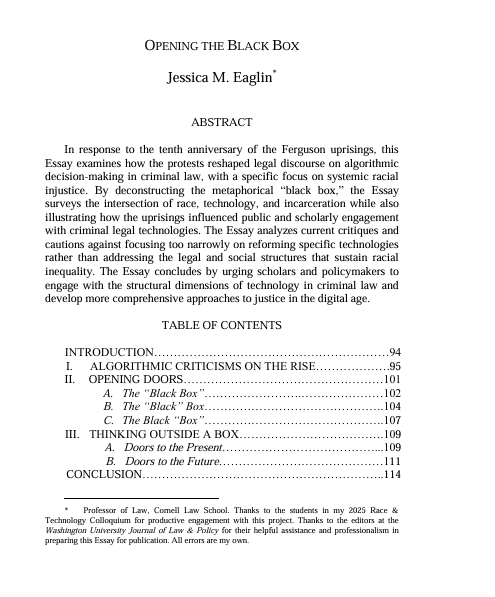
OPENING THE BLACK BOX

By Jessica M. Eaglin 

 In response to the tenth anniversary of the Ferguson uprisings, this Essay examines how the protests reshaped legal discourse on algorithmic decision-making in criminal law, with a specific focus on systemic racial injustice. By deconstructing the metaphorical “black box,” the Essay surveys the intersection of race, technology, and incarceration while also illustrating how the uprisings influenced public and scholarly engagement with criminal legal technologies. The Essay analyzes current critiques and cautions against focusing too narrowly on reforming specific technologies rather than addressing the legal and social structures that sustain racial inequality. The Essay concludes by urging scholars and policymakers to engage with the structural dimensions of technology in criminal law and develop more comprehensive approaches to justice in the digital age.

Washington University Journal of Law and Policy, Volume 78 • Issue 1 • 2025 

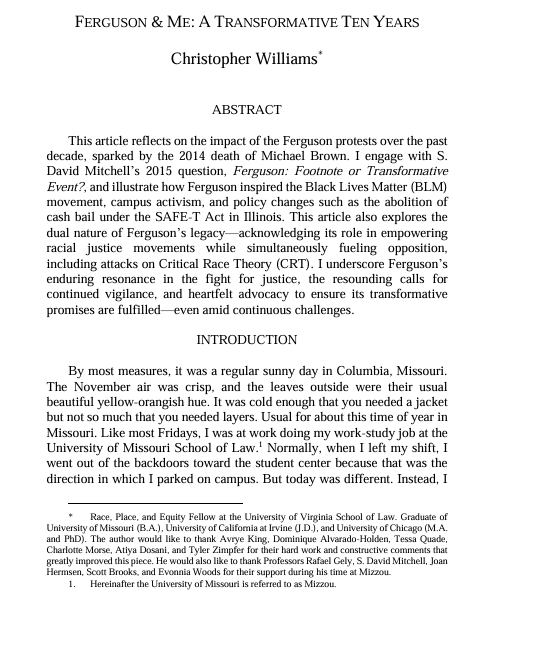
FERGUSON & ME: A TRANSFORMATIVE TEN YEARS

By Christopher Williams

 This article reflects on the impact of the Ferguson protests over the past decade, sparked by the 2014 death of Michael Brown. I engage with S. David Mitchell’s 2015 question, Ferguson: Footnote or Transformative Event?, and illustrate how Ferguson inspired the Black Lives Matter (BLM) movement, campus activism, and policy changes such as the abolition of cash bail under the SAFE-T Act in Illinois. This article also explores the dual nature of Ferguson’s legacy—acknowledging its role in empowering racial justice movements while simultaneously fueling opposition, including attacks on Critical Race Theory (CRT). I underscore Ferguson’s enduring resonance in the fight for justice, the resounding calls for continued vigilance, and heartfelt advocacy to ensure its transformative promises are fulfilled—even amid continuous challenges.

  Washington University Journal of Law and Policy, Volume 78 • Issue 1 • 2025 

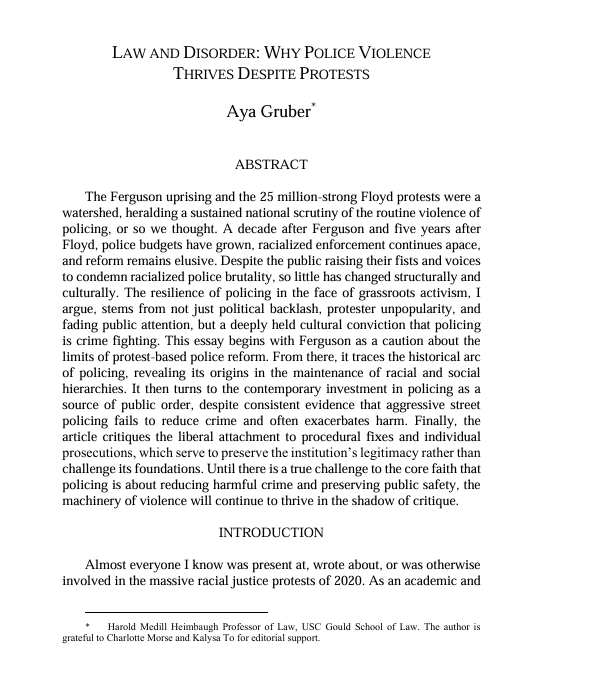
LAW AND DISORDER: WHY POLICE VIOLENCE THRIVES DESPITE PROTESTS

By Aya Gruber

The Ferguson uprising and the 25 million-strong Floyd protests were a watershed, heralding a sustained national scrutiny of the routine violence of policing, or so we thought. A decade after Ferguson and five years after Floyd, police budgets have grown, racialized enforcement continues apace, and reform remains elusive. Despite the public raising their fists and voices to condemn racialized police brutality, so little has changed structurally and culturally. The resilience of policing in the face of grassroots activism, I argue, stems from not just political backlash, protester unpopularity, and fading public attention, but a deeply held cultural conviction that policing is crime fighting. This essay begins with Ferguson as a caution about the limits of protest-based police reform. From there, it traces the historical arc of policing, revealing its origins in the maintenance of racial and social hierarchies. It then turns to the contemporary investment in policing as a source of public order, despite consistent evidence that aggressive street policing fails to reduce crime and often exacerbates harm. Finally, the article critiques the liberal attachment to procedural fixes and individual prosecutions, which serve to preserve the institution’s legitimacy rather than challenge its foundations. Until there is a true challenge to the core faith that policing is about reducing harmful crime and preserving public safety, the machinery of violence will continue to thrive in the shadow of critique

Washington University Journal of Law and Policy, Volume 78 • Issue 1 • 2025 

Third-Party Policing A Randomized Field Trial to Assess Drug Crime Reduction and Police-Hotel Partnerships

By Jeremy D. Barnum., Kevin D. Lucey,  Meagan E. Cahill,  William H. Sousa, 

  Illicit drug use is a significant problem in the United States, driven in large part by the opioid crisis. In 2023, the nation reported 107,543 drug overdose deaths, with more than 80,000 deaths involving an opioid. Stimulants have also become a growing problem; in 2023, more than 36,000 overdoses involved a psychostimulant, and nearly 30,000 involved cocaine (CDC 2024). Law enforcement is a crucial piece of the broader response to the drug crisis (PERF 2021). Proactive police interventions that leverage problem-solving and involve partnerships with community stakeholders offer the most substantial evidence of effectiveness (Mazerolle, Soole, and Rombouts 2007). One strategy to reduce drug problems is third-party policing (TPP). TPP involves police efforts to persuade or coerce nonoffending third parties (landlords, business owners, etc.) to take on more responsibility for addressing crime and disorder at or around their premises (Mazerolle and Ransley 2006). Typically, police begin by seeking voluntary cooperation of third parties by sharing information with them about specific problems, educating third parties on ways to prevent problems, or providing support to third parties to make changes. When third parties resist collaborative efforts, police may use coercive approaches, such as warnings, property inspections, or enforcement of civil remedies (Bichler, Schmerler, and Enriquez 2013; Eck and Wartell 1998; Mazerolle and Roehl 1998b). The study This report describes a randomized controlled evaluation of a TPP intervention implemented in Anne Arundel County, Maryland. The intervention, called Operation CheckOut, aimed to reduce drug problems at hotel s and motels by fostering trusted partnerships between police and hotel staff. Officers from the Anne Arundel County Police Department (AACOPD) conducted four in-person visits between August 2022 and May 2023 to a randomly selected group of hotels. During in-person visits, officers engaged in a scripted procedural justice dialogue with hotel managers, delivered educational materials, identified legal responsibilities, and provided a dedicated email address that functioned as a “tip line” to report problems or suspicious activity directly to the Operation Check-Out team. The intervention was designed as a partial replication of Operation Galley, a TPP intervention   implemented by the Queensland (Australia) Police Service in 2017 (Mazerolle et al. 2018). The goal of the intervention was to bolster intelligence, investigations, and enforcement actions; reduce crime and disorder; and improve perceptions of police. Key findings Outcome analysis Calls for service data were analyzed to determine the impact of Operation Check-Out on four outcomes: (1) drug activity, (2) sick persons (e.g., overdoses), (3) disorder, and (4) violence. Average monthly calls for service for each outcome were compared among hotels in the treatment and control groups during the pre-intervention period, during the intervention period, and during the post-intervention period. Three findings were significant: 1. Calls reporting drug activity were lower at treatment hotels during the post-intervention period than during the pre-intervention or intervention periods. 2. Calls reporting sick persons were lower at treatment hotels during the post-intervention period than during the pre-intervention or intervention periods. 3. Calls reporting disorder were higher at treatment hotels during the intervention period than during the pre-intervention or post-intervention periods. That there were significantly fewer drug activity calls at treatment hotels following Operation Check-Out than there had been before is encouraging, as the intervention was specifically designed to mitigate drug problems. Reducing drug activity reduces the need for hotel staff to call 911. Also, as part of their efforts to build rapport with hotel management, officers often provided their direct work lines—allowing management to call specific officers familiar with their facility and problems instead of the generic 911 line. That there were significantly fewer sick person calls at treatment hotels during the postintervention period than during the pre-intervention or intervention periods further supports the idea that Operation Check-Out reduced drug activity during the intervention period with impacts realized during the post-intervention period. Given less drug activity, fewer overdoses would be expected. Finally, the finding that there were more disorder calls at treatment hotels during the intervention period than during the pre-intervention or post-intervention periods is somewhat unexpected, as fewer disorder calls would be expected in an environment with greater cooperation, enforcement, and police presence. One plausible explanation is that hotel staff were more willing to contact the police as a result of Operation Check-Out because, for example, they may have felt they had a supportive partner in addressing issues at their hotel, or they may have understood that the intervention involved repeated visits and become concerned about bringing trouble to the hotel if they failed to report problems to police.

Washington, DC: Police Executive Research Forum, 2025. 103p.

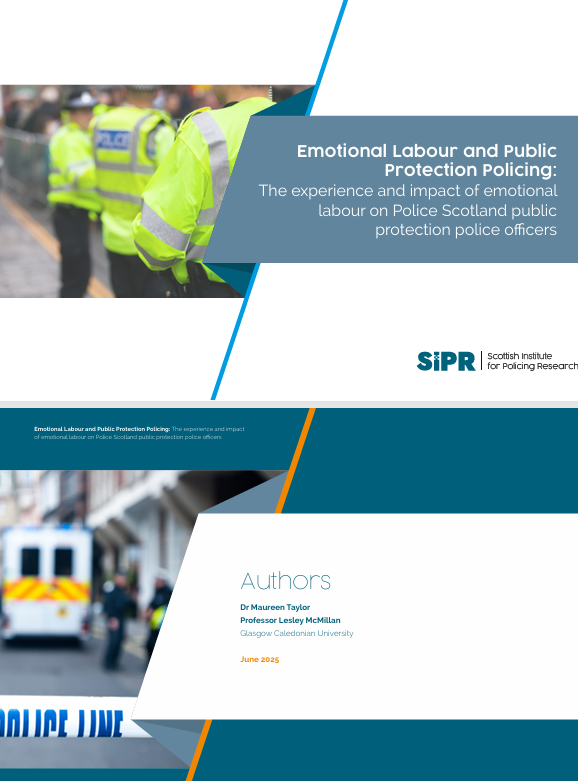
Emotional Labour and Public Protection Policing: The experience and impact of emotional labour on Police Scotland public protection police officers

By Maureen Taylor ahd Lesley McMillan 

  There is a significant body of research that illustrates the emotional demands of policing and the physical and psychological toll this takes on officers and staff. However, the management of these demands, particularly in more specialist roles such as those in public protection policing where the demand may be higher, are less well understood. This research explores the experiences of public protection police officers in Police Scotland through a lens of emotional labour..  The aims of this research were to: • Critically review the literature around the emotional impacts of policing on officers and the role of emotional labour in policing; • Establish the experience of, and impact on, officers involved in the investigation of public protection cases; assess how police officers in roles where emotional labour may be heightened, manage their emotions and the strategies they develop to do so; and • Examine how emotions and emotion management are mediated by organisational, departmental and role values, demands and culture In doing so, the research sought to answer the following research questions: 1. What is the emotional experience of police officers in public protection roles and what impact does it have on them? 2. What emotional labour do officers undertake, and what strategies of emotion management do officers employ? 3. To what extent does the theory of emotional labour explain the experiences of public protection police officers? 4. What role does the prevailing organisational culture play in the emotion management strategies of public protection policing? This report presents the findings from this research and a potential framework for understanding the factors that contribute to resilience within the context of public protection policing    

Edinburgh: Scottish Institute for Policing Research 2025. 32p.   

Improving Policing and Public Safety: Problems Presented by Police and Vehicle Pursuits

By Letitia James

  Every day, millions of New Yorkers take to the roads. They deserve traffic safety and policing that is fair and effective. This report describes some of the harms that can arise from police vehicle pursuits and high-speed vehicle chases and proposes reforms to help keep New Yorkers safe. Police chases have been shown to increase danger and result in injury or fatalities to drivers, passengers, bystanders, and police. We offer the following recommendations: Pass legislation to increase transparency New York law enforcement agencies should be required to track and publish a standardized set of data about traffic pursuits and high-speed chases. This should be facilitated by a centralized agency such as the Division of Criminal Justice Services (DCJS). Ban high-speed police pursuits, with very narrow exceptions High-speed chases can be deadly. Chases may be necessary when a serious or violent felony has been or will be committed, and when the driver’s conduct poses an imminent threat of death. But, in large part, ordinary speeding or minor traffic infractions should not lead to a high-speed, dangerous chase.  

Albany:  Office of the New York State Attorney General Letitia James, 2025. 11p.

Police Use of Force Policies Across America

Regulations from 100 Cities, Post-Floyd Policy Reforms, and Revisiting Constitutional Standards

By Dan Sutton, Fatima Dahir

Five years after George Floyd’s killing sparked unprecedented demands for police reform, questions persist about the changes that have—and haven’t—been made to American policing. Many Americans may be surprised to learn that policing rules vary significantly across jurisdictions, with stark differences in how officers are permitted to use force. One city may require officers to try de-escalating a traffic stop before using any force, while another city may permit officers to immediately draw their weapons without attempting alternatives.

The post-Floyd reform movement has produced a complex landscape of change: departments have largely converged on reforms like chokehold bans and requiring officers to intervene against excessive force, but they remain deeply divided on fundamental questions of when and how force should be used. Our study, which we believe represents the largest systematic analysis of American force regulations to date, examines 22 distinct policy dimensions across the nation’s 100 largest cities, comprising 2,200 total regulations collected through 2023. See Figure 1. This research was motivated by the troubling and well-documented relationship between race and police violence and the ongoing need to address systemic issues at the intersection of race, policy, and use of force.

Palo Alto, CA: Stanford Center for Racial Justice, 2025. 34p.By Dan Sutton, Fatima Dahir

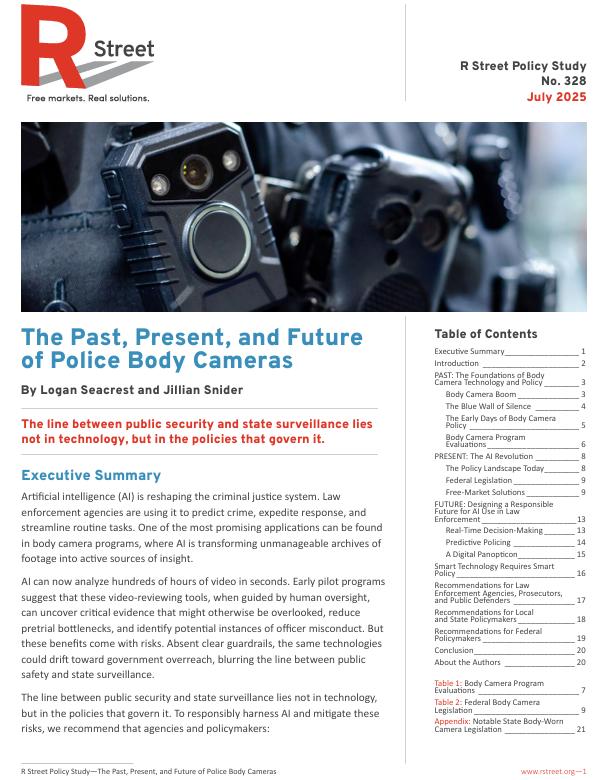
The Past, Present, and Future of Police Body Cameras

By Logan Seacrest and Jillian Snider

Artificial intelligence (AI) is reshaping the criminal justice system. Law enforcement agencies are using it to predict crime, expedite response, and streamline routine tasks. One of the most promising applications can be found in body camera programs, where AI is transforming unmanageable archives of footage into active sources of insight. AI can now analyze hundreds of hours of video in seconds. Early pilot programs suggest that these video-reviewing tools, when guided by human oversight, can uncover critical evidence that might otherwise be overlooked, reduce pretrial bottlenecks, and identify potential instances of officer misconduct. But these benefits come with risks. Absent clear guardrails, the same technologies could drift toward government overreach, blurring the line between public safety and state surveillance. The line between public security and state surveillance lies not in technology, but in the policies that govern it. To responsibly harness AI and mitigate these risks, we recommend that agencies and policymakers: • Establish and enforce clear use policies. Statewide rules for body camera use and AI governance ensure consistency across jurisdictions, particularly in areas like body camera activation, evidence sharing, and public disclosure. • Pair technology with human oversight. AI should enhance—not replace—human decision-making. Final judgments must rest with trained personnel, supported by independent policy oversight from civilian review boards. • Safeguard civil liberties. Safeguards must be in place to protect individual rights, limit surveillance overreach, and ensure data transparency. For example, limiting facial recognition during constitutionally protected activities like protests will help ensure AI is aligned with democratic ideals. With the right guardrails in place, AI can elevate body cameras from afteraction archival tools to always-on intelligence tools, informing decisions in the moment, when it matters most. 

R Street Policy Study No. 328 

Washington, DC: R Street, 2025. 25p.