Open Access Free Library
CRIME+CRIMINOLOGY.jpeg

CRIME

Violent-Non-Violent-Cyber-Global-Organized-Environmental-Policing-Crime Prevention-Victimization

Posts in Human Rights
“A Long, Long Way To Go” An Assessment of the Metropolitan Police at the Commissioner’s Mid-Term 

By David Spencer

Summary of Recommendations 1. Given the very poor performance of the Metropolitan Police across a wide range of areas for an extended period – including prior to the present Commissioner’s term of office and particularly in relation to the fight against crime – the Home Secretary should become the “policing body” for the Metropolitan Police. This would remove the Mayor of London’s role in relation to oversight of policing in the capital. Shifting direct political oversight to the Home Secretary, as the minister principally responsible to Parliament for policing and crime, will enable both Government and Parliament to exercise far greater scrutiny and influence over the force’s performance in a way which has the potential to deliver the significant improvements which are required. 2. To enable the Metropolitan Police to shift the force’s principal focus to local crime fighting, the Government should transfer responsibility for the national leadership of the police counterterrorism network from the Metropolitan Police to a national Counter-Terrorism Policing body led by a Chief Constable. 3. The Chief Inspector of Constabulary should return the Metropolitan Police to the “Engage” process – more commonly known as “Special Measures”. The force was, based on performance across several areas, erroneously removed from the “Engage” process inmore commonly known as “Special Measures”. The force was, based on performance across several areas, erroneously removed from the “Engage” process in January 2025. There should be a presumption that all materials relating to the “Engage” process should be made publicly available. The current lack of transparency provides the public with little confidence that the necessary steps are being taken to deliver substantial improvements in the force’s performance. 4. The Home Secretary should order an inspection of the Metropolitan Police’s approach to protest policing using section 54 (2B) Police Act 1996. This should include consideration of both the strategic approach and operational tactics used, including what new strategies and tactics are required to more effectively deal with large-scale and widespread protests. This should consider the strategies and approaches used in other jurisdictions to determine what might be learned and adopted by the force – in particular the willingness of police chiefs to use non-human based means of “creating distance” between officers and protestors. 5. The Commissioner of the Metropolitan Police should review the performance of his most senior leaders and where individuals have been found to have failed to perform to the necessary standard, in some cases over very long periods, they should be replaced at the earliest opportunity. There should also be a substantial change in the approach to performance management for middle and senior leaders in the organisation – including being prepared to more willingly remove officers and staff who fail to deliver the necessary levels of performance, particularly in relation to fighting crime. Data should be published on every senior officer’s performance on crime-fighting throughout their leadership career. There should be a substantial increase in the transparency of the force’s Frontline Policing performance meetings, where local police commanders are questioned on their performance. This should include the publication of performance data, the publication of the meeting’s minutes and the option for members of the public to attend these meetings through online hosting. 

London: Policy Exchange, 2025. 52p.
Automated License Plate Readers in Iowa: Review and Recommendations - ACLU of Iowa

By Mia Savicevic and Ethan Miner

This report is a focused look at the growing use of automated license plate readers (ALPRs) by law enforcement agencies across Iowa—a surveillance tool that poses serious risks to Iowans’ privacy and civil liberties. ALPRs are not speed cameras. They are not “red light” cameras. Instead, they are cameras used along roadways throughout Iowa that quickly take thousands of snapshots of license plates as vehicles drive by. That information can then be fed into a network of nationally shared databases that has too few privacy protections and is subject to abuse. More details about ALPRs generally can be found on the ACLU of Iowa website. Unlike other traffic cameras, ALPRs aren’t activated because you violated a law. They record you and every other person who drives by, simply to build a database of vehicle information. ALPRs can take hundreds of photos in a matter of minutes. And unlike ordinary surveillance cameras, where data is either not shared or shared in a more limited manner, the main purpose of ALPRs is to feed this information into a database. To investigate how this technology is being used, the ACLU of Iowa engaged the Technology Law Clinic at the University of Iowa College of Law to conduct independent research on the use of ALPRs in Iowa. We sent open records requests to a broad cross-section of 48 law enforcement agencies across the state, to larger towns, to smaller communities, and to Iowa’s college towns. The study was not comprehensive of all ALPRs in Iowa. Of the 48 agencies that were selected, 5 did not respond to our records request before publication: the Des Moines Police Department, the Clinton Police Department, the Fayette Police Department, the Fremont Police Department, and the Mills Police Department.While researching this project, the clinic also identified agencies (see Appendix D) that have accessed other Iowa cities’ or counties’ ALPR databases, whether they have their own ALPRs or not.

Technology Law Clinic at the University of Iowa College of Law and ACLU of Iowa, 2025. 63p.


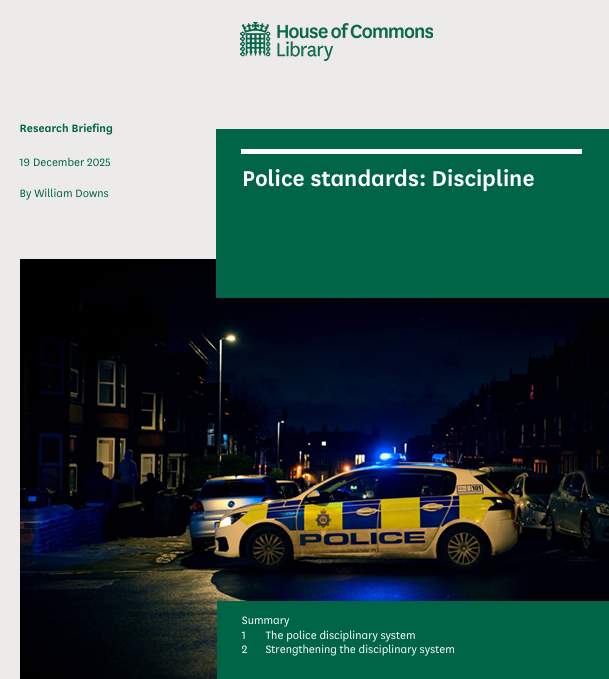
Police standards: Discipline 

By William Downs

Police disciplinary proceedings are brought in cases where it is agreed, following an investigation, that a police officer has a case to answer for: • misconduct (meaning a breach of the standards of professional behaviour that justifies disciplinary action of at least written), or • gross misconduct (meaning a breach of the standards of professional behaviour that is so serious to justify dismissal) A decision on whether there is a case to answer is based on whether there is sufficient evidence upon which a misconduct panel “could make a finding on the balance of probabilities” that an officer’s behaviour amounted to misconduct or gross misconduct. The Commons Library briefings Police standards: Complaints and Police Standards: Conduct explain in more detail how allegations of police wrongdoing are investigated.

London: UK Parliament. House of commons Library.. 2025. 19p.

‘Dealing With People as We See Fit’: Framing Police Decisions to (and not to) Arrest in the COVID‐19 Pandemic

By Camilla De Camargo, Fred Cram

The advent of the COVID-19 pandemic required police officers in England and Wales to enforce new public health restrictions (e.g., stay-at-home directives, social distancing requirements and mask mandates), as well as navigate the risk that COVID-19 posed to their own health and safety during interactions with the public. From a practical standpoint, these factors changed the nature of the policing task significantly, with previously routine police decision-making (e.g., whether or not to carry out stops, searches, arrests and/or detentions) necessarily responding not only to traditional concerns around suspicion and evidence but also directly to these novel legal and organisational challenges. Findings from interviews carried out in 2020 and 2022 with 18 police officers from 11 different forces in England and Wales suggest that well-established predictors of arrest decisions (e.g., offence severity, evidence and/or the pursuit of culturally orientated objectives) were disrupted due to broader considerations, uniquely related to the COVID-19 pandemic. This article uses Keith Hawkins’ (2002) conceptual framework of criminal justice decision-making—surround, field and frame—as an explanatory device to help us understand arrest and non-arrest decisions of street-level police officers during this period, despite the existence of sufficient evidence to support such action.

The Howard Journal of Crime and Justice Volume 64, Issue 3 Sep 2025 Pages 277-417

Forced Migration and Humanitarian Action: 

Operational Challenges and Solutions for Supporting People on the Move

By Guadagno, Lorenzo (editor), Robles, Lisette R. (editor)

Forced population movements are a defining feature of almost any humanitarian crisis, shaping the design, targeting, and delivery of emergency responses. This book investigates how the evolving situation of different forced migrants is accounted for and addressed in humanitarian action in order to improve their access to support and assistance. Bringing together case studies from Africa, Asia, Europe, and the Pacific, this book focuses on a diversity of operational modalities and types of assistance provided by both traditional and non-traditional humanitarian actors to address the specific needs of displaced children, women, people with disabilities and older people, as well as trafficked migrant workers. This book adopts a broad perspective on humanitarian action, acknowledging how its boundaries are challenged and expanded in forced migration contexts. Its operational and theoretical insights will be useful for a range of readers, from humanitarian and migration researchers and students to practitioners and policymakers.

London: Routledge, 2026. 

From Border-Based to Status-Based Mandatory Detention

By Mary Holper

The United States once authorized only border-based mandatory detention. However, immigration detention is now like an enormous fortress that has grown two mandatory detention turrets: status-based mandatory detention and crime-based mandatory detention. Status-based mandatory detention sees its only doctrinal foundations in the detention of those physically standing at the border. Yet, it has grown to reach both physically and temporally beyond those stopped at the border. Status-based mandatory detention first grew to include those stopped within 100 miles of a land border and under fourteen days in the U.S., whom immigration enforcement agents placed in expedited removal. Then, status-based mandatory detention grew further to include those stopped anywhere in the U.S. and under two years in the U.S., whom immigration enforcement agents placed in expedited removal. Most recently, status-based mandatory detention has grown to include persons who entered the U.S. at any time and whom immigration enforcement agents never placed in expedited removal. 
This article documents each of the blocks that have been placed in the massively-growing turret of status-based mandatory detention, and analyzes the strength of each block to hold up the turret. The article argues that broad status-based detention is inconsistent with the intent of Congress in passing what traditionally has been border-based mandatory detention. Under principles of statutory interpretation, this excessively large status-based mandatory detention turret cannot hold up.

Boston College Law School Legal Studies Research Paper No. 65653 Fordham Urb. L. J. ___ (forthcoming 2026)44 Pages Posted: 16 Aug 2025 Last revised: 9 Sep 2025

Understanding Intimate Partner Violence

By Lisa Blaydes, James D. Fearon, and Mae MacDonald

Violence against women occurs at high rates in societies across the world. The most common form is intimate partner violence, abuse perpetrated against a spouse or intimate relationship partner. We present a household bargaining model that seeks to clarify causal mechanisms and to identify key pathways by which economic, political, legal, and cultural factors external to households influence domestic abuse rates, gender equity within relationships, and rates of relationship dissolution. We relate key parameters to factors that differ across societies and over time, including economic opportunities for women, laws that criminalize domestic abuse, and social norms associated with gender equality. We review research associated with these topics to establish what we know and do not know about violence against women in households. While much of this literature is outside of the field of political science, we highlight opportunities for political scientists to contribute to our understanding of how and why domestic violence persists in the world today.

Annu. Rev. Political Sci. 2025. 28:351–74

Oppression Beyond Plantations: How Emancipation Led to Incarceration in Urban Buenos Aires

By Valentín Figueroa and Guadalupe Tuñón

We show that the emancipation of enslaved Black people led to their subsequent incarceration in a context of urban slavery —a context that lacked the economic incentives for incarceration present in plantation economies such as the U.S. South. To establish causality, we study a lottery of certificates of freedom in nineteenth-century Buenos Aires that randomly freed a small group of enslaved persons. Through archival research and digitization of the full count of the handwritten 1810 census, we link lottery winners and sets of eligible nonwinners to police records until 1830. We find that emancipation increased the probability of incarceration, on average, by 11.8 percentage points. Exploring mechanisms, we find no evidence that the e↵ect was driven by rural labor shortages, bur rather by the criminalization of petty offenses..

Peinxwron, NJ: Princeton University,

Liechtenstein Institute on Self-Determination.

2023. 49p.

Electric-Shock Weapons, Tasers and Policing: Myths and Realities

By Abi Dymond

Building on five years of research, and drawing on criminology, science and technology studies (STS), socio-legal studies and social psychology, this book is the first non-medical book written on electric-shock weapons, of which the best well known is the TASER brand. The police’s ability to use force is one of their most crucial powers, yet one that has been relatively neglected by criminology. This book challenges some of the myths surrounding the use of these weapons and considers their human rights implications and impact on members of the public and officers alike. Drawing on STS, it also considers the role and impact of electric-shock technologies, examines the extent to which technologies and non-human agency may also play a role in shaping officer decision making and discretion, and contributes to long standing debates about police accountability. This is essential reading for policing scholars around the world, particularly those engaged with use of force, culture and accountability, as well as those engaged with Science and Technology studies.

London; New York: Routledge, 2022. 202p.

State and Community Responses to Domestic Violence in Sri Lanka

By Kamalini Wijayatilake and Camena Guneratne

The Sri Lanka Report on domestic violence was undertaken by CENWOR for the regional project on Monitoring Progress in the Elimination of Discrimination Against and the Achievement of Equality for women, conducted by the International Women’s Rights Action Watch Asia-Pacific (IWRAW-AP). The purpose of the project was to create a mechanism by which to assess and facilitate the fulfilment of State obligations under the UN Convention on the Elimination of All Forms of Discrimination Against Women and the Beijing Platform for Action. CENWOR as the focal point in Sri Lanka for this project was required to identify a priority area to be monitored based on whether it results in extensive gender disparities. CENWOR identified violence against women as the area it would study, with specific reference to domestic violence. The first activity of the project would be to produce a baseline report on the identified issue as a basis on which to measure the fulfilment of the State’s obligations in the advancement of women’s rights.

Asia Pacific Gender Equality Network (APGEN), Centre for Women’s Research (CENWOR) Colombo, 2002, 105p.

Male Rape, Masculinities, and Sexualities Understanding, Policing, and Overcoming Male Sexual Victimisation

By ALIRAZA JAVAID

On an unimaginable, uncertain and unpredictable night, I was alone after a night out, floating aimlessly when really I should be getting home, to sleep and to experience the dreaded hangover the next day: but no, something kept me lingering on after the night out fuelled with alcohol and excitement. I was drunk. There was just one thing on my mind and that was finding love; I was still embedded in naivety, even at the age of 20–21, which was how old I was when my selfish offender raped me. When I was lingering on while people on the night out had started to disperse into their own ways, getting taxis to go home alone or with strangers for casual sex, I was looking for something or should I say someone, someone with whom I had previous sex with. Him and I had sex twice before. I wanted to see him again for the third time, as I was thirsty for some more sex. I fancied him. I lusted over him. I wanted to fall in love with him, but he just wanted to penetrate me and then to leave me, like all men. I never gave up trying to fall head over heels for him, though, so I went to see him after the night out; it was not dark as such, the light started to shine. While I was intoxicated, I made my way to his flat. Eventually, he came downstairs to get me after he was sleeping.

Palgrave Macmillan, 2018, 302p.

Locating the Processes of Policy Change in the Context of Anti-Rape and Domestic Worker Mobilisations in India

By Shraddha Chigateri, Mubashira Zaidi and Anweshaa Ghosh

This research seeks to address the question of when and why the state in India responds to women’s claims making by foregrounding the mobilisations of women’s groups on two issues: anti-rape laws and domestic work. In particular, it analyses the relationship between women’s claims making and laws and policies, especially focusing on the issues around which mobilisations take place, the processes and strategies of claims making by women’s groups, and the processes through which the changes in laws and policies occur. The research addresses these concerns at both a national level, as well as two subnational levels, Gujarat and Karnataka. It also compares the differences and similarities in mobilisations, structural configurations, actors and coalitions between the two issue areas, and across the levels (national and subnational).

Institute of Social Studies Trust, New Delhi, April 2016, 226p.

THE CRIME Volume 3.

BY Richard Grelling.. Translated By Alexander Gray. Introduction by Colin Heston.

Richard Grelling’s The Crime (Das Verbrechen), translated into English by Alexander Gray and published in London and New York between 1917 and 1919, is conceived as both a moral successor and completion to his earlier pacifist landmark, J’Accuse!, written between August 1915 and November 1916. In creating this extended work, Grelling sought to underscore the causes of World War I and dissect the self-justifying rhetoric that sustained the conflict long after its outbreak. Volumes I and II lay foundational groundwork, tracing the immediate antecedents of the war: imperialist tendencies within Germany and, on the part of the opposing Entente powers, ostensibly defensive motives followed by trait protectionism.

Never before in the annals of humankind has a crime of such sweeping magnitude been committed—and seldom has its perpetration been met with denial so unashamed. Within the very citadels of reason and culture, a proud civilization unleashed catastrophe under the guise of necessity—only to scramble afterward in self-exculpation. It is in this spirit of moral defiance—standing firm against voices of dissent, even from one’s own kin—that The Crime is offered to you. In the trilogy’s third volume, Grelling moves beyond the origins of war into the heart of wartime rationalization, exposing the “war-aims” that enabled aggression to persist under the cloak of purpose. May this work cast a clear light upon the structures of self-deception that allowed the world’s descent, and may it stir an unyielding clarity in us to recognize—and reject—such patterns again.

Read-Me.Org Inc. New York-Philadelphia-Australia. 2025. 261p.

How Not to Tackle Grooming Gangs: The National Grooming Gang Inquiry and a Definition of Islamophobia'

By John Jenkins, Andrew Gilligan and Paul Stott

A new report from Policy Exchange calls for the Government to suspend the working group chaired by Rt Hon Dominic Grieve — that is developing a definition of Islamophobia — with immediate effect.

Former top UK diplomat Sir John Jenkins, the ex-Ambassador to Saudi Arabia and co-author of the report, has refused to engage with Grieve’s group. In a letter to Grieve — published for the first time today — he warns that any official definition of Islamophobia “will almost certainly turbocharge ‘cancel culture’” and would “be an undeniable act of two-tier policy, creating special status and protection for members of one faith alone."

London: Policy Exchange, 2025. 39p.

Small Boats, Big Stakes: Options for a UK-EU Deal on Migration and Asylum

By Meghan Benton, Susan Fratzke and Nurbanu Hayır

When it left the European Union, the United Kingdom lost its participation in the EU system for managing which country is responsible for which asylum seekers. This change has been a major, though not the sole, factor in burgeoning numbers of people attempting to reach UK shores in small boats, some dying in the process. The UK government and its European counterparts recently announced progress on cooperation in trade, security, and youth mobility, but addressing the politically corrosive Channel crossings will depend on whether the United Kingdom and its EU partners sign a readmissions deal— an issue that has proved much more thorny. Under the contemplated deal, the United Kingdom would accept transfers of certain asylum seekers from the European Union in return for an agreement by France and/or other Calais Group countries (Belgium, Germany, and the Netherlands) to readmit asylum seekers who have reached the United Kingdom by sea. Such an agreement could be a bilateral readmission agreement, which would be easiest to stand up but holds political risks for the French if it lacks the European Union’s blessing. Alternately, an agreement could be reached with the European Union itself to facilitate the readmission of small boat arrivals directly to the EU country responsible for them, in line with rules set out by the EU Pacton Migration and Asylum—an option that could take longer to negotiate but also reduce the risk of simply shifting irregular migration routes to a neighboring country. The architects of the deal will need to balance the need to quickly deliver an agreement and proof of concept with the longer-term goal of creating a system that will significantly bring down dangerous Channel crossings and improve how countries share responsibility for the asylum seekers involved. This deal is an opportunity to test a more managed approach to asylum and migration.

Washington, DC: Migration Policy Institute, 2025. 16p.

No Right to Life: Lives Lost and the Legalized Violence that Shaped a Humanitarian Crisis in the Arizona Borderlands

By Madeline Brashear, Sarah Diaz

Along the U.S.-Mexico border, particularly within California, Arizona, and Texas, exists one of the largest mass graves in the world, both perpetuated and ignored by the U.S. government. Since 1998, the remains of over 7,500 migrants1 have been recovered around the U.S.-Mexico border and over 7,667 are still missing.2 According to data compiled by the Missing Migrants Project, “more lives are known to be lost in the United States of America than in all other countries in the Americas combined.”3 The International Organization for Migration (IOM) has found that the Mexico-United States border is the zone of the most border deaths in the Americas, due in large part to the “harsh conditions of the arduous desert trek,” and is the third-highest zone of border deaths in the world.4 These numbers, while incredibly high, are a significant undervaluation, as thousands of migrants are reported missing each year, yet to be discovered.5 Many of these missing perished in the remote regions of the desert, their bodies will never be recovered, and their stories may never be told. An accurate calculation of the death toll will never be known.6 This brutal reality is the product of our nation’s immigration laws and policies: Border Patrol disguises the impact of its current enforcement policy by mobilizing a combination of sterilized discourse, redirected blame, and “natural” environmental processes that erase evidence of what happens in the most remote parts of southern Arizona. The goal is to render invisible the innumerable consequences this socio-political phenomenon has for the lives and bodies of undocumented people.7 In Arizona alone, the remains of approximately 3,500 migrants have been recovered since 1990. 8 Over one third of those recovered remain unidentified due to the state of decomposition in the harsh conditions of the Sonoran Desert.9 The Pima County Office of the Medical Examiner (PCOME), located in southern Arizona along the Tucson sector of the border, continues to be the agency that investigates the highest number of migrant deaths in the United States.10 While the local medical examiners work diligently to recover and identify missing migrants, the federal government does nothing to ameliorate the problem they created. It leaves that task to the border communities affected by this silent violence. For over twenty years, humanitarian organizations, NGOs, and scholars have sounded the alarm, expecting the United States government to take action to prevent the preventable.11 Instead of enacting policies to stop the deadly policies, the Department of Homeland Security (DHS) and within it, Customs and Border Patrol (CBP) have consistently enacted policies that have only amplified the problem.

CLALS Working Paper Series, No. 44 (Nov. 2023) Washington, DC: American University,

Center for Latin American & Latino Studies, 2023. 38p.

Zero Tolerance. Atrocity Crimes Against Migrant Children and Families in the United States: An Accountability Framework for Family Separation

By Sarah J. Diaz, Jenny Lee

In the spring of 2018, United States citizens bore witness to the unfathomable: children, toddlers, and even breastfeeding infants were ripped screaming from their parents’ arms by U.S. immigration officials and then disappeared into government detention. The events that took place shocked the collective conscience, moving American mothers to march with their children to government immigration offices across the country to demand a halt to the program. The policy of family separations, or parent-child separations, was formally announced by the Trump Administration through a memo entitled “Zero Tolerance” and defended by the administration as not only permissible but required by U.S. law. The Biden Administration condemned the phenomenon as a “human tragedy that occurred when our immigration laws were used to intentionally separate children from their parent or legal guardians (families).” However, there have been no pronouncements by the Biden Administration that the Zero Tolerance policy was anything other than a legitimate, albeit unfortunate, immigration policy. The global community cannot allow the Trump Administration’s policy of family separation to be accepted as a legitimate government immigration policy. Instead, it is imperative to recognize that the policy of family separation, and the manner in which parent-child separations were carried out, constitute crimes against humanity. FINDINGS AND RECOMMENDATIONS The following document synthesizes data gathered from litigation, the Freedom of Information Act (FOIA), and publicly available reports written by NGOs, government bodies, and international organizations alike to determine exactly how the Trump Administration’s policy of parent-child separations via Zero Tolerance unfolded. The review uncovered the following key findings of fact explored extensively in the Findings of Fact section of this report: • Throughout the Trump Administration’s four years in power, top government leaders deployed nativist, xenophobic and increasingly inflammatory rhetoric to describe Central American migration. This rhetoric stemmed from the top, emboldening its widespread use amongst rank-and-file officers at the southern border. Trump himself disparaged Central American migration as a “violent invasion” or an “infestation”—at one point calling migrants “animals.” Then-DHS Secretary John Kelly’s rhetoric revealed an attitude of insidious structural racism toward Central American migrants in which he referred to them as “rural people with limited education who don’t have skills nor integrate well.” The rhetoric at the top was replicated by line officials, and Customs and Border Protection (CBP) was eventually described as having “a pervasive culture of cruelty aimed at immigrants.” • The Trump Administration implemented the policy of family separation with the specific intent to deter migration from Central America (specifically, from Guatemala, Honduras, and El Salvador – referred to as the “Northern Triangle”). Then-DHS Secretary John Kelly specifically indicated to the media that family separation was being considered to deter future migration to the southern border by Central American families. The policy was only implemented at the southern border and was never carried out along the northern border, coastal ports of entry, or ports of entry in the interior. • Family separation was first carried out in secret, away from the public eye, and denied by the Trump Administration. In the spring of 2017, long before the formal implementation of Zero Tolerance, the government quietly launched family separation pilots in Yuma and El Paso. The Trump Administration denied the existence of the pilot programs even as immigration and child welfare advocates offered evidence of a sharp increase in the separation of infants and toddlers from their parents. • Terrorizing children and families was central to the government’s policy, not merely an unfortunate byproduct. From the beginning of the Trump Administration, the government openly stated that it was considering family separation as a tool of deterrence. While the Trump Administration repeatedly claimed that separation was merely incidental to a policy of prosecution, recently released government emails show an administration furiously working to enforce separation even when it was not necessary, when it could have been avoided, and even when other government agencies were trying to immediately reunify families. The secret pilot programs demonstrated the inevitable harms to separated children (including losing children into detention systems, protracting separation, exacerbating harm) but these lessons were deliberately ignored by the Trump Administration. • The Trump Administration was at all times aware of the unthinkable and lasting harm that the family separation policy would cause to children. Researchers have documented the harm of parent-child separation for decades. In the midst of the Trump Administration’s separation of families, medical experts were unequivocal in their condemnation: family separation causes lasting and profoundly harmful physical and psychological effects on children. The American Academy of Pediatrics described the practice as “state-sanctioned child abuse.” The medical community denounced the practice as a form of child torture. In fact, the government’s own detention facilities recorded family separations as “abuse in DHS custody.” • The Trump Administration exploited harm to children to employ pervasive and illegal coercive practices to force deportations of separated families. One report contains evidence that U.S. government officials used physical and verbal threats, deception and intimidation to coerce separated parents into signing forms to relinquish their right to request asylum and to opt instead for deportation. The trauma of being separated from their children, as well as the coercive environment created by government officials, made it extremely difficult for parents to participate meaningfully in the legal process. Thirty percent of mothers reported that immigration officers threatened that if the mother did not sign the deportation order, they would never see their children again. • As of the date of this publication, the Trump Administration separated over 5,500 children from their parents pursuant to the policy of family separations via Zero Tolerance; an accurate number will never be known. According to government records, at least 5,569 children were separated from their parents by the Trump Administration as of January 20, 2021. However, these numbers do not paint the complete picture. In addition to the unreported numbers from Yuma, multiple agencies have reported parent-child separations that were not registered in HHS records.

Chicago: Center for the Human Rights of Children at Loyola University Chicago School of Law, 2022. 83p.

Understanding the Trafficking of Children for the Purposes of Labor in the United States

By Amy Farrell; Meredith Dank; Katherine Kaufka Walts; Callie Hansson; Andrea Hughes; Chlece Neal

The exploitation of children who are working in the United States is a critical social issue. While recent public attention has been directed toward labor abuses of migrant children, there is strong evidence that labor trafficking impacts a wide range of children who experience individual and structural vulnerabilities. Despite public concern about the exploitation and labor trafficking of children, we lack detailed information about what young people are exploited for labor, the contexts under which these abuses occur, and how to best meet the needs of these young survivors – both U.S. citizen and foreign-national. Utilizing data from 71 cases of child labor trafficking either prosecuted by U.S. officials (36) or served by legal advocacy agencies in four U.S. sites (35). Across these cases information was coded for 132 child labor trafficking victims and 145 child labor trafficking perpetrators. Case data was supplemented with in-depth interviews with legal advocates, victim service providers, child welfare, law enforcement and other government officials, as well as adult child labor trafficking survivors, this study fills important gaps in our knowledge

Report to the U.S. National Institute of Justice, 2024. 93p.

Empowering Young People with Special Educational Needs to Recognize and Report Child Sexual Exploitation and Abuse: A Mixed-Methods Review

By Laura E. McMinn, Juliane A. Kloess, and Zoe Stephenson

Young people with special educational needs (SEN), such as intellectual disability and/or autism, are particularly vulnerable to child sexual exploitation and abuse (CSEA). This mixed-methods systematic literature review consolidates findings in respect to how young people with SEN are currently being taught about CSEA in the UK, incorporating empirical and practice-based findings to counteract publication bias. Key databases were searched, and relevant organizations were contacted regarding studies published between 2015 and 2022 (inclusive). Thirteen articles met the inclusion criteria. Of these, 10 adopted a qualitative methodology, and three a mixed-methods approach. The thematic synthesis of the qualitative studies identified the following themes: (a) beliefs and stereotypes about CSEA, vulnerability. and risk have led to young people with SEN being misinformed and misunderstood, and (b) anxiety about the topic of sex and abuse creates polarized views regarding CSEA education in adult guardians of young people with SEN. Themes are discussed in the context of societal biases in respect to vulnerability and risk, and these biases are considered to have a negative effect on how young people with SEN are supported. The findings of this review encourage providers of CSEA awareness education to be mindful of not endorsing harmful stereotypes, and to involve parent–carers as much as possible. This review additionally encourages services and organizations to increase focus on practitioner reflexivity and regular training to counteract potential biases in respect to gender, vulnerability, and risk.

Trauma, Violence, & AbuseVolume 25, Issue 3, July 2024, Pages 2503-2520

Child Labor and Trafficking in the Lake Volta Area

By Audrey N. Beck, Sheldon Zhang, Kyle Vincent, Kantar Ghana

This study estimates likely child trafficking and exploitative child labor in three fishing districts around Lake Volta in Ghana. Both international and Ghanaian definitions were applied to determine these populations. Targeting children in fishing villages along the coast of Lake Volta, this study used a household-based probability sampling to reach N=1,286 children. Household parent/caregivers (N=489) were also sampled to understand community perceptions of trafficking and child labor in these areas. Among children interviewed, we find that about 38% were likely victims of human trafficking and an additional 45% were engaged in likely exploitative child labor (i.e., excessive hours, harsh conditions). Additionally, we find that children identified as likely trafficked victims are more frequently exposed to dangerous working conditions, physical and psychological harm. Among children, we find: • Approximately 37.7% (CI=34.3,41.1) of children were identified as likely trafficked victims. • The majority of these children were boys (~60%). • These children were about 13 years old on average. • An additional 45.1% (CI=41.6,48.7) were engaged in likely exploitative child labor conditions only, and 17.2% (CI=14.6,20.2) were doing other child work/ help. • About half of all children engage in fishing tasks out on the lake, such as bailing/scooping water, paddling the boat, diving for nets, etc. • Some of these tasks are particularly dangerous, with 15% reporting going underwater to retrieve nets. • About 20% of children said they were not attending school, citing the need to work as one of the most common reasons for skipping school. Likely trafficked children • Many were working in dangerous conditions (28.6%) or working excessive hours, including: ~22.5 per week on average, 34.4% working six days a week, and 13.7% reporting working seven days a week. • More than half worked while it was dark. • 58% of likely trafficked children report extreme fatigue, 55% report severe stomach aches, and 51% report severe back and joint pain. About 40% expressed feeling sad, hopeless, or having little interest in things. • Emotional violence, such as being belittled and insulted, was significantly higher among likely trafficked children (25.3%) than those in likely exploitative child labor (12.3%). A similar pattern emerges for physical violence and threats of violence, with 36.7% of likely trafficked children experiencing such conditions. • Likely trafficked children experienced the highest levels of restrictions on their freedom, perceived exit or work refusal costs, and emotional and physical abuse at work. Among parent/guardians, we find: • Nearly 20% know of a child brought to their village to work, while about 34% know of a child not enrolled in school (most commonly to support their family economically). • About a fifth have witnessed children engaged in dangerous fishing tasks, with about 10% noting they have seen boys being treated badly in fishing. • However, most parent/caregivers believed children enjoyed working in fishing, most commonly because it allowed them to earn money for themselves or their family. • Knowledge of labor laws is lacking, with only 9% reporting their employers are knowledgeable about most labor laws. Using rigorous probability-based methods, this study finds child labor in the fishing industry to be pervasive in the villages along Lake Volta, dangerous and abusive working conditions to be common, and the number of potential child trafficking victims to be alarming. In addition to probability household sampling, we also used population-based calibrations to weight our results. These results point to the need for increased efforts to enforce child protection laws, eliminate abusive working conditions for children, and improve access to child welfare and education services. More importantly, periodic assessment through repeated measures should be built into all anti-child trafficking or anti-human trafficking efforts to evaluate program outcomes and monitor progress.

Washington, DC: International Justice Mission, 2023. 31p.