Open Access Publisher and Free Library
CRIME+CRIMINOLOGY.jpeg

CRIME

Violent-Non-Violent-Cyber-Global-Organized-Environmental-Policing-Crime Prevention-Victimization

Posts in Policy
The End of Intuition-Based High-Crime Areas

By Ben Grunwald and Jeffrey Fagan

In 2000, the Supreme Court held in Illinois v. Wardlow that a suspect’s presence in a “high-crime area” is relevant in determining whether an officer has reasonable suspicion to conduct an investigative stop. Despite the importance of the decision, the Court provided no guidance about what that standard means, and over fifteen years later, we still have no idea how police officers understand and apply it in practice. This Article conducts the first empirical analysis of Wardlow by examining data on over two million investigative stops conducted by the New York Police Department from 2007 to 2012. Our results suggest that Wardlow may have been wrongly decided. Specifically, we find evidence that officers often assess whether areas are high crime using a very broad geographic lens; that they call almost every block in the city high crime; that their assessments of whether an area is high crime are nearly uncorrelated with actual crime rates; that the suspect’s race predicts whether an officer calls an area high crime as well as the actual crime rate; that the racial composition of the area and the identity of the officer are stronger predictors of whether an officer calls an area high crime than the crime rate itself; and that stops are less or as likely to result in the detection of contraband when an officer invokes high-crime area as a basis of a stop. We conclude with several policy proposals for courts, police departments, and scholars to help address these problems in the doctrine.

California Law Review 345-404 (2019
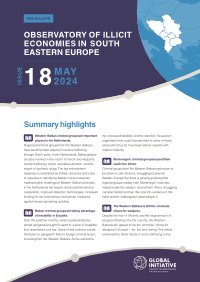
Observatory of Illicit Economies in South Eastern Europe

By Global Initiative Against Transnational Organized Crime’s Observatory of Illicit Economies in South Eastern Europe.

In this issue, we focus on three cases where criminal groups from the region have been active in recent years: the Netherlands, Ecuador and parts of Africa.

These examples illustrate the growing involvement of Balkan criminal groups in some of the world’s hotspots for illicit activity. Research for these articles is facilitated by the Global Initiative’s network of contacts with local investigative journalists, as well as close cooperation between regional observatories of illicit economies, namely South Eastern Europe, West Africa and Latin America.

As part of the GI-TOC’s analysis of the risks of firearms trafficking from Ukraine, in this issue we show that the Western Balkans remain the main source of illegal weapons in Europe. At present, weapons are still cheap and plentiful in the region, and stockpiles have been augmented by inflows from Turkey via Bulgaria, particularly of gas and alarm guns. More on this topic can be found in a forthcoming GI-TOC report on trends in arms trafficking from the Ukraine conflict.

In this issue, we also report on a major crackdown by Serbian authorities in late 2023 on increasingly violent smugglers operating along the border between Serbia and Hungary, and examine how this has displaced migration flows towards Bosnia and Herzegovina.

Risk Bulletin No. 18. Geneva, SWIT: Global Initiative Against Transnational Organized Crime, 2024. 25p.

Oil Theft, Energy Security and Energy Transition in Mexico

By Vlado Vivoda, Ghaleb Krame and Martin Spraggon

Oil theft refers to the exploitation of crude oil or refined petroleum products for criminal purposes. In Mexico, oil theft—referred to as huachicolero—is endemic and widespread. By framing it within the energy security and transition context, this paper offers a new perspective on the problem of oil theft in Mexico. Focusing on crude oil and refined petroleum, the paper demonstrates that Mexico’s energy security—as framed around the 4As (availability, accessibility, affordability, and acceptance)—has deteriorated over the past decade. Application of the 4As framework in the Mexican context shows that the increasing frequency of oil theft has contributed to this deterioration. The proposed solution to the energy security and oil theft problems is centred on Mexico moving from gasoline and diesel to electrification in the transportation sector. The paper demonstrates that, while transport electrification in Mexico has been lagging behind other countries, recent developments in the country point to growing momentum among the country’s political and business elites, in tandem with US partners, in support for the energy transition. Areas where further emphasis should be placed to accelerate Mexico’s energy transition in the transportation sector are identified. Finally, the feasibility of and potential limitations associated with implementing the transition are evaluated.

Resources 202312(2), 30; https://doi.org/10.3390/resources12020030

Substance Use, Overdose Prevention, and the Courts: A Citywide Collaboration

By The Center for Justice Innovation

The Center for Justice Innovation and RxStat convened together stakeholders in the criminal justice, court, and public health systems to discuss the treatment of drug use and prevention of fatal overdoses in the context of the criminal justice system, as well as the integration of harm reduction principles. This document, which maps many of the court-based problem substance use interventions currently utilized across New York City, came out of this forum of experts.

On September 19, 2023, the Center for Justice Innovation and RxStat convened together stakeholders in the criminal justice and court systems, clinicians, and public health experts to discuss the treatment of drug use and prevention of fatal overdoses in the context of the criminal justice system, as well as the integration of harm reduction principles into these and related programs. Among the pre-conference materials distributed were this document, which maps many of the court-based problem substance use interventions currently utilized across New York City. We divided these initiatives into four stages within the timeline of a criminal case: pre-arraignment, arraignment, pre-plea, and post-plea. This categorization is intended to highlight the distinct role that each stage plays within the larger system of treatment and prevention.

New York: The Center for Justice Innovation. 2023, 16pg

Projecting Illinois Crime Rates and the Impact of Further Prison Population Reductions

By James Austin, Todd Clear, and Richard Rosenfeld

Illinois is one of several states considering how to reduce its prison population amid the pandemic and calls for an end to mass incarceration. In recent years, the state has taken steps to reduce its prison population through judicial discretion, bail reform, and diversion programs. As Illinois’ prison population declines and policymakers, prosecutors, and courts consider alternatives to incarceration, what is the risk to public safety? Is crime likely to increase or decline in the state as those convicted of crimes are released or diverted to other programs? In this study, funded by The Harry Frank Guggenheim Foundation, the authors conclude that Illinois crime rates, which have been on the decline since the 1990s, will continue to decline in a fluctuating pattern, with moderate year-to-year changes. This will be true even if Illinois reduces its prison population by an additional 25% over five years. The authors reached this conclusion by constructing a quantitative model that accounts for Illinois crime trends over nearly four decades and provides a basis for predicting crime rates in the near future. This study is a companion to the 2020 Harry Frank Guggenheim Foundation report Explaining the Past and Projecting Future Crime Rates, which examined national crime trends and reached similar conclusions about crime rates in the near future.   

New York: Harry Frank Guggenheim Foundation. 2020, 23pg

Projecting Florida Crime Rates and the Impact of Prison Population Reductions

By James Austin, Richard Rosenfeld and Todd Clear

Florida has benefited from the national drop in crime that began in the early 1990s. Its growth in incarceration also paralleled the steady national imprisonment rise of the last forty-five years. Florida’s rate peaked around 2010 and has been declining ever since. Policy makers would benefit from defensible projections of future trends in crime, and especially from estimates of the effect that further reductions in the number of people in jail and prison might have on those trends. The authors of this study developed quantitative models—explained here in non-technical language—of the effects of various demographic and economic factors, as well as the imprisonment rate, on Florida’s past crime rates. They then used these models to project crime trends into the 2020s, both with and without the assumption of a substantial reduction in imprisonment.

New York: Harry Frank Guggenheim Foundation. 2021, 28pg

Can Research Impact Public Opinion about Police Stops and Searches?

By Peter Leasure and Hunter M. Boehme

This study examined whether public perceptions of police traffic stops and searches varied when participants were randomly assigned to receive various traffic stop and search statistics derived from research. We utilized an experimental information provision survey sent to head of households in South Carolina with an associated email address. Respondents were randomly assigned to one of three conditions: 1) a condition where respondents were presented statistics on contraband hit rates (i.e., rate at which contraband is found during a stop), 2) a condition where respondents were presented statistics on racial disparities in traffic stops, or 3) the control condition. Results from roughly 4,600 respondents indicated that research on traffic stops and searches could impact public opinion regarding whether the police should conduct more stops and searches. Statistically significant differences were found with the contraband versus the racial disparity conditions and with the racial disparity versus control conditions. Looking at the overall probabilities (without regard to the p-values for the differences), respondents who received the racial disparity condition were the least likely to agree that police should conduct more traffic stops and searches, while respondents who received the contraband condition were most likely to agree that police should conduct more traffic stops and searches. However, it should be noted that probabilities for all conditions ranged from approximately 32% to 38%, meaning that most respondents did not agree that more traffic stops and searches should be conducted.

Drug Enforcement and Policy Center. February 2024, 20pg

Drug Trafficking Deterrence Signs and Ohio Schools: A Survey of Ohio Principals

By Peter Leasure


Nearly all states, including Ohio, have laws increasing punishments for drug trafficking in or near schools, though there are long-standing concerns for how these laws function. With a novel inquiry of school leaders, the current study explores whether Ohio schools displayed signage that was viewable by the general public stating that drug traffickers could face enhanced penalties if the conduct occurred on or near school premises. The current study also sought to gauge school principal perception about the deterrence effectiveness of such signs and whether enhanced penalty laws should explicitly require that individuals know they are on or near school premises to receive a penalty enhancement. The results of this survey of Ohio school principals suggested that the vast majority of Ohio schools lack any signage seeking to notify individuals of enhanced penalties for drug trafficking or that generally seek to deter drug trafficking. The results also showed that a majority of Ohio principals believed that the Ohio Revised Code should require that individuals know they are on or near a school's premises to receive increased penalties for drug trafficking (e.g., selling drugs) on or near school premises. Policy recommendations informed by the above findings are discussed.

Drug Enforcement and Policy Center. March 2024, 11pg