


By Lorraine Mazerolle,
Kevin Petersen,
Michelle Sydes and
Janet Ransley
Partnerships in policing are used worldwide to reduce crime and disorder problems. Police forge partnerships with businesses, government agencies, and communities to co-produce public safety. Third-party policing (TPP) is a particular type of partnership that involves the police addressing crime and disorder by working through (and with) third-party partners. This Element focuses on the nature and effectiveness of TPP partnerships. Using systematic review and meta-analytic techniques, it shows that TPP interventions are effective in efforts to reduce crime and disorder, without displacement of these problems. Cooperative partnerships are associated with considerably larger crime control effects than interventions relying on coercive engagement styles. Dyad partnerships – twosome partnerships between police and one third party – are likely to offer the “sweet spot” in TPP. The Element concludes that partnership policing using non criminal justice legal levers is a promising approach to crime control.
By Annelieke Mooij
This open access book examines regulating an environment that has no jurisdiction, is fully anonymous and infinitely vast? Welcome to the Metaverse, an online virtual reality that is expected to add billions to the global economy. The Metaverse offers a new type of virtual economy with practically endless business opportunities. The question is how to prevent these opportunities from being abused to commit money laundering and finance terrorism (MLFT).
This book explores the current European Union legislation designed to prevent MLFT in connection with the Metaverse. It analyses the legislation in relation to the three traditional stages of MLFT: placement, layering and integration. Furthermore, some additional risks specific to the Metaverse are discussed, such as Non-Fungible Tokens (NFTs) and the high level of anonymity. The book concludes that the current legislation is not suitable for facing the new challenges of the Metaverse.
In turn, the book puts forward a novel approach to regulating and enforcing MLFT legislation: using a system of smart assets equipped with AI to prevent and detect MLFT. In addition, it makes recommendations on how to improve the legal framework with regard to the new challenges arising from the Metaverse. Particular attention is given to creating a legal framework that incorporates the use of smart assets and the Internet of Things, in order to provide a safe environment for potential users and society.

By Helena Machado and Rafaela Granja
Genetic Surveillance and Crime Control presents a new empirical and conceptual framework for understanding trends of genetic surveillance in different countries in Europe and in other jurisdictions around the world. The use of DNA or genome for state-level surveillance for crime governance is becoming the norm in democratic societies. In the post-DNA, contemporary modes of criminal identification are gradually changing through the increasing expansion of transnational sharing of DNA data, along with the development of highly controversial genetic technologies that pose acute challenges to privacy and generate fears of discrimination, racism and stigmatization. Some questions that guide this book are: How is genetic surveillance in the governance of crime intertwined with society, ethics, culture, and politics? What are the views and expectations of diverse stakeholders –scientists, police agencies, and non-governmental organizations? How can social sciences research about genetic surveillance accommodate socio-cultural and historical differences, and be sensitive to specificities of post-authoritarian societies in Europe? Taking an interdisciplinary approach focused on challenges to genetic privacy, human rights and citizenship in contemporary societies , this book will be of interest to students and scholars of social studies of science and technology, sociology, criminology, law and policing, international relations and forensic sciences.

By Violence Policy Center
Large capacity ammunition magazines are the common thread running through most mass shootings in the United States. Since 1980, there have been at least 110 mass shootings (three or more fatalities not including the shooter) where the shooter used large capacity ammunition magazines containing more than 10 rounds. A total of 981 people were killed in these shootings, and 1,328 were wounded. This number is likely a significant undercount of actual incidents as there is no consistent collection or reporting on thisdata. Even in many high-profile shootings, information on magazine capacity is neither released nor reported. The Violence Policy Center has compiled this list of incidents by analyzing news reports and follow-up investigative reports on mass shootings. Only shootings in which there is specific information that large capacity magazines were used are included. Columbine shooter armed with Intratec TEC-DC9 assault pistol equipped with high capacity ammunition magazine
Large capacity ammunition magazines are the common thread running through most mass shootings in the United States. Since 1980, there have been at least 110 mass shootings (three or more fatalities not including
the shooter) where the shooter used large capacity ammunition magazines containing more than 10 rounds.
A total of 981 people were killed in these shootings, and 1,328 were wounded. This number is likely a significant undercount of actual incidents as there is no consistent collection or reporting on this data. Even in many high-profile shootings, information on magazine capacity is neither released nor reported. The Violence Policy Center has compiled this list of incidents by analyzing news reports and follow-up investigative reports on mass shootings. Only shootings in which there is specific information that large capacity magazines were used are included.
By Rose Kim, Elizabeth Wagner, Nandita Somayaji, Silvia Villarreal, Cassandra Crifasi
44,447 people died from gun violence in the United States in 2024. Each day, an average of 121 people died from gun violence—one death every 12 minutes. Gun suicides reached an all-time high in the total number of deaths for the fourth consecutive year. For the past five years, guns remained the leading cause of death among young people (ages 1–17), with more deaths than any other single cause, including car crashes, overdoses, and cancers. While males have higher gun death rates and are at elevated risk for gun violence overall, females are uniquely impacted by the intersection between gun violence and domestic violence—nearly half of all females who are murdered are killed by a current or former intimate partner, and more than half of these intimate partner homicides are by gun. In this year’s report, we examined the overall rise of female gun deaths and their disproportionate impact across certain races and ethnicities from 2015 to 2024.
While the burden of gun violence in the U.S. remains high, there are evidence-based, equitable solutions to save lives. These solutions are supported by most people, including gun owners. Despite this broad support, policymakers hesitate to heed the evidence and enact policies that will save lives.
Each year, it is our mission to provide policymakers and the public accurate and up-to-date data on gun fatalities and illustrate the enormous toll gun violence has on our country. This report is an update to “Gun Violence in the United States 2023: Examining the Gun Suicide Epidemic.” It uses firearm mortality data listed on death certificates that are provided to the Centers for Disease Control and Prevention (CDC) and made available through the CDC WONDER Underlying Cause of Death database. The substantial lag in data availability makes it challenging to understand the burden of gun violence in real time; however, understanding the magnitude of this issue, even with the time lag, is essential to inform public health interventions to reduce violence.We recognize that each data point discussed in this report is a person who died by gun violence. This loss has an immeasurable impact on families, friends, and communities; data can only partly illuminate the true burden of gun violence. In addition to analyzing the data, we must listen to and uplift the voices of those directly impacted by gun violence, their loved ones, and their communities
By Michael Sanders, Kate Bancroftb, Susannah Humea, Oliver Chetwyndc and Paul Quintonca
We aim to test the impact of a new national curriculum for public and personal safety training (PPST) developed by the College ofPolicing, which aims to reduce the use of force by police. We con-duct a large-scale Stepped Wedge Pragmatic Controlled Trial with a single police force and 1843 participating police officers.Officers were assigned to be trained during a particular week of the year. We find statistically significant reductions in the use of force by police officers as a result of the training. These effects are a reduction of between 8.0% and 10.9% in the propensity to use force in a given week compared to the counterfactual. The Effect is accompanied by a significant reduction in the likelihood of injury to civilians, and no rise in the risk of harm to officers.We conclude that the PPST curriculum appears effective at reduc-ing use of force by police in a large scale, robust trial

By Erika Fortunato, Reneta Slikboer, Marie Henshaw, Denny Meyer and James RP Oglof
Abstract | Despite increasing research on online child sexual exploitation, limited research compares female and male perpetrators. This study examined 116 females and 116 age-matched males known to police for online child sexual exploitation on group characteristics and risk of reoffending. Some differences emerged, with females co-offending and experiencing violent victimisation more often thanmales. However, several similarities were also apparent, including that females and males had similar risk of recidivism. These findings have implications for policy and highlight several important avenues for future research.
By Sobhan Lawler, Samantha Lyneham, Christopher Dowling
Over the past decade, cyber-scam centres dedicated to running online scams at a massive scale have proliferated across areas of South-East Asia, partly fuelled by a workforce of persons who have been trafficked for the purpose of forced criminality. Alongside the scams, which affect victims globally, these centres themselves have become sites of significant exploitation. Historically, women and girls constitute the majority of victim-survivors of trafficking overall, but the extent to which gender shapes pathways into, and experiences of, exploitation in this context is only beginning to be explored. To understand women and girls’ experiences of trafficking into cyber-scam centres for forced criminality, the research involved qualitative consultations with 86 stakeholders in the South East Asian region and in-depth interviews with three victim-survivors.
Women and girls are predominantly recruited into cyber-scam centres through someone they know, using strategies that exploit relational trust. Women in cyber-scam centres commonly experience compounded forms of exploitation, most often forced criminality (online scamming) as well as sexual exploitation. Sex work, threats and extreme forms of violence are routine control mechanisms used by criminal organisations to make people of all genders perform and conform in this environment. Gender-responsive approaches are imperative for addressing the complex and multiple forms of exploitation that women experience while inside cyber-scam centres and post-release. Recommendations are made for developing gendered awareness campaigns, trauma-informed victim identification processes and aftercare, and strengthening partnerships across the region.

By Christopher Dowling and Laura Doherty
The production and availability of pornography has increased dramatically over the past few decades. Concerns have been raised regarding pornography’s influence on sexual violence, particularly among men, who constitute the majority of its audience. While a vast body of research has examined the association between pornography use and sexual violence, questions remain regarding the strength of this association, including among Australian men, and its underlying mechanisms.
Drawing on the survey responses of almost 2,000 Australian heterosexual cisgender men, the current study examined the association of intentional pornography viewing across the life course and self-reported sexual violence perpetration in the 12 months preceding survey completion. It also examined the extent to which this association is mediated by pornography’s effect on respondents’ attitudes towards sex and women. Findings show that more frequent intentional viewing of violent pornography is associated with a small but statistically significant increase in the probability of having perpetrated sexual violence. Meanwhile, the probability of perpetrating sexual violence does not significantly change with an increase in the intentional viewing of any (ie violent or non-violent) pornography. Furthermore, a portion of the relationship between the frequency of intentional violent pornography viewing and sexual violence perpetration is mediated by the degree to which respondents exhibit a promiscuous, emotionally detached orientation towards sex and hostile attitudes towards women. However, the importance of these mediators varies between respondents. This study provides valuable information to inform measures to prevent and counteract any potential negative impacts of violent pornography on sexual behaviour.
By Samantha Bricknell and Amy McDonald
The Human Trafficking and Modern Slavery National Minimum Dataset is anational data collection on modern slavery events. This study describes modern slavery reports received between July 2024 and June 2025, the characteristics of victim-survivors and perpetrators, the nature of Australia Government-funded support provided to victim-survivors and the outcomes of modern slavery prosecutions.
By Min-Taec Kim, Fan Cheng
The Bureau of Crime Statistics and Research (BOCSAR) has released a new study that considered whether linked data from health, education, child protection (and more) can be used to predict which children are likely to offend before turning 18. The study found: Whole-of-population level: Machine learning methods applied to large-linked data can identify future young offenders with reasonable accuracy. Aboriginal young people: The models were far less accurate for Aboriginal young people and could not be reliably used for this group. Offending predictions for Aboriginal young people were more likely to be wrong than for non-Aboriginal young people – a higher rate of false positives. This raises significant ethical concerns about the practical use of such models for Aboriginal people and other sub-populations. Predictive factors over time: The study also identified key predictors of offending and how these change with age. At birth, gender and parental characteristics are most influential. Between ages 5 and 10, child protection reports and disability become important. By age 15, school suspension is the strongest predictor of youth offending.
By Queensland Parliament. Education, Arts and Communities Committee
Responses to elder abuse, and opportunities to improve responses to elder abuse within the government, broader community, non-government and private sectors. The report provides 16 recommendations.
Key findings
Elder abuse often occurs in private settings, frequently within families, and remains underreported due to victims’ reluctance or lack of awareness. Evidence indicates that elder abuse stems from a complex and evolving environment, marked by ambiguous definitions and diverse causes. Contributing factors include family stress, social isolation and financial pressures. The committee noted pervasive ageism, whereby older people are at once undervalued yet expected to share their assets with younger generations. Data collection by government and funded services was found to be inadequate, inconsistent and poorly integrated across agencies. In addition to recommending that the Legislative Assembly note the report, the committee made 15 recommendations around the following key themes, to: improve data collection, management and reporting strengthen Queensland’s elder abuse prevention and response frameworks collaborate at a national level to ensure consistent reform.

By Laura Gobey
Child abuse and neglect is a major problem in Australia. This policy and practice paper provides an overview of recent research evidence on the risk and protective factors for child abuse and neglect in families. It also discusses how knowledge of risk and protective factors can inform practice for practitioners and other professionals working with children and families.

By Diarmaid Harkin, Mary Iliadis, Jessica Woolley, Marilyn McMahon and Karen Bentley
Victim-survivors of domestic and family violence (DFV) are increasingly using closed-circuit television (CCTV) systems. To date, the impacts of CCTV systems on victim survivors have been unclear. This paper presents the findings from a world-first study into how victim survivors of DFV experience the use of CCTV systems. It draws on a national survey of 125 DFV support practitioners and 28 in-depth interviews (including with 9 victim-survivors). The findings demonstrate that CCTV can have beneficial impacts on the wellbeing of victim-survivors by providing a sense of safety and security but also carries risks, including that victim-survivors will become hypervigilant.victim-survivors of domestic and family violence (DFV) are increasingly using closed-circuit television (CCTV) systems. To date, the impacts of CCTV systems on victim survivors have been unclear. This paper presents the findings from a world-first study into how victim survivors of DFV experience the use of CCTV systems. It draws on a national survey of 125 DFV support practitioners and 28 in-depth interviews (including with 9 victim-survivors). The findings demonstrate that CCTV can have beneficial impacts on the wellbeing of victim-survivors by providing a sense of safety and security but also carries risks, including that victim-survivors will become hypervigilant.
By Alexandra Voce, Isabella Voce, Anthony Morgan
In the past 10 years, there has been a rapid proliferation of publicly available tools and applications (apps) using artificial intelligence (AI). While these tools have the potential to significantly benefit daily life, studies find there are growing concerns about the potential for AI technologies to be misused for criminal, nefarious or antisocial purposes. Little to no research has examined whether Australians believe they or their families will be personally impacted by crimes involving AI technology in the imminent future, and which specific AI technologies are perceived as posing the greatest risk of harm to individuals and their families.
This report examined data from the Australian Cybercrime Survey to measure the perceived frequency of AI-enabled crimes and which specific technologies pose the greatest perceived risk of victimisation. The findings highlight priority areas for industry safeguards and public education.
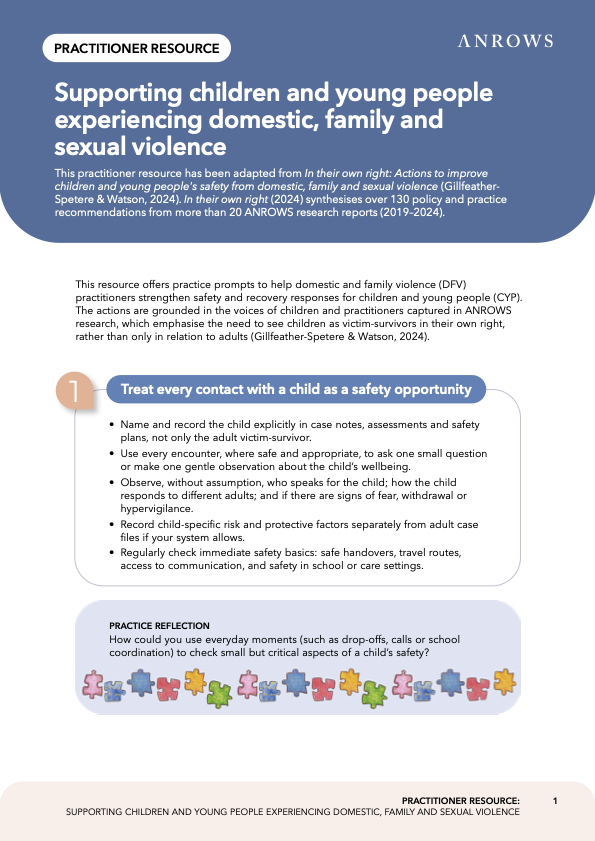
By The Australian National Research Organisation for Women's Safety ( ANROWS)
This resource supports frontline workers to strengthen safety and recovery responses for children and young people experiencing domestic, family and sexual violence. Focused on translating evidence into everyday practice, the resource is particularly relevant for practitioners working in regional and rural contexts, where service gaps, confidentiality risks and workforce pressures shape how support is delivered.
By Katrina Scurrah, Swen Kuh, Mulu Woldegiorgis, Catherine Andersson, Sean Martin
Using data from Wave 1 (2013–14) and Wave 4 (2022) of Ten to Men: The Australian Longitudinal Study on
Male Health, we found: Higher-risk alcohol use was associated with men starting to use intimate partner violence (IPV) over time. Men with hazardous drinking at Wave 1 were 27% more likely to initiate IPV by Wave 4 than low-risk drinkers; men with harmful use or possible dependence were 57% more likely. The relationship between alcohol use and IPV was similar across the different forms of IPV measured (emotional-type abuse, physical violence and sexual abuse) and was strongest for the use of physical IPV. Men with harmful use/possible dependence had around double the risk (119%) of initiating physical IPV than low-risk drinkers.
How much men drank in a typical session mattered more than how often they drank. Men who typically drank 10+ standard drinks were 55% more likely to initiate IPV than non-drinkers; drinking frequency and age at first drink were not linked to later IPV initiation.
Overall scores for conformity to masculine norms were not associated with IPV initiation but some specific norms were. Higher scores on the measure, used in Wave 1, for the domains of playboy, violence and risk taking were associated with starting to use IPV. In contrast, patterns combining emotional openness, self-reliance and primacy of work were associated with a lower likelihood of starting to use IPV. Another masculinity-related scale that assessed gender-role identity was used in Wave 4 and there was no clear association with the use of IPV. There was little evidence that self-reported masculinities changed the strength of the relationship between alcohol use and IPV initiation. Higher-risk drinking was linked to IPV regardless of the strength between alcohol use and IPV initiation. Higher-risk drinking was linked to IPV regardless of the strength of conformity to these masculine norms. The combined highest-risk group (harmful/probable alcohol dependence plus high scores on the masculine norms measure used at Wave 1) showed at most a modest additional increase in risk of IPV use compared with either high alcohol risk or stronger conformity to specific masculine norms alone.
These findings suggest the following could enhance policy and practice to support IPV prevention efforts: Use alcohol harm reduction as a practical lever for IPV prevention. Strengthen routine alcohol screening and brief intervention/referral pathways in settings that see large numbers of men (primary care, mental health and community services), with clear, safe escalation pathways where IPV risk is identified. Prioritise indicators of heavier drinking in risk identification for IPV initiation. Policies and practice guidance should focus on current severity/patterns rather than drinking frequency alone for men, as these were the measures most predictive of later use of IPV. Target the specific masculine norms associated with IPV use. While this report found little evidence that these norms change the strength of the alcohol–IPV association, the highest observed risks tended to be among men with both higher-risk drinking and higher-risk masculine norm profiles. This suggests prevention and behaviour-change approaches may be particularly valuable when targeted to men already identified as higher risk (e.g. through alcohol-related risk) and should address norms related to violence acceptance, risk taking, sexual entitlement and status/power, and build skills such as emotion regulation and non-violent conflict management – integrated with alcohol-focused interventions where relevant. Taken together, these findings point to the potential value of coordinated alcohol and other drugs–family and domestic violence (AOD–FDV) pathways, rather than separate, parallel responses. This includes alcohol interventions that incorporate safe identification of family violence risk and enable appropriate referral, as well as specialist programs that address both alcohol-related harm and relevant attitudes and behaviours as part of a tailored response.
By Sophie King-Hill
This evidence review explores how masculinity influences offending, vulnerability and engagement with the criminal justice system. It examines the impact of gender norms, trauma and online influences, and considers how gender-informed, trauma-aware approaches can support prevention, rehabilitation and safer communities.

By Violence Policy Center
Large capacity ammunition magazines are the common thread running through most mass shootings in the United States. Since 1980, there have been at least 110 mass shootings (three or more fatalities not including
the shooter) where the shooter used large capacity ammunition magazines containing more than 10 rounds.
A total of 981 people were killed in these shootings, and 1,328 were wounded. This number is likely a significant undercount of actual incidents as there is no consistent collection or reporting on this data. Even in many high-profile shootings, information on magazine capacity is neither released nor reported. The Violence Policy Center has compiled this list of incidents by analyzing news reports and follow-up investigative reports
on mass shootings. Only shootings in which there is specific information that large capacity magazines were used are included. Columbine shooter armed with Intratec TEC-DC9 assault pistol equipped with high capacity ammunition magazine
Large capacity ammunition magazines are the common thread running through most mass shootings in the United States. Since 1980, there have been at least 110 mass shootings (three or more fatalities not including
the shooter) where the shooter used large capacity ammunition magazines containing more than 10 rounds.
A total of 981 people were killed in these shootings, and 1,328 were wounded. This number is likely a significant undercount of actual incidents as there is no consistent collection or reporting on this data. Even in many high-profile shootings, information on magazine capacity is neither released nor reported. The Violence Policy Center has compiled this list of incidents by analyzing news reports and follow-up investigative reports
on mass shootings. Only shootings in which there is specific information that large capacity magazines were used are included.
By Rose Kim, Elizabeth Wagner, Nandita Somayaji, Silvia Villarreal, Cassandra Crifasi
44,447 people died from gun violence in the United States in 2024. Each day, an average of 121 people died from gun violence—one death every 12 minutes. Gun suicides reached an all-time high in the total number of
deaths for the fourth consecutive year. For the past five years, guns remained the leading cause of death among young people (ages 1–17), with more deaths than any other single cause, including car crashes, overdoses, and cancers. While males have higher gun death rates and are at elevated risk for gun violence overall, females are uniquely impacted by the intersection between gun violence and domestic violence—nearly half of all females who are murdered are killed by a current or former intimate partner, and more than half of these intimate partner homicides are by gun. In this year’s report, we examined the overall rise of female gun deaths and their disproportionate impact across certain races and ethnicities from 2015 to 2024.
While the burden of gun violence in the U.S. remains high, there are evidence-based, equitable solutions to save lives. These solutions are supported by most people, including gun owners. Despite this broad support, policymakers hesitate to heed the evidence and enact policies that will save lives. Each year, it is our mission to provide policymakers and the public accurate and up-to-date data on gun fatalities and illustrate the
enormous toll gun violence has on our country. This report is an update to “Gun Violence in the United States 2023: Examining the Gun Suicide Epidemic.” It uses firearm mortality data listed on death certificates that are provided to the Centers for Disease Control and Prevention (CDC) and made available through the CDC
WONDER Underlying Cause of Death database. The substantial lag in data availability makes it challenging to understand the burden of gun violence in real time; however, understanding the magnitude of this issue, even with the time lag, is essential to inform public health interventions to reduce violence.We recognize that each data point discussed in this report is a person who died by gun violence. This loss has an immeasurable
impact on families, friends, and communities; data can only partly illuminate the true burden of gun violence. In addition to analyzing the data, we must listen to and uplift the voices of those directly impacted by gun violence, their loved ones, and their communities