Open Access Publisher and Free Library
CRIMINAL JUSTICE.jpeg

CRIMINAL JUSTICE

CRIMINAL JUSTICE-CRIMINAL LAW-PROCDEDURE-SENTENCING-COURTS

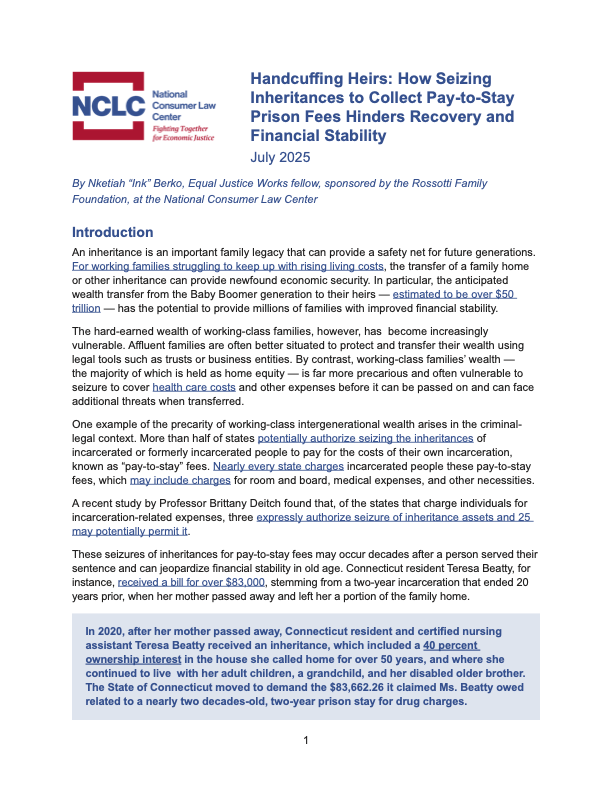
Handcuffing Heirs: How Seizing Inheritances to Collect Pay-to-Stay Prison Fees Hinders Recovery and Financial Stability

By Nketiah “Ink” Berko  

An inheritance is an important family legacy that can provide a safety net for future generations. For working families struggling to keep up with rising living costs, the transfer of a family home or other inheritance can provide newfound economic security. In particular, the anticipated wealth transfer from the Baby Boomer generation to their heirs — estimated to be over $50 trillion — has the potential to provide millions of families with improved financial stability.

The hard-earned wealth of working-class families, however, has become increasingly vulnerable. Affluent families are often better situated to protect and transfer their wealth using legal tools such as trusts or business entities. By contrast, working-class families’ wealth — the majority of which is held as home equity — is far more precarious and often vulnerable to seizure to cover health care costs and other expenses before it can be passed on and can face additional threats when transferred.

One example of the precarity of working-class intergenerational wealth arises in the criminal-legal context. More than half of states potentially authorize seizing the inheritances of incarcerated or formerly incarcerated people to pay for the costs of their own incarceration, known as “pay-to-stay” fees. Nearly every state charges incarcerated people these pay-to-stay fees, which may include charges for room and board, medical expenses, and other necessities.

A recent study by Professor Brittany Deitch found that, of the states that charge individuals for incarceration-related expenses, three expressly authorize seizure of inheritance assets and 25 may potentially permit it.

These seizures of inheritances for pay-to-stay fees may occur decades after a person served their sentence and can jeopardize financial stability in old age. Connecticut resident Teresa Beatty, for instance, received a bill for over $83,000, stemming from a two-year incarceration that ended 20 years prior, when her mother passed away and left her a portion of the family home.

Pay-to-stay laws and, in particular, the seizure of family inheritances to cover pay-to-stay fees, exacerbate an already wide chasm between the haves and have-nots, causing poor families to grow poorer as rich families continue to grow richer.

Seizing family inheritances to pay for incarceration causes particular harm to Black communities. Due to widespread inequities across the criminal justice system, as well as historic disinvestment in Black neighborhoods, Black families have less wealth available to pass to their heirs and are more likely to lose what little wealth they manage to build to the government to pay for the costs of operating prisons and jails. Moreover, seizure of resources to collect pay-to-stay fees can make it harder for returning citizens to achieve the financial stability necessary to reintegrate into society and avoid reincarceration.

Constitutional challenges to pay-to-stay fees have largely been unsuccessful, but reformers have made progress through several state legislatures. IllinoisNew Hampshire, and Missouri have repealed their pay-to-stay statutes in recent years. Additionally, in 2022, Connecticut partially reformed its pay-to-stay laws, exempting incarcerated individuals from paying the first $50,000 of their incarceration costs and collecting only from individuals convicted of “serious crimes.”

State policymakers have an important role to play in reforming the laws that sentence formerly incarcerated people and their families to generations of debt. In addition to an analysis of the disparate harm that pay-to-stay laws and inheritance seizures have on low-income and Black communities. This paper provides recommendations to state lawmakers on how to end or alleviate the punishing impact of incarceration fees.

State policymakers have an important role to play in reforming the laws that sentence formerly incarcerated people and their families to generations of debt. In addition to an analysis of the disparate harm that pay-to-stay laws and inheritance seizures have on low-income and Black communities. This paper provides recommendations to state lawmakers on how to end or alleviate the punishing impact of incarceration fees.

National Consumer Law Center, 2025. 7p.
Survey of Inmates in Local Jails Redesign and Pretest

By Stephanie Fahy, PhD, Abt Global, LLC Jennifer Bronson, PhD, formerly of Abt Global, LLC Charlotte Lopez-Jauffret, PhD, formerly of Abt Global, LLC Brenda Rodriguez, Abt Global, LLC Allison Ackermann

This third-party report by Abt Global presents findings on the redesign and pretest project for BJS’s Survey of Inmates in Local Jails (SILJ). The report presents Abt Global and BJS’s review of, and recommended revisions to, the existing SILJ instrument.

The SILJ is the only nationally representative survey that collects self-reported, individual-level information on hard-to-reach jail populations, making it a vital resource for policymakers, facilities, government agencies, and researchers. Since the survey was last administered in 2002, the characteristics of jail populations have changed, and new policies and policing reforms have been enacted. Abt Global and BJS entered into a cooperative agreement in 2015 to address gaps in the 2002 version of the instrument with the goal of producing reliable national estimates of local jail populations through the redesigned survey instrument.

Abt Global, 2025. 20p.

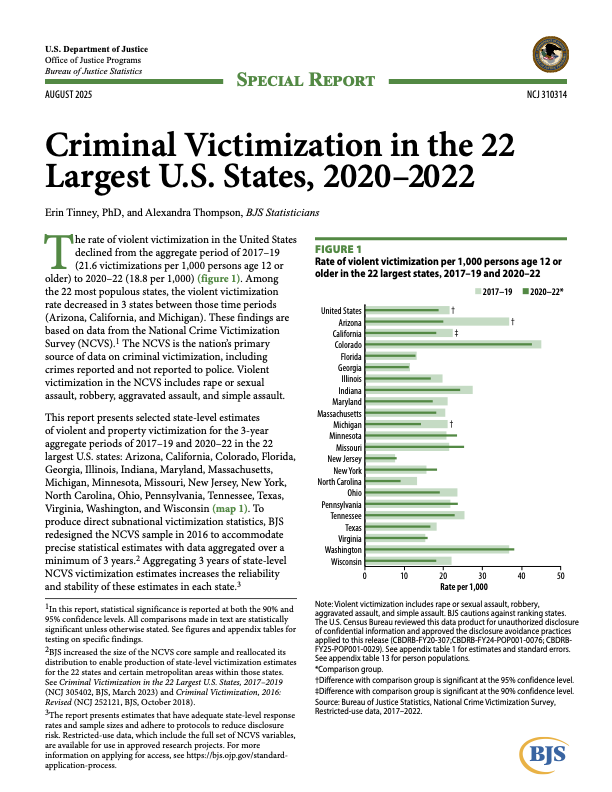
Criminal Victimization in the 22 Largest U.S. States, 2020–2022

By Erin Tinney and Alexandra Thompson,

This report presents statistics from the National Crime Victimization Survey (NCVS) and examines victimization rates across the 22 most populous U.S. states and how reported and unreported crime levels vary across these states and over time. It analyzes selected state-level estimates of violent and property victimization for the 3-year aggregate periods of 2017–19 and 2020–22 in the 22 largest U.S. states. Findings are based on data from the NCVS, the nation’s primary source of data on criminal victimization. State-level data, available following an increase in the NCVS sample that began in 2016, can provide more detailed information than the national NCVS estimates and other NCVS estimates historically produced for BJS reports, such as regional estimates.

Washington, DC: U.S. Department of Justice Office of Justice Programs Bureau of Justice Statistics. 2025. 27p.

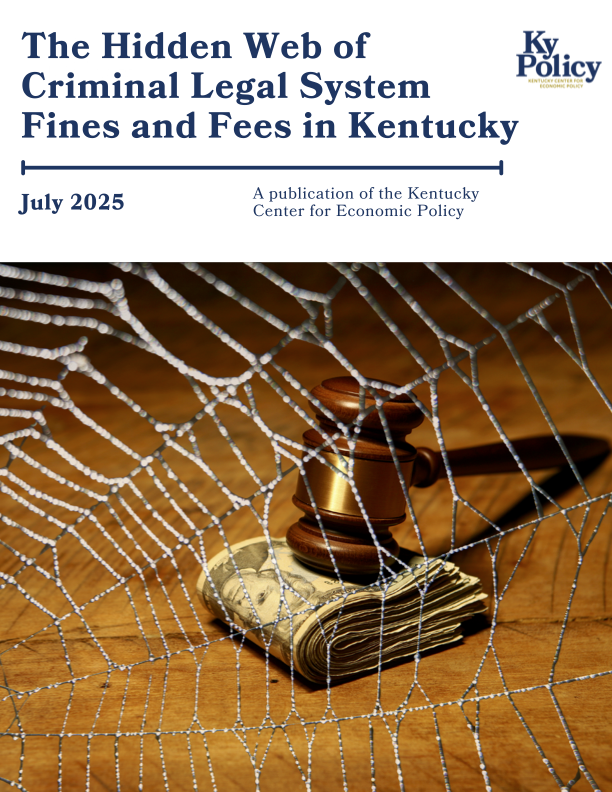
The Hidden Web of Criminal Legal System Fines and Fees in Kentucky

Ashley Spalding, Pam Thomas, Patience Martin, Scott West and Kaylee Raymer | July 8, 2025

Thousands of provisions in Kentucky state law, and untold local ordinances, make up a vast, hidden web of criminal legal system fines and fees that trap many people in a cycle of long-term debt and incarceration. In a poor state like Kentucky, owing a few hundred dollars in fines and fees for a minor offense can all too easily ensnare a person indefinitely in the criminal system and result in lost income and employment, homelessness, poor health, and family instability, among other consequences. As of 2019, Kentuckians owed at least $91 million in fines and fees debt.

2025. 27p.

The Police’s Work In Connection With Profiling and Equal treatment.

With a focus on discriminatory and ethnic profiling.

By Anna Öström, Lars Lewenhagen, Emma Patel and Sara Jonsson

This is a complex subject to study. To address the questions in the study, Brå has therefore used several different types of data and methodological approaches, both qualitative and quantitative. One important contribution is the large number of interviews and conversations held with managers at different levels within the organisation, and with police officers on patrol duty. Significant parts of the report are thus based on what employees at both strategic and operational levels deem to be important in the work in connection with profiling and equal treatment.

The study has a particular focus on discriminatory ethnic profiling, which involves the police relying solely or primarily on an individual’s ethnic origin when assessing who they check or suspect of crimes. The profiling work examined in this study mainly relates to suspected drug offences. This is a typical search and intervention offence in which the police have a relatively wide scope for action

English summary of Brå report 2023:12

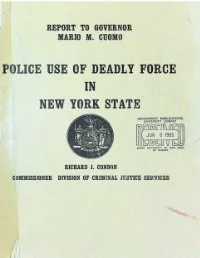
Police Use Of Deadly Force In New York State: A Report To Governor Mario M. Cuomo

Richard J. Condon Commissioner Division Of Criminal Justice Services

Police Use of Deadly Force in New York State: A Report to Governor Mario M. Cuomo (1985) offers one of the earliest systematic examinations of how and why lethal force was deployed by law enforcement across the state during a period of intense public scrutiny. Commissioned at a time when debates over police accountability, training standards, and civil rights were gaining national prominence, the report evaluates legal frameworks, departmental policies, and patterns of police–citizen encounters to assess the necessity and proportionality of deadly force incidents. Drawing on case reviews, agency surveys, and statistical analyses, it seeks to identify structural weaknesses and propose reforms aimed at reducing unnecessary violence and strengthening public trust.

Viewed from today’s perspective, the report stands as an important precursor to contemporary discussions about policing and the appropriate limits of state power. In the decades since its publication, nationwide movements such as Black Lives Matter, advances in data transparency, increased availability of video evidence, and evolving constitutional standards have intensified scrutiny of deadly force practices. Modern debates continue to revolve around issues the 1985 report identified early on: the need for clear and consistent use‑of‑force policies, robust training in de‑escalation, improved data collection, and stronger mechanisms of accountability. As current policymakers and communities grapple with how to balance public safety, civil liberties, and equitable treatment, this historical report offers valuable insight into the longstanding nature of these challenges and the enduring need for thoughtful, evidence‑based reform.

If you'd like, I can also turn this into a full foreword, integrate it into a larger document, or tailor the tone for academic, policy, or public audiences.

NY. Division Of Criminal Justice Services. 1985. p.273.

The Pinkertons: A Detective Dynasty

By Richard Wilmer Rowan/ Introduction Graeme R. Newman

The enduring legacy of the Pinkerton National Detective Agency serves as a foundational blueprint for modern private security and state surveillance, making Richard Wilmer Rowan’s 1931 chronicle, The Pinkertons: A Detective Dynasty, an essential text for understanding the evolution of policing in the twenty-first century. When Rowan published this work, the United States was grappling with the rise of organized crime and the professionalization of the FBI under J. Edgar Hoover, yet the shadow of the Pinkerton "Eye" remained the most potent symbol of investigative authority in the American consciousness. To read this book today is to witness the birth of the surveillance state and the privatization of law enforcement, themes that have only intensified with the advent of digital tracking and global security conglomerates. Rowan provides a meticulous window into how a single family transformed from a small Midwestern agency into a quasi-governmental force that, at its peak, employed more men than the standing army of the United States. This historical dominance raises uncomfortable but necessary questions about the blurred lines between private profit and public safety, a tension that remains at the heart of contemporary debates regarding police reform and the rise of private military contractors.

Rowan’s examination of Allan Pinkerton’s tenure as the head of the Union Intelligence Service during the Civil War—the precursor to the Federal Secret Service—highlights the original sin of American intelligence: the reliance on private entities to perform core state functions. The portrait of Pinkerton that opens the book is not merely a likeness of a man but an icon of the "Eye that never sleeps," a concept that has evolved from a physical detective on a street corner to the algorithmic "always-on" monitoring of the internet and public spaces. In today’s context, the methods pioneered by the Pinkertons, such as the systematic collection of "mug shots" and the creation of detailed criminal databases, are the direct ancestors of facial recognition technology and predictive policing. By studying Rowan’s account of these early techniques, a modern reader can trace the genealogy of modern privacy erosion, recognizing that the desire for total information awareness is not a product of the silicon age but a nineteenth-century ambition codified by the Pinkerton dynasty.

Furthermore, the book’s detailed accounts of the agency’s role in labor disputes offer a sobering reflection on the current state of corporate security and workers' rights. The Pinkertons became synonymous with "union-busting" and the violent suppression of strikes, most notably during the Homestead Strike of 1892, an event that Rowan treats with the gravity of a military campaign. In an era where modern tech giants and multinational corporations are frequently accused of using sophisticated surveillance and psychological tactics to discourage unionization, the tactics described in this 1931 text feel disturbingly fresh. Rowan allows us to see that the privatization of force has historically served to protect capital at the expense of civil liberties, providing a historical mirror for today’s discussions on the "gig economy" and the power dynamics between massive employers and their workforces.

Ultimately, Rowan’s narrative is relevant because it captures the transition of the detective from a romanticized figure of justice into a cold instrument of institutional power. While the book was written nearly a century ago, its exploration of how information is gathered, how secrets are traded, and how private individuals can wield the authority of the law remains the central drama of our digital age. It serves as a reminder that the "Lawless Police" described by Hopkins and the "Detective Dynasty" described by Rowan are two sides of the same coin—a persistent struggle to define where the power of the state ends and the rights of the individual begin. As we navigate an era defined by data breaches, private security patrols in residential neighborhoods, and state-sponsored cyber-espionage, Rowan’s history provides the necessary context to understand that we are not living in a new world, but rather a more technologically advanced version of the one the Pinkertons built.

Boston. Little, Brown, And Company. I931. Read-Me.Org Inc. New York-Philadelphia-Australia. 2026. p.208.

Read-Me.Org
Our Lawless Police: A Study of the Unlawful Enforcement of the Law

By Ernest Jerome Hopkins. Introduction by Graeme R. Newman

When Our Lawless Police first appeared in 1931, it shocked the American public with its unflinching revelations about the dark machinery behind everyday law enforcement. Ernest Jerome Hopkins—an investigative journalist of rare precision and independence—exposed a world where the police, entrusted with upholding justice, routinely violated the very laws they were sworn to enforce.

Drawing on first-hand interviews, case records, and on-the-ground reporting from major cities, Hopkins documents a pervasive system of beatings, coerced confessions, warrantless searches, political favoritism, payoffs, and routine brutality. His study reveals not a handful of rogue officers but an entrenched culture in which illegality operates as a method of governance—shielded by political machines, tolerated by the courts, and often applauded by a public eager for swift results.

More than a historical exposé, Our Lawless Police remains a profoundly relevant critique of institutional power. Hopkins’ analysis anticipates many of today’s urgent debates over police accountability, civil liberties, and the limits of state authority. His work reminds us that democratic societies cannot rely on the rule of law unless those who enforce it are themselves bound by it.

This new edition brings Hopkins’ landmark investigation back into the center of contemporary conversation—an essential text for readers concerned with justice, reform, and the unfinished struggle to build lawful, transparent, and accountable policing in America.

Read-Me.Org Inc. New York-Philadelphia-Australia. 2026. p.203.

Read-Me.Org
The Law Of Nations Applied To The Conduct And Affairs Of Nations And Sovereigns.

By M. D. Vattel. Introduction by Graeme R. Newman

A foundational work of international law, still resonant today.

First published in the eighteenth century and issued in authoritative English editions throughout the nineteenth, The Law of Nations by Emer de Vattel shaped how statesmen, jurists, and diplomats understood the rights and duties of sovereign powers. In this monumental treatise, Vattel applies the principles of natural law to the real conduct of nations, addressing war and peace, treaties and alliances, commerce and neutrality, diplomacy, and the limits of lawful power.

Rejecting both utopian idealism and brute realpolitik, Vattel argues that true national interest is inseparable from justice, restraint, and respect for sovereignty. Nations, like individuals, are bound by moral obligations arising from their coexistence in a shared international society. His careful analysis of war, intervention, and treaty obligations established enduring standards that influenced constitutional debates, foreign policy doctrine, and the development of modern international law.

This edition preserves a work that continues to illuminate contemporary conflicts and global challenges. Clear-eyed, systematic, and profoundly influential, The Law of Nations remains essential reading for anyone seeking to understand how lawful order, moral principle, and power intersect in the affairs of nations.

The theses advanced in The Law of Nations remain strikingly relevant to contemporary international disputes, particularly those involving intervention, recognition of governments, and claims of humanitarian necessity. Vattel’s insistence on sovereignty as the cornerstone of international order places clear limits on the legitimacy of external interference in the internal affairs of states. While he allows that extreme cases—such as manifest tyranny threatening the very existence of a people—may raise difficult moral questions, he consistently warns that powerful states are prone to disguise ambition and interest under the language of justice.

This caution is especially pertinent when considering recent controversies surrounding efforts by the United States to promote regime change in Venezuela, including diplomatic, economic, and political measures aimed at displacing the government of Nicolás Maduro. From a Vattelian perspective, such actions raise fundamental questions about lawful authority, the limits of collective judgment, and the distinction between moral condemnation and legal right. Vattel argues that no nation may unilaterally assume the role of judge over another sovereign without undermining the mutual independence on which international society depends. To do so, he suggests, risks converting international law into a mere instrument of power.

At the same time, Vattel’s framework does not deny the reality of gross misrule or humanitarian suffering. Rather, it demands rigorous scrutiny of motives and means. Economic coercion, diplomatic isolation, and recognition of alternative authorities would, in his analysis, need to be justified not by ideological preference or strategic advantage, but by clear evidence that such measures genuinely serve the common good of nations and do not erode the general security of the international system. His emphasis on proportionality, necessity, and respect for established sovereignty stands in tension with modern practices of intervention that rely on contested doctrines of legitimacy.

Viewed through this lens, contemporary debates over Venezuela illustrate the enduring force of Vattel’s central warning: that the stability of international relations depends less on the moral claims of individual powers than on shared restraint. His work reminds modern readers that the erosion of sovereignty in one case—however rhetorically justified—sets precedents that may ultimately weaken the legal protections upon which all nations, strong and weak alike, rely.

P.H. Nicklitn etc. Philadelphia. 1829. Read-Me.Org Inc. New York-Philadelphia-Australia. 2026 p.424.

Above the Law? NYPD Violations of the Public Oversight of Surveillance Technology (POST) Act--

By Eleni Manis, PHD and Albert Fox Cahn, Esq

In this report, S.T.O.P. documents the New York City Police Department (NYPD)’s repeated failures to comply with New York City’s Public Oversight of Surveillance Technology Act (POST Act). Enacted in 2020, the POST Act is the first law to oversee the NYPD’s use of surveillance technology. A first attempt to regulate NYPD’s surveillance tools, the law only requires NYPD disclose its surveillance tools. As this report establishes, NYPD falls far short of the reporting norms set by other police departments subject to similar surveillance technology oversight laws. The report concludes by calling on the New York City Council to use its oversight authority to ensure that the bill is not ignored. S.T.O.P. also recommends that individual lawmakers and civil society organizations continue to evaluate potential litigation, seeking judicial intervention to compel the NYPD to comply with the POST Act.

Scarily Precise: Location Tracking with Ultra-Wideband

By Mahima Arya, Juilee Shivalker, Maxwell Votey, Jackie Singh, Albert Fox Cahn, ESQ., Eleni Manis, PHD, MPA

Ultra-Wideband (“UWB”) is a short-range wireless technology somewhat like Bluetooth or Wi-Fi, but with superior locating abilities, enabling the highly accurate identification of an object’s position in three-dimensional space. UWB capabilities are now standard on many newer-model smartphones, allowing users to track UWB-enabled beacons from their smartphones and allowing vendors to leverage inbuilt UWB capabilities to create massive sensor networks using unwitting users’ mobile devices. This report focuses on privacy and anti-trust concerns surrounding UWB beacons, the tip of the iceberg of planned UWB applications. Because UWB’s locating abilities are so precise, beacons provide an easy way to track and stalk people. Beacons pass detailed device location data through neighboring devices’ networks, introducing the twin risks of malicious hacking and commercial exploitation by vendors. Apple and Amazon have acted to shut competitors out of the UWB beacon space, demonstrating a clear linkage between the story of these beacons and the larger story of Big Tech anti-trust concerns.

The Spy Next Door: The Danger of Neighborhood Surveillance Apps

By Paula Garcia-Salazar, Nina Loshkajian, Albert Fox Cahn, ESQ., Eleni Manis, PHD, MPA

Everyone sees them: signs “welcoming” you to a neighborhood with the warning that “All Suspicious Persons and Activities Reported to Law Enforcement.” In the 1960’s, Neighborhood Watch groups proliferated in supposed response to increased burglaries. 1 In fact, the groups appear to have been a direct response to increased residential integration.2 A brainchild of the National Sheriffs Association, Neighborhood Watch groups were touted as a way to increase community involvement in crime prevention by encouraging residents to patrol their own streets and act as the eyes and ears of the local police. 3 But too often, local residents have interpreted this as a chance to become vigilantes, in many cases acting purely on bias to raise false alarms and profile fellow community members, endangering the very people these groups are allegedly designed to protect. 4 The groups have proliferated across the country even as they have been demonstrated to promote profiling and distract from actual public safety, there being little evidence that Neighborhood Watch programs reduce crime. 5 Now, a new form of Neighborhood Watch is here: smartphone-based apps that supplant the classic program with online forums for local neighborhoods. Nextdoor (27 million regular users),6 Neighbors by Ring (10 million users),7 Citizen (7 million users),8 and recently piloted Facebook Neighborhoods deliver “hyperlocal” updates to geographic “neighbors.” Nextdoor and Facebook Neighborhoods invite users to post on a range of local-interest content: upcoming events, business reviews, goods for sale, and so on. But the backbone of neighborhood surveillance apps is crime, both real and imagined. Apps encourage users to upload video footage, photos and descriptions of suspected crimes and supposedly “suspicious” people near their homes, producing reports riddled with dog whistles and overt racism. Apps court a police audience for these posts and enable police to request app users’ video footage, photos, and input. Apps even drive user engagement by inviting bystanders join in on the crime-oriented conversation: as on Facebook, users can comment, “like” and otherwise interact with posts with the click of a button.

NYC Internet Remastered: A Privacy & Equity Analysis of the New York City Internet Master Plan

By Albert Fox Cahn, ESQ. Caroline Magee

On January 7, 2020, New York City released its Internet Master Plan. The document identified how many New Yorkers lacked access to broadband and what the City intended to do about it. The numbers were staggering: 46% of New York households in poverty lack a home broadband subscription.[1]

But what had been a problem evolved into a crisis when the COVID-19 pandemic descended on New York City in March. For the first time, New Yorkers had to stay home: as New York’s 1.1 million public school students logged into Zoom for the first time, and their parents tried to take phone meetings in the same rooms, it became clear that the internet, once a luxury, was now a necessity.

As the fall semester loomed, the de Blasio administration tried to close the gap in July 2020, investing $157 million for providing low-or-no-cost internet to 600,000 New Yorkers, one-third of whom live in New York City Housing Authority housing.[2] The City is scrambling. In this light, a plan to expand internet access for residents of New York City is much needed and reflects the modern reality of reliable, affordable internet access as a barrier for reaching public services and economic opportunities. What is missing from the City’s Internet Master Plan, however, is a needed degree of specificity on the privacy and cybersecurity protections built into this planned internet expansion.

2021 NYC Hikvision Camera Census

By S.T.O.P

In this first annual surveillance census, S.T.O.P. sought to map out all of the internet-enabled cameras operating in New York City. Even as many companies hide the location of their surveillance equipment, the Chinese-based firm Hikvision still allows their devices to be located…and the results are shocking. We identified 16,692 cameras in New Yorker City alone. This page details where Hikvision cameras across the five boroughs. While the numbers are extraordinarily high, please remember that for every one Hikvision camera we have mapped, there are dozens, possibly hundreds of other camera systems whose location remains hidden.

January 6th: A Surveillance Review

By S.T.O.P.

Our review of the 146 individuals who plead guilty in connection with the January 6th insurrection shows that facial recognition and other surveillance technology is not needed to properly identify suspects. Department of Justice data documents only 3 cases that used facial recognition. In contrast, the vast majority of cases used low-tech and less-invasive techniques, with 104 cases using tips from the public.

ShotSpotter and the Misfires of Gunshot Detection Technology

By Helen Webley-Brown, Anna Sipek, Katie Buoymaster, Juliee Shivalker, Will Owen, Eleni Manis, PHD, MPA

U.S. cities are squandering money on ShotSpotter’s unproven gunshot surveillance technology. 

  • ShotSpotter surveillance increases police activity, but it wastes officers’ time. One major study of the technology showed that ShotSpotter fails as an investigative tool, providing no evidence of a gun-related crime more than 90% of the time and producing exceedingly few arrests (less than 1 per 200 stops) and recovered guns (less than 1 per 300 stops).

  • ShotSpotter fails the Black and Latinx communities where it appears to be disproportionately deployed. The tool increases police activity and the risk of police violence without producing any significant effect on firearm offenses or on shooting victims’ medical outcomes.

Wiretaps on Wheels

By Evan Enzer, Anna Sipek, Mahima Arya, Nina Loshkajian, David Siffert, Eleni Manis, PHD, MPA

New cars are surveillance on wheels, sending sensitive passenger data to carmakers and police. Cars also store enormous amounts of passenger data onboard, where police can extract it using specialized tools. We estimate that law enforcement agencies could have accessed car data hundreds of thousands of times in 2020.

  • Constitutional loopholes allow access to most data on cars without a warrant. Police can access information from car-connected phones and online accounts without the warrant typically required.

  • U.S. immigration agencies weaponize car data. Other law enforcement agencies are poised to follow suit if they are not already doing so.

  • New legislation, enforcement of existing data protection laws, and responsible car design and data storage policies can shift car data surveillance into reverse.

Privatizing The Surveillance State: How Police Foundations Undermine Rule of Law

Police foundations allow police departments to secretly fund controversial programs and equipment.

  • Foundations invest in dangerous surveillance tools like predictive policing software, digital surveillance platforms, cellphone hacking devices, and robotic spy dogs. 

  • Foundations allow departments and officers to accept gifts from contractors in a way that would normally be illegal for city employees.

  • Foundations violate good-government standards for city agencies and transparency standards for nonprofit organizations. Ideally, they should be abolished, but at a minimum, cities must end untraceable donations and corporate influence peddling.

The Trojan Horse

By Evan Enzer, Arjun Ravi, Julian Melendi, Sohini Upadhyay, Eleni Manis, PHD, MPA

“Smart home” devices record audio and video in the home—and even collect daily schedules and health details. Once collected, this data is less than a warrant or data breach away from police and hacker access. Across the board, smart home devices have superior, privacy-protecting alternatives that perform the same key functions. The law doesn’t protect smart home users. “Do not buy” is the best advice until it does

Obstructed Justice: NYC's Biased License Plate Enforcement

Eleni Manis, PHD, MPA, Alexander Hughes, PHD

As NYC relies increasingly on traffic cameras, the NYPD has pulled over more and more drivers for a minor traffic infraction—license plate obstruction—particularly in precincts with the most BIPOC residents.

  • This problem is only getting worse: NYPD’s racist enforcement gap doubled between 2016 and 2021.

  • Automated traffic enforcement shouldn’t lead to more in-person traffic stops. Cities should study cameras' effects and adjust policing policies to ensure that cameras don't contribute to the over policing of BIPOC communities.