

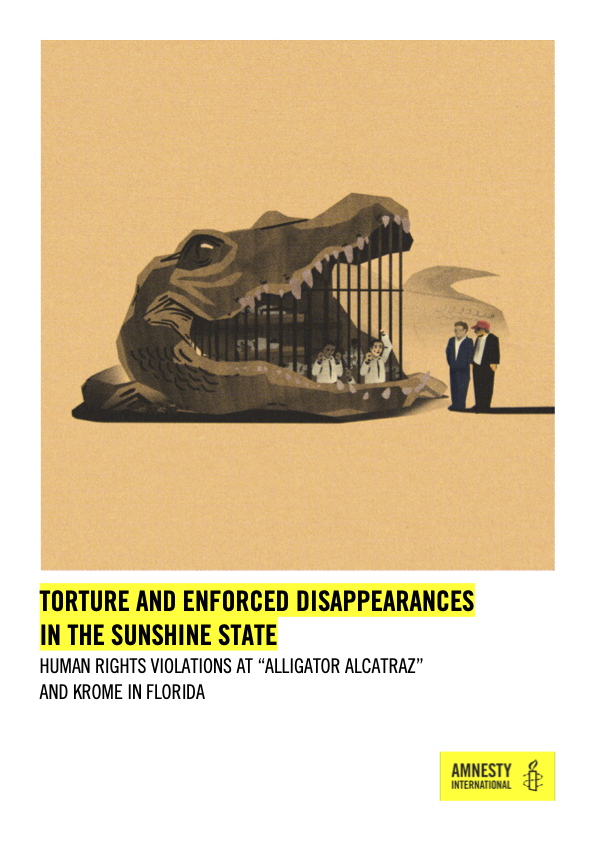
By Amnesty International
This report presents Amnesty International’s findings from a research trip to southern Florida in September 2025, to document the human rights impacts of federal and state migration and asylum policies on mass detention and deportation, access to due process, and detention conditions since President Trump took office on 20 January 2025. In particular, it focuses on detention conditions at the Krome North Service Processing Center (Krome) and the Everglades Detention Facility, also known as “Alligator Alcatraz”.

By Giulia Berlusconi
This paper investigates the impact of the targeting of key players by law enforcement on the structure, communication strategies, and activities of a drug trafficking network. Data are extracted from judicial court documents. The unique nature of the investigation – which saw a key player being arrested mid-investigation but police monitoring continuing for another year – allows to compare the network before and after targeting. This paper combines a quantitative element where network statistics and exponential random graph models are used to describe and explain structural changes over time, and a qualitative element where the content of wiretapped conversations is analysed. After law enforcement targeting, network members favoured security over efficiency, although criminal collaboration continued after the arrest of the key player. This paper contributes to the growing literature on the efficiency-security trade-off in criminal networks, and discusses policy implications for repressive policies in illegal drug markets.
Global Crime, Volume 23, 2022 - Issue 1

By Matthew Edwards,Jack Mark Whittaker, Cassandra Cross & Mark Button
The internet has revolutionised retail sales, with online shopping a common practice globally. While convenient, offenders have also embraced the opportunity to target potential victims and their shopping carts. Online shopping fraud occurs when offenders represent themselves as legitimate online sellers to gain sales from unsuspecting victims, both by impersonating genuine retailers and creating fictional retailers with non-existent products. The current article explores the victimisation and near misses of consumers to online shopping fraud. Based on survey responses of 1011 Australians, the article examines the online shopping activities of individuals as well as any victimisation or near miss experiences. The results indicate a high level of victimisation and near misses across this sample. It further examines a range of impacts experienced by these consumers and considers the implications of these results for the retail sector and prevention practices into the future.
Global Crime, 26(1), 69–89.
By Fritz Brugger, Joschka J. Proksik & Felicitas Fischer
Most research on illicit financial flows (IFFs) has focused on illicit outflows from low-income countries and the role of non-state actors in generating IFFs. Less attention has been paid to processes through which IFFs enter formal value chains – in effect being legalised before leaving the country – or the crucial role of state institutions as gatekeepers. We develop a novel explanatory approach to account for the enabling role of state institutions in the legalisation of IFFs. Building on political settlement theory, we explain the performance of institutions in regulating IFFs as a function to maintain political power. Taking the case of Bolivia, we examine how legalising illicit value flows works in practice and analyse the motives and underlying conditions that lead state institutions to permit the formal export of gold shipments that have been illicitly sourced or transferred. We find that the legalisation of IFFs accommodates the interests of powerful cooperatives dominating the gold-mining sector, which are critical to maintaining the political settlement on which the incumbent government’s power is based. By maintaining a status quo of non-enforcement, legal ambiguity, and informality, gold-mining cooperatives reap higher benefits from resource extraction at the expense of domestic revenue mobilisation.
New Political Economy, Volume 29, 2024 - Issue 4
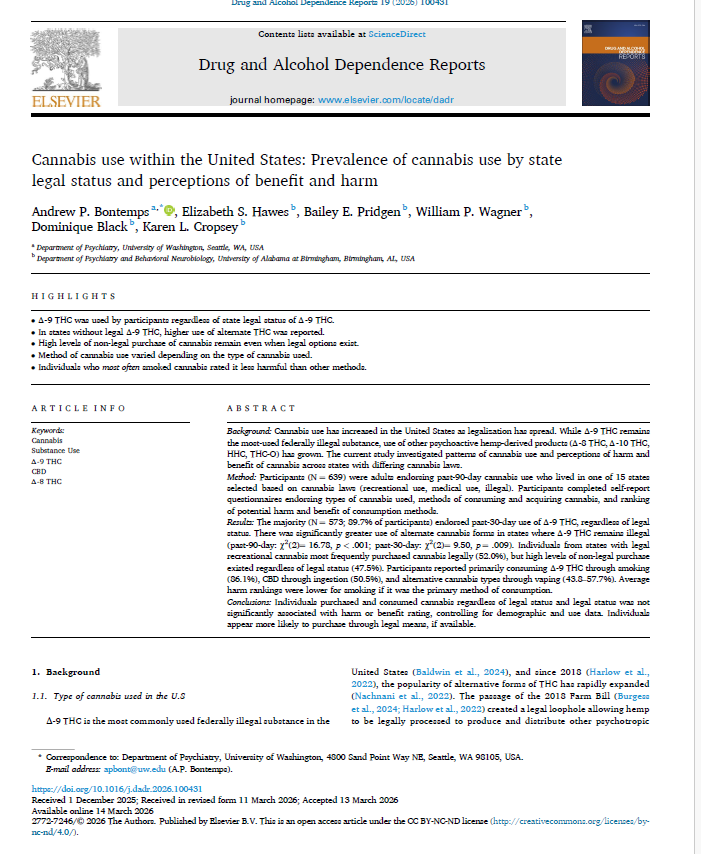
By Andrew P. Bontemps, Elizabeth S. Hawes, Bailey E. Pridgen, William P. Wagner, Dominique Black, Karen L. Cropsey
Background:Cannabis use has increased in the United States as legalization has spread. While Δ-9 THC remains the most-used federally illegal substance, use of other psychoactive hemp-derived products (Δ-8 THC, Δ-10 THC, HHC, THC-O) has grown. The current study investigated patterns of cannabis use and perceptions of harm and benefit of cannabis across states with differing cannabis laws.
Method
Participants (N=639) were adults endorsing past-90-day cannabis use who lived in one of 15 states selected based on cannabis laws (recreational use, medical use, illegal). Participants completed self-report questionnaires endorsing types of cannabis used, methods of consuming and acquiring cannabis, and ranking of potential harm and benefit of consumption methods.
Results
The majority (N=573; 89.7% of participants) endorsed past-30-day use of Δ-9 THC, regardless of legal status. There was significantly greater use of alternate cannabis forms in states where Δ-9 THC remains illegal (past-90-day: χ2(2)=16.78, p<.001; past-30-day: χ2(2)=9.50, p=.009). Individuals from states with legal recreational cannabis most frequently purchased cannabis legally (52.0%), but high levels of non-legal purchase existed regardless of legal status (47.5%). Participants reported primarily consuming Δ-9 THC through smoking (86.1%), CBD through ingestion (50.5%), and alternative cannabis types through vaping (43.8-57.7%). Average harm rankings were lower for smoking if it was the primary method of consumption.
Conclusions
Individuals purchased and consumed cannabis regardless of legal status and legal status was not significantly associated with harm or benefit rating, controlling for demographic and use data. Individuals appear more likely to purchase through legal means, if available.
Drug and Alcohol Dependence Reports
Available online 14 March 2026, 100431
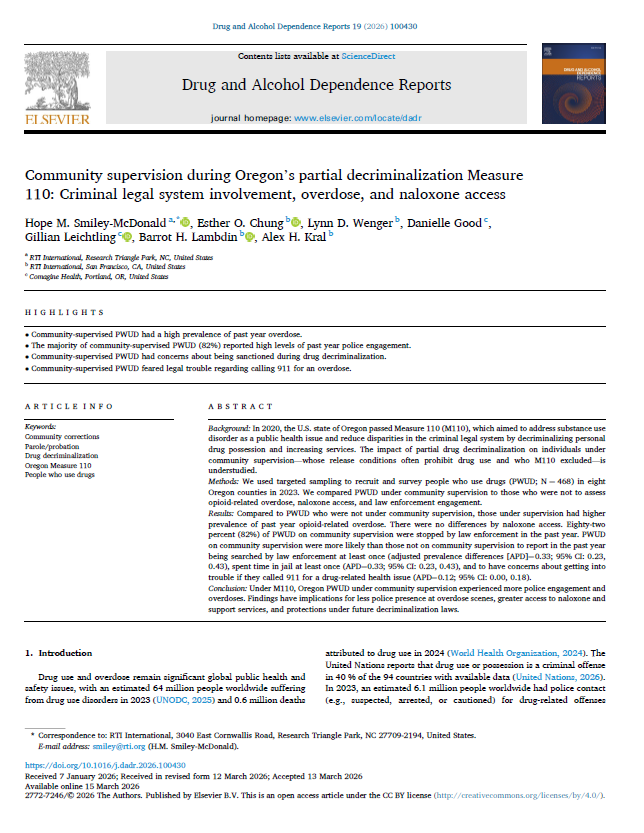
Bt Hope M. Smiley-McDonald, Esther O. Chung , Lynn D. Wenger, Danielle Good , Gillian Leichtling c, Barrot H. Lambdin , Alex H. Kral
Background
In 2020, the U.S. state of Oregon passed Measure 110 (M110), which aimed to address substance use disorder as a public health issue and reduce disparities in the criminal legal system by decriminalizing personal drug possession and increasing services. The impact of partial drug decriminalization on individuals under community supervision—whose release conditions often prohibit drug use and who M110 excluded—is understudied.
Methods
We used targeted sampling to recruit and survey people who use drugs (PWUD; N=468) in eight Oregon counties in 2023. We compared PWUD under community supervision to those who were not to assess opioid-related overdose, naloxone access, and law enforcement engagement.
Results
Compared to PWUD who were not under community supervision, those under supervision had higher prevalence of past year opioid-related overdose. There were no differences by naloxone access. Eighty-two percent (82%) of PWUD on community supervision were stopped by law enforcement in the past year. PWUD on community supervision were more likely than those not on community supervision to report in the past year being searched by law enforcement at least once (adjusted prevalence differences [APD]=0.33; 95% CI: 0.23, 0.43), spent time in jail at least once (APD=0.33; 95% CI: 0.23, 0.43), and to have concerns about getting into trouble if they called 911 for a drug-related health problem (APD=0.12; 95% CI: 0.00, 0.18).
Conclusion
Under M110, Oregon PWUD experienced more police engagement and overdoses. Findings have implications for less police presence at overdose scenes, greater access to naloxone and support services, and protections under future decriminalization laws.
Drug and Alcohol Dependence Reports
Available online 15 March 2026, 100430
In Press, Journal Pre-proof
By Matthew F. Garnett, Jodi A. Cisewski, Farida B. Ahmad
Objective:
This report identifies the specific drugs most frequently involved in drug overdose deaths in the United States from 2017 through 2023.
Methods:
Data from the 2017–2023 National Vital Statistics System mortality files were linked to literal text data from death certificates. Drug overdose deaths were identified using the International Classification of Diseases, 10th Revision underlying cause-of-death codes X40–X44, X60–X64, X85, and Y10–Y14. Specific drugs were identified by searching three literal text fields of the death certificate: the causes of death from Part I, significant conditions contributing to death from Part II, and the description of how the injury occurred. Contextual information was used to determine drug involvement in the death. Descriptive statistics were calculated for the most frequently mentioned drugs involved in drug overdose deaths. Deaths involving multiple drugs were counted in all relevant drug categories.
Results:
Among drug overdose deaths with mention of at least one specific drug, the most frequently mentioned drugs during 2017–2023 included: fentanyl, heroin, oxycodone, morphine, methadone, hydrocodone, alprazolam, diphenhydramine, cocaine, methamphetamine, amphetamine, gabapentin, and xylazine. Fentanyl ranked first across all years and was the most common concomitant drug found with other top drugs, ranging from 99.0% of xylazine-involved drug overdose deaths to 48.3% of oxycodone-involved drug overdose deaths. Cocaine and methamphetamine were also frequent concomitant drugs. Trends in age-adjusted rates across the 2017 to 2023 period varied by drug, but notably the rate for heroin-involved deaths sharply declined, while the rate for fentanyl-involved deaths increased and then stabilized between 2022 and 2023. In 2023, the most frequently mentioned drugs in unintentional drug overdose deaths were fentanyl, methamphetamine, and cocaine, while the most frequently mentioned drugs for suicide-related drug overdoses were diphenhydramine, oxycodone, and bupropion.
Conclusions:
This report identifies patterns in the specific drugs most frequently involved in drug overdose deaths from 2017 through 2023.National Vital Statistics Reports; CDC National Center for Health Statistics; 2026.
By lBenedikt Fischer, Didier Jutras-Aswad, Bernard Le Foll, Daniel T. Myra
Highlights
•
The province of British Columbia (Canada) temporarily implemented a decriminalization initiative for personal drug possession/use (2023–2024) in contexts of a toxic drug death crisis.
•
The decriminalization initiative was a priori promoted as a “tool to end the overdose crisis” and widely expected to reduce adverse health outcomes from toxic drug use.
•
Emerging evaluation data indicate that the drug decriminalization initiative was not associated with population-level changes in drug use-related mortality (e.g., overdose deaths) or morbidity (e.g., hospitalizations).
•
Drug use decriminalization remains an essential step to align prohibition-based drug policy frameworks with public health and human rights principles, but must be approached realistically and designed sensibly.
•
To tangibly address toxic drug use-related harms, expanded measures are required that are effectively capable of preventing and reducing PWUDs’ exposure to and use of toxic drugs
International Journal of Drug Policy
Volume 150, April 2026, 105181
By Nicolas Sarullo .Yuriy Gorodnichenko, Tatyana Deryugina,James Hodson ,Ilona Sologoub, Anastassia Fedyk
Using household survey data on expenditures and incomes, we construct an objective measure of corruption in the public sector for a broad spectrum of countries. Specifically, we focus on the consumption-income gap for public sector workers relative to private sector workers to gauge the extent of hidden income (bribes) in the government. After validating our data and documenting properties of the consumption-income gap, we compare our measure with popular corruption perception indices. We find that i) the relationship between our measure and the alternatives is nonlinear; ii) available indices appear to be only weakly (and sometimes “wrongly”) correlated with the consumption income gap at high frequencies; iii) the available indices appear to have a low weight on the relative consumption-income gap in the public sector.
By Carolina Martinelli
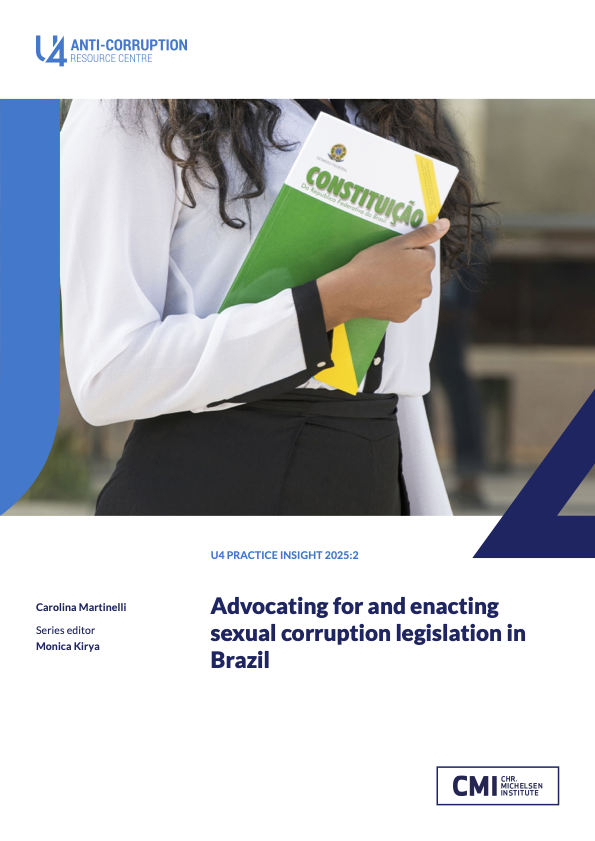
Brazil may join a small but growing number of countries that have already criminalised sexual corruption through specific legal provisions. This legislative effort shows how naming, strategic framing, and cross-sector collaboration can bring invisible gendered abuses into legislative concern. It offers critical lessons on the importance of political sponsorship, data collection, and media visibility for addressing complex, underreported crimes.