


By Alexander Ritzmann
This article is part four of CEP’s series on the violent extreme left in Europe. It focuses on antisemitism and eliminationist anti-Zionism within violence-oriented left-wing milieus. The article provides examples and analysis from France, Germany, Greece, Italy, and Spain and asks how antisemitic and anti-Zionist narratives can justify violence, connect extremist actors, or contribute to target selection. It concludes with policy recommendations for EU and national authorities on identifying, assessing, and responding to violence-oriented antisemitic extremism.
Key Findings
The Israel–Palestine conflict has become an additional mobilizing issue within parts of Europe’s existing violence-oriented extreme left. Several actors examined here have incorporated antisemitism and/or eliminationist anti-Zionism into established revolutionary, anti-imperialist, or antifascist agendas. Justifying violence as “resistance” is a recurring pattern. Some actors praise attacks or present militant action as a model for political action. The risk of violence increases when general support for “resistance” develops into endorsement of specific attacks, identification of concrete targets, or encouragement of further
violence. Target expansion is an important escalation indicator. In several cases, hostility moves from Israel and Israeli institutions toward businesses, organizations, and identifiable people described as “Zionists. Public lists, collection of identifying information, and intimidation reduce the distance between ideological hostility and physical targeting. Actors perform different functions: some legitimize violence, connect
groups, identify targets, or organize and conduct attacks. These functions can overlap without common leadership. Available statistics cannot establish the scale of antisemitic violence attributable to left-wing extremist actors across Europe. National systems measure different phenomena, and perpetrators’
affiliations often remain unknown.

By Mohammad H. Rahmati, David A. Hyman
Crime doesn't pay. Or does it? We study the role of expectations regarding sanctions and the likelihood of detection on whether people obey the law. We examine how expectations influence whether people obey the law and conduct simulations of various enforcement counterfactuals. We find the average assessment of the likelihood of detection is reasonably accurate, but those who (mistakenly) believe the probability is lower than it is are much more likely to break the law. Further, expectations with regard to the likely consequences of getting caught are also heterogeneous. In our simulations, perceived fines have little impact on willingness to break the law, but a higher perceived likelihood of apprehension has an appreciable impact. Because marginal respondents are pivotal in the rate of law-breaking, debiasing expectations among the whole population has little impact

By Gabriel Silveira de Queirós Campos, Américo Bedê Jr., Aline Pires de Angeli Ferreira
This article presents the findings of a quantitative study on sentencing practices in Brazil, focusing on the presence of numerical patterns and “penal clustering” in judicial decisions. Drawing on a dataset of criminal sentences from São Paulo—the country's most populous and active judiciary—the research statistically investigates whether Brazilian judges display preferences for certain sentence lengths, such as even numbers, “round numbers,” and multiples of 6 months. The study also examines the role of numerical fractions in shaping sentence variability. Despite Brazil's civil law tradition and the absence of formal sentencing guidelines, the results reveal a significant degree of penal clustering, with judges consistently relying on a narrow set of sentencing values. These patterns suggest the influence of cognitive heuristics, particularly “anchoring effects,” in sentencing decisions. While the use of numerical fractions may enhance consistency and predictability, it may also constrain individualization—raising concerns about mechanical decision-making and reduced responsiveness to case-specific circumstances. The article discusses the implications of these findings for judicial training, institutional reform, and public policy. It argues for a more data-informed and psychologically aware approach to sentencing, capable of balancing the dual demands of consistency and individualization within both common law and civil law traditions.
By Ian T. Adams, Kyle McLean, Geoffrey P. Alpert
Police body-worn cameras (BWCs) generate extensive video data on officer behavior, yet resource constraints mean that only a fraction of this footage is ever reviewed. Recent advancements in artificial intelligence (AI) present an opportunity to automate these reviews, potentially influencing police conduct. We evaluate the impact of AI-led auditing in two pre-registered, randomized controlled trials conducted within two large US police agencies. The findings are mixed but positive: In a department operating under a consent decree, officers exhibited significant reductions in substandard professionalism, whereas in an agency without external oversight, officers increased the frequency of highly professional interactions. These results show that AI auditing of BWC footage can influence officer behavior, with its effects shaped by organizational and institutional contexts.

By Kevin Petersen, Brian D. Johnson, Allison D. Redlich, Miranda A. Galvin
Extant research on criminal sentencing generally concludes that racial/ethnic disparity is concentrated in the “in–out” decision, and that racial differences in sentence lengths are small and inconsistent. However, sentence length analyses rarely focus on the fact that criminal sentences are often partially or fully suspended, creating situations in which the sentence formally imposed differs from the sentence served. In many jurisdictions, suspended sentencing is used widely and is a highly discretionary decision that carries considerable potential to mask racial inequality in punishment. This study uses 24 years of sentencing guideline data (2000–2023) from the state of Maryland to test for racial/ethnic disparity in the use of suspended sentences. Using a novel modeling approach capable of simultaneously estimating the probability of receiving a fully suspended sentence, a fully executed sentence, and variation in the proportion of the total sentence suspended, we test for racial disparities in the application of suspended sentencing outcomes. We identify significant and meaningful disparities in suspended sentences that are largest for minority defendants convicted at trial. However, we also find that this disparity has been declining over time. Ultimately, we emphasize the importance of distinguishing between active and suspended sentences in ongoing research on punishment inequalities.

By Lindsay Graef, Aurelie Ouss
Despite increasing attention to prosecutors' role in shaping criminal justice outcomes, there is limited empirical research on what prosecutors do. While most theories of prosecutorial discretion emphasize overarching goals related to justice and safety, our paper shifts the focus toward the practical realities of the job, particularly in the lower courts. We propose a case management model of prosecutorial discretion, grounded in analyses of misdemeanor cases handled by the Philadelphia District Attorney's Office. Importantly, our dataset includes hearing-level prosecutor identifiers and decisions. By adapting established benchmarking methods, we identify credible counterfactuals and analyze how prosecutor actions influence case and defendant outcomes. We find that prosecutors vary in their case management skills, which are an important driver of conviction. Defendants fare better under prosecutors who secure fewer convictions, indicating negative consequences of conviction, but prosecutors who secure fewer convictions tend to be less effective in their day-to-day case management tasks. This highlights a fundamental tension in a prosecutor's work: prosecutors meeting office standards demonstrate worse outcomes in terms of future criminal justice contacts. Our findings underscore the need to rethink what makes an effective prosecutor in order to achieve policy goals such as public safety, rehabilitation, and efficient resource use.

By William J. Schultz, Sandra M. Bucerius, Kevin D. Haggerty
Drug entry into prisons represents a serious issue for both incarcerated people and prison staff. Although substances enter prisons in many ways, staff drug smuggling represents a consistent problem facing correctional institutions globally. We draw on 131 interviews with correctional officers (COs) working in four Western Canadian prisons to analyze how COs understand and respond to drug smuggling. Participants drew on specific cultural narratives to portray coworkers who smuggled drugs, suggesting that CO occupational subcultures played a meaningful role in shaping how they perceived drugs, drug smuggling, and “dirty” correctional staff. Officers further detailed cultural narratives and frames they employed to detect and prevent drug trafficking among their peers. These included the informal social controls of boundary work and horizontal surveillance, which we analyze using Douglas’ concepts of purity and impurity. Participants justified such practices as efforts to reduce drug smuggling but also described how boundary work and horizontal surveillance stratified the CO population in distinctive ways. We conclude by discussing how CO cultures should influence our perceptions of staff drug smuggling.
By Francesco Calderoni, Jürgen Lerner, David Bright
This study examines how social embeddedness and multiplex relationships shape criminal collaboration within organized crime networks. Drawing on data from three major investigations into the ‘Ndrangheta, we analyze how kinship, clan affiliation, leadership, and prior interactions influence participation in meetings and phone calls. Using relational hyperevent models, we assess the dynamic and multiplex nature of these networks across time and investigations. Results show that kinship, leadership, and shared clan affiliation consistently increase the likelihood of interaction, with stronger effects for face-to-face meetings. Prior joint interactions also predict future collaboration, especially when the mode remains consistent. We find contrasting patterns of closure: meetings resist triadic closure, reinforcing exclusivity and hierarchy, whereas phone calls promote connectivity by bridging structural holes. By modeling multiple relational mechanisms simultaneously and across different networks, this study contributes to research on criminal embeddedness and the structural organization of illicit collaboration.

By Jason Robey, Matt Vogel
Social scientists have long been interested in understanding how age, period, and cohort effects shape long-term homicide trends. Yet fundamental measurement challenges remain pervasive in estimating age-specific homicide rates for birth cohorts. We begin by defining multiple alternative approaches for measuring homicide rates for birth cohorts, highlighting their advantages and disadvantages. We empirically demonstrate substantial differences in the estimated cohort-specific homicide rates across alternative measurement approaches. These discrepancies are particularly large when using 5-year age categories and 5-year birth cohorts, with a nearly twofold difference in estimated homicide rates for 15- to 19-year-olds in some cohorts. Substantively, these discrepancies have consequences even for basic questions about homicide trends, including which birth cohorts had the highest homicide rates. We provide a framework for understanding why these discrepancies arise and propose the reconstructed cohort measurement approach as a practical solution to produce valid estimates given available data. Simulation analyses confirm this approach substantially outperforms approaches used in the prior literature. Lastly, we demonstrate that these measurement challenges can lead to fundamentally different results in regression models predicting cohort effects on homicide rates. Our results underscore how accurately measuring cohort-specific homicide rates is an essential, yet often overlooked, part of understanding homicide trends.
By Katheryn Russell-Brow
This article is based on Katheryn Russell-Brown's 2025 presidential address at the 85th annual meeting of the American Society of Criminology, held in Washington, D.C. The article begins with an overview of the Author's approach to research and the highlights of her scholarly contributions. Following this, the article presents a research question—whether contemporary race and crime scholars and their scholarship have been stigmatized by the creation of a moral panic designed to marginalize and criminalize their work. This moral panic specifically targets Black history and other race-related scholarship. A criminological and sociological lens is used to analyze the breadth of the panic. Using moral panic as a base for the discussion, the next section examines the broad contours of stigma, and stigmatization and how race-related stigmas operate. Following this is a look at how negative stigmas assigned to race scholars and race scholarship harms the discipline of criminology. For instance, studies indicate that fewer scholars will embrace race and crime scholarship if its value is diminished. Migration studies and imagined futures are included in the assessment of how racial stigmas impact race scholarship. Academic disciplines benefit from rigorous engagement regarding their core principles and perspectives. The absence or diminishment of critical research creates a void in the criminology literature. This raises questions about the representativeness, integrity, and comprehensiveness of criminological scholarship. The article concludes with a charge to the discipline to ensure that race and crime scholarship remain a robust part of the criminological canon.
By Verónica Grondona, Markus Meinzer, Nara Monkam, Alison Schultz, Gonzalo Villanueva
This study presents a new, multidisciplinary method to assess countries’ vulnerabilities to illicit financial flows (IFFs) in different economic channels. Acknowledging that money laundering involves legitimate financial channels and regulatory gaps, our approach combines quantitative data on bilateral economic activities with a qualitative assessment of the regulatory frameworks of trade and investment partners. Using publicly available and contemporary data along with a legal analysis focused on the loopholes that can be exploited for IFFs, the proposed methodology addresses the limitations of current National Risk Assessments (NRAs) and offers an accessible and cost-effective approach that can be applied for anti-money laundering. We illustrate the effectiveness of our approach by analyzing IFF vulnerabilities in Nigerian inward foreign direct investment, Brazilian outward portfolio investment, and Indonesian imports demonstrating its potential to refine and enhance National Risk Assessments
By Mohammad Fazle Rabbi
Environmental crime poses a significant threat to global ecosystems, biodiversity, and human well-being, encompassing activities such as pollution, illegal waste disposal, trade in protected species, and natural resource degradation. Understanding the dynamics of these crimes is essential for devising effective mitigation strategies and promoting sustainability at micro, meso, and macro level. The aim of the study is to examine environmental crimes in the EU, focusing on their current trends, patterns, and Intensity, as well as the impact on sustainability across its three dimensions. Fourteen EU countries environmental crime data from 2016 to 2021were analysed to reveal variations and trends. Geographic information systems (GIS) utilized to identify countries with elevated environmental crime rates, emphasizing the need for interventions in pollution control, waste management, and resource conservation. Results indicate high environmental pollution intensity in Italy, Sweden, and Denmark. Moreover, Italy emerges as the epicentre of illegal waste dumping, with notable cases also present in Belgium and France. Additionally, France, Slovakia, and Italy show alarming levels of illegal wildlife trade. Furthermore, France and Sweden exhibit the highest density of natural resource degradation cases. In addition, the study unveiled a positive correlation () between environmental pollution, trade in protected species, and natural resource degradation with population growth, while waste disposal exhibited a negative correlation (). Moreover, trade in protected species and resource degradation correlated negatively () with the poverty ratio. Addressing environmental crimes aligns with the pursuit of green justice, recognizing the interconnectedness of environmental, social, and economic factors. The findings offer valuable insights for policymakers, environmentalists, and communities, guiding interventions towards a sustainable and resilient future.
By Robert O. Motley Jr , Eric Williamson , Melissa McTernan , Sara Beeler c, Christopher P. Salas-Wright
Purpose
Racism-based police violence (RPV) is an emerging public health concern. However, limited research has examined the relationship between RPV exposure and substance use, particularly among Black or African American and Hispanic emerging adults aged 18–29 years. This study assessed associations between lifetime RPV exposure across three domains (direct victimization, witnessing in person, and media-based exposure) and past 30-day and 12-month alcohol and cannabis use in this population.
Methods
A cross-sectional survey was conducted from August to October 2023 using a national nonprobability internet sample recruited via Qualtrics. The analytic sample included 936 Black or African American (48 %) and Hispanic (52 %) emerging adults. Negative binomial and logistic regression models were used to examine associations.
Results
Higher levels of RPV exposure were significantly associated with increased alcohol and cannabis use. RPV–Victim exposure was the strongest predictor of alcohol use, including past 30-day (IRR = 1.02, 95 % CI: 1.00–1.05) and 12-month (OR = 1.04, 95 % CI: 1.01–1.07) use. RPV–Witness exposure was most strongly associated with cannabis use, including past 30-day (IRR = 1.02, 95 % CI: 1.00–1.03) and 12-month (OR = 1.03, 95 % CI: 1.01–1.06) use. A dose-response pattern was observed across increasing levels of RPV exposure.
Conclusions
RPV exposure is a significant correlate of alcohol and cannabis use among Black or African American and Hispanic emerging adults. Findings suggest that perceived racialized policing is a significant risk factor for substance use and warrants further investigation as a potential structural determinant, highlighting it as an important target for public health interventions.

By The Centre of expertise on child sexual abuse (CSA Centre)
This resource introduces some of the key research and statistics on what is known about child sexual abuse: what it is, who harms children, where it takes place, the impact on children and, crucially, what you as a police professional can do in response. It is designed for all police professionals, whether you're the attending officer responding to a call or the officer assigned to a case. Throughout the 10 sections, you’ll find blue boxes containing key takeaways, prompts and signposts for you to consider when faced with concerns of child sexual abuse. At the end, there are links to other publications from the CSA Centre, which provide practical information and advice on understanding, identifying and responding to child sexual abuse. Remember, it is never a child’s responsibility to prevent abuse, protect themselves or make the abuse stop. But by better understanding child sexual abuse, having conversations and highlighting concerns, we can all play a role in better protecting children.
By Samantha Weston, Clare Griffiths and Anne-Marie Day
Louise Casey’s review revealed a series of concerns about London Metropolitan Police concluding that institutional racism, misogyny and homophobia pervades across the whole organisation. Acknowledging that police legitimacy is under threat, some have called for the police to be defunded. Drawing on data collected via a survey and focus groups with children and young people from traditionally unheard minoritised groups attending a community-based programme, this article reveals low levels of satisfaction with and trust of the police among this group. In contrast, activities based and created within young people’s own communities provided opportunities to be safe, protected and among people they trusted. Drawing on Gramsci’s theory of hegemony, we suggest that the call to ‘defund the police’ may not be the radical alternative that many would have us believe and instead call to ‘refund civil society’ by advocating for a ‘community first’ approach to resolve complex social problems.

By Jeremy M. Wilson and Clifford A. Grammich
This publication illustrates elements of the police staffing challenge and explores how they form a broader ecosystem that agencies should consider when assessing staffing issues, contemplating goals and strategies, and implementing solutions. It presents a six-step approach for police workforce planning and managing workload demand and addresses planning for three common staffing scenarios.
By Rashad James
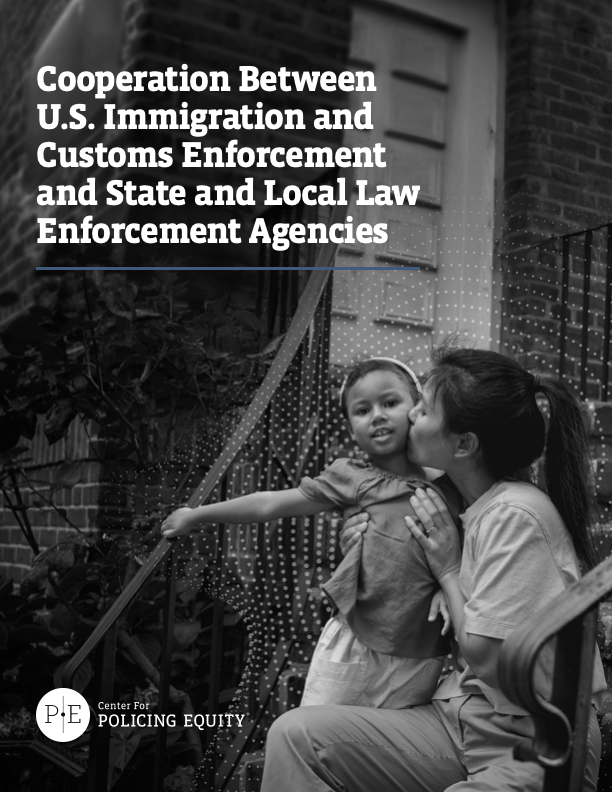
For community advocates, policymakers, and law enforcement agencies (LEAs) interested in exploring alternatives, this document outlines how federal immigration authorities can—and cannot—compel state and local LEAs to cooperate. It also proposes four strategies that state and local jurisdictions can adopt to resist the growing push for a uniform law enforcement system under executive authority. Specifically, jurisdictions can 1) name the actions currently underway; 2) claim their moral vision through proactive legislation; 3) restrain the use of local funding for immigration enforcement; and 4) reframe these initiatives as measures that strengthen public safety. Community members and elected leaders are encouraged to share this document as a pathway toward a more just and equitable future.
By Robin S. Engel, Nicholas Corsaro, Gabrielle T. Isaza, Hannah D. McManus, University of Cincinnati
In recent months, law enforcement officers have been faced with an unprecedented set of circumstances, navigating major social unrest in communities amid a pandemic and economic crisis. Acknowledging the dangers to both the community and officers, efforts have intensified to identify “solutions” to reduce the frequency and severity of violent encounters between police and the public. Calls for the adoption of “de-escalation” policies and training – widely endorsed by policy makers, policing experts, and the public – have been especially strong, and recent statistics on law enforcement practices suggest the field has responded (Engel et al., 2020b). For example, in a 2019 national survey of 155 large police departments in the United States, nearly all responding agencies indicated they offered some form of de-escalation training to officers in their agency (CBS, 2019). Although the implementation of de-escalation training is often encouraged, the effects of this training on police officers and their interactions with the public has not been systematically evaluated (Engel et al., 2020a). For this reason, the impact of de-escalation training on the frequency and severity of officers’ use of force and the subsequent injuries to citizens and officers is not well understood. It was within this context that the Louisville (KY) Metro Police Department (LMPD) stepped forward to both deliver and participate in the evaluation of a deescalation training. Specifically, the LMPD introduced the Police Executive Research Forum’s (PERF) Integrating Communications, Assessment, and Tactics (ICAT) training program to instruct officers in de-escalation tactics and critical thinking skills for the management of potentially volatile police-citizen encounters. Seeking to understand the effectiveness of this training, the LMPD partnered with the International Association of Chiefs of Police/University of Cincinnati Center for Police Research and Policy (IACP/UC Center) to conduct an independent, external evaluation of the effects of the ICAT training on their agency. This report documents the methodology and findings of the evaluation of ICAT training implemented within the LMPD. This study represents one of the first large-scale, methodologically rigorous evaluations of a well-known de-escalation training for police. Specifically, this study uses a multi-method approach, relying upon two distinct survey designs (i.e., repeated measure survey design, cross-sectional survey design) to assess the impact of training on the perceptions and self-reported experiences of officers and first-line supervisors, and a stepped-wedge randomized control trial design to examine training effects on officers’ behaviors and changes in the outcomes of police-citizen encounters. This seminal study is the first randomized control trial to demonstrate a significant reduction in officer use of force following de-escalation training implementation.
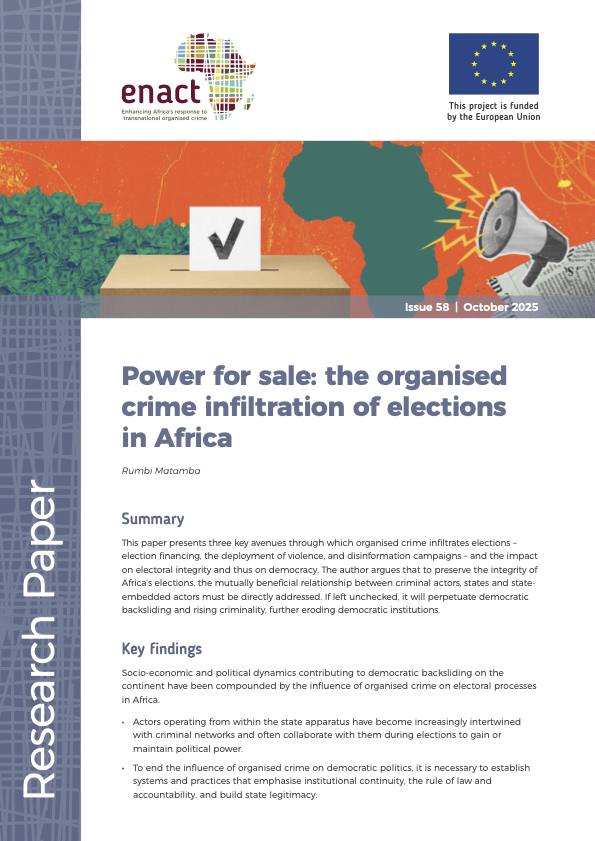
By Rumbi Matamba
Breaking the mutually beneficial relationship between criminal actors and political elites is essential to preserving electoral integrity and democracy in Africa. This paper presents three key avenues through which organised crime infiltrates elections – election financing, the deployment of violence, and disinformation campaigns – and the impact on electoral integrity and thus on democracy. The author argues that to preserve the integrity of Africa’s elections, the mutually beneficial relationship between criminal actors, states and stateembedded actors must be directly addressed. If left unchecked, it will perpetuate democratic backsliding and rising criminality, further eroding democratic institutions
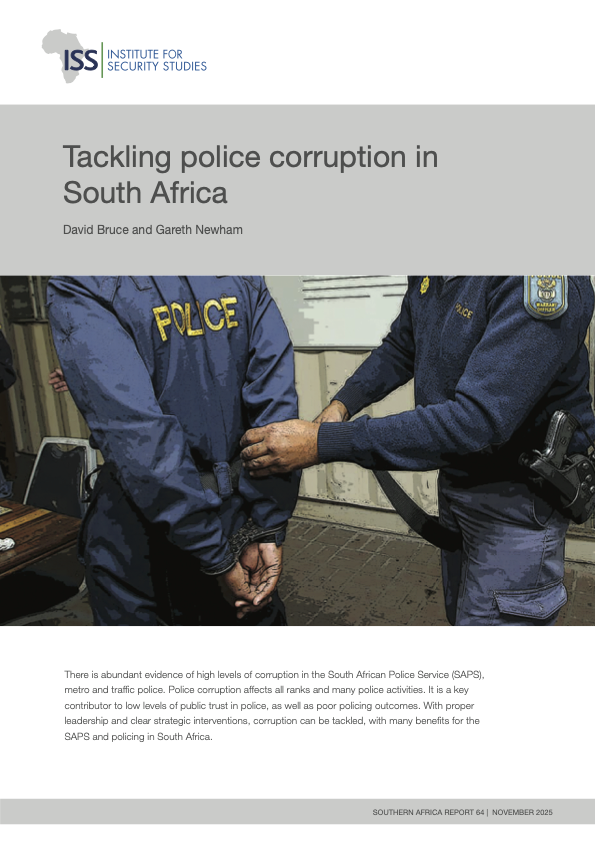
By David Bruce and Gareth Newham
Key findings There is strong evidence of ongoing widespread corruption in the South African Police Service (SAPS), including among its senior leaders. Corruption levels in the metro and traffic police are also high, although they receive less scrutiny than the SAPS. Perceptions of high levels of police corruption contribute to low levels of public trust in the police. TrA range of agencies and mechanisms are tasked with investigating police corruption, but no agency has overall responsibility. Coordination between agencies is limited. SAPS has introduced multiple anti-corruption strategies, but has not implemented intelligencedriven measures to ensure that corruption is tackled effectively. The SAPS Anti-Corruption Investigation Unit (ACIU) is substantially under-resourced. Despite evidence of misconduct, a majority (77%) of SAPS disciplinary hearings result in no meaningful accountability.ust is vital for the police to effectively address crime. SAPS members are often unwilling to report crime or corruption by colleagues because they fear negative consequences for themselves. The willingness of many members of the public to pay bribes is an important contributor to high levels of police corruption.