Open Access Free Library
CRIMINAL JUSTICE.jpeg

CRIMINAL JUSTICE

CRIMINAL JUSTICE-CRIMINAL LAW-PROCDEDURE-SENTENCING-COURTS

Cascading Constraint and Subsidiary Discretion: Perspectives on Police Discretion From Police-Led Drug Diversion and Stop and Search in England

By : Lex Stevens, Winifred Agnew-Pauley, Matthew Bacon, Helen Glasspoole-Bird, Nadine Hendrie, Caitlin Elizabeth Hughes, Charlie Lloyd, Mark Monaghan, Rivka Smith, Charlie Sutton 

This article explores how discretion is managed and exercised across senior, middle, and street levels of policing. It uses qualitative data from two studies in England. The first, a study across three police force areas, involved interviews and focus groups with 221 people who were designers, deliverers, and recipients of police-led drug diversion. The second study used 354 hours of ethnographic observation and 21 interviews to examine stop-and-search practices in one other police force. Rather than a simply expanding scope of discretion at lower levels of the hierarchy, the findings reveal a multi-level process of cascading constraints and subsidiary discretion. At each level, we observe the exercise of occupational professionalism and autonomous judgement, but higher-level constraints shape how discretion is applied in pursuit of organizational professionalism.

How could taxing illicit financial flows contribute to financing a universal child benefit in Ghana?

By Enrico Nichelatti and Adnan Abdulaziz Shahir

Trade mis-invoicing represents a significant economic challenge in Ghana, with losses estimated at 3.03 per cent of gross domestic product in 2018. We examine the potential of a universal child benefit in Ghana through a counterfactual taxation of illicit financial flows. Using microsimulation, we model two budget-neutral designs: a flat per-child transfer and a quasi-universal schedule with higher amounts for larger households. Both options lower poverty and inequality, with stronger effects in rural areas and among larger households. The universal design yields slightly greater overall poverty reduction: the quasi-universal variant better protects large families. Although such revenues cover only a limited share of the poverty gap, redirecting them can expand social protection without raising distortionary taxes. The study links tax justice to social policy expansion and questions claims that universal benefits are unaffordable in low- and lower-middle-income countries. The study assesses only first-round effects and does not address political feasibility.

Over-Federalization: Federal Intrusion Into State Criminal Law 

By Liz Komar

A broad and growing number of crimes are criminalized at both the state and federal levels. This means that either state or federal authorities, or both, can prosecute these offenses. Long-standing political pressure for federal lawmakers to demonstrate their responsiveness to constituent concerns about crime,1 even if the crimes in question are already subject to local prosecution, has led to a federeral criminal code that encompasses a wide array of local conduct. That broad reach comes at a significant cost

Brady Lists 

By Rachel Moran

Brady lists, named after the Supreme Court decision Brady v. Maryland,1 are lists some prosecutors maintain of law enforcement officers with histories of misconduct that could impact the officers’ credibility in criminal cases.2 Brady and its progeny require prosecutors to disclose exculpatory evidence within the government’s possession or control to defendants in criminal cases.3 This includes evidence that could impeach a witness’s credibility.4 Evidence that a police officer involved in a criminal case has, for example, previously written a false police report, lied in court, or used racial slurs during an arrest may be exculpatory because it casts doubt on the officer’s truthfulness, credibility, and impartiality.5 Brady lists originated from this disclosure obligation: the lists ostensibly allow prosecutors to keep track of, and disclose to defense counsel when necessary, information that negatively impacts officers’ credibility.6 Brady lists are simple in concept and complicated in practice. Prosecutorial practices around maintaining and using Brady lists vary widely and are almost completely unregulated.7Neither federal nor most state laws require prosecutors to maintain Brady lists, and recent journalist investigations suggest that most prosecutor offices do not maintain such lists.8 The lists that do exist are not all equal. Some prosecutor agencies maintain expansive lists of police officers who are accused of or found to have committed misconduct of nearly any kind,9 while others limit their Brady lists to officers with histories of dishonesty orcriminal convictions.10 Disclosure practices are similarly inconsistent: some prosecutors maintain Brady lists as internal mechanisms for assessing credibility concerns about their own officerwitnesses and refuse to provide their lists to people outside the office.11 Others affirmatively disclose their lists to defendants in criminal cases.12 Some make the lists available to the public.

Improving Remand Decisions in the Magistrates’ Courts .Recommendations based on JUSTICE research evidence and stakeholder consultation

By JUSTICE (UK)

Despite the recommendations made in JUSTICE’s 2023 research paper on pre-trial remand decision-making in the Magistrates Court little substantive progress has been made to address the challenges identified. This report presents a targeted set of recommendations to address persistent issues in pre-trial remand decision-making within the Magistrates’ Courts of England and Wales. The proposals are designed to (i) ensure custodial remand is genuinely used as a last resort, (ii) enhance the quality and lawfulness of decisions, (iii) reduce unnecessary pre-trial detention, and (iv) foster a fairer justice system. The recommendations within this latest report are informed by a combination of quantitative data and qualitative evidence gathering, and have been tested through discussions with key individual and organisational stakeholders. Improving Diversity and Accessibility in the Magistracy a. The current lack of diversity in the magistracy undermines the perceived legitimacy and the quality of decision making. b. Structural barriers to joining and remaining in the magistracy should be removed, including simplifying the application process and eliminating the requirement for employer references at the pre-selection stage. c. Enhanced data collection on recruitment and attrition is required to identify obstacles faced by underrepresented groups, with the aim of building a magistracy that better reflects the communities it serves

Law Enforcement with Rent Dissipation

By Murat C. Mungan. J. Shahar Dillbary

We consider a framework which brings together losses arising from rent-dissipation and the workhorse model of law enforcement. Governmental actors engage in a contest to share the proceeds from the enforcement of the law through monetary fines, which leads to rent-dissipation. This causes monetary sanctions to be costly, rendering the model used for studying nonmonetary sanctions a better fit for their analysis. The effect of rent-dissipation on optimal sanctions is directly related to the sanction elasticity of offenses measured at the classic optimum (i.e., where the expected sanction equals the direct harm from the offense). When offenses are inelastic, the optimal sanction is smaller than the classic optimum and it is decreasing in the degree of rent-dissipation; and a legislator who does not fully internalize contest costs chooses an overly-punitive sanction which is smaller than the classic optimum. The opposite results are obtained when offenses are elastic. We discuss implications and extensions.

Trump v. Biden Judges

By Stephen J. Choi, Mitu Gulati

Curious about the merits of judges Donald Trump appointed in his first term as president, we looked in an earlier study at the performance during 2020 to mid-2023 of the judges Trump appointed as compared to those appointed by other presidents. On a set of three measures--productivity, quality and independence--the Trump judges performed as well, if not better, than judges appointed by Presidents Obama and Bush. As for President Biden's appointees, they did systematically worse than the Trump appointees. Biden judicial selections were, at the time we did our prior study, however, new judges. Maybe, we wondered, these judges would do better on our measures a year or two hence? What follows are our preliminary results on that question. Our short answer is that Trump judges continue to dominate the Biden judges. 

Immigration, Due Process, and Executive Power

By Shoba Sivaprasad Wadhia and Peter Margulies 

The current Administration's approach to immigration law enforcement has augmented executive power and reduced procedural safeguards. That approach has raised questions under the Immigration and Nationality Act (INA) and the Constitution. Courts have often pushed back, although the Supreme Court has stayed judicial curbs on one area we'll discuss: Removal to a country other than the home country of the noncitizen (sometimes called third-country removal (TCR)). In other areas, such as the First Amendment rights of foreign students and the reach of the Alien Enemies Act (AEA), adjudication is moving through the courts, although the Supreme Court has imposed limits on the use of the AEA. 

Analyzing the Successful Incompetent to Be Executed - Cases in the United States: A First Pass

By I-An Su, John H. Blume and Stephen J Ceci

More than three decades ago, the Supreme Court of the United States (SCOTUS) ruled that individuals who are not competent (alternatively referred to by the Court as insane) at the time of their scheduled execution cannot be put to death. Despite the years that have passed since the Court's decision and the literal life-or-death stakes involved, competency for execution (CFE) remains underexplored in the psychological, psychiatric, and legal literature. A number of important legal and ethical issues that arise when a person on death row maintains they are not competent to be executed are still unresolved even after the landmark Supreme Court cases such as Ford v. Wainwright (1986), Panetti v. Quarterman (2007), and Madison v. Alabama (2019). In this first-of-its-kind descriptive study, we analyzed the demographic and case characteristics of the 28 successful Ford claimantsindividuals in the United States who have been found to be incompetent to be executed and compared them to the general death row population and homicide cases nationwide. Our findings reveal some similarities but also some differences between these claimants and the general death row population and homicide cases: the successful Ford claimants are exclusively male (in keeping with the general prison population on death row), relatively older, and underrepresented among White and Latinx inmates (i.e., Black claimants are more successful than their White and Latinx counterparts at evading execution). Nearly all (96%) suffer from schizophrenia, with 79% experiencing psychiatric comorbidity, yet only 54% received any significant treatment before or after the criminal offense. The claimants' cases also involve a higher proportion of child victims, male family members, and female non-family member victims, as well as more multiple-victim cases (not indiscriminate) and fewer intraracial homicides. Fewer victims are male, and more are female. However, the cases do not align with typical male-on-male violent crimes or femicide patterns, such as those involving sexual or domestic violence. Additionally, systematic psycho-legal deficiencies are prevalent, including a low rate of mental health evidence (61%) presented at trials and some cases lacking psychiatric involvement in CFE evaluations. Temporal influence and drastic state variations on CFE evaluation are also noted. Although the small sample size limits generalizability, this small-scale descriptive study offers a number of important insights into the complexities of CFE decisions and lays the groundwork for future research and policy development.

Blasé: Deviant Lawyers and the Denial of Discrimination

By Swethaa Ballakrishnen

Using 60 interviews with a range of minority law students and early career legal professionals (primarily differentiated by race, gender identity, religion, and disability), this Article illuminates the cruciality of empirical Critical Race Theory to understand individual deviance within the legal profession and develops a framework – blasé – for considering interactional violence that is not legally or socially cognizable as discrimination but still causes harm. These data reveal that discrimination was minimized and denied to varying degrees for all minority respondents. However, for genderqueer respondents whose identities had not achieved a high degree of sociolegal legibility, these denials had low contestability and were often without contrition. Unlike microaggressions which might have resonance in common cultural parlance as operationalizations of structural violence, what distinguishes blasé discrimination, I argue, is the ordinariness of the act in interactional parlance alongside its relative unlikeliness to be seen as problematic when confronted. It is this possibility of defense and justification in the face of being challenged that makes blasé and its ambiguous parameters worthy of our attention in identity jurisprudence. This exploration of the blasé response to discrimination sheds light on the opportunities available for revealing structural inequalities when analysis begins from the perspectives of peripheral actors.

Prosecutor Transparency Project: Racial Disparities Study (Washtenaw County, Michigan)

By Grady Bridges,  J.J. Prescott

This report investigates and estimates racial disparities in prosecutorial decision-making in the Washtenaw County Prosecutor’s Office (WCPO) from 2017 to 2022. The analysis relies on currently available data resources at the WCPO and examines decision-making at four different junctures in the prosecutorial process: 1) case approval (i.e., warrant authorization) and charge selection, 2) habitual-offender designation (under Michigan law), 3) plea bargaining, and 4) diversion and deferral opportunities. Racial disparities appear most visibly at the earliest stages of the criminal justice process, with People of Color substantially overrepresented in the warrant requests the WCPO receives from law enforcement. The data further indicate that, conditional on receiving a warrant request, the WCPO is somewhat more likely to charge People of Color with a crime, although the practical difference in charging rates is small. Furthermore, the analysis uncovers statistically significant racial differences in charging outcomes among defendants with at least one authorized warrant, with the WCPO charging People of Color with more total offenses and more severe offenses than white people on average. Interestingly, the data also indicate that People of Color fare somewhat better than white people with respect to habitual-offender designation, though the use of such designations by the WCPO in recent years is rare. Currently available data indicate no other notable racial disparities in WCPO decision-making during the period of study. Limitations in current data-collection practices represent the main impediment to further examination of WCPO decision-making. Improving and expanding data collection and organization efforts will allow the WCPO to 1) better understand how disparities arise at its early phases of prosecution (e.g., charging) and 2) further explore other decision-making junctures (including plea bargaining and diversion and deferral opportunities) where data are insufficiently available.

The Legal Basis and Institutional Optimization of Special Treatment for Juvenile Delinquency in Criminal Law

By Haoyao He  

 The phenomenon of delinquency among young people is one that is pervasive in the culture of today. Criminal laws in many countries frequently adopt unique procedures that are separate from those that are used to deal with adult delinquency when dealing with juveniles. These strategies are employed to deal with juveniles. It is because of the distinct psychological, physiological, and socialization levels that are linked with juveniles that this is the case. Not only does this unique scenario serve as an illustration of the humanitarian principles of criminal law, but it also serves as an illustration of the fundamental value orientation of giving precedence to the preservation and correction of the rights of children. In the framework of China's criminal law, the objective of this article is to analyze the legal underpinnings that underpin the specialized treatment of juvenile delinquency, as well as its institutional practice and process of optimization. Specifically, the study will focus on the treatment of juveniles who have committed crimes.

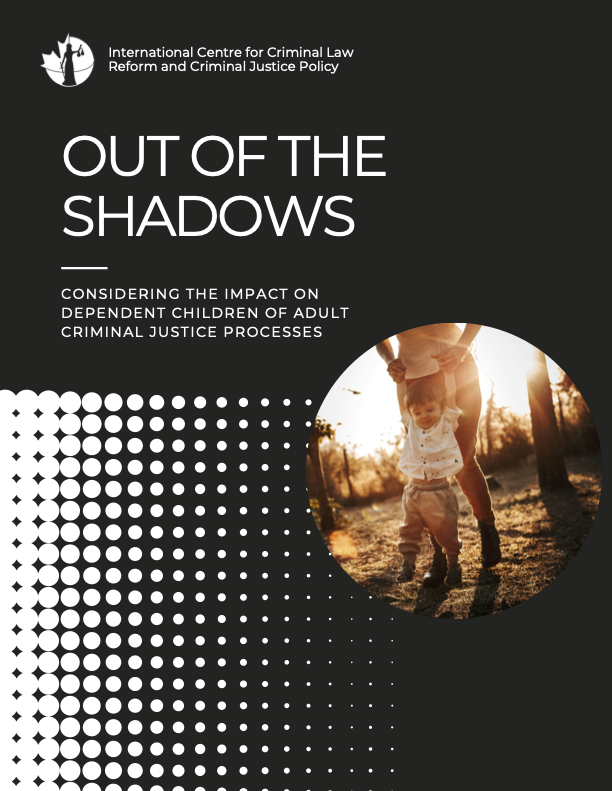
Out Of The Shadow.  Considering The Impact On Dependent Children Of Adult Criminal Justice Processes

By Allan Castle, Hayli Millar, Yvon Dandurand, Vivienne Chin, Shawn Bayes, Megan Capp, Richard Fowler, Jessica Jahn and Barbara Pickering.

What happens to children whose parents are incarcerated, remanded, or otherwise subject to the criminal justice system? Too often, the answer is: pain and distress due to separation from a parent, stigmatization, poor performance in school, social withdrawal, impoverishment, diminished life chances, health problems, and increased likelihood of the child themselves being incarcerated in adulthood. That these harms to children are unintended ‘collateral’ effects of justice decisions is immaterial. The effects are similar to those of many other more direct, adverse experiences a child may encounter. The adult criminal justice system in Canada is of course not alone in creating harmful outcomes for children, today or historically. For more than 150 years, the residential school system h caused devastating intergenerational harm to generations of Indigenous families. Provincial child welfare systems continue to be a focus of reform and devolution due to the harmful effects of past and current practices. In identifying the harms caused by institutions and systems, we must point out that harm to children is not only systemic in origin. Parental abuse or neglect driven by substance use, trauma or mental illness is common, even though many of those individual behaviours may in turn have systemic origins. Whether the harms experienced by children have systemic or individual causes, we now understand that many different actors and sectors must collaborate to protect children, as systemic and individual harms routinely overlap and multiply the damage done. For example, the trauma and loss of belonging associated with being removed from parental care due to parental incarceration may be expressed by self-harm or behavioral acting out at school. The disruption of parental incarceration can impede the delivery of routine health care, such as vaccinations. Child homelessness brings greater exposure toexploitation. Considering these overlaps, it is insufficient to act in isolation. Child advocates, Indigenous Nations and communities, non-profit services, child welfare and health authorities, educators and other systems – including the adult criminal justice system – all have a role to play in collaborating to protect children, prevent their stigmatization, and support their healthy development. The subject of this paper – the substantial impact of adult criminal justice system decisions on the dependent children of those coming before the system – has to date received little consideration by the system itself, whether in terms of research, case law, legislation, or legal principles. Moreover, there is no consensus within the system itself as to the degree of responsibility the system itself should bear in mitigating these harms. One recent superior court decision suggested that while lamentable, such child impact should be understood as an unavoidable consequence of serious criminality.  

Police Reform and the Dismantling of Legal Estrangement

By Monica C. Bell In police reform circles, many scholars and policymakers diagnose the frayed relationship between police forces and the communities they serve as a problem of illegitimacy, or the idea that people lack confidence in the police and thus are unlikely to comply or cooperate with them. The core proposal emanating from this illegitimacy diagnosis is procedural justice, a concept that emphasizes police officers’ obligation to treat people with dignity and respect, behave in a neutral, nonbiased way, exhibit an intention to help, and give them voice to express themselves and their needs, largely in the context of police stops. This Essay argues that legitimacy theory offers an incomplete diagnosis of the policing crisis, and thus de-emphasizes deeper structural, group-centered approaches to the problem of policing. The existing police regulatory regime encourages large swaths of American society to see themselves as existing within the law’s aegis but outside its protection. This Essay critiques the reliance of police decision makers on a simplified version of legitimacy and procedural justice theory. It aims to expand the predominant understanding of police mistrust among African Americans and the poor, proposing that legal estrangement offers a better lens through which scholars and policymakers can understand and respond to the current problems of policing. Legal estrangement is a theory of detachment and eventual alienation from the law’s enforcers, and it reflects the intuition among many people in poor communities of color that the law operates to exclude them from society. Building on the concepts of legal cynicism and anomie in sociology, the concept of legal estrangement provides a way of understanding the deep concerns that motivate today’s police reform movement and points toward structural approaches to reforming policing.

Prevention Beyond Deterrence

By Benjamin A. Barsky
This Article reconceptualizes preventive justice—the public safety paradigm that seeks to prevent harm before it occurs. Scholars have long documented how cities have advanced this paradigm through largely punitive measures, notably variants of broken windows policing, which posit that aggressive misdemeanor enforcement deters more serious crime. Yet in the aftermath of the 2020 George Floyd protests, and as underscored recently in City of Grants Pass v. Johnson, these measures have faced a legitimacy crisis—prompting calls for nonpunitive responses to nonviolent incidents. This Article establishes a preventive justice approach that advances health and safety without emphasizing crime deterrence. It draws on fieldwork research on alternative emergency response programs (“Alternative Responses”) that proliferated after the 2020 protests to replace police in health crises and other nonviolent incidents. Data include interviews with fifty individuals and over two hundred hours of observations in Oakland, California; Dayton, Ohio; and Madison, Wisconsin. 

Barriers to Criminal Enforcement Against Counterfeiting in China

By Daniel C.K. Chow

Multinational companies (MNCs) with valuable trademarks in China seek criminal enforcement against counterfeiting because other available avenues of relief, such as administrative and judicial remedies, have proven to be ineffective. While MNCs prefer enforcement through China’s Police, the Public Security Bureau (PSB), many MNCs are unaware of the significant hidden dangers of using the PSB.Most MNCs will delegate enforcement of trademark rights to their Chinese subsidiaries. These subsidiaries are known to make illegal payments to the PSB that may violate the laws of the PRC as well as the United States Foreign Corrupt Practices Act (FCPA). These acts expose MNCs to draconian penalties under PRC law and the FCPA. MNCs can be unaware of these illegal practices because many MNCs organize their business structures and intellectual property (IP) management strategies in ways that shield MNCs from reviewing some of the on-the-ground actions by their Chinese subsidiaries. This Article exposes these risks, explains how some of these risks arise, and makes suggestions on how MNCs can structure their business organizations and IP management structures in China to eliminate or mitigate these risks. *

Strategies to Combat Internet Sales of Counterfeit Goods 

By Daniel C.K. Chow 

The proliferation of counterfeits for sale on e-commerce sites has created new and more dangerous challenges to brand owners than counterfeits sold through brick and mortar establishments. Most brand owners are currently focusing their efforts on simplifying and streamlining Notice and Takedown (“NTD”) procedures set up by ecommerce platforms to remove illegal listings. The shortcomings of these efforts are that NTDs do not directly reach the counterfeiter who remains free to conduct its illegal activities with impunity and that NTDs do not prevent delisted counterfeiters from reappearing in short order under a new fictitious name and identity. Brand owners should seek to induce China to rigorously enforce its recently enacted Electronic Commerce Law (“ECL”), which was designed by China’s lawmakers to create a “choke point” that excludes counterfeiters and other unscrupulous merchants from gaining access to online accounts. The ECL requires multiple layers of government review and approval that were designed so that they can be satisfied only by legitimate and economically viable business entities. To date, e-commerce sites in China do not strictly comply with the ECL, and U.S.-based ecommerce sites do not require any compliance whatsoever with the ECL. Rigorous enforcement of the ECL should result in preventing counterfeiters from gaining access to e-commerce sites based in China and the United States and should lead to a decrease in sales of counterfeits on the internet.

Shutting Down the Supply Chain Pipeline of Counterfeit Goods Running From Alibaba to Amazon

By Daniel C. Chow

An immense supply chain pipeline constantly funnels millions of counterfeit goods from Alibaba’s e-commerce sites in China to third party sellers who sell these goods on Amazon to U.S. consumers. Amazon has acknowledged that it has a problem with counterfeits on its e-commerce sites, but its current responses to counterfeiting are primarily performative and intended to pacify disgruntled brand owners and frustrated consumers. Amazon’s responses will likely have little or no effect on counterfeits on its websites. This Article sets forth a direct and straightforward method for shutting down or seriously disrupting this pipeline based on using China’s existing laws. This method involves using verification methods required by China’s laws to ensure that only lawful and legitimate businesses, not counterfeiters, can open online accounts on Alibaba and other Chinese e-commerce platforms. Unless these steps are taken, counterfeits sold on Amazon and other e-commerce platforms will likely continue to plague brand owners, consumers, and the general public in the United States for the foreseeable future.

Generative AI as Courtroom Evidence: A Practical Guide

By Neal Feigenson and Brian Carney

You are the lawyer in a case in which the crucial incident was captured by dozens of smartphone, surveillance, and other cameras. Imagine your forensic video expert putting all of those videos into a generative artificial intelligence (GenAI)1 model that quickly synchronizes the audio and video streams, links relevant documents, and provides an outline for the strategy of your case—enabling you to understand exactly what happened in minutes instead of weeks and then suggesting ways to prove it at trial. The expert could also employ GenAI to enhance those videos, making relevant facts clearer by rendering blurry images more legible and inaudible conversations more intelligible, or even by creating important camera angles showing views not found in the original images. Or imagine, in a complex commercial dispute, feeding masses of documents and other data into a GenAI model that produces timelines and other visualizations of the relevant events, as well as lists of inherent contradictions in the evidence, which you could then use to prepare your arguments and illustrate your theory of the case in court. All of these tools and more will soon be available. Much has been written in the last half-dozen or so years about the prospect of images, video, and audio created with GenAI being used in court. Most of the concern has focused on deepfakes, andmassive data sources—primarily the Internet—in response to a user’s prompt.

Western Cape Gang Monitor

By The Global Initiative Against Transnational Organized Crime

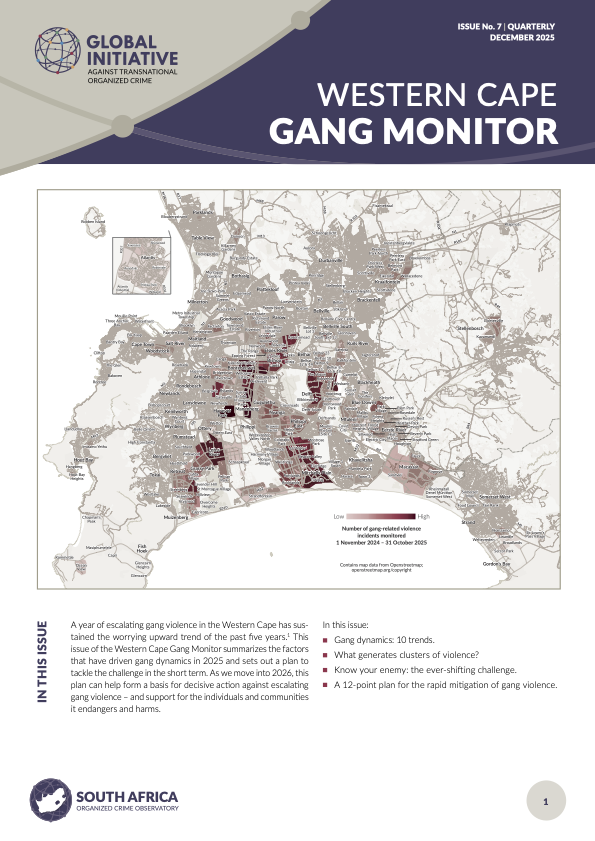
 Years of escalating gang violence in the Western Cape has sustained the worrying upward trend of the past five years. This issue of the Western Cape Gang Monitor summarizes the factors that have driven gang dynamics in 2025 and sets out a plan to tackle the challenge in the short term. 

 As we move into 2026, this plan can help form a basis for decisive action against escalating gang violence – and support for the individuals and communities it endangers and harms.

In this issue:

  • Gang dynamics: 10 trends.

  • What generates clusters of violence?

  • Know your enemy: the ever-shifting challenge.

  • A 12-point plan for the rapid mitigation of gang violence.

This is the seventh issue of the Global Initiative Against Transnational Organized Crime’s (GI-TOC) Western Cape Gang Monitor, an output of our South Africa Organized Crime Observatory. This series of bulletins tracks developments in Western Cape gang dynamics each quarter, to provide a concise synthesis of relevant trends to inform policymakers and civil society. This is a year-in-review issue, combining analysis published by the GI-TOC throughout the year with new research. The monitor draws on information provided by field researchers working in gang-affected communities of the Western Cape. This includes interviews with current and former gang members, civil society and members of the criminal justice system.