Open Access Free Library
Fiction+Mediajpg.jpg

FICTION and MEDIA

CRIME AND MEDIA — TWO PEAS IN A POD

Posts in Homicide
Dr. NIKOLA - The Complete Saga: Volume 2


by Guy Boothby (Author), Graeme Newman (Editor), Colin Heston (Introduction)

. When the enigmatic Dr. Nikola first stepped onto the literary stage in 1895, clutching his sinister black cat Apollyon and weaving schemes that stretched from the back alleys of Shanghai to the hidden monasteries of Tibet, he didn't just capture the Victorian imagination—illegally or otherwise, he colonized it.
These volumes bring together, for the first time in a single definitive collection, the complete saga of Dr. Nikola: A Bid for Fortune, Dr. Nikola, The Lust of Hate, Dr. Nikola’s Experiment, and Farewell, Nikola. To read them in succession is to witness the birth of the modern "super-villain" and to appreciate the unique, rugged perspective Boothby brought to the crowded field of late-Victorian sensation fiction.
Born in Adelaide in 1867, Guy Newell Boothby was the son of a prominent South Australian parliamentarian. While he eventually found fame in the drawing rooms of London, his formative years were spent in the wide-open, often unforgiving landscapes of the Australian colonies.
In the 1890s, the literary world was reeling from "Sherlock-mania." While Sir Arthur Conan Doyle gave the world the ultimate champion of logic, Boothby gave it the ultimate agent of chaos. Dr. Nikola is not merely a criminal; he is a polymath, an occultist, and a man of immense physical and intellectual magnetism.
Across these five novels, we see Nikola evolve:
Volume 1:
A Bid for Fortune (1895): We are introduced to the Doctor through the eyes of Richard Hattasall. Here, Nikola is a vengeful shadow, a man whose "vendetta" drives a globe-trotting chase.
Dr. Nikola (1896): Arguably the centerpiece of the series, Boothby takes us into the forbidden heart of Tibet. It remains one of the finest examples of the "Lost World" genre, enriched by Stanley L. Wood’s iconic illustrations.
The Lust of Hate (1898): A darker, more psychological turn where Nikola manipulates a broken man’s desire for revenge.
Volume 2
Dr. Nikola’s Experiment (1899): Here, Boothby touches on the "mad scientist" tropes that would later define 20th-century sci-fi, as Nikola attempts to conquer death itself.
Farewell, Nikola (1901): The swan song of the character, providing a sense of closure to a man who lived his life in the liminal space between genius and madness.
Guy Boothby died tragically young at the age of 37, leaving behind a staggering 53 novels written in just over a decade. For years, his work languished in the shadows of more "academic" Victorian literature. However, as these works have entered the public domain, a new generation of readers—and editors—has rediscovered the sheer, unadulterated joy of his storytelling.
Boothby’s Dr. Nikola remains a vital link in the evolution of popular fiction. Without Nikola, would we have Sax Rohmer’s Fu Manchu? Would we have the sophisticated antagonists of James Bond? Probably not. By centering this edition on Boothby’s Australian roots, we acknowledge that the "King of Sensation" wasn't just a product of London’s Fleet Street, but a traveler of the world who brought the wild energy of the Antipodes to the heart of the Empire. This collection aims to preserve the thrill of the original serialization while providing the context necessary for a modern reader. As you follow the Doctor through the mist-shrouded streets of London and the sun-bleached ports of the Pacific, remember that you are in the hands of a master who knew those ports firsthand.
Welcome to the world of Dr. Nikola. Tread carefully—Apollyon is watching!

Read-Me.Org Inc. New York-Philadelphia-Australia. 2026. 292p.
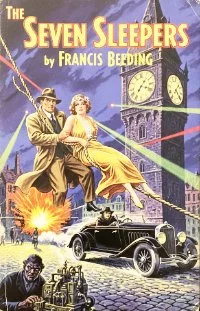
The Seven Sleepers

By Francis Beeding. Introduction by Colin Heston.

In the shadows of a Europe still scarred by the Great War, a new and more terrifying conspiracy awakens. When Thomas Preston arrives in Geneva, he expects nothing more than a quiet diplomatic mission. Instead, he is thrust into a lethal game of cat-and-mouse after stumbling upon the secrets of the "Seven Sleepers"—a clandestine cabal of German industrialists and embittered generals plotting to shatter the fragile peace of the League of Nations.

Equipped with a terrifying hidden technology and a ruthless determination to rewrite the Treaty of Versailles, the Sleepers have already set their clock for a second global cataclysm. Preston’s only hope lies with the enigmatic Colonel Alastair Granby of British Intelligence. From high-speed chases across the continent to the inner sanctums of hidden laboratories, they must race to dismantle the conspiracy before the world is plunged back into the abyss of total war.

Originally published in 1925, The Seven Sleepers is the pulse-pounding debut of Francis Beeding’s most famous hero. It is a classic of the "clubland" thriller era, blending atmospheric suspense with the high-stakes espionage that defined a generation.

NU. Little Brown & Co. 1925.. New York-Philadelphia-Australia.. Read-Me.Org Inc. 2026. 182p.

Grey Riders: The Story of The New York State Troopers

By Frederic F. Van de Water. Introduction by Graeme R. Newman

When Grey Riders appeared in 1922, Frederic F. Van de Water was already emerging as one of the most capable interpreters of American frontier mythology. A journalist, historian, and novelist, he had spent years documenting the enduring tensions between law, order, memory, and violence in the development of the Atlantic seaboard. Grey Riders stands as one of his most vivid contributions to that project: a narrative history and interpretive reconstruction of the Border Riders—Vermont and New York militiamen, irregulars, and informal vigilante bands who policed, contested, and sometimes exploited the wilderness regions between the American colonies and British Canada during the late eighteenth and early nineteenth centuries

Van de Water had a journalist’s fascination with complexity, and Grey Riders is at its strongest when it illuminates the contradictions inherent in a frontier culture that simultaneously demanded firmness of justice and tolerated the improvisational violence of irregular policing. In his account, the riders are men shaped by hardship—farmers, Loyalists, deserters, Yankee patriots, trappers, smugglers, and opportunists—who alternately defended and defied the emerging legal structures of the early United States. Their world was one where the line between protector and predator was always negotiable.

The book’s historical frame—stretching most visibly from the late Revolutionary era through the War of 1812—allows Van de Water to explore how unresolved grievances, economic scarcity, and geopolitical rivalry produced a frontier culture that did not neatly conform to the nation-state boundaries we take for granted today. The riders themselves were products of this ambiguity. While some acted as scouts and auxiliaries for the Continental Army or state militias, others drifted into banditry, smuggling, or private vengeance. Van de Water refuses to simplify this ambiguity; instead, he constructs a narrative that emphasizes how the frontier’s conditions forged men who were, by necessity, adaptable to both moral clarity and moral shade.

For the modern reader, Grey Riders also holds value as part of the broader early-twentieth-century reconsideration of American origins. The 1920s were a period of heightened nostalgia, cultural nationalism, and renewed interest in the country’s formative conflicts. Van de Water, however, avoids sentimentalism. His frontier is not a place of heroic inevitability but a zone of tension where identity, loyalty, and legitimacy are constantly renegotiated. In this respect, the book anticipates the more critical frontier historiography that would emerge later in the century.

Contemporary scholars may also find in Grey Riders an instructive account of how local communities develop security practices when state institutions are weak, distant, or contested—an issue that remains resonant in discussions of borderlands worldwide. The riders, as Van de Water portrays them, are precursors to many modern forms of irregular security actors: militias, local auxiliaries, self-appointed protectors, and armed community defense groups. Their actions demonstrate both the necessity and danger of such formations, especially when scarcity and political friction define daily life.

This new edition returns readers to a moment when questions of national boundaries, informal justice, and community resilience are central to global debate. Van de Water’s riders, moving through a grey zone of legality and identity, offer a powerful reminder that the frontier has never been a simple place—and that the forces shaping it never truly disappeared.

Read-Me.Org Inc. New York-Philadelphia-Australia. 2025. p.188.

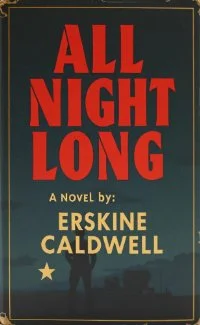
All Night Long: A Novel of Guerrilla Warfare in Russia

By Erskine Caldwell. Designed and Edited with an Introduction  by Colin Heston

When All Night Long appeared in 1942, Erskine Caldwell was already one of the most widely read—and most controversial—American novelists of his generation. Known primarily for his unsparing portrayals of poverty, violence, and moral stress in the American South, Caldwell here turned his attention outward, to a global conflict unfolding at unprecedented scale. Subtitled A Novel of Guerrilla Warfare in RussiaAll Night Long represents Caldwell’s direct literary engagement with the Second World War at the moment when its outcome remained deeply uncertain and when the Soviet Union, newly allied with the United States, had become a central symbol of resistance to fascist aggression.

Caldwell’s Russia is not a romanticized abstraction nor a detailed ethnographic portrait. Instead, it functions as a stark moral landscape shaped by occupation, deprivation, and constant threat. Villages, forests, and frozen terrain become arenas of endurance rather than scenery. The emphasis falls on night operations, secrecy, hunger, exhaustion, and the psychological toll of living in a perpetual state of danger. The title itself—All Night Long—signals this temporal and emotional register: war as an unbroken vigil, a continuous strain that erodes the boundary between action and survival.

For modern readers, the novel occupies an intriguing position in Caldwell’s body of work and in twentieth-century war literature more broadly. It stands apart from his Southern novels in geography but not in theme. As in Tobacco Road or God’s Little Acre, Caldwell examines how extreme conditions strip life down to its essentials and expose the structures—economic, political, or military—that govern human behavior. In All Night Long, the setting is international, but the underlying concerns remain consistent: power, exploitation, resilience, and the cost of endurance.

Read today, All Night Long also invites reflection on the evolving representation of guerrilla warfare itself. Long before such conflicts became a dominant feature of late-twentieth- and early-twenty-first-century military discourse, Caldwell recognized the strategic and moral complexity of irregular resistance. His novel anticipates later debates about asymmetrical warfare, civilian involvement, and the blurred lines between combatant and noncombatant—issues that continue to shape global conflicts.

Ultimately, All Night Long is less a novel about Russia per se than a novel about resistance under occupation. It captures a historical moment when global war demanded new forms of solidarity and new narrative frameworks to explain them. Caldwell’s achievement lies in his ability to translate that vast struggle into an intimate, unrelenting account of human persistence, sustained through darkness, danger, and the long hours of night.

NY.Book League of America. 1942. Read-Me.Org Inc. Australia, New York & Philadelphia. 2025. 161p.

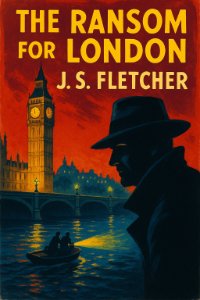
The Ransom for London

by J. S. Fletcher. Preface by Colin Heston.

The Ransom for London is one of the last full-length mysteries penned by J. S. Fletcher, the prolific master of British crime fiction whose work helped shape the modern detective novel. First published in 1937—just months before the golden age of classic mystery reached its twilight—this novel stands as a testament to Fletcher’s enduring gifts: intricate plots, bristling suspense, and a keen sense of how crime reveals the hidden tensions of society.

This edition invites readers to rediscover a late gem from a writer whose contributions to the detective genre paved the way for many who followed. With The Ransom for London, Fletcher delivers a fast-moving, atmospheric tale that demonstrates his continuing relevance, his wit, and his unmatched instinct for suspense.

Step into London on the brink—into a story built on riddles, danger, and the high cost of holding a city’s fate in the balance. The ransom has been demanded. Whether the truth is paid in gold or courage is for you to discover.

Read-Me.Org Inc. New York-Philadelphia-Australia. 2025. p.229.