Open Access Free Library
CRIMINAL JUSTICE.jpeg

CRIMINAL JUSTICE

CRIMINAL JUSTICE-CRIMINAL LAW-PROCDEDURE-SENTENCING-COURTS

Posts in Crime
Criminal Politics: An Integrated Approach to the Study of Organized Crime, Politics, and Violence

By Nicholas Barnes

Over the last decade, organized criminal violence has reached unprecedented levels and has caused as much violent death globally as direct armed conflict. Nonetheless, the study of organized crime in political science remains limited because these organizations and their violence are not viewed as political. Building on recent innovations in the study of armed conflict, I argue that organized criminal violence should no longer be segregated from related forms of organized violence and incorporated within the political violence literature. While criminal organizations do not seek to replace or break away from the state, they have increasingly engaged in the politics of the state through the accumulation of the means of violence itself. Like other non-state armed groups, they have developed variously collaborative and competitive relationships with the state that have produced heightened levels of violence in many contexts and allowed these organizations to gather significant political authority. I propose a simple conceptual typology for incorporating the study of these organizations into the political violence literature and suggest several areas of future inquiry that will illuminate the relationship between violence and politics more generally.

Perspectives on Politics. 2017;15(4):967-987.

CRIMINAL COEXISTENCE.  THE ILLICIT ECOSYSTEM OF THE SOUTHERN CONE’S TRIPLE BORDER 

By Renato Rivera Rhon | Gabriel Funari

The Southern Cone tri-border area —comprising Ciudad del Este (Paraguay), Foz do Iguaçu (Brazil) and Puerto Iguazú (Argentina)— constitutes one of the most distinctive cross-border spaces in South America. Its particular geographical configuration combines densely populated urban areas with strategic riverine zones that facilitate intense cross-border circulation. More than 650,000 inhabitants coexist in an integrated social space marked by intense movement of people and one of the most heavily used commercial routes on the continent.

Within this environment of high mobility and commercial dynamism, smuggling has consolidated itself as the principal structuring axis of illicit economies. Since the creation of the free trade zone in Ciudad del Este in 1995, the region became a re-export centre for products destined mainly for the Brazilian market. Cigarettes, electronic products and alcoholic beverages enter Brazil as contraband, mobilized by local family clans and transnational illicit networks.

The report identifies a criminal ecosystem of coexistence characterized by interdependence, profitability and the historical continuity of illicit markets, sustained by commercial free movement, corruption and institutional fragility. Unlike other border areas in South America, the tri-border area presents high levels of criminal activity but low levels of violence, without armed disputes over territorial control or manifestations of criminal governance based on extortion or systematic coercion.

The report analyses the evolution of organized crime in the region, from the era of the “comboios” to the specialization of riverine routes and the “ant smuggling” model. It also examines the presence of the Primeiro Comando da Capital (PCC), which has consolidated control over clandestine ports in specific sectors of the Paraná River, without exercising generalized authority over the regional population.

Beyond smuggling, the report addresses cannabis trafficking produced in Paraguay, cocaine trafficking, arms trafficking and money laundering. Ciudad del Este emerges as a strategic financial node where commercial companies, real estate businesses, gambling houses and crypto-asset operations proliferate, facilitating the movement of illicit capital. The study also finds that the Argentinian side of the tri-border area has emerged as an increasingly prevalent smuggling hub over the past five years, generating new contraband routes and new security threats in the region.

The study is based on fieldwork and direct observation conducted in Ciudad del Este, Foz do Iguaçu and Puerto Iguazú, including interviews with members and former members of security forces, customs officials, judicial officials, academics and journalists specialized in the criminal dynamics of the tri-border area.

The Southern Cone tri-border area thus reveals a highly collaborative and adaptable criminal ecosystem, where smuggling functions as a base economy connecting flows, actors and routes used for drug trafficking, arms trafficking and other illegal goods. Its persistence is explained by its relatively non-violent character, informal regulation sustained by family clans and limited state capacities in the face of complex transnational dynamics.

Geneva: Global Initiative Against Transnational Organized Crime.. 2026. 31p.

Wrongful convictions in Spain: Systematic analysis of judgments from 1996 to 2022

By Nuria Sánchez , Guadalupe Blanco-Velasco , Linda M. Geven , Jaume Masip , Antonio L. Manzanero 

A comprehensive analysis of wrongful convictions in Spain was conducted. Out of 447 Supreme Court judgments made between 1996 and 2022, 243 cases involving a successful appeal made by a person claiming their innocence were examined in terms of the characteristics of wrongfully convicted individuals, the crime types, and the factors contributing to these judicial errors. An average rate of nine wrongful convictions per year was found, mostly for crimes against public safety and property, with a significant overrepresentation of foreign citizens. Legal professionals’ misconduct was identified as the main factor contributing to these wrongful convictions. The mean time between the judgment and the conviction being overturned was around 4.5 years. More than half of the cases were reopened due to evidence indicating that the alleged crime never occurred. While new evidence was the primary reason for reopening cases, only 3 % were reopened based on DNA evidence. The systematic methodology used in this research may serve as a model for future studies on wrongful convictions in other countries. To reduce wrongful convictions in Spain, several key measures must be implemented. Legal representation should be mandatory for all individuals accused of crimes, without exception. Legal professionals must receive enhanced training to minimize judicial errors. Furthermore, stricter forensic protocols should be established, and forensic experts must be properly accredited to prevent the misapplication of scientific evidence in legal proceedings. Additionally, reforms are needed to ensure that plea bargains are subject to more rigorous scrutiny, and that minor crimes are properly investigated.

Journal of Criminal Justice

Volume 103, March–April 2026,

Court Trends in Washington over the Past Two Decades

By Vasiliki Georgoulas-Sherry & Hanna Hernandez

Collecting and analyzing data is essential for understanding and evaluating the court trends in Washington in past decades — as well as, at times, demographic differences such as disparities and disproportionalities — within the criminal justice system. Gaining insight into these trends and disparities is crucial for identifying and addressing criminal trends and systemic inequities. This issue continues to draw significant attention from a wide range of sources, including local, state, and federal agencies; advocacy organizations; policymakers; researchers; scholars; and community members. Ongoing evaluation of these trends and disparities is vital for promoting fairness, ensuring accountability, and advancing equity within the justice system. To respond to these impacts, the Criminal Justice Research & Statistics Center - the Washington Statistical Analysis Center (SAC) applied for and received the 2023 State Justice Statistics (SJS) grant from the Bureau of Justice Statistics (BJS) to assess this work. Through data from the Washington State Patrol (WSP) maintains the Computerized Criminal History (CCH), this report evaluates the court trends in the U.S. over the past 25 years, and the underlying court trends and demographic differences that impact the criminal justice system.

Olympia: Washington State Statistical Analysis Center, 2025. 46p.

Racial and Ethnic Disparities in Felony Case Processing in New York State

By New York State Division of Criminal Justice Services Justice Lab

This report describes an analysis of racial and ethnic disparities in felony case processing in New York State at three processing points: arrests made in 2019, disposition of those arrests, and prison sentences imposed after convictions resulting from those arrests. 2019 was chosen as the benchmark because arrests made that year occurred prior to the implementation of landmark changes to the state’s bail, and evidence and information disclosure (discovery) laws. As a result, this analysis provides an overview of how the system functioned prior to those reforms and before the full impact of the COVID-19 pandemic, which disrupted all facets of the state’s criminal justice system.


Albany: New York State, Division of Criminal Justice Services Justice Lab.. 2025. 22p.

The Scam Economy: The True Cost of Online Scams and Crimes in America

By  Consumer Federation of America

Federal agencies, third parties, and other groups report on scam losses each year, but these numbers are only the tip of the iceberg in measuring the size and devastation experienced by those who are targeted. Behind these reports and big spreadsheets describing reported losses are shattered families, rent money lost, and grandmothers exploited. Newer technology is leading to a rise in these scams – in both severity and number: AI is supercharging these scams, social media platforms are enabling the spread, and data brokers facilitate targeting of victims, allowing criminals to reach consumers at massive scales while exploiting highly precise profiling to victimize vulnerable people. One of the biggest problems in fully understanding the scope of these scams is underreporting. Due to reporting fragmentation and communication, as well as the understandable devastation, embarrassment, and confusion that victims often feel, estimates on how many people report their losses to scams put it extremely low – often in the single digit percent of the actual number, according to conservative key government estimations. CFA is proud to publish this report that takes the most conservative estimate of underreporting and uses it to estimate The True Cost of Scams. While this issue is complicated to solve completely, there are significant unrealized opportunities for legislators, enforcement agencies, and industry to step up to address it.

Washington, DC: Consumer Federation of America, 2026, 31p.

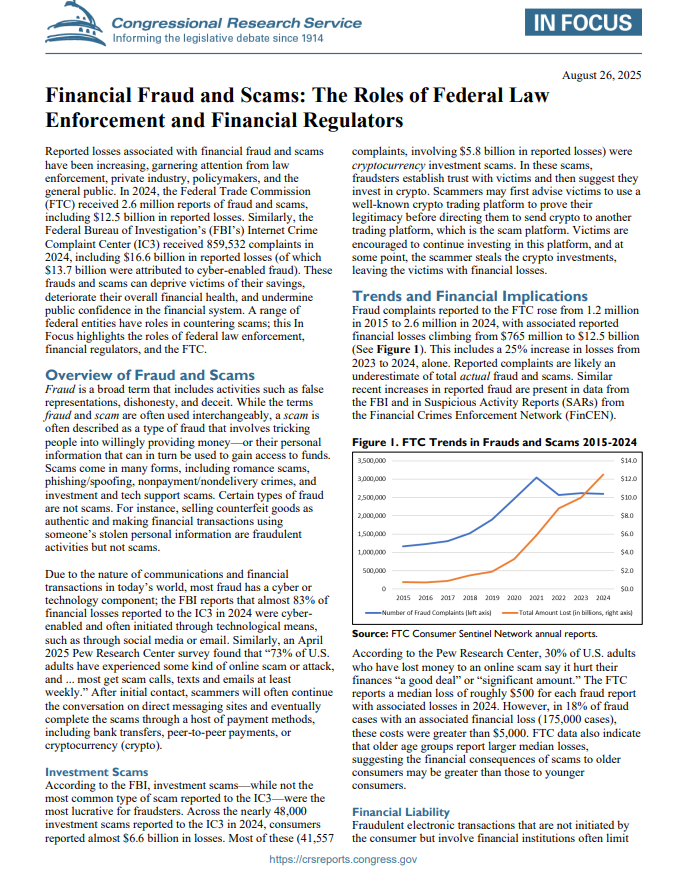
Financial Fraud and Scams: The Roles of Federal Law Enforcement and Financial Regulators

By the Federal Trade Commission

Reported losses associated with financial fraud and scams have been increasing, garnering attention from law enforcement, private industry, policymakers, and the general public. In 2024, the Federal Trade Commission (FTC) received 2.6 million reports of fraud and scams, including $12.5 billion in reported losses. Similarly, the Federal Bureau of Investigation’s (FBI’s) Internet Crime Complaint Center (IC3) received 859,532 complaints in 2024, including $16.6 billion in reported losses (of which $13.7 billion were attributed to cyber-enabled fraud). These frauds and scams can deprive victims of their savings, deteriorate their overall financial health, and undermine public confidence in the financial system. A range of federal entities have roles in countering scams; this In Focus highlights the roles of federal law enforcement, financial regulators, and the FTC.

Washington, DC: Federal Trade Commission, 2026. 3p.

State-Corporate Crime, Systemic Risk, and Governance Failures in Mass Transportation: Insights from the Tempi Train Tragedy

By Nikos Passas, Stratos Georgoulas, Christos Kouroutzas, Dimitris Paraskevopoulos 

This paper analyzes the Tempi railway tragedy of 28 February 2023 as a case of state-corporate crime and institutional corruption rather than a mere accident, focusing on the systemic endangerment of Greece’s mass transportation system. Drawing on qualitative content analysis of official documents and media records, 76 semi-structured interviews, and ongoing participant observation, the study reconstructs how safety-critical investments and controls were undermined by corrupt practices, regulatory neglect, and austerity-driven privatization. The analysis shows how criminogenic asymmetries, dysnomie, and the normalization of deviance allowed unlawful and “lawful but awful” policies to hollow out the railways’ safety function while serving mutually reinforcing state and corporate interests. These governance failures obscured systemic risk, facilitated the misrepresentation of violations as “human error,” and weakened transparency, accountability, and effective compliance in the rail sector. By situating Tempi within a comparative framework of state-corporate crimes and transport disasters, the paper highlights the blurred boundaries between financial crime, institutional corruption, and regulatory failure in critical infrastructure. It concludes with policy and compliance recommendations aimed at strengthening structural accountability, restoring institutional integrity, and reducing systemic risk in mass transportation governance.

Journal of Illicit Trade, Financial Crime, and Compliance, vol. 1, 205.

Rebooting International Criminal Justice Cooperation Against Illicit Trade and Financial Crime

By Yvon Dandurand and Megan Capp


This article examines the erosion of rule-based, multilateral international cooperation against illicit trade and financial crime amid declining state commitment to the rule of law. It argues that while global cooperation remains essential, a new framework and leadership are needed to respond effectively to transnational crime in an increasingly fragmented international order.


Journal of Illicit Trade, Financial Crime, and Compliance. 2026.  (653a23)


The Process of Transnationalization of Drug Trafficking Organisations: The case of the Mexican Cartels    

By Laura Diorella Islas Limiñana

This thesis seeks to develop a better understanding of the transnational behaviour of drug trafficking organisations (DTOs) by documenting the role that Mexican DTOs had in the cocaine trafficking to Europe after 2008. This was the year when the Italian authorities announced their discoveries that there were business interaction between the Mexican DTOs and the Italian mafia groups. At the same time the Italian authorities were announcing their findings, my literature review showed a lack of analysis and documentation regarding the transnationalization of Mexican DTOs to Europe.

While most of the literature focuses on the explanation of the cartels inside Mexico, my research question focused on clarifying whether or not the Mexican DTOs are expanding their cocaine trafficking activities to Europe. At this point I considered the reports of the Italian authorities that affirm that the Mexican DTOs are relevant drug trafficking intermediaries in the cocaine trafficking routes to Europe.

To answer my research question, and to systematically describe the evolution of DTOs, a qualitative methods approach was deployed (Mohajan, 2018) with a case study design adapted from Yin (2003). My analysis was carried out through the use of multiple triangulation techniques that helped me to collect and study different types of data to understand the subject. I collected empirical information through 28 interviews with security personnel with experience in countering Mexican DTOs or in the cocaine routes to Europe. The information gathered from the security personnel, complemented by official reports and open source information, was useful to answer my research question and test my hypothesis.

The analysis showed that despite Italian authorities’ claims and perceptions, the power of the Mexican cartels is very limited when talking about their presence and links in Europe, and resulted in four key findings. Firstly, that the perception of the Mexican DTOs as having trans-Atlantic powers is erroneous, because the evidence showed that there is no transatlantic expansion. Secondly, the analysis uncovered the internal, national and international variables that were observed to alter the evolution and behaviour of the Mexican DTOs. At the internal level, the variables included the loss of leadership and the grievances between groups. At the national level the identified variables were the democratic transitions, corruption and impunity networks. And at the international level the variables were the international drug demand, the changes in the international illicit world, the situation of governance and corruption in foreign countries and the geography of the region where the illicit business are taking place.

Overview of drug markets in the European Neighbourhood Policy-East countries Regional report

By: The European Monitoring Centre for Drugs and Drug Addiction
This report presents an analysis of the drug markets in the European Neighbourhood Policy-East (ENP-East) countries: Armenia, Azerbaijan, Belarus (1), Georgia, Moldova and Ukraine. It provides a top-level overview of the information available on drug production, trafficking, sale, use and harms, as well as exploring what is known about the drivers and facilitators of drug markets across the ENP-East region. It highlights drug-related threats and their potential implications for security and health. Due to its proximity as well as economic and social ties, developments in this region have potentially important implications for the EU. The analysis presented here focuses on the drug situation over the period 2018-2021, and specifically on key developments prior to the COVID-19 pandemic through to the end of 2021. However, Russia’s invasion of Ukraine in February 2022 and its potentially significant implications for the drug situationare also considered, although solid information to inform the analysis is lacking. The ENP-East region comprises two geographically distinct groups of countries separated by the Black Sea and Russia (Figure 1). While there are similarities in the drug markets across these countries, their geographical location has influenced their domestic drug situations, including production, trafficking, sales and use. In the north-western part of the ENP-East region lie Belarus, Moldova and Ukraine. These countries share borders with EU Member States, Russia and the Black Sea. In the south-eastern part of the region lie the Southern Caucasus countries, namely Armenia, Azerbaijan and Georgia. The Southern Caucasus borders Iran, Russia, Türkiye and the Black Sea. The drug markets in the region continues to undergo significant change in terms of the production, trafficking, sale and use of illicit drugs. A key recent development has been the growth of online markets, which has been linked with the availability of a broader spectrum of drugs, particularly new psychoactive substances (NPS). Thereported emergence of new trafficking routes for heroin and cocaine through the Black Sea, with involvement of international criminal networks, is another relatively recent phenomenon that highlights the need for continuing vigilance in this area. New developments have also been noted in drug production, with synthetic drug production sites identified and dismantled in several countries in the region. In addition, there are concerns that the Russian invasion of Ukraine in February 2022 may impact on drug flows and lead to increased drug-related harms, both in Ukraine and in neighbouring countries. The findings detailed in this report are based on semistructured interviews conducted between September and December 2021 with over 40 stakeholders in the six countries of the ENP-East region. Stakeholders included government representatives, law enforcement agencies, non-governmental organisations (NGOs), researchers and international organisations. To substantiate the information that emerged from these interviews, scientific literature and other data and reports published by governmental and non-governmental entities were consulted. However, it is important to note that in general there is a lack of routinely collected and detailed information on the drug situation in the region. This highlights the importance of strengthening routine drug monitoring data systems for collecting and reporting reliable and comparable information.

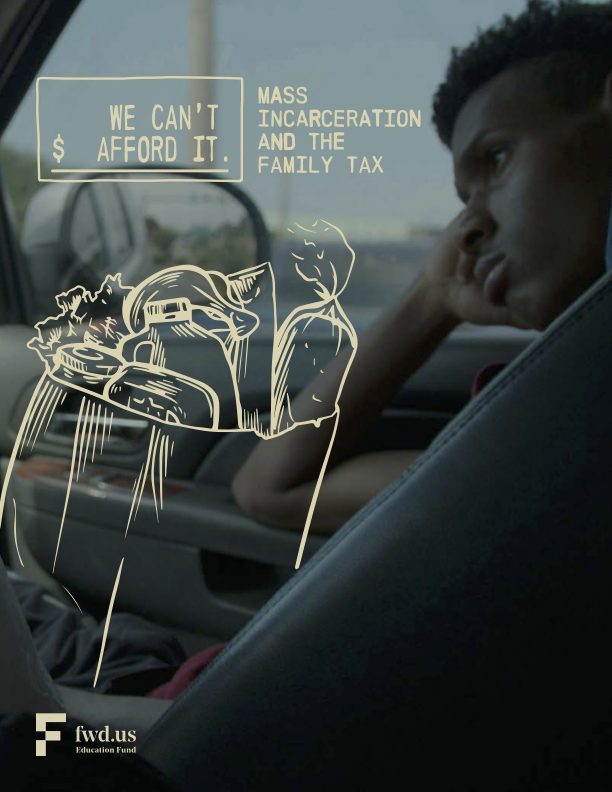
We Can’t Afford It: Mass Incarceration and the Family Tax

By Brian Elderbroom, Peter Mayer, and Felicity Rose

Key Findings:

  • Families with an immediate family member incarcerated spend an average of $4,195 annually to maintain contact and provide support; spouses/co-parents spend the most ($6,225 annually), followed by adult children ($5,470 annually).

  • Families spend a total of $5.6 billion annually on commissary deposits, prison accounts, and other direct support for basic necessities and other items their family members might need.

    • Black family members spend $280 per month on direct support compared to $152 per month for white family members.

  • On an annual basis, Black family members spend 2.5 times more ($8,005) than white family members ($3,251). 

    • Hispanic family members spend an average of $6,367 annually, and Native American family members spend an average of $6,464 annually.

This mixed-methods report quantifies the financial costs incurred by families when a loved one is incarcerated. Drawing on a nationally representative survey of adults with an immediate family member incarcerated for at least three months, supplemented by focus groups, the study documents both direct out-of-pocket spending and longer-term financial impacts. The central finding is that families pay large, recurring costs to maintain contact and provide for incarcerated loved ones, and they suffer persistent income losses that compound intergenerationally. The authors estimate that families collectively bear an annual financial burden of $348 billion. These costs are not distributed evenly: Black, Hispanic, Native American, and low-income families shoulder a disproportionate share, devoting more of their household resources to supporting incarcerated relatives. All in all, the findings highlight the far-reaching consequences of incarceration on family financial stability and intergenerational economic opportunities.

The Situational Character Of Prison Violence: An Exploratory Qualitative Study

Author(s): Dante BC Hoek, Ard J Barends, Esther FJC van Ginneken
Focus: This explorative qualitative research on prison violence investigates how, and why, potentially violent situations between incarcerated men occur. Through in-depth interviews with imprisoned and formerly imprisoned men, the research explores the situational circumstances of prison violence.
Conclusion: The article identifies three distinct categories of situations where violence can occur: when incarcerated individuals perceive threats to their (1) status, (2) safety and (3) shared interests (or goals). The findings show how these particular threats impact participants’ interactions and interpretations of situations and subsequent potentially violent behaviour. 

Cascading Constraint and Subsidiary Discretion: Perspectives on Police Discretion From Police-Led Drug Diversion and Stop and Search in England

By : Lex Stevens, Winifred Agnew-Pauley, Matthew Bacon, Helen Glasspoole-Bird, Nadine Hendrie, Caitlin Elizabeth Hughes, Charlie Lloyd, Mark Monaghan, Rivka Smith, Charlie Sutton 

This article explores how discretion is managed and exercised across senior, middle, and street levels of policing. It uses qualitative data from two studies in England. The first, a study across three police force areas, involved interviews and focus groups with 221 people who were designers, deliverers, and recipients of police-led drug diversion. The second study used 354 hours of ethnographic observation and 21 interviews to examine stop-and-search practices in one other police force. Rather than a simply expanding scope of discretion at lower levels of the hierarchy, the findings reveal a multi-level process of cascading constraints and subsidiary discretion. At each level, we observe the exercise of occupational professionalism and autonomous judgement, but higher-level constraints shape how discretion is applied in pursuit of organizational professionalism.

Law Enforcement with Rent Dissipation

By Murat C. Mungan. J. Shahar Dillbary

We consider a framework which brings together losses arising from rent-dissipation and the workhorse model of law enforcement. Governmental actors engage in a contest to share the proceeds from the enforcement of the law through monetary fines, which leads to rent-dissipation. This causes monetary sanctions to be costly, rendering the model used for studying nonmonetary sanctions a better fit for their analysis. The effect of rent-dissipation on optimal sanctions is directly related to the sanction elasticity of offenses measured at the classic optimum (i.e., where the expected sanction equals the direct harm from the offense). When offenses are inelastic, the optimal sanction is smaller than the classic optimum and it is decreasing in the degree of rent-dissipation; and a legislator who does not fully internalize contest costs chooses an overly-punitive sanction which is smaller than the classic optimum. The opposite results are obtained when offenses are elastic. We discuss implications and extensions.

Barriers to Criminal Enforcement Against Counterfeiting in China

By Daniel C.K. Chow

Multinational companies (MNCs) with valuable trademarks in China seek criminal enforcement against counterfeiting because other available avenues of relief, such as administrative and judicial remedies, have proven to be ineffective. While MNCs prefer enforcement through China’s Police, the Public Security Bureau (PSB), many MNCs are unaware of the significant hidden dangers of using the PSB.Most MNCs will delegate enforcement of trademark rights to their Chinese subsidiaries. These subsidiaries are known to make illegal payments to the PSB that may violate the laws of the PRC as well as the United States Foreign Corrupt Practices Act (FCPA). These acts expose MNCs to draconian penalties under PRC law and the FCPA. MNCs can be unaware of these illegal practices because many MNCs organize their business structures and intellectual property (IP) management strategies in ways that shield MNCs from reviewing some of the on-the-ground actions by their Chinese subsidiaries. This Article exposes these risks, explains how some of these risks arise, and makes suggestions on how MNCs can structure their business organizations and IP management structures in China to eliminate or mitigate these risks. *

Function Over Form in Federal Drug Sentencing

By Alison Siegler and Grant Delaune

Although the U.S. Sentencing Commission’s drug guidelines were intended to align punishment with culpability, decades of sentencing practice reveal a different reality. Outcomes are primarily driven by drug type and quantity, which have proved to be poor proxies for assessing culpability. We put forward a new approach to drug sentencing that instead focuses on a person’s function in a drug enterprise. We also propose anchoring base offense levels to pre-Guidelines sentencing data. To illustrate this model, we present a rewritten version of Guideline § 2D1.1 incorporating our proposed framework. Focusing on function rather than drug type and quantity will ensure that sentences are calibrated based on culpability and better fulfill the core purposes of punishment.

University of Chicago Law School, Public Law & Legal Theory Research Paper No. 25-38,  2025,

Improving Data Infrastructure to Reduce Firearms Violence

Editors: John K. Roman, Philip Cook

One of the great policy successes of the last decade is the increasing role of rigorous, objective, and transparent data and research in policymaking. Developing and implementing a data-driven government in which valid and reliable evidence informs solutions to our nation’s most pressing health and safety challenges is more critical than ever as those challenges are ever more complex. Nowhere is that data foundation more needed than in the realm of firearms violence. Trustworthy data is a much-needed bridge to effective policymaking that can reduce the number of firearm accidents, suicides, homicides, and assaults. In an age of intense partisanship, shared facts are the cornerstone for building a shared purpose. The shared purpose of modernizing firearms data infrastructure is to improve public safety by reducing gun violence. In the fall of 2020, Arnold Ventures, a philanthropy dedicated to maximizing opportunity and minimizing injustice, and NORC at University of Chicago, an objective nonpartisan research institution, released the Blueprint for a US Firearms Infrastructure (Roman, 2020)1 . The Blueprint is the consensus report of an expert panel of distinguished academics, trailblazing practitioners, and government leaders. It describes 17 critical reforms required to modernize how data about firearms violence of all types (intentional, accidental, and self-inflicted) are collected, integrated and disseminated. This project, which is also supported by Arnold Ventures, takes the conceptual priorities described in the Blueprint and proposes specific new steps for implementation. The first step in building a better firearms data infrastructure is to acknowledge where we currently stand. In The State of Firearm Data in 2019 (Roman, 2019)2 , the expert panel found that while there are a substantial number of data sources that collect data on firearms violence, existing datasets and data collections are limited, particularly around intentional injuries. There is some surveillance data, but health data on firearms injuries are kept separately from data on crimes, and there are few straightforward ways to link those data. Data that provide context for a shooting—where the event took place, and what the relationship was between victim and shooter—are not available alongside data on the nature of injuries. Valuable data collections have been discontinued, data are restricted by policy, important data are not collected, data are often difficult to access, and contemporary data are often not released in a timely fashion or not available outside of specialized settings. As a result, researchers face vast gaps in knowledge and are unable to leverage existing data to build the evidence base necessary to adequately answer key policy questions and inform firearms policymaking.

Felony Murder Reform 

By ALISSA SKOG AND JOHANNA LACOE 

Research series examining second look policies in California The five policy briefs and overview report in this series describe the characteristics and recidivism rates of individuals affected by second look policies in California. Committee on Revision of the Penal Code Before 2019, people who participated in certain felonies that resulted in a death could be convicted of murder, even if the person had neither committed the killing nor intended for it to occur. These convictions were based under the felony murder rule or the “natural and probable consequences” doctrine, which both allowed for broad liability. To address concerns about fairness and excessive punishment, Senate Bill 1437 (2018) narrowed or eliminated the application of these doctrines and allowed individuals convicted under them to petition for resentencing. In recognition that other serious convictions were similarly affected, Senate Bill 775 (2021) expanded eligibility to include those convicted of manslaughter or attempted murder under these legal theories. This brief examines who was resentenced under felony murder reform, the offenses for which they were originally convicted, and their recidivism rates following release. Key findings • Nearly 1,200 people were resentenced after these changes to the felony murder rule. As of December 2024, 1,172 people initially convicted under the felony murder rule have had those charges vacated, and were resentenced based on the remaining charges in their cases. Of those resentenced, 78% have since been released from prison. • Most people convicted of felony murder were young at the time of the offense, and for many, it was their first admission to prison. The median age at the time of the offense was just over 21, and for 75% of those resentenced, that conviction was their only prison sentence. • Women made up a larger share of those resentenced under felony murder reform (9%) than the share of all people released from prison in fiscal year 2018–19 (7%). • Recidivism rates for those resentenced under felony murder reform (9%) than the share of all people released from prison in fiscal year 2018–19 (7%). • Recidivism rates for those resentenced under felony murder reform were notably low. New conviction rates were consistently lower than the total releases (3% within one year, 7% within two years, and 10% within three years, compared to 21%, 33%, and 42%). Of those resentenced and released, most new convictions were misdemeanors. • Very few people were convicted of a new serious or violent felony after resentencing under felony murder reform. Fewer than five people were convicted within one- and two- years, and only 2% (n=5) were convicted within three years. However, we can only assess full three-year outcomes for 25% of people who have been released (n=274).

Nonpolice Alternative Response Programs Across the United States: A National Portrait

By Anna Cook, Jon Lloyd, Fablina Sharara, Jennifer Key,

When someone is in a crisis, a police response can lead to help — or harm. Across the country, communities are trying something new: sending mental health specialists, peer specialists or other trained professionals to crisis calls instead of police through alternative response programs (ARPs). Research on ARPs has focused on case studies and standout programs like CAHOOTS in Oregon and Denver STAR, but we know relatively little about the broader trends in this growing field. Comprehensive information about where and how jurisdictions are implementing ARPs is crucial so that policymakers, funders and advocates can make better informed strategic decisions regarding public safety innovation. To address this gap, we created a novel database of 216 ARPs established since the early 1970s and operational as of 2024 to produce one of the first overviews of these programs throughout the United States. By summarizing the design, scale and geographic distribution of ARPs, we provide a broad look at the field to help inform and empower community leaders to build stronger public safety systems while reducing dependence on traditional policing. Our findings underscore critical choices in how ARPs are implemented and raise important questions about their scope, accessibility and long-term potential. As policymakers, practitioners and advocates continue to explore alternatives to police response, this report provides a foundation for understanding the current landscape and identifying paths for growth. Given current gaps in ARP implementation, future research and innovation are needed to explore how these programs can evolve to handle a higher volume and wider range of calls, understand the benefits and limitations of different call lines, and expand to meet the needs of smaller or underserved communities.

 Key findings: • Recent proliferation: Public officials and other decisionmakers established nearly 120 ARPs from 2020 through 2024, reflecting a surge in interest and political willpower following national Black Lives Matter protests. • Limited scale: Most programs serving large populations respond to fewer than five calls per 1,000 residents per year. • Narrow scope: Mental and behavioral health are a stated focus for 94% of programs; far fewer are designed to address issues like traffic safety, interpersonal conflict or homelessness. • 911 reliance: Despite their focus on mental crisis calls, only 18% of ARPs use the 988 national mental health crisis line, while 50% use 911 for dispatch. • Urban concentration: Programs are concentrated in large, racially diverse, urban areas.

West Hollywood, CA,

WeWest Hollywood, CA,West Hollywood, VThe Center for Policing Equity’s (CPE) , 2025. 23p.