Open Access Publisher and Free Library
CRIMINAL JUSTICE.jpeg

CRIMINAL JUSTICE

CRIMINAL JUSTICE-CRIMINAL LAW-PROCDEDURE-SENTENCING-COURTS

Child Protection in India;

Assessing Multi-disciplinary Response Mechanisms

Edited by Paromita Chattoraj

Child Protection in India: Assessing Multi-disciplinary Response Mechanisms offers a comprehensive exploration of the institutional, legal, and social frameworks surrounding child protection in India. Anchored in a multidisciplinary approach, the book brings together insights from law, social work, psychology, education, and public policy to examine how various systems interact in addressing the issues related to protection of children from abuse, neglect, trafficking, and exploitation. This book is intended for researchers, academicians, legal professionals, social workers, policymakers, child rights activists, and students engaged in child welfare and protection studies. It critically analyses existing response mechanisms by stakeholders such as the Juvenile Justice Boards, Child Welfare Committees, Child Care Institutions, police, and the judiciary, and the implementation of various laws, including Juvenile Justice (Care and Protection) Act, the POCSO Act, Prohibition of Child Marriage Act, while also highlighting challenges in inter-agency coordination. By combining chapters under four broad themes focusing on empirical research, policy review, and case studies, this volume equips readers with a nuanced understanding of the gaps and strengths in current practices and highlights of best practices around the world. The book aims to foster a rights-based and child-centric approach, encouraging collaboration across disciplines and sectors. It is a valuable resource for anyone seeking to engage meaningfully with child protection frameworks in India and to contribute to more effective, sustainable interventions.

London: Routledge, 2026. 

The Military and Law Enforcement in Peace Operations: Lessons from BosniaHerzegovina and Kosovo 

By Cornelius Friesendorf

For post-conflict stabilisation and peacebuilding efforts to have a chance of success, security gaps need to be closed. Domestic law enforcement agencies tend to be too weak or unreliable after war to enforce the law and fight serious crime. As a consequence, operations against organised crime, the arrest of suspected war criminals and the protection of minorities depend on international intervention forces. Much attention has been paid to domestic police reform and the problems of deploying international civilian police. This book examines the under-explored role of international military missions in post-conflict law enforcement, with a focus on serious crime. The military is under pressure to fill security gaps. Yet military involvement in crime-fighting is problematic practically (soldiers are generally not trained and equipped for it), politically (crime-fighting is seen as military mission creep) and normatively (it undermines the delineation of military and policing functions). Military support of law enforcement poses a major dilemma in peace operations. Decision-makers continue to struggle with this dilemma in an ad-hoc fashion, while scholars have so far provided few empirical accounts. This book focuses on post-war Bosnia-Herzegovina (BiH) and Kosovo. It argues that the pros of military involvement in law enforcement outweigh the cons, given the continuing lack of strong police forces, the criminalised nature of contemporary wars and the negative influence of spoilers onstabilisation and peacebuilding efforts. Military support of the fight against serious crime is not sufficient for these efforts to succeed, but it is necessary. This book has three objectives. It describes the role of NATO and EU military missions in law enforcement in BiH and Kosovo from the 1990s through early 2009, thus filling an empirical knowledge gap. By formulating a strategy for military involvement in law enforcement, the book also makes a normative contribution to the debate on peace operations. Drawing on, among other sources, interviews in these two ‘international protectorates’, the book shows that military support of the fight against serious crime has lacked effectiveness, efficiency and legitimacy, examples of success notwithstanding. Third, the book adds conceptual value to the debate on peace operations, by drawing on security governance, Security Sector Reform and Security Sector Governance. These concepts help to understand the military role in post-conflict law enforcement and to guide improved efforts.

Geneva: Geneva Centre for the Democratic Control of Armed Forces (DCAF) , 2010. 207p.

The Authorized Trade in Small Arms: Latin America from a Global Perspective

By Nicolas Florquin with Victor de Oliveira

SITUATION UPDATE: LATIN AMERICA

Based on UN Comtrade data, reported global small arms and light weapons (hereafter ‘small arms’) exports rose sharply from USD 5 billion in 2019 to USD 9.2 billion in 2024. Consistent with previous trade updates, ammunition remains the most traded weapon category, accounting for 35% of the value of reported global imports for the period 2019–24, followed by sporting and hunting shotguns and rifles (21%), and pistols and revolvers (18%).

The Authorized Trade in Small Arms: Latin America from a Global Perspective—a Situation Update from the Mapping the Transnational Circulation and Control of Small Arms in Latin America project—examines the global authorized trade in small arms between 2019 and 2024, with a particular focus on trends in Latin America. It finds the region to be a comparatively small player in the global authorized small arms trade, accounting for 2.8% of global small arms imports and 6.3% of exports. Yet military firearms represented about 10% of all Latin American small arms imports during this period—almost double the global average of 5.6%.

The Situation Update also identifies a significant increase in European—and in particular Eastern European—imports during this period, which seem to have fuelled the growing trade. Indeed, European imports accounted for 40% of all reported global imports in 2024, while the value of Eastern European imports multiplied by more than ten between 2019 and 2024.

Geneva: Small Arms Survey, 2025. 16p.

Development and testing of a dimensional typology of cyberdeviance

By Alina D. Machande 

The burgeoning field of cyberdeviance lacks a unified conceptual framework, hindering classification and understanding of its subtypes and underlying psychological mechanisms. To address this gap, we conducted two studies. In Study 1 (N = 20), employing the repertory grid technique, we identified five key dimensions of cyberdeviance. In Study 2 (N = 268), participants rated 16 cyberdeviant behaviors on these dimensions, revealing three subtypes: data-oriented, interpersonal, and non-prototypical cyberdeviance. Our findings suggest a shift from singular cyberdeviance investigation toward recognition of its diverse subtypes, each necessitating tailored interventions. By adopting a dimensional approach, we transcend categorical and technocentric perspectives, enabling examination of behavior clusters across cultural and temporal contexts. Our work underscores the importance of integrating foundational deviance theories and expanding conceptual frameworks to comprehensively grasp cyberdeviance phenomena.

The Information Society, 1–19. 2025.

Law Enforcement Tools to Detect, Document, and Communicate Use of Service Weapons

By Steven Schuetz, et al.

  Context Service weapon activity, including instances where an officer’s firearm is drawn, pointed, or discharged, plays an important role in understanding events transpiring during a police–public encounter. Detection, documentation, and communication of these events in a way that is accurate, timely, and dependable is vital for enhancing transparency and accountability of law enforcement service weapon use. About this Report The National Institute of Justice (NIJ) requested the Criminal Justice Technology Testing and Evaluation Center (CJTTEC) to investigate the landscape of commercially available and emerging technologies that could meet this need. CJTTEC conducted a review of technologies capable of detecting when a service weapon has been unholstered, pointed, or discharged; documenting when a law enforcement officer discharges their service weapon (or initiating documentation such as body-worn camera (BWC) recordings in such incidents); and communicating the information to dispatchers. CJTTEC’s methodology to understand this technology landscape included secondary research (e.g., reviewing patents, trade literature, press releases, news articles, and publications) and primary research with technology experts, product representatives, and researchers. This brief provides a high-level summary of technology systems capable of documenting, detecting, and communicating service weapon activity, focusing specifically on technology integrated into or onto the weapon, in a holster, in a BWC, in a wearable device, or in environmental sensing tools. Conclusion Although no single commercially available tool is capable of detecting, documenting, and communicating service weapon activity, law enforcement agencies may be able to rely on a suite of products to help them address these needs.  Key Takeaways ¡ Agencies are facing increased pressure to document service weapon activity. From 2015 through 2020, on average, an estimated 1,769 people were injured annually—979 fatally and 790 nonfatally— from shootings by police in the United States.1 Because of the impact that officer-involved shootings (OISs) have on the community, law enforcement agencies are facing increased public pressure and policy mandates to document service weapon activity. ¡ There is a need for tools or technologies that can objectively detect, document, and communicate service weapon activity. OISs are stressful incidents that can occur quickly and under poor visual circumstances, which can impact accurate documentation of events. Further, obtaining reliable service weapon activity data can be challenging because of noncompliance with body-worn camera (BWC) policies, lack of BWCs, or inaccurate witness and officer accounts. ¡ There is no single commercially available product that meets service weapon activity needs. No single product can currently (1) detect service weapon activity, such as recording actual shots fired in an incident involving law enforcement weapons; (2) document the activity, such as initiating BWC recordings; and (3) communicate information about service weapon activity to police dispatchers. ¡ Agencies can rely on a suite of products to address these needs or choose specific products, each with strengths and limitations. Available technologies may be integrated into or onto the weapon, in a holster, in a BWC, in a wearable device, or in environmental sensing tools. Weapon-integrated tools offer the most functionality to detect and document multiple types of service weapon activity during a use-of-force incident, but many of these products, such as those developed by Armaments Research Company and Yardarm, are not commercially available. These products often lack the capability to communicate updates in real-time with dispatch. Holster-integrated tools can sense officer unholstering activity, activate BWC, and communicate with dispatch, but they cannot detect activity related to pointing or firing a weapon. BWCs, activated by multiple types of triggers, can document audio and video of the incident and communicate with dispatch, but they cannot specifically detect officer firearm activities (e.g., weapon unholstering, pointing, gunshot detection). Wearable devices can detect officer firearm activities, document metadata, and communicate with dispatch, but most products are still in a development phase for law enforcement applications. Environmental sensing tools may detect and document activities transpiring within a certain area, including shots fired in an incident, and communicate information to dispatch, but they cannot detect or attribute gunshot activities specifically to an officer's service weapon. ¡ Technology advancements and independent testing, evaluation, and implementation research are needed to accelerate adoption. Technology developers are currently working through several technical hurdles and are leveraging insights from BWC to improve technology uptake. Some commercially available products have been evaluated for performance, but more studies are needed as technologies are further developed and released into the market.  

Criminal Justice Testing (and Evaluation Consortium, 2024. 15p.

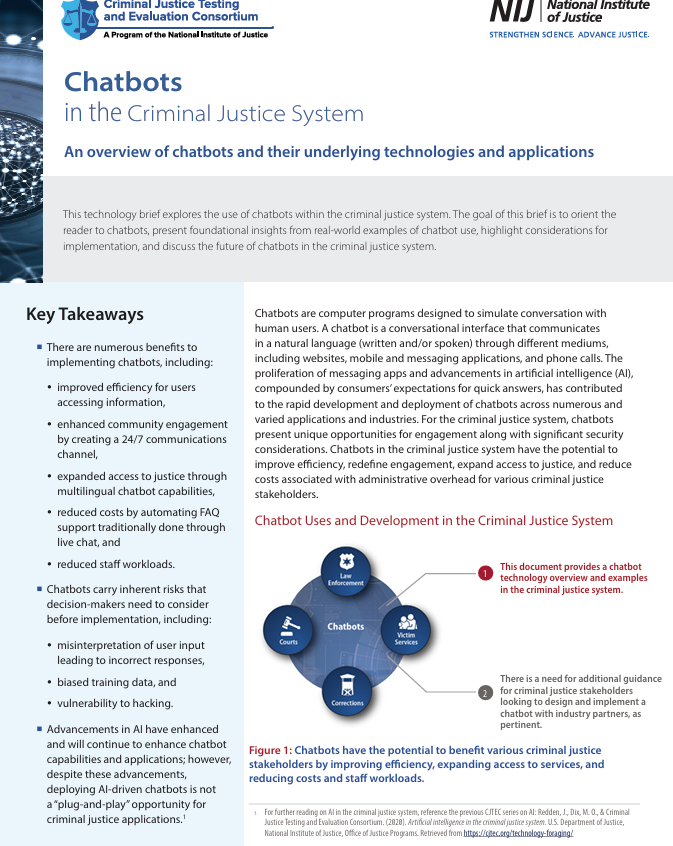
Chatbots in the Criminal Justice System An overview of chatbots and their underlying technologies and applications

By Camello, M. L., Houston-Kolnik, J. D., & Planty, M

This technology brief explores the use of chatbots within the criminal justice system. The goal of this brief is to orient the reader to chatbots, present foundational insights from real-world examples of chatbot use, highlight considerations for implementation, and discuss the future of chatbots in the criminal justice system  

  Key Takeaways ¡ There are numerous benefits to implementing chatbots, including: Ÿ improved efficiency for users accessing information, Ÿ enhanced community engagement by creating a 24/7 communications channel, Ÿ expanded access to justice through multilingual chatbot capabilities, Ÿ reduced costs by automating FAQ support traditionally done through live chat, and Ÿ reduced staff workloads. ¡ Chatbots carry inherent risks that decision-makers need to consider before implementation, including: Ÿ misinterpretation of user input leading to incorrect responses, Ÿ biased training data, and Ÿ vulnerability to hacking. ¡ Advancements in AI have enhanced and will continue to enhance chatbot capabilities and applications; however, despite these advancements, deploying AI-driven chatbots is not a “plug-and-play” opportunity for criminal justice applications

Research Triangle Park, NC:RTI International, 2021. 15p.  

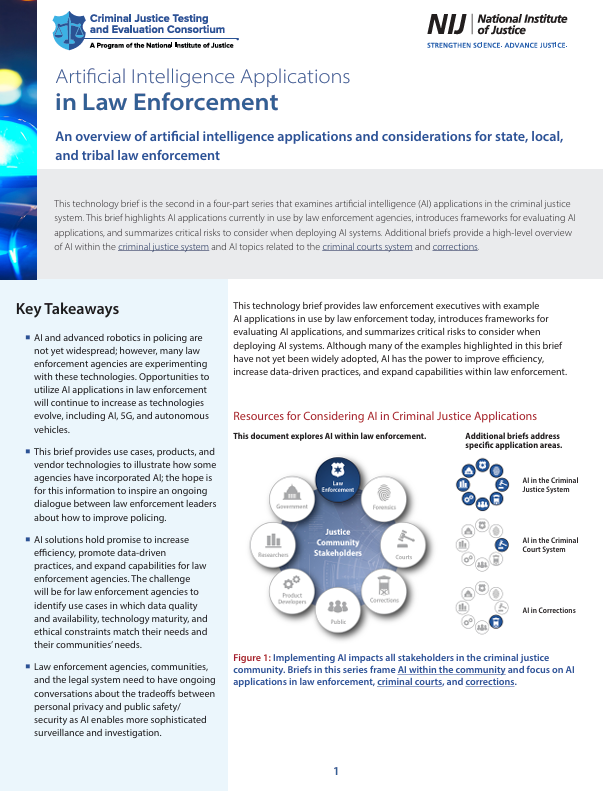
Artificial Intelligence Applications in Law Enforcement. An overview of artificial intelligence applications and considerations for state, local, and tribal law enforcement

By Redden, J., Aagaard,B., Taniguchi, T  

 This technology brief is the second in a four-part series that examines artificial intelligence (AI) applications in the criminal justice system. This brief highlights AI applications currently in use by law enforcement agencies, introduces frameworks for evaluating AI applications, and summarizes critical risks to consider when deploying AI systems. Additional briefs provide a high-level overview of AI within the criminal justice system and AI topics related to the criminal courts system and corrections.   

  Key Takeaways ¡ AI and advanced robotics in policing are not yet widespread; however, many law enforcement agencies are experimenting with these technologies. Opportunities to utilize AI applications in law enforcement will continue to increase as technologies evolve, including AI, 5G, and autonomous vehicles. ¡ This brief provides use cases, products, and vendor technologies to illustrate how some agencies have incorporated AI; the hope is for this information to inspire an ongoing dialogue between law enforcement leaders about how to improve policing. ¡ AI solutions hold promise to increase efficiency, promote data-driven practices, and expand capabilities for law enforcement agencies. The challenge will be for law enforcement agencies to identify use cases in which data quality and availability, technology maturity, and ethical constraints match their needs and their communities’ needs. ¡ Law enforcement agencies, communities, and the legal system need to have ongoing conversations about the tradeoffs between personal privacy and public safety/ security as AI enables more sophisticated surveillance and investigation

Criminal Justice Testing (and Evaluation Consortium, 2020. 10p.

Landscape Study of Generative Artificial Intelligence in the Criminal Justice System

By Smith, J., Camello, M., & Planty, M

  Generative artificial intelligence (AI) refers to AI1 used to create content, such as text, images, music, audio, and videos.2 Generative AI offers many potential benefits, enabling users to automate, augment, and accelerate a wide range of workflows, from simple administrative tasks like transcription and translation to more-complex functions such as investigation and decision support. In the criminal justice system, generative AI offers promising solutions to address human resource and budget challenges, allowing practitioners to focus on more-impactful work. Generative AI–integrated tools may enhance data analysis, improve detection and objective assessment of evidence, and streamline administrative processes. However, its integration, particularly in the criminal justice domain, raises some concerns, including potential biases, privacy issues, and the need for rigorous oversight to ensure effective implementation. It is unclear whether these tools can deliver on their promised efficiencies in practice, as evidenced by early research evaluating time savings of implementing AI-assisted report writing software.3 These concerns highlight the necessity for addressing bias and accuracy, maintaining strict data privacy and security protocols, and promoting transparency and accountability in AI-driven decisions and processes. This report is intended to help criminal justice decision-makers do the following: ¡ Understand what generative AI is and how it relates to the criminal justice system ¡ Identify how generative AI may be applied to tasks and jobs within the criminal justice system and the potential benefits, realities, and limitations ¡ Consider the technical, operational, and governance factors that may influence adoption and implementation ¡ Understand what makes up the generative AI technology stack and how models can be trained Key Takeaways • Generative AI represents an acceleration and advancement in technological innovation that already impacts the criminal justice system and will continue to do so—it is no longer a question of if or when, but how and to what extent. • Generative AI–powered software tools may offer many potential benefits, such as improving efficiency and augmenting capabilities across an extremely broad set of applications for criminal justice system stakeholders. Although these products hold promise, little empirical evidence currently supports or refutes promised benefits from these products. • Generative AI models can be deployed in various forms, including cloud-based models that centralize data processing and federated models that enable decentralized training across multiple locations, preserving data privacy and enhancing security for sensitive criminal justice applications. • Decision-makers should be aware of the substantial technical, operational, and governance risks associated with generative AI– powered software tools prior to implementation. • Responsible use of generative AI requires addressing bias and accuracy concerns, maintaining strict data privacy and security protocols, adhering to ethics and legal standards, and promoting transparency and accountability in AI-driven decisions and processes. • Generative AI technology is evolving faster than the legal or policy environment for AI—the criminal justice community must be proactive and must implement robust internal training and policy frameworks rather than relying solely on external legal or regulatory guidance.  

Research Triangle Park, NC: RTI International, 2025 28p.

Artificial Intelligence Applications for Criminal Courts.  An overview of artificial intelligence applications and associated considerations for the criminal court system 

By Redden, J., Banks, D.,   

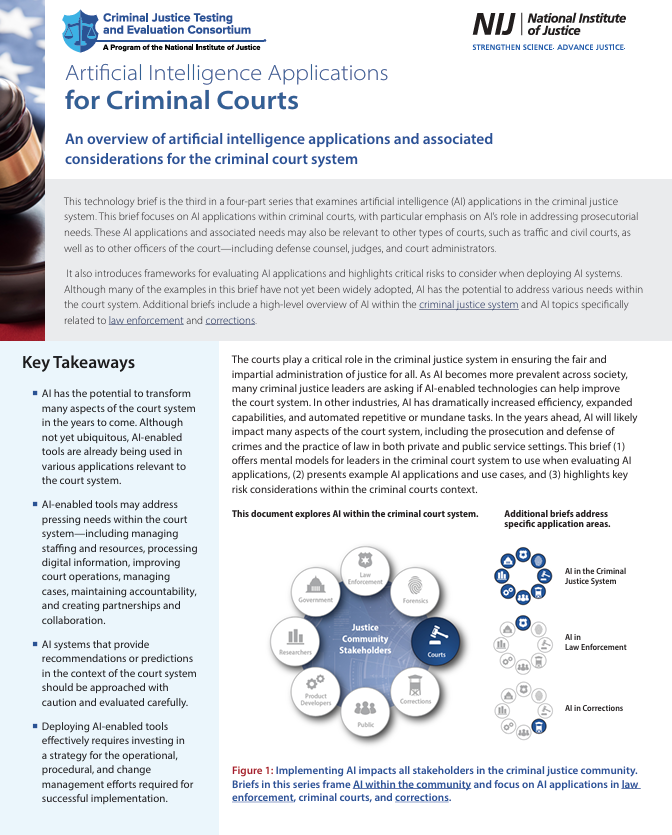
Key Takeaways ¡ AI has the potential to transform many aspects of the court system in the years to come. Although not yet ubiquitous, AI-enabled tools are already being used in various applications relevant to the court system. ¡ AI-enabled tools may address pressing needs within the court system—including managing staffing and resources, processing digital information, improving court operations, managing cases, maintaining accountability, and creating partnerships and collaboration. ¡ AI systems that provide recommendations or predictions in the context of the court system should be approached with caution and evaluated carefully. ¡ Deploying AI-enabled tools effectively requires investing in a strategy for the operational, procedural, and change management efforts required for successful implementation. This technology brief is the third in a four-part series that examines artificial intelligence (AI) applications in the criminal justice system. This brief focuses on AI applications within criminal courts, with particular emphasis on AI’s role in addressing prosecutorial needs. These AI applications and associated needs may also be relevant to other types of courts, such as traffic and civil courts, as well as to other officers of the court—including defense counsel, judges, and court administrators. It also introduces frameworks for evaluating AI applications and highlights critical risks to consider when deploying AI systems. Although many of the examples in this brief have not yet been widely adopted, AI has the potential to address various needs within the court system. Additional briefs include a high-level overview of AI within the criminal justice system and AI topics specifically related to law enforcement and corrections

  The courts play a critical role in the criminal justice system in ensuring the fair and impartial administration of justice for all. As AI becomes more prevalent across society, many criminal justice leaders are asking if AI-enabled technologies can help improve the court system. In other industries, AI has dramatically increased efficiency, expanded capabilities, and automated repetitive or mundane tasks. In the years ahead, AI will likely impact many aspects of the court system, including the prosecution and defense of crimes and the practice of law in both private and public service settings. This brief (1) offers mental models for leaders in the criminal court system to use when evaluating AI applications, (2) presents example AI applications and use cases, and (3) highlights key risk considerations within the criminal courts context.

Criminal Justice Testing (and Evaluation Consortium . 2020. 11p.

Artificial Intelligence in the Criminal Justice System.  Demystifying artificial intelligence, its applications, and potential risks 

By James Redden; Molly O'Donovan Dix

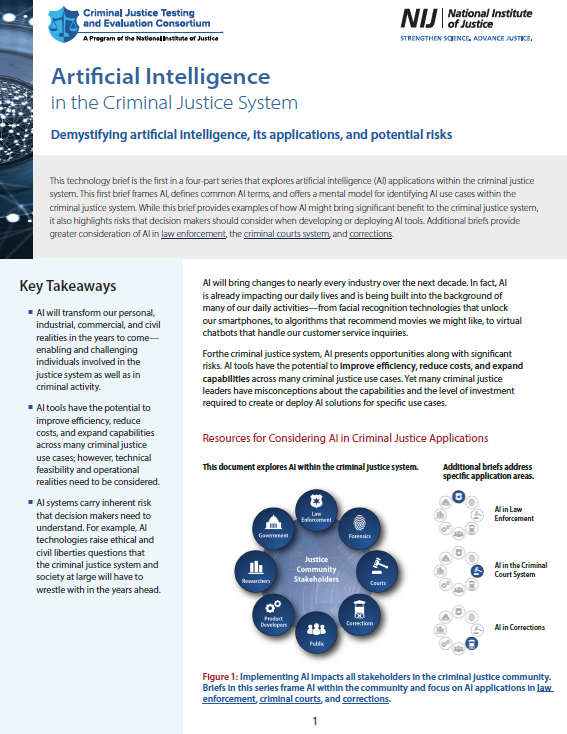
This technology brief is the first in a four-part series that explores artificial intelligence (AI) applications within the criminal justice system. This first brief frames AI, defines common AI terms, and offers a mental model for identifying AI use cases within the criminal justice system. While this brief provides examples of how AI might bring significant benefit to the criminal justice system, it also highlights risks that decision makers should consider when developing or deploying AI tools. Additional briefs provide greater consideration of AI in law enforcement, the criminal courts system, and corrections.   

  Key Takeaways ¡ AI will transform our personal, industrial, commercial, and civil realities in the years to come— enabling and challenging individuals involved in the justice system as well as in criminal activity. ¡ AI tools have the potential to improve efficiency, reduce costs, and expand capabilities across many criminal justice use cases; however, technical feasibility and operational realities need to be considered. ¡ AI systems carry inherent risk that decision makers need to understand. For example, AI technologies raise ethical and civil liberties questions that the criminal justice system and society at large will have to wrestle with in the years ahead. AI will bring changes to nearly every industry over the next decade. In fact, AI is already impacting our daily lives and is being built into the background of many of our daily activities—from facial recognition technologies that unlock our smartphones, to algorithms that recommend movies we might like, to virtual chatbots that handle our customer service inquiries. Forthe criminal justice system, AI presents opportunities along with significant risks. AI tools have the potential to improve efficiency, reduce costs, and expand capabilities across many criminal justice use cases. Yet many criminal justice leaders have misconceptions about the capabilities and the level of investment required to create or deploy AI solutions for specific use cases

Research Triangle Park, NC:RTI International.,   . 

2020. 10p.

Characteristics of Drug-Related Deaths Among Individuals Engaged in Sex Work in the United Kingdom, 1997–2023

By Emmert Roberts, Sharmila Parmanand, Caroline Copeland

Individuals engaged in sex work are an understudied population recognised to be at differential risk of experiencing drug-related harms. We aimed to determine the case characteristics, circumstances of death and type of implicated drugs among sex workers dying due to drug-related causes.

Methods

Retrospective cohort study in the United Kingdom using coronial records from the National Programme on Substance Use Mortality, 1997–2023. Information was available on decedent sociodemographics, characteristics of death and implicated drugs.

Results

Nineteen decedents were reported to be sex workers at the time of their death. Overall, decedents were predominantly female (n = 17, 90%) with a mean age of 36.4 years (SD 8.0; range 26–58). Poisoning was the only disease or condition that was certified as a direct, antecedent or contributory cause of death. The mean number of drugs detected at post-mortem was 5.4 (SD 2.5; range 1–10) with multiple drug toxicity implicated in the majority of cases (n = 18, 95%). The most commonly implicated drug groups were opioids (n = 17, 90%) and benzodiazepines (n = 9, 47%). All decedents had a history of substance dependence (n = 19, 100%), with almost a third injecting (n = 6, 32%).

Discussion and Conclusions

There have been low but consistent numbers of drug-related deaths each year where individuals were reported to be sex workers, results likely representing significantly conservative estimates. Polysubstance, opioid and benzodiazepine use are overrepresented within a largely female population with a significant burden of substance dependence. Non-judgmental facilitation of access to evidence-based addiction treatment, in particular for opioid use disorder, should be a priority.

Summary

  • International research consistently reports an increased risk of drug-related harm among individuals who are engaged in sex work.

  • Over the last two decades in the UK, there have been 19 drug-related deaths where individuals were reported to be sex workers.

  • Overall decedents were predominantly female and all had a history of substance dependence. Opioids were implicated in death in the majority of cases.

  • Non-judgmental facilitation of access to evidence-based addiction treatment, in particular for opioid use disorder, should be a priority.

  • There are likely a substantial number of individuals engaged in sex work where this had either not been established by those submitting coronial evidence, or their sex work status was not deemed pertinent to report. As such, numbers reported are likely to represent significantly conservative estimates.

Drug and Alcohol Review, July 2025

Billion-Dollar Blind Spot: Brazil’s Drug Traffickers and the Florida Corporate Registry

By C4ADS Staff

On August 28, 2025, Brazil launched Operation Carbono Oculto, reportedly the largest police operation targeting organized crime in its history. As part of Operation Carbono Oculto, at least 1,400 law enforcement agents executed 200 search and arrest warrants against 350 individuals and companies across 10 Brazilian states. The ongoing operation seeks to dismantle a network of individuals and companies accused of laundering money for the TCO Primeiro Comando da Capital (PCC). In São Paulo’s Faria Lima financial district—known as the Brazilian Wall Street—alone, the police served warrants at 42 fintech, real estate, and asset management firms. PCC’s infiltration of financial systems is not restricted to Brazil. Publicly available information exposes how the criminal group has extended its malign presence internationally, including in the United States. Founded in 1993 by eight inmates at the Taubaté Penitentiary in São Paulo, PCC has since expanded to a network of an estimated 40,000 members4 operating across five continents in at least 29 countries. While the PCC’s expansion was predominantly fueled by drug trafficking, which it likely continues to prioritize, it is now a “multinational of crime,” infiltrating multiple sectors in Brazil and worldwide.6When the U.S. Department of the Treasury sanctioned the PCC in December 2021, it described the group as “the most powerful organized crime group in Brazil and among the most powerful in the world.”7 In January 2024, the Brookings Institution called the PCC “a transnational criminal ‘leviathan’,”8 and in February 2025, The Washington Post described it as “South America’s most powerful drug-trafficking gang.”9 Despite its notoriety within law enforcement and policy circles, the PCC—and its access to the U.S. financial system—remain virtually unknown to the U.S. public. By leveraging publicly available corporate, judicial, and police records in the United States and Brazil, C4ADS identified an active Florida company, Bozhanaj Group Corporation, that may be servicing two alleged PCC members: Marinel Bozhanaj and Sebastião Cazula. C4ADS also uncovered alleged PCC money launderer João Gabriel de Mello Yamawaki’s Florida-registered companies from 2017.

Washington DC: C4ADS, 2025. 12p.

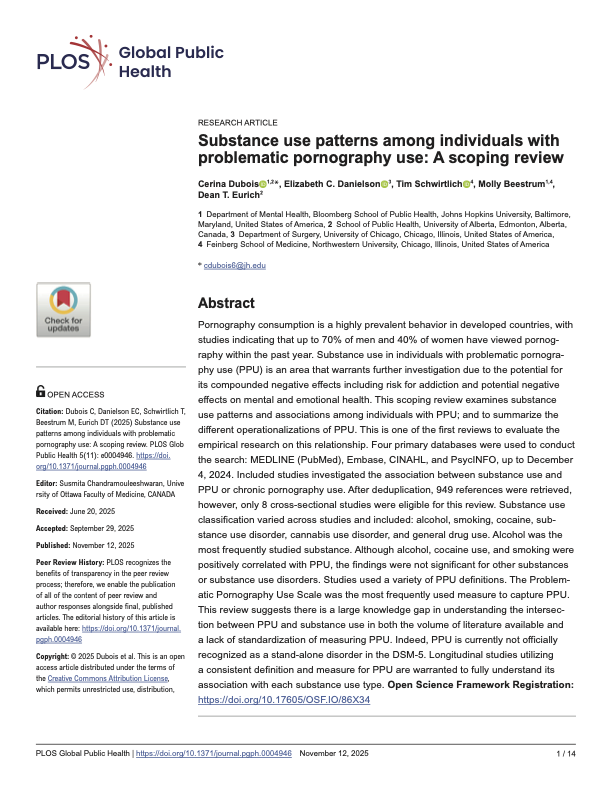
Substance Use Patterns Among Individuals With Problematic Pornography Use: A scoping review

By Cerina Dubois , Elizabeth C. Danielson, Tim Schwirtlich, Molly Beestrum, Dean T. Eurich

Pornography consumption is a highly prevalent behavior in developed countries, with studies indicating that up to 70% of men and 40% of women have viewed pornography within the past year. Substance use in individuals with problematic pornography use (PPU) is an area that warrants further investigation due to the potential for its compounded negative effects including risk for addiction and potential negative effects on mental and emotional health. This scoping review examines substance use patterns and associations among individuals with PPU; and to summarize the different operationalizations of PPU. This is one of the first reviews to evaluate the empirical research on this relationship. Four primary databases were used to conduct the search: MEDLINE (PubMed), Embase, CINAHL, and PsycINFO, up to December 4, 2024. Included studies investigated the association between substance use and PPU or chronic pornography use. After deduplication, 949 references were retrieved, however, only 8 cross-sectional studies were eligible for this review. Substance use classification varied across studies and included: alcohol, smoking, cocaine, substance use disorder, cannabis use disorder, and general drug use. Alcohol was the most frequently studied substance. Although alcohol, cocaine use, and smoking were positively correlated with PPU, the findings were not significant for other substances or substance use disorders. Studies used a variety of PPU definitions. The Problematic Pornography Use Scale was the most frequently used measure to capture PPU. This review suggests there is a large knowledge gap in understanding the intersection between PPU and substance use in both the volume of literature available and a lack of standardization of measuring PPU. Indeed, PPU is currently not officially recognized as a stand-alone disorder in the DSM-5. Longitudinal studies utilizing a consistent definition and measure for PPU are warranted to fully understand its association with each substance use type. 

PLOS Global Public Health, 2025.

Crime, Drugs, PornographyShamaya Banks
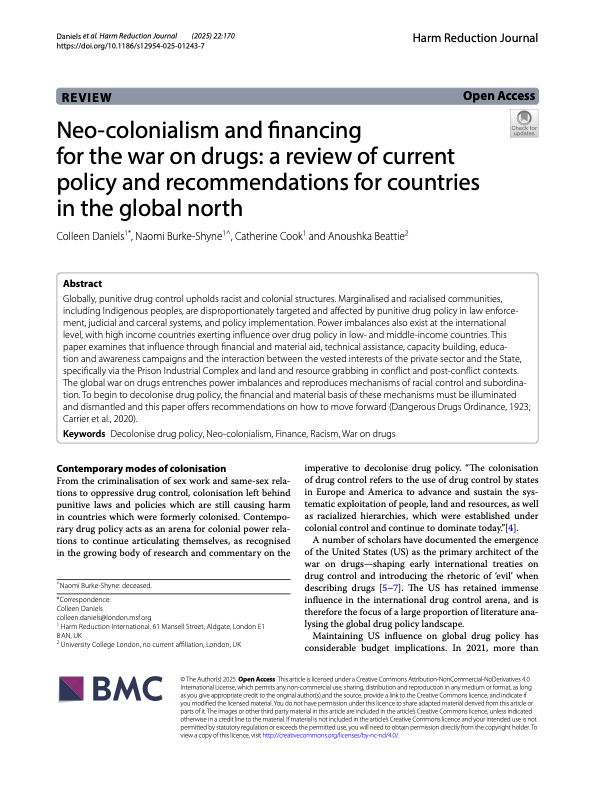
Neo‑colonialism and financing for the war on drugs: a review of current policy and recommendations for countries in the global north

By Colleen Daniels, Naomi Burke‑Shyne. Catherine Cook and Anoushka Beattie

Neo‑colonialism and financing for the war on drugs: a review of current policy and recommendations for countries in the global north Colleen Daniels1*, Naomi Burke‑Shyne1^, Catherine Cook1 and Anoushka Beattie2 Abstract Globally, punitive drug control upholds racist and colonial structures. Marginalised and racialised communities, including Indigenous peoples, are disproportionately targeted and affected by punitive drug policy in law enforcement, judicial and carceral systems, and policy implementation. Power imbalances also exist at the international level, with high income countries exerting influence over drug policy in low- and middle-income countries. This paper examines that influence through financial and material aid, technical assistance, capacity building, educa‑ tion and awareness campaigns and the interaction between the vested interests of the private sector and the State, specifically via the Prison Industrial Complex and land and resource grabbing in conflict and post-conflict contexts. The global war on drugs entrenches power imbalances and reproduces mechanisms of racial control and subordina‑ tion. To begin to decolonise drug policy, the financial and material basis of these mechanisms must be illuminated and dismantled and this paper offers recommendations on how to move forward (Dangerous Drugs Ordinance, 1923; Carrier et al., 2020).

Monitoring the Future national survey results on drug use, 1975–2024: Overview and detailed results for secondary school students

By Richard A. Miech,  Lloyd D. Johnston, Megan E. Patrick, Patrick M. O’Malley

Substance use is a leading cause of preventable morbidity and mortality; it is in large part why, among 17 high-income nations, people in the United States have the highest probability of dying by age 50.1,2,3 Substance use is also an important contributor to many social problems including domestic violence, violence more generally, criminal behavior, suicide, and more—and it is typically initiated during adolescence. It warrants our sustained attention. Monitoring the Future (MTF) is designed to give such attention to substance use among the nation’s youth and adults. It is an investigator-initiated study that originated with, and is conducted by, teams of research professors at the University of Michigan’s Institute for Social Research. Since its onset in 1975, MTF has been funded continuously by the National Institute on Drug Abuse—one of the National Institutes of Health—under a series of peer reviewed, competitive research grants. The 2024 survey, reported here, is the 50th consecutive national survey of 12th grade students and the 34th national survey of 8th and 10th grade students (who were added to the study in 1991). MTF contains ongoing national surveys of both adolescents and adults in the United States. It provides the nation with a vital window into the important but often hidden problem behaviors of use of illegal drugs, alcohol, tobacco, and psychotherapeutic drugs used without a doctor’s orders. For nearly five decades, MTF has helped provide a clearer view of the changing topography of these problems among adolescents and adults, a better understanding of the dynamic factors that drive some of these problems, and a better understanding of some of their consequences. It has also given policymakers, government agencies, public health professionals, and nongovernmental organizations (NGOs) in the field some practical approaches for intervening. A widespread epidemic of illicit drug use emerged in the 1960s among U.S. youth, and since then dramatic changes have occurred in the use of nearly all types of illicit drugs as well as alcohol and tobacco. Of particular importance, as discussed in detail below, are the many new illicit drugs that have emerged, along with new forms of alcoholic beverages and nicotine products. Among the substances and devices that have emerged over the life of the survey are new classes of drugs that include vaping devices, hookah smoking, synthetic marijuana, and drugs taken for performance enhancement. New devices and methods for taking drugs, such as vaporizers and e-cigarettes,number of new substances added to the list over the years substantially outnumbers the number removed because so many substances remain in active use. Throughout these many changes, substance use among the nation’s youth has remained a major concern for parents, educators, health professionals, law enforcement, and policymakers, largely because substance misuse is one of the largest and yet most preventable causes of morbidity and mortality during and after adolescence. The MTF annual monograph series is a key vehicle for disseminating MTF’s epidemiological findings. In addition to this monograph, the series includes a separate, annual monograph that presents prevalence and trends among U.S. adults now ages 19 to 65, including both college students and their age peers who are not attending college (scheduled for publication this summer), as well as an additional, periodic monograph that presents information on risk and protective behaviors for HIV among young adults. All MTF publications, including press releases, are available on the project website at www.monitoringthefuture.org 

Ann Arbor: University of Michigan Institute for Social Research , 2025. 484p.

It's Not So Simple: The Impact Of Simple Drug Possession and Trafficking Offenses On Health Equity

By The HIV Legal Network

In Canada, there is a growing body of evidence that indicates criminalizing simple drug possession (i.e. possessing drugs for personal use) and other activities related to drug use (e.g. activities captured by the trafficking prohibition) do not protect public health or public safety. Rather, these prohibitions have been ineffective in reducing the use and availability of criminalized drugs while contributing to profoundly negative health outcomes for people who use drugs. At the same time, criminalizing these activities has legally entrenched stigma, racism, and other forms of discrimination against people who use drugs, particularly those who are Indigenous, Black, unhoused, and poor. Acknowledging the harms of drug prohibition policymakers and other criminal legal system actors in Canada and globally have focused on the potential impacts of decriminalizing simple drug possession. Numerous United Nations bodies, for example, recommend “alternatives to conviction and punishment in appropriate cases, including the decriminalization of drug possession for personal use,” and countries across Europe and the Americas have implemented reforms regarding how simp le possession and/or personal drug use is legally defined and regulated.These changes have been implemented for diverse reasons, including to align laws and policies with public health principles and to alleviate demand on strained criminal legal systems. Yet, there has been little to no corresponding momentum to reform laws and policies when it comes to offences related to the supply and distribution of drugs (e.g. drug “trafficking”). A series of law and policy developments in Canada over the past decade have sought to mitigate some of the harms of the simple drug possession offence while directing focus towards people who supply drugs. This focus has manifested in an increase in sentences for drug trafficking across multiple jurisdictions, an approach that has been affirmed by the Supreme Court of Canada. As the Court recently held, drug trafficking should be “understood as an offence of violence, even beyond the ruinous consequences it has for those who abuse drugs and in the process, destroy themselves and others” — thus warranting heavy punishment.6 Yet, research suggests that a narrow focus on decriminalizing simple drug possession and the shift towards pursuing and more severely punishing drug trafficking may exacerbate the structural vulnerability of people who use drugs while actually contributing to health and social harms, such as violence, racism, and poverty, that can push people into conflict with the law in the first place.

Toronto: HIV Legal Network, 2025. 

No sales after midnight: evaluating the impact of a business curfew on drug-related crime in San Francisco’s tenderloin

By Mirko Nazzari, Marco Calaresu, Moris Triventi

Business curfews are emerging as regulatory policy instruments to reduce crime in high-risk areas, yet rigorous evaluations remain limited. This study examines San Francisco’s Tenderloin Retail Hours Restriction Pilot, which required select businesses to close from 12:00 a.m. to 5:00 a.m. starting July 2024. Using a customized Bayesian Structural Time Series model, we estimate a 56% reduction (95% credible interval: −72% to −27%) in drug-related incidents during curfew hours over nine months, with no evidence of spatial displacement to nearby areas or temporal displacement within the Tenderloin Public Safety Area. Results hold under CausalARIMA sensitivity tests. Findings suggest curfews may reduce opportunities for street-level drug activity, but potential economic costs and questions about longterm sustainability underscore the need for careful policy design.

Crime, Drugs, LegislationShamaya Banks
Change to Federal Definition of Hemp and Implications for Federal Enforcement

By Lisa N. Sacco, Zachary T. Neuhofer, Hassan Z. Sheikh

Change to Federal Definition of Hemp and Implications for Federal Enforcement

December 3, 2025 (IN12620)

On November 12, 2025, Congress and President Trump enacted a full-year FY2026 Agriculture appropriations act (P.L. 119-37, Division B), which contained a provision that reimposes federal controls over certain hemp products.

Both marijuana and hemp are varieties of the cannabis plant, and until 2018, hemp was considered to be marijuana as defined under the Controlled Substances Act (CSA). From 1970 until 2018, the federal government's definition of marijuana included hemp and its derivatives, and widespread hemp production was generally prohibited. Under the Agriculture Improvement Act of 2018 (2018 farm bill; P.L. 115-334), Congress amended the CSA definition of marijuana to reflect the differences in the chemical and psychoactive properties between hemp and marijuana, but it referred only to the level of delta-9 tetrahydrocannabinol (THC) to distinguish between them and not the other cannabinoids found within the cannabis plant. Some interpreted this definition of marijuana and the new federal definition of hemp to mean that products containing less than 0.3% delta-9 THC in addition to other psychoactive compounds would not be considered marijuana and would legally be considered hemp—the so-called farm bill loophole

Washington, DC: Congressional Research Service, 2025. 3p.

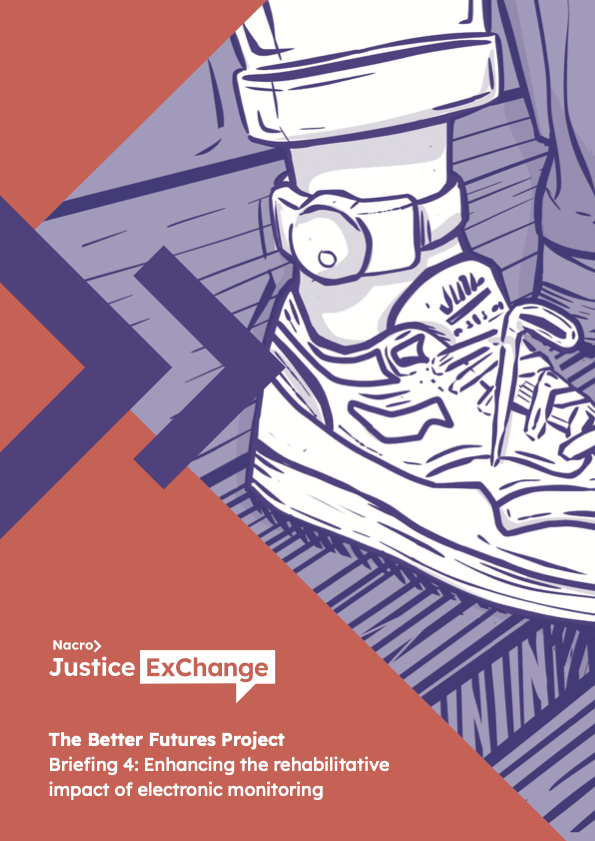
Enhancing the Rehabilitative Impact of Electronic Monitoring

By The Nacro Justice ExChange

Electronic monitoring plays an important role in the criminal justice system, acting as an alternative to prison. Current Government proposals mean that its use is set to increase significantly. In this context, it is important to understand what works and where improvements can be made to ensure that its use supports people’s rehabilitation, and ultimately safer communities. Through our survey and interviews, we heard from people who were positive about the impact of electronic monitoring, including how it had provided accountability and structure. We also heard from people for whom electronic monitoring had put in place barriers to rehabilitation, such as being unable to find and take up work and keep in contact with families, factors well evidenced to reduce the risk of reoffending. This briefing explores these issues in more detail along with problems with the fitting and functioning of tags, and specific challenges some groups face. We urge Government to address these barriers before expanding the use of electronic monitoring to ensure it has the best chance of success

The Better Futures Project Briefing 4

London: Nacro Justice Exchange 2025. 

The European Survey Of Probation Staff’s Stress and Morale

By Charlie Brooker, et al.

This study presents the first cross-European investigation into occupational stress and morale among probation staff across member jurisdictions of the Confederation of European Probation (CEP). Using a mixed-method design, data were collected from 357 individual probation officers across 20 European countries and organisational directors from 22 jurisdictions during summer 2025. The Maslach Burnout Inventory (MBI) was used to assess emotional exhaustion, depersonalisation, and personal accomplishment, while a complementary organisational questionnaire examined structural provisions for staff well-being, including primary, secondary, and tertiary prevention measures. Results revealed moderate levels of burnout across the sample, with mean MBI scores of 21.3 (emotional exhaustion), 6.8 (depersonalisation), and 30.7 (personal accomplishment). Approximately one-third of respondents (34%) were engaged, 32% ineffective, 23% overextended or disengaged, and 12% met the criteria for full burnout. Burnout was most prevalent among staff with high caseloads and longer tenure, but demographic variables such as age and gender were not significant predictors. Organisational analyses identified three national clusters—advanced, emerging, and minimal protection—based on the degree of institutionalisation of staff support systems. Jurisdictions such as Austria, the Netherlands, and Norway demonstrated comprehensive, multi-tiered prevention frameworks, while others relied on informal, ad hoc measures. Cross-mapping of individual and organisational data indicated that higher engagement levels corresponded closely with robust institutional prevention systems. The findings affirm that staff morale in probation work is primarily an organisational outcome rather than an individual trait. Sustainable well-being depends on formalised policies for workload governance, confidential support access, and structured reintegration after burnout. The report concludes that embedding well-being within probation systems’ governance and evaluation frameworks is essential for maintaining professional efficacy, reducing turnover, and safeguarding the rehabilitative function of community corrections across Europe.

Utrecht: Confederation of European Probation, 2025. 32p.