Open Access Publisher and Free Library
HUMAN RIGHTS.jpeg

HUMAN RIGHTS

Human Rights-Migration-Trafficking-Slavery-History-Memoirs-Philosophy

Posts in Human Rights
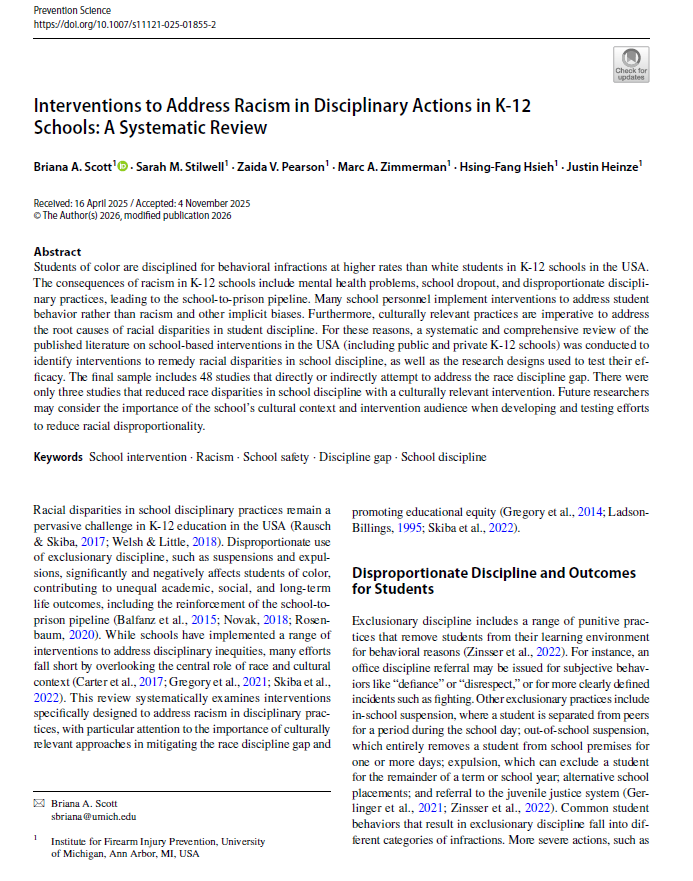
Interventions to Address Racism in Disciplinary Actions in K-12 Schools: A Systematic Review

By Briana A. Scott, Sarah M. Stilwell, Zaida V. Pearson, Marc A. Zimmerman


Students of color are disciplined for behavioral infractions at higher rates than white students in K-12 schools in the USA. The consequences of racism in K-12 schools include mental health problems, school dropout, and disproportionate disciplinary practices, leading to the school-to-prison pipeline. Many school personnel implement interventions to address student behavior rather than racism and other implicit biases. Furthermore, culturally relevant practices are imperative to address the root causes of racial disparities in student discipline. For these reasons, a systematic and comprehensive review of the published literature on school-based interventions in the USA (including public and private K-12 schools) was conducted to identify interventions to remedy racial disparities in school discipline, as well as the research designs used to test their efficacy. The final sample includes 48 studies that directly or indirectly attempt to address the race discipline gap. There were only three studies that reduced race disparities in school discipline with a culturally relevant intervention. Future researchers may consider the importance of the school’s cultural context and intervention audience when developing and testing efforts to reduce racial disproportionality

CHRISTIANITY VERSUS SLAVERY

BY HUGH CHARLES, LORD CLIFFORD.

In a world still grappling with the echoes of systemic inequality, Christianity Versus Slavery (1841) emerges not merely as a historical relic, but as a prescient manifesto on human dignity and the moral imperatives of justice. This collection—comprising the fiery oratory of George Thompson, the strategic appeals of Lord Clifford to the Catholics of Ireland, and the authoritative weight of centuries of Papal Briefs—challenges the modern reader to confront the persistent "complicated interests" and "rotten politics" that continue to shape global structures of exploitation. At its heart, the work champions the "Scriptural doctrine of equality," asserting that the "innate dignity of man" is an immutable truth that transcends "complexion" or state borders. This 19th-century insistence that "God has made of one blood the varied tribes of man" serves as a foundational precursor to our modern concept of universal human rights.

The book’s relevance to the modern era is perhaps most striking in its sophisticated analysis of the intersection between global exploitation and domestic economic health. Lord Clifford’s address highlights how the "ruinous, than unchristian and inhuman traffic" of slavery in the colonies was inextricably linked to the "general distress" and "awful distress" of the manufacturing interests and the "starving workman" at home. This early critique of an "equally wicked and foolish policy" that prioritized "sordid lucre" over justice prefigures modern debates regarding ethical supply chains, globalized labor rights, and the hidden human costs of consumer goods. By linking the oppression of India and Ireland to the struggle for abolition, the text invites a contemporary audience to view justice as an indivisible, global pursuit.

Furthermore, the work offers a timeless strategy for social change through the "regeneration of public sentiment". In an age often dominated by digital echo chambers and a "venal press," the book’s emphasis on the "power of truth" and "moral power" as weapons "mightier than armies" remains a potent call to action. It warns that the struggle for justice is "slow and progressive," requiring a "struggle continued through a series of years" against "deep-seated prejudices" and "long-cherished pride". Ultimately, Christianity Versus Slavery serves as a rigorous moral compass, reminding the modern era that the "spiritual nature and affinity of the races" is the only legitimate basis for a sane and just civilization.

Read-Me.Org Inc. New York-Philadelphia-Australia. 2026. 100p.

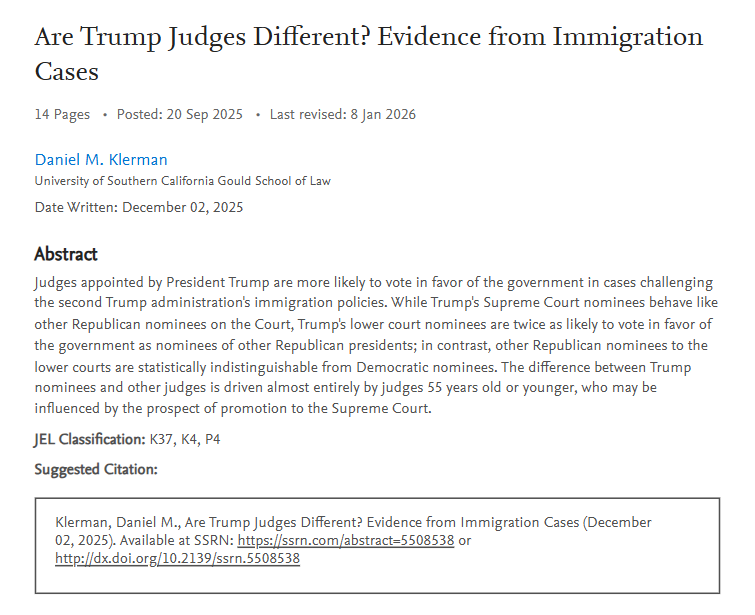
Are Trump Judges Different? Evidence from Immigration Cases

By Daniel M. Klerman

Judges appointed by President Trump are more likely to vote in favor of the government in cases challenging the second Trump administration's immigration policies. While Trump's Supreme Court nominees behave like other Republican nominees on the Court, Trump's lower court nominees are twice as likely to vote in favor of the government as nominees of other Republican presidents; in contrast, other Republican nominees to the lower courts are statistically indistinguishable from Democratic nominees. The difference between Trump nominees and other judges is driven almost entirely by judges 55 years old or younger, who may be influenced by the prospect of promotion to the Supreme Court.

 USC CLASS Research Paper No. 2522, 2025, 

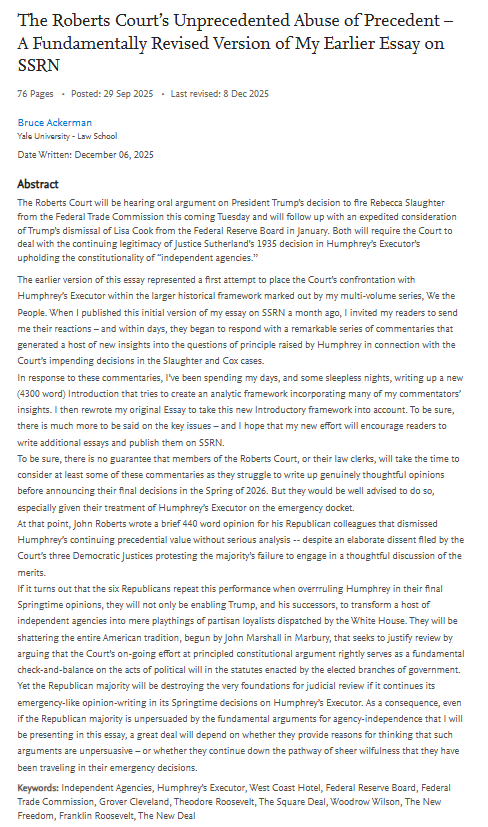
The Roberts Court’s Unprecedented Abuse of Precedent – And How It Is Destroying the Judiciary’s Role in the System of Checks-and-Balances

By Bruce Ackerman

From the days of the Federalist Papers and Marbury v. Madison, the Court’s commitment to reasoned elaboration of constitutional principle has served as the justification for its role in the system of checks-and-balances. Yet the very foundations of judicial legitimacy are at stake in two cases that the Roberts Court has scheduled for expedited consideration during the early months of its 2025-26 Term. These cases deal with the continuing legitimacy of Humphrey’s Executor’s unanimous decision upholding the constitutionality of “independent agencies” – most notably, the Federal Reserve and the Federal Trade Commission. This prospect has provoked a great deal of scholarly debate over the implications of relatively recent decisions by the Roberts Court on these issues. In contrast, my essay puts these decisions in a larger framework – emphasizing the crucial role played by the President and Congress in constructing “independent agencies” during the half-century preceding Humphrey’s unanimous decision upholding their constitutionality in 1935. It demonstrates that, after the breakthrough creation of the Interstate Commerce Commission by the Cleveland Administration, every President – from Theodore Roosevelt through Woodrow Wilson through Herbert Hoover – gained Congressional support for the creation of new independent agencies self-consciously organized to restrict presidential power in order to assure the deployment of impartial and expert regulation over crucial areas of socio-economic life. Justice Sutherland’s unanimous opinion of 1935 represents the self-conscious recognition of the legitimacy of this bipartisan affirmation of the role of expertise in modern government – and should not be cast aside without a principled confrontation with its historical foundations in American constitutional development.

Yale Law School, Public Law Research Paper, 2025

The impact of cyber-crime and violent extremism on socio-economic development in Nigeria

By Chukwudi Kingsley Onyeachu, Ikechukwu Clement Okoro & Martina Mgbosolu Ugwuoke 

Cybercrime and violent extremism have not only become mutually reinforcing, in recent times, but also fast growing, multidimensional and easily joined by the youth for lack of socio-economic opportunities to break out of poverty and overcome family and peer pressures. Research findings have proven that to ‘get-rich-quick’ through cyber-criminalities influences performance of human blood and body parts rituals, which translates to violent extremism. The youth who make money through these inhuman practices that negate acceptable societal values believe that education, apprenticeship, human capital development and decent work are a dysfunctional social-orientation. Careful observations have shown that when the youth acquire illicit money, the result is excessive clubbing, frivolous spending, promotion of prostitution, substance abuse, which undermine effective youth engagement in socio-economic development. The youth bulge theory was adopted in the study. The theory postulates that large youth population can become a “demographic dividend” when their potentials are properly harnessed, and it can also become a “demographic bomb” in the face of systemic socio-economic exclusion, unemployment, hunger and family poverty. The methodology applied was content analysis, leveraging empirical studies in Nigerian context and other sources of data. The paper revealed that youth unemployment, systemic corruption, absence of transparency in the administration of poverty alleviation interventions and limited opportunities are manifestations of youth exclusion from decision-making process and they are key factors influencing youth participation in cybercrime and violent extremism. The paper recommended practical youth-specific engagement strategies in socio-economic development as a means to discouraging cybercrime and its associated extreme practices.

Discov glob soc 3, 72 (2025)

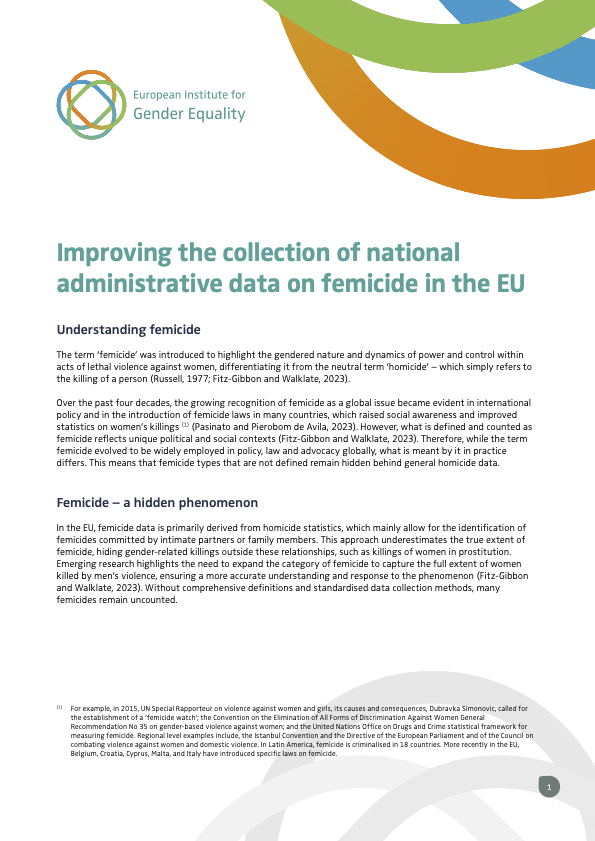
Improving The Collection Of National Administrative Data On Femicide In The EU

By The European Institute for Gender Equality

EIGE’s research on femicide has focused on the definition and measurement of femicide as a specific crime, due to the gendered nature of the killings and dynamics of power imbalance between women and men.

EIGE supports Member States in collecting administrative data on femicides within the context of intimate-partner relationships, domestic relationships or any relationships. 

This policy brief presents the data on femicide from the latest EU-wide collection of national administrative data on intimate partner violence and domestic violence.

The brief maps MS’ progress in data collection on femicide in the period between 2014 to 2022 and their ability to disaggregate the data by sex and relationship type between victim and perpetrator. 

The policy brief highlights several findings: women are disproportionately affected by intimate partner homicide, in which women represent 87 % of all victims and 60 % of victims in domestic homicides versus 42 % of all homicide victims. 

It further encourages MS to establish common legal definition of femicide and collect data disaggregated by sex and relationship and advocates for an expanded collection of data related to the context and circumstances of the killing to support improved understanding of femicide and enable improvements in development and use of risk assessment tools. 

2025. 9p.

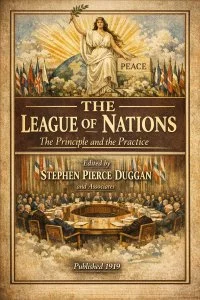
THE LEAGUE OF NATIONS: The Principle and the Practice

Edited by Stephen Pierce Duggan. Introduction by Graeme R. Newman

A Landmark Vision of International Order at the Dawn of the Modern World

Published in 1919 at the very moment when the post–First World War settlement was taking shape, The League of Nations: The Principle and the Practice, edited by Stephen Pierce Duggan, is one of the most authoritative and illuminating contemporary statements of the ideas that sought to prevent another global catastrophe. Written as the Covenant of the League of Nations moved toward ratification, this volume captures the urgency, optimism, and hard-headed realism of thinkers grappling with the central political question of the twentieth century: how can peace be made durable in a world of sovereign states?

Bringing together leading scholars, jurists, historians, and policy practitioners, the book moves beyond slogans to examine how an international organization must actually function. It explains not only the moral and historical foundations of the League idea, but also its practical machinery—arbitration, sanctions, international administration, and continuous cooperation across borders. Readers are guided through the institutional logic of collective security, the limits of national sovereignty, and the challenges posed by armaments, small nations, and postwar reconstruction.

Distinctive for its clarity and documentary richness, the volume includes key historical texts and the full Covenant of the League itself, allowing readers to engage directly with the constitutional framework of early international governance. Written in accessible but rigorous prose, it was intended for educated citizens as well as specialists—an informed guide for public debate at a decisive historical moment.

Today, The League of Nations: The Principle and the Practice stands as an indispensable primary source for understanding the intellectual foundations of modern global governance. It reveals how the ambitions and anxieties of 1919 shaped later institutions, including the United Nations, and it remains strikingly relevant in an era once again marked by questions of collective security, international law, and global cooperation. For historians, political scientists, legal scholars, and readers interested in the origins of the contemporary international order, this book is both a historical document and a continuing challenge to think seriously about how peace is organized.

The Atlantic Monthly Press. BOSTON. 1919. Read-Me.Org Inc. New York-Philadelphia-Australia. 2025. p.253.

Pregnancy Panopticon: Abortion Surveillance After Roe

By Albert Fox Cahn, ESQ. and Eleni Manis, PHD, MPA

Abortion rights will soon be a thing of the past for millions of Americans. At the time of publication, a leaked Supreme Court draft opinion shows a majority of justices are poised to strike down Roe v. Wade, Planned Parenthood v. Casey, and any federal constitutional right to abortion. But repealing a half century of reproductive rights won’t transport Americans back to 1973, it will take us to a far darker future, one where antiquated abortion laws are enforced with cutting edge technology. Sweeping abortion laws are already on the books in many states, primed to go into effect the moment the Supreme Court’s decision is published. But those sprawling bans won’t enforce themselves. Police, prosecutors, and private anti-abortion litigants will weaponize existing American surveillance infrastructure to target pregnant people and use their health data against them in a court of law. This isn’t speculation—it’s already happening. Abortion opponents surveil pregnant people and abortion providers to chill their reproductive freedoms.1 Hospitals track pregnant patients with suspicionless drug testing, 2 while police harness surveillance to enforce existing abortion laws. Nearly every aspect of pregnant peoples’ online lives is already targeted—including search histories, online purchases, and messages—while cellphone location data is used to track their movements in physical space. 3 If this is the state of surveillance today, in an America with abortion rights, what surveillance will we see in a post-Roe future?

Banned For Being: Moderating Online Games' Public Sphere

By Eleni Manis, Evan Enzer, Derek Smith, Leticia Murillo, Anna Sipek, Sarah Roth, Brittan Heller

Online gamers aren’t just playing games: they’re joining lively public forums that reflect offline civil society with both its good and its evils.

  • Game companies moderate content to promote civility in these forums, but they frequently make bad calls against historically marginalized gamers. These gamers get “banned for being” when they assert their identities and “banned for responding” when they reply to harassment by standing up for themselves.

  • Games can begin to combat repeated bad calls against historically marginalized gamers—which amount to structural discrimination in online games—by offering robust notice and appeals systems.

  • But to build truly inclusive public forums, games must also change the rules of moderation. Games must consider gamers’ words in context to avoid penalizing historically marginalized gamers for asserting their identities or for responding to hate. They must carefully limit any rules against political and controversial speech to avoid forcing historically marginalized gamers off of gaming platforms.

Game Over: The Unintended Consequences of Video Game Censorship

By Albert Fox Cahn and Evan Enzer

Video games aren’t merely a toy anymore. Instead, they represent one of the fastest growing segments of the global internet ecosystem, garnering rapidly expanding user engagement and investment. Yet as video game platforms have evolved from the standalone cabinets and consoles of the late 20th century into a vibrant and interconnected social network, gaming has been plagued by many of the same speech moderation questions that have confronted Meta, Twitter, TikTok, and other social media platforms. Video game platforms aren’t just a place to shoot virtual enemies and fly simulated spaceships, they are also a place for users to engage in a wide array of political, religious, and other constitutionally protected activities.

Guidelines for Prosecutors on Digital Evidence Collection in Compliance with International Standards on Freedom of Expression and Privacy

By Sabin Ouellet, Simon Clements

Guidelines for prosecutors on digital evidence collection emphasize balancing law enforcement needs with international standards on freedom of expression and privacy. They provide practical tools like case studies, checklists, and guidance on preserving evidence and maintaining its integrity. Key principles include adhering to legality and due process, properly documenting the collection process, and protecting the rights of all individuals involved. 

UNESCO, International Association of Prosecutors; 2025 18p.

Child Protection and the European Court of Human Rights: Lessons from Norway in the Development and Contestation of Children’s Rights

Stein Helland, Hege (editor), Skivenes, Marit (editor), Gloppen, Siri (editor)

Article 1 of the European Convention of Human Rights gives children the same protection of their fundamental rights and freedoms as adults. However, there is a notable absence of specific provisions for their rights. What does this imply in practice? This interdisciplinary volume brings together leading scholars in political science, law, social work and more to examine how the European Court of Human Rights (ECtHR) shapes – and is shaped by – child protection litigation and mobilisation. Norway has had more child protection cases decided by the ECtHR than any other country, and so this book, a first of its kind, uses Norway as a specific focus and explores the evolving role of the Court in balancing parental rights, state authority and children’s best interests, offering a fresh perspective on the intersection of international human rights law, children’s rights and child protection policy.

Bristol, UK: Policy Press, 2025. 

A Sword and a Shield: An Antidiscrimination Analysis of Academic Freedom Protections

By Apratim Vidyarthi

Academic freedom is an essential principle undergirding education in the United States. Its purpose is to further the freedom of thought and inquiry in the academic profession by advancing knowledge and the search for truth. Academic freedom goes back more than a century, and is now intertwined with First Amendment doctrine. Yet today’s academic freedom doctrine suffers from serious problems, some of which perpetuate discrimination in the classroom and systemically in educational institutions. The definition of academic freedom in theory is misaligned with that in case law. Courts have done little to analyze what protections academic freedom provides, and case law generally provides too much protection in some cases, and too little in others. Worse, academic freedom for universities and professors has been hotly debated and thus well-defined and protected in case law, whereas students’ academic freedom has received less attention, making it a “second-tier” academic freedom. Often, protecting university and professors’ academic freedom comes at the expense of students’ academic freedom, though courts have never truly struggled with multistakeholder academic freedom questions or tried to create a clear process to determine whose academic freedom prevails when the two conflict. This results in academic freedom being used as a sword to promote discriminatory behavior, and as a shield to protect acts of discrimination from being punished. Existing constitutional and statutory antidiscrimination protections do not provide adequate support against discrimination, especially for students’ academic freedom. Constitutional protections for students’ academic freedom often take the back seat to free speech doctrine, and antidiscrimination protections are often parried by using academic freedom to protect problematic behavior. A few solutions abound: first, the definition of academic freedom is nearly a century old, and needs to be redefined to incorporate antidiscrimination principles to be relevant for the present. Second, students’ academic freedom rights need to be understood and defined more clearly. Third, courts must find a way to balance competing stakeholders’ academic freedom interests, ultimately looking to the purpose of academic freedom to advance knowledge. Finally, universities must play their part by creating systems and structures to ensure that discrimination is remedied as early as possible, and that university processes help clarify the extent of academic freedom definitions and support application of antidiscrimination law.

JOURNAL OF CONSTITUTIONAL LAW [Vol. 26:2, 2024. . 79p.

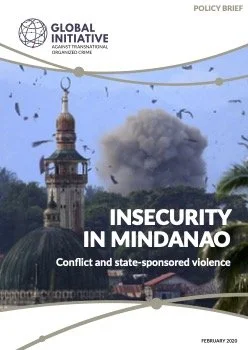
Insecurity in Mindanao: Conflict and State-Sponsored Violence

By Jason Eligh

This brief provides an overview of the challenges facing the various autonomous government authorities of Mindanao, in the southern Philippines, in transitioning the region from conflict to peacebuilding, and to assess the response of the Philippine state to these challenges. Mindanao has long been fractured by a toxic mixture of political violence, identity-based armed conflict, and ethnic and clan divisions, and has been beset by sustained rebel and terrorist violence. These divisive factors have militated against regional political unity and social coherence, exacerbated by the area’s socioeconomic and development challenges. This context has also provided fertile ground for non-state armed groups involved in criminal enterprises to develop. When strongman Rodrigo Duterte was elected mayor of Davao, the capital of Mindanao, before he became president of the country, his approach to regional insecurity took the form of a highly securitized crackdown involving state-sanctioned and extrajudicial violence meted out by death squads. The methodology is qualitative and presents a narrative grounded in both primary and secondary data sets. These are supplemented by publicly available resources from news, research and civil-society organizations. Key points ■ State-sponsored violence has been deployed in Mindanao, and the Philippines more broadly, as a national policy. ■ Extrajudicial killings have continued in the war on drugs across the Philippines, following the same pattern as the earlier violence under Duterte’s Davao Death Squad. ■ The government implemented martial law in the Mindanao region for two years – purportedly for security, but conveniently hindering investigations of human-rights abuses by the state

has also provided fertile ground for non-state armed groups involved in criminal enterprises to develop. When strongman Rodrigo Duterte was elected mayor of Davao, the capital of Mindanao, before he became president of the country, his approach to regional insecurity took the form of a highly securitized crackdown involving state-sanctioned and extrajudicial violence meted out by death squads. The methodology is qualitative and presents a narrative grounded in both primary and secondary data sets. These are supplemented by publicly available resources from news, research and civil-society organizations. Key points ■ State-sponsored violence has been deployed in Mindanao, and the Philippines more broadly, as a national policy. ■ Extrajudicial killings have continued in the war on drugs across the Philippines, following the same pattern as the earlier violence under Duterte’s Davao Death Squad. ■ The government implemented martial law in the Mindanao region for two years – purportedly for security, but conveniently hindering investigations of human-rights abuses by the state. ■ Mindanao has seen a disproportionately high number of killings of human-rights advocates and activists. ■ Extremist and rebel groups in Mindanao are involved in criminal economies, deriving financing from drug and arms trafficking, kidnapping and extortion. ■ There is evidence that political elites in the region are involved in illicit drug markets. ■ A fundamental factor in promoting regional security and stability will be the need to support Mindanao in its transition to a peaceful, resilient post-conflict future

Geneva: Global Initiative against Transnational Organized Crime, 2020. 25p.

Guide on Engaging the United States Government on Arbitrary or Wrongful Detention Cases

By Robert F. Kennedy Human Rights Center

Addressing arbitrary and wrongful detention through advocacy and litigation is an area of extensive expertise and experience for RFK Human Rights. In the last decade, we have worked with families of arbitrarily and wrongfully detained individuals, including US persons, to facilitate their release and return home. A central reflection from our engagements with other practitioners and family members of arbitrarily or wrongfully detained persons is that the policy and legal architecture for the United States Government (USG) response to arbitrary and wrongful detention is complex and convoluted. Despite the successes in reuniting detained individuals with family members and the positive posture of the government toward negotiations, many stakeholders believe that clarity about the role each office or agency plays in the government’s response and uniformity in the government’s engagement with the families could facilitate even more positive outcomes.

In 2023, RFK Human Rights started a project aimed at steering USG and Congress towards more decisive action to address arbitrary and wrongful detention around the world and enhancing awareness around the government’s response architecture. Through the generous support from Open Society Foundations – United States, the project included advocacy engagements with the USG, litigation before the United Nations Working Group on Arbitrary Detention (UNWGAD), and publication of the Guide for Engaging the United States Government on Arbitrary and Wrongful Detention Cases.

About the Guide

The Guide on Engaging the United States Government on Arbitrary and Wrongful Detention Cases provides clear and concise information regarding advocacy strategies and engagement with the United States Government on arbitrary and wrongful detention cases. While every case is unique, this Guide aims to ease the burden of the engagement and advocacy process by shedding light on ways that the USG can engage on these cases and offering a set of best practices for advocating before the USG to secure the victim’s release. The Guide is based on RFK Human Rights’ institutional knowledge and experience working on arbitrary and wrongful detention cases, desk research, and a large number of interviews with experts and victims of arbitrary detention.

Washington, DC; New York: Robert F. Kennedy Human Rights, 2025. 68p.

Compliance Theater: The NWDC’s Unenforced Contract

By The Center for Human Rights, The Henry M. Jackson School of International Studies, University of Washington

The University of Washington Center for Human Rights's newest report, “Compliance Theater: The NWDC’s Unenforced Contract," looks at ICE’s use of enforcement mechanisms in its $700 million contract with GEO Group, Inc., the private company that runs the Northwest Detention Center (NWDC) in Tacoma, Washington.

How does ICE enforce the contract to operate the NWDC, and what happens if GEO fails to meet contract standards? Report findings include:

The contract between ICE and GEO Group for operation of the Northwest ICE Processing Center/NWDC expires in September 2025; it is likely to be renewed.

The contract includes extensive enforcement mechanisms and references to ICE standards, which are cited by ICE in response to criticisms of conditions at the facility.

UWCHR has filed multiple FOIA requests for various categories of records mandated under the facility’s contract, but in many cases ICE has responded that the required records do not exist; Members of Congress have also been unable to obtain records required under the contract.

Despite documented failures to uphold contract standards, GEO Group has never been sanctioned by ICE under the terms of the contract.

Seattle: Center for Human Rights, The Henry M. Jackson School of International Studies, University of Washington, 2025

The Human Right to Democracy in Multilevel Systems at a Time of Democratic Backsliding: Global, Regional and European Union Perspectives

By Thomas Giegerich

This open access book takes stock of the current situation of the human right to democracy in multilevel systems of government - at a time of renewed struggles with antidemocratic forces (democratic backsliding). It tries to answer three questions: (1) Is there a human right to democracy in contemporary global and regional international law as well as European Union law and what consequences does that have for the States’ governmental structure (top-down perspective on national democracy)? (2) Does the human right to democracy also extend to decision-making at the international and supranational level (bottom-up perspective on international/supranational democracy)? (3) What is the relation between national democracy and international democracy and the corresponding human entitlements (interdependence perspective)? The first part of an answer to these questions derives from the elements of democracy proclaimed by the United Nations as a universal value. The second part results from an investigation of the national and international democratic ingredients of the right of self-determination of peoples, whose recognition and codification is the mainstay of the human rights revolution since 1945. The third part is added by a survey and comparison of the various democratic rights included in the global and regional human rights treaties that constitute the subjective cornerstones of democracy. The fourth part is devoted to analysing the EU as exemplary but imperfect multilevel democracy. In all these parts, the enforcement of democratic entitlements are also discussed. In the fifth part, conclusions will be drawn. The book is addressed to international and EU law experts as well as political scientists.

Cham: Springer Nature, 2026.

Policing Same-Sex Relations in Eighteenth-Century Paris: Archival Voices from 1785

Edited by Jeffrey Merrick

Police in Paris arrested thousands of men for sodomy or similar acts in the eighteenth century. In the mid-1780s, they recorded depositions in which prisoners recounted their own sexual histories. These remarkable documents, curated and translated into English by Jeffrey Merrick, allow us to hear the voices of men who desired men and to explore complex questions about sources, patterns, and meanings in the history of sexuality. This volume centers on two cartons of paperwork from commissaire Charles Convers Desormeaux. Dated from 1785, the cartons contain 221 dossiers of men arrested for sodomy or similar acts in Paris. Merrick translates and annotates the police interviews from these dossiers, revealing how the police and those they arrested understood sex between men at the time. Merrick discusses the implications of what the men said (and what they did not say), how they said it, and in what contexts it was said. The best-known works of clergy and jurists, of enemies and advocates of Enlightenment, and of novelists and satirists from the eighteenth century tell us nothing at all about the lived experience of men who desired men. In these police dossiers, Merrick allows them to speak in their own words. This primary text brings together a wealth of important information that will appeal to scholars, students, and general readers interested in the history of sexuality, sodomy, and sexual policing.

University Park, PA: Penn State University, 2024.

Narrativity and Violence: Conceptual, Ethical and Methodological Challenges

Edited by Doris Reisinger, Christof Mandry, Sabine Andresen

Survivors' narratives are an invaluable source for the study of violence across academic fields. At the same time, they present several difficulties for academic research. Sources may be marked by the effects of trauma, the lasting impact of perpetrators' political power or blurred lines between reality and fiction. Ethical and legal problems, distances in time between a violent event and the moment of its narration, and the variation in linguistic phrasing chosen by survivors present additional problems. Based on several case studies, the contributors explore typical problems in the study of violence through survivors' narratives, and possible ways of dealing with them.

Bielefeld, Germany, transcript Verlag, 2024. 

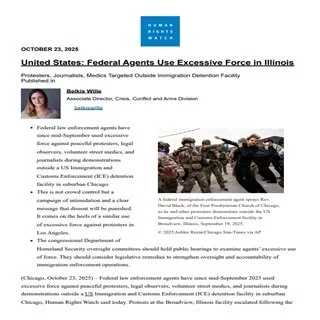
United States: Federal Agents Use Excessive Force in Illinois: Protesters, Journalists, Medics Targeted Outside Immigration Detention Facility

By Belkis Wille

Federal law enforcement agents have since mid-September 2025 used excessive force against peaceful protesters, legal observers, volunteer street medics, and journalists during demonstrations outside a US Immigration and Customs Enforcement (ICE) detention facility in suburban Chicago, Human Rights Watch said today. Protests at the Broadview, Illinois facility escalated following the start of ICE’s “Operation Midway Blitz” on September 8 and an increase in immigration raids and seizures throughout the Chicago area. 

Based on accounts by witnesses and videos that Human Rights Watch analyzed, Department of Homeland Security (DHS) agents—sometimes in the presence of state and local police, and other federal agents—repeatedly used excessive force against small groups of protesters who appeared to pose no threat to the agents or to public security, and against clearly identifiable journalists, legal observers, and volunteer street medics. They detained dozens of protesters, and at least one journalist and one volunteer street medic. The violent response comes on the heels of law enforcement’s use of excessive force against protesters opposing immigration raids in June in Los Angeles.

“This is not crowd control, but a campaign of intimidation,” said Belkis Wille, associate crisis and conflict director at Human Rights Watch. “Federal agents are using chemical irritants and firing projectiles at peaceful protesters, volunteer street medics, and journalists in broad daylight. The message is clear that dissent will be punished.”

Human Rights Watch interviewed 18 people who were present during the Broadview protests: 7 protesters, 4 journalists, 1 volunteer street medic, 2 immigration rights advocates, and a religious leader. Researchers also analyzed 17 videos recorded during the protests that were posted to social media or provided to researchers. On October 17, Human Rights Watch sent a letter to Homeland Security Secretary Kristi Noem summarizing these findings, posing questions, and offering the opportunity to comment, but has not received a response.

Witnesses and video confirm that DHS agents used tear gas and fired projectiles directly into groups of protesters, including from the detention facility roof, often without warning, and without protesters appearing to pose any risk to agents. Witnesses and verified footage show there were sometimes as few as 10 protesters and never more than 250. 

New York: Human Rights Watch, 2025.