Open Access Publisher and Free Library
SOCIAL SCIENCES.jpeg

SOCIAL SCIENCES

Social sciences examine human behavior, social structures, and interactions in various settings. Fields such as sociology, psychology, anthropology, and economics study social relationships, cultural norms, and institutions. By using different research methods, social scientists seek to understand community dynamics, the effects of policies, and factors driving social change. This field is important for tackling current issues, guiding public discussions, and developing strategies for social progress and innovation.

Rise and Thrive with Science: Teaching PK-5 Science and Engineering

By Nancy Kober; Heidi Carlone; Elizabeth A. Davis; Ximena Dominguez; Eve Manz; Carla Zembal-Saul; Amy Stephens and Heidi Schweingruber

Research shows that that children learn science and engineering subjects best by engaging from an early age in the kinds of practices used by real scientists and engineers. By doing science and engineering, children not only develop and refine their understanding of the core ideas and crosscutting concepts of these disciplines, but can also be empowered to use their growing understanding to make sense of questions and problems relevant to them. This approach can make learning more meaningful, equitable, and lasting.

Using cases and shorter examples, Rise and Thrive with Science shows what high-quality teaching and learning in science and engineering can look like for preschool and elementary school children. Through analyses of these examples and summaries of research findings, the guide points out the key elements of a coherent, research-grounded approach to teaching and learning in science and engineering. This guide also discusses the kinds of support that educators need to implement effective and equitable instruction for all children. This book will provide inspiration for practitioners at the preschool and elementary levels to try new strategies for science and engineering education, whatever their level of experience.

Rise and Thrive with Science will be an essential guide for teachers as they organize instruction to enable young children to carry out their own science investigations and engineering design projects, determine the kinds of instruction that lead to meaningful learning, and try to engage every one of their students.

National Academies of Sciences, Engineering, and Medicine. 2023. Rise and Thrive with Science: Teaching PK-5 Science and Engineering. Washington, DC: The National Academies Press
download
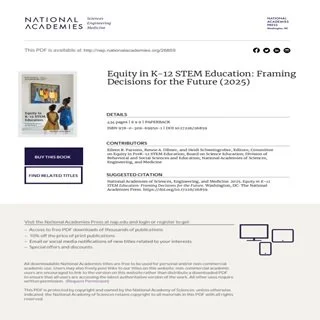
Equity in K-12 STEM Education Framing Decisions for the Future

By Eileen R. Parsons, Kenne A. DIbner, and Heidi Schweingruber

Science, technology, engineering, and mathematics (STEM) live in the American imagination as promising tools for solving pressing global challenges and enhancing quality of life. Despite the importance of the STEM disciplines in the landscape of U.S. political, economic, and social priorities, STEM learning opportunities are unevenly distributed, and the experiences an individual has in STEM education are likely to vary tremendously based on their race, ethnicity, socio-economic class, gender, and a myriad of other factors.

Equity in K-12 STEM Education: Framing Decisions for the Future approaches equity in STEM education not as a singular goal but as an ongoing process that requires intentional decision-making and action toward addressing and disrupting existing inequities and envisioning a more just future. Stakeholders at all levels of the education system - including state, district, and school leaders and classroom teachers - have roles as decision-makers who can advance equity. This consensus study report provides five equity frames as a guide to help decision-makers articulate short- and long-term goals for equity and make decisions about policy and practice.

National Academies of Sciences, Engineering, and Medicine. 2025. Equity in K-12 STEM Education: Framing Decisions for the Future. Washington, DC: The National Academies Press

Link
Scaling and Sustaining Pre-K-12 STEM Education Innovations: Systemic Challenges, Systemic Responses

By Christine M. Massey and Amy Stephens

In the modern history of the United States, investment in the teaching of science, technology, engineering and mathematics has resulted in a rich variety of education innovations (programs, practices, models, and technologies). Although a number of these innovations have had the potential to impact learners on a broad scale, that potential often remains unrealized. Efforts vary in their success in widescale implementation and sustainability across different educational contexts - leaving questions about how to achieve the major improvements to STEM education that many policy leaders seek.

Scaling and Sustaining Pre-K-12 STEM Education Innovations: Systemic Challenges, Systemic Responses examines the interconnected factors at local, regional, and national levels that foster or hinder the widespread implementation of promising, evidence-based Pre-K-12 STEM education innovations, to identify gaps in the research, and to provide guidance on how to address barriers to implementation. This report comes in response to a mandate within the CHIPS and Science Act of 2022.

National Academies of Sciences, Engineering, and Medicine. 2025. Scaling and Sustaining Pre-K-12 STEM Education Innovations: Systemic Challenges, Systemic Responses. Washington, DC: The National Academies Press
download
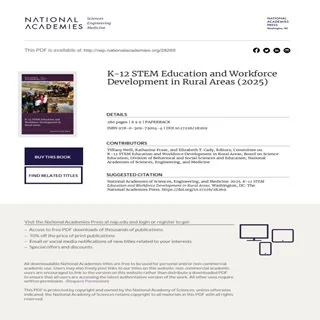
K-12 STEM Education and Workforce Development in Rural Areas

By Tiffany Neill, Katharine Frase, and Elizabeth T. Cady

Rural areas can provide a rich context for learning science, technology, engineering and mathematics (STEM), but these communities and the students in them are often overlooked in ongoing efforts to expand access to high-quality K-12 STEM education and workforce development. Addressing barriers, often related to funding, and promoting unrecognized assets for STEM learning can enhance the ability of individuals in rural areas to further engage in and contribute to their communities or to broader scientific exploration and discovery.

K-12 STEM Education and Workforce Development in Rural Areas makes recommendations to federal, state, and local educational agencies, programs, and other relevant stakeholders to advance STEM education and workforce development for rural America. This report comes in response to a mandate within the CHIPS and Science Act of 2022.

download
The Anatomy of Right-Wing Populism:  Dealing with transformational fatigue in Central and Eastern Europe

Edited by Jan Kubik, Richard C. M. Mole

Over the past two decades, populist politicians and parties have enjoyed remarkable success across the globe. The rise of right-wing populism is perhaps most noticeable in post-communist Europe, especially in Hungary and Poland, where politicians subscribing to this ideology have come to power and weakened media pluralism, the protection of minorities, the sovereignty of civil society and the independence of the judiciary. To develop a multidisciplinary understanding of the rise and functioning of right-wing populism in Central and Eastern Europe, The Anatomy of Right-wing Populism examines the two original concepts of neo-traditionalism (to capture the construction of the pure people in opposition to the corrupt elites and the threatening others) and neo-feudalism (to capture an economic strategy whereby a relatively small elite controls the apex of political power and a sizable portion of the country’s economy). This book argues that the causes and consequences of populism cannot be fully understood without a multidisciplinary analysis, drawing on the theories and approaches of politics, history, economics, sociology and anthropology. Grounded in empirical research, this volume provides theoretical insights into how populism became such a powerful political force and formulates policy recommendations on how to resist illiberalism, thereby appealing not only to academics but also to activists and policy makers.

London: UCL Press, 2025. 

link
Origins of Mendelism

By Robert C. Olby

From the cover:

"At last, a book about genetics has been written as a science to be reckoned with. Mr. Olby, a librarian of the Cotany School, Ixford, England, has written the whole story with remarkable ease. The text has a clarity which is not found too often in a book of this kind. This is partly because of the excellent notes and bibliography at the end of each chapter. The appendixes give further proof that a book such as this has never been written before-the work cited in each chapter is quoted as originally written by the scientists doing the work in this complicated field." -Library Journal

"Significant contribution to the history of genetics.... After reading this account, one cannot but have greater esteem and appreciation for Mendel as a scientist, a mathematician, a keen observer, and a keeper of careful records. The work and lives of the early hybridists are included in an informing manner with many accounts.... A large appendix includes original findings and writings of the early hybridists. ...Laymen as well as geneticists will appreciate this book." -Choice

Copyright © 1966, 1966 by Robert C. Olby. Schocken. 1967. 209p.

Read
Solidarism

by Rudolf Diesel (Author), Graeme R. Newman (Translator)

When Rudolf Diesel published Solidarismus: Natürliche wirtschaftliche Erlösung des Menschen in 1903, he was already celebrated as the inventor of the internal combustion engine that bore his name. Yet behind the engineer stood a man deeply troubled by the social consequences of industrial capitalism. He had seen firsthand the paradox of modernity: machines producing abundance while workers lived in misery.
By Rudolf Diesel. Translated from the German by Graeme R. Newman (assisted by ChatGTP)

Diesel’s Solidarism was his attempt to resolve this contradiction. It was neither Marxist nor anarchist, nor a conventional liberal reform. Instead, Diesel proposed a peaceful, cooperative, and disciplined movement in which ordinary workers, artisans, and families would pool resources into “People’s Treasuries.” From these would grow “Beehives”—productive cooperatives where every member shared in ownership and security. Over time, he envisioned these federating into a global network that could replace the inequities of capitalism with solidarity, justice, and peace.
The book attracted attention in Europe as an unusual hybrid of social thought, moral appeal, and engineering pragmatism. Diesel stressed repeatedly that he was not a professional economist but an inventor who felt compelled to seek “the natural economic redemption of mankind.” Some reviewers praised his sincerity and practical outlook; others dismissed him as a dreamer outside his field.
Socialists noted that Diesel rejected class struggle, revolution, and expropriation, favoring instead disciplined self-help and gradualism. Conservatives criticized his call for economic transformation beyond private capitalism. For both sides, Diesel seemed too unorthodox to embrace fully, but impossible to ignore. Diesel diagnosed the dangers of unregulated capitalism—inequality, insecurity, global rivalries—that remain urgent today. He envisioned cooperative economics, community-based security, and international solidarity long before these became mainstream topics.
In an era of global climate crisis, technological upheaval, and renewed questions about justice, Diesel’s voice speaks with surprising clarity. He insists that no technical advance has value unless it serves humanity; that no society can survive when millions live in fear and want; and that solidarity, not competition, is the moral law of the future.
Of course, Diesel’s scheme of Treasuries and Beehives reflects its own time, with the language and structures of early-twentieth-century Germany. But behind the particulars lies a timeless conviction: that human beings can organize economic life around justice, security, and brotherhood. His call is not to tear down violently, but to build patiently—penny by penny, act by act, institution by institution—the foundations of a more humane order.
This English edition makes accessible, for the first time in a complete form, Diesel’s forgotten social manifesto. It allows modern readers to see him not only as an inventor of machines, but as a moral thinker wrestling with the human meaning of technology.

Read-Me.Org Inc. New York-Philadelphia-Australia. 2025. . p.138.

download free
Kindle $2.99 -- Paperback $9.99
The Visual Memory of Protest

Edited by Ann Rigney and Thomas Smits

Social movements are not only remembered in personal experience, but also through cultural carriers that shape how later movements see themselves and are seen by others. The present collection zooms in on the role of photography in this memory-activism nexus. How do iconographic conventions shape images of protest? Why do some images keep movements in the public eye, while others are quickly forgotten? What role do images play in linking different protests, movements, and generations of activists? Have the affordances of digital media made it easier for activists to use images in their memory politics, or has the digital production and massive online exchange of images made it harder to identify and remember a movement via a single powerful image? Bringing together experts in visual culture, cultural memory, social movements, and digital humanities, this collection presents new empirical, theoretical, and methodological insights into the visual memory of protest.

Amsterdam: Amsterdam University Press, 2023.233p.

download
A Brief Guide To Understanding the Mind

By Mark Rozen Pettinelli

So you can categorize all of the information right. There’s emotion and cognition, studying that is important if you want to be clear and intelligent thinking I think. I mean, i know what the difference be- tween a feeling and a thought is. That’s important to understand be- cause it’s good to have a feeling for that in order to function properly. If you know the difference between feelings and thoughts then you should be able to think clearly right? What else is there to clear thinking and logic? Making logical arguments and using proper reasoning is a part of logic. What else would someone need in order to think logically then?

2025, 31p.

download
Consciousness and Mind

By Mark Rozen Pettinelli

In conclusion of my research, in order to understand what you are feeling, simply try to feel what you can feel. It is simple, I could just try to figure out what I am feeling at the moment. I can try to analyze my feelings using what I learned about feelings. So then what would I use to analyze or understand my feelings then. I know about the mental processes, the main ones are feeling, thought, attention, perception, awareness, language, and memory. So I could say to myself, well now I'm feeling this and that, the feeling feels like this and this or that mental process is being used. If you don't know what the mental processes are you could look them up or just think about how your mind is working and what it could possibly be doing at the moment to produce the feelings your currently experiencing. That is my guide for understanding what you are feeling at any time or the current moment. You could just ask yourself," what mental processes could my mind be using in order to make myself feel this way.

2024, 23p.

download
The Psychology Of Emotions, Feelings and Thoughts

By Mark Pettinelli

This paper puts forth the idea that life is divided into three groups, emotion, think- ing, and feeling. These three groups make humans feel in certain ways, thinking, physical stimulus, and emotion all contribute to feeling. But what is the dierence between a thought, an emotion, and a feeling? Is there an overlap between the three? Probably, since any emotion can be broken down into the sensations and real events that caused it, and these events all lead to emotions, feelings and thoughts. So emo- tions, feelings and thoughts all might have the same source, they are just expressed dierently in the mind. Where do your emotions, feelings and thoughts rate on a scale of clarity? Where do they rate on a scale of focus and attention? How does under- standing the psychology of ones emotions, feelings and thoughts lead to a long term increased consciousness?

July 27, 2007, 43p.

download
‘Kill two million of them’: institutionalised hate speech, impunity and 21st century atrocities in India

By Cecilia Jacob | Cecilia.Jacob and

Mujeeb Kanth |

Hate speech and incitement have been instrumental in atrocity crimes that have occurred in India, even prior to its independence. These atrocities include targeted killings of minorities based on religious and ethnic identity, and demonstrate persistent features of systematic, orchestrated violence that is fuelled by a Hindu nationalist ideology. This ideology is routinely promulgated at the highest levels of political leadership. This article traces both the historical and institutional character of hate speech and incitement in India to understand its repeated manifestation over time. Through case studies of recent violence, it considers the implications of new legal developments, technology and the covid-19 pandemic on the character and dynamic of hate speech, incitement and atrocity violence in India. It considers key reforms and areas for accountability on which the international community could engage the government and civil society in India on the issue of hate speech and incitement to promote atrocity prevention at the domestic level.

Global Responsibility to Protect 15 (2023) 209–245

download
Non-crime hate incidents: a chilling distraction from the public’s priorities on policing

By David Spencer

In this policy note we outline the origins of Non-Crime Hate Incidents (NCHIs), the approach by police forces to recording them and their threefold impact: (1) distracting police officers from focusing on what should be the core mission of policing to fight crime, (2) curtailing the employment prospects of individual members of the public through inappropriate disclosures of NCHIs, and (3) having a broader chilling effect on freedom of expression in our society. The origins of NCHIs can be found in the Stephen Lawrence Inquiry, published in 1999, which recommended that the police formally log “racist incidents” that did not reach the threshold of being a criminal offence. Subsequently expanded to cover other types of incident, NCHIs were entrenched in policing practice through the College of Policing’s 2014 ‘Hate Crime Operational Guidance’. As a result of a successful legal challenge in 2021, R (on the application of Miller) v College of Policing, the previous Government exercised its statutory power to introduce a new Code of Practice for the recording of NCHIs in June 2023. Until this point NCHIs had no formal basis in legislation whatsoever. The Code of Practice, issued pursuant section 60 of the Police, Crime, Sentencing and Courts Act 2022, defines Non-Crime Hate Incidents (NCHIs) as: “an incident or alleged incident which involves or is alleged to involve an act by a person (‘the subject’) which is perceived by a person other than the subject to be motivated - wholly or partly - by hostility or prejudice towards persons with a particular characteristic.” This paper demonstrates that the protections which Parliament and the previous Government attempted to introduce through this Code of Practice have been largely ineffective. A recent Inspection by His Majesty’s Inspectorate for Constabulary and Fire and Rescue Services (HMICFRS) shows that police forces have been willing entirely to ignore – and in fact to act contrary to – the Code of Practice. Out of 120 case files examined by HMICFRS sixteen NCHIs and fourteen hate crimes had been incorrectly recorded by police forces – an error rate of 25%. Of the 120 cases that HMICFRS reviewed, police had incorrectly recorded seven incidents on school premises. That police forces are failing to get it right is no surprise – their track record in this domain has been poor. In 2021, Merseyside Police were rightly criticised for producing a false and misleading advertising campaign which contained the slogan “BEING OFFENSIVE IS AN OFFENCE” – revealing that the officers involved were entirely wrong in their understanding of the law. A senior officer in the force subsequently withdrew the campaign and attempted to shift the blame onto the “local policing team on the Wirral”. Police forces continue to be highly opaque in their approach to NCHIs – producing little clarity over their policies or data relating to the recording of NCHIs. What data does exist shows that there is very wide variation in rates of reporting between police forces. Essex Police, records NCHIs at a rate of 21.5 NCHIs per 100 officers per annum in 2023 – a rate three times that of the Met, four times that of Greater Manchester and ten times that of West Yorkshire. The number of NCHIs recorded per 100 officers per annum is 7.2 in the Metropolitan Police, 5.72 in Greater Manchester Police and 2.4 in West Yorkshire Police. This compares to an estimated national rate in the 12 months to June 2024 of 8.9 NCHIs recorded per 100 officers. The distraction of police officers from other, more important activities is of grave concern to great swathes of the public – particularly given NCHIs do not involve allegations of criminality. In many cases Police and Crime Commissioners have been insufficiently robust in ensuring that forces have been focused on the fight against crime. In doing so it appears that PCCs are demonstrating an undue regard for an expansive understanding of police chiefs’ ‘operational independence’ – something the public will not thank them for. (continued)

London: Policy Exchange, 2024. 38p.

download
The Emotions of LGBT Rights and Reforms: Repairing Law

The Emotions of LGBT Rights and Reforms:

Repairing Law

By Senthorun Sunil Raj

Emotions are central to the pursuit, organisation, and contestation of LGBT rights in law. The Emotions of LGBT Rights and Reforms: Repairing Law analyses emotions that shape conflicts of rights that emerge between different minoritised groups across law reforms directed at better supporting LGBT people. This book examines law reform debates about religious exceptions to anti-discrimination laws, legal recognition of trans people, bans on “conversion therapy,” and sex and LGBT education in schools from jurisdictions like the United Kingdom, Australia, and the United States. Drawing from socio-legal theories, this book develops the concept of “emotional grammar” to show how emotions structure law reform pursuits (by threading Hansard, legislation, case law, law reform consultations, statutory guidance) and explains why addressing this emotional grammar is important for scholars, lawyers, judges, legislators, and activists seeking to navigate conflicts over LGBT rights and reforms that aim to repair the inequalities faced by LGBT people.

Edinburgh: Edinburgh University Press, 2025.

download
Digital Citizenship in Africa: Technologies of Agency and Repression

Edited by Tony Roberts and Tanja Bosch

Since the so-called Arab Spring, citizens of African countries have continued to use digital tools in creative ways to ensure that marginalised voices are heard, and to demand for the rights they are entitled to in law: to freely associate, to form opinions, and to express them online without fear of violence or arrest. The authors of this compelling open access volume have brought to life this dramatic struggle for the digital realm between citizens and governments; documenting in vivid detail how citizens are using mobile and internet tools in powerful viral global campaigns to hold governments accountable and force policy change. With contributions from scholars across the continent, Digital Citizenship in Africa illustrates how citizens have been using VPNs, encryption, and privacy-protecting browsers to resist limits on their rights to privacy and political speech. This book dramatically expands our understanding of the vast and growing arsenal of tech tools, tactics, and techniques now being deployed by repressive governments to limit the ability of citizens to safely and openly express opposition to government and corporate actions. AI-enabled surveillance, covertly deployed disinformation, and internet shutdowns are documented in ten countries, concluding with recommendations on how to curb government and corporate power, and how to re-invigorate digital citizenship across Africa. The ebook editions of this book are available open access under a CC BY-NC-ND 4.0 licence on bloomsburycollections.com.

London: Zed Books, 2023. 256p.

download
Prince Henry The Navigator

By C. Raymond Beazley. Edited by Colin Heston

Prince Henry the Navigator: The Hero of Portugal and of Modern Discovery, 1394–1460 A.D. by C. Raymond Beazley is a scholarly and richly detailed biography that explores the life and legacy of Prince Henry of Portugal, a pivotal figure in the early Age of Exploration. Beazley’s work is more than just a biography—it’s a comprehensive historical study that places Prince Henry within the broader context of medieval geographical knowledge and the intellectual currents of Christian Europe. The book is structured to serve both as a narrative of Prince Henry’s life and as an account of the geographical and scientific progress that laid the groundwork for his achievements.

Though he never personally embarked on voyages, Prince Henry was instrumental in initiating and supporting expeditions along the West African coast. He established a navigation school at Sagres, where he gathered cartographers, sailors, and scholars to advance maritime knowledge. Beazley highlights the development of the caravel and other innovations that enabled longer and more efficient sea voyages. He also explores the political stability and ambition of Portugal under the House of Aviz, which made such exploration possible.

The book opens with a detailed preface and chapters that trace the evolution of geographical science from the Crusades onward, showing how medieval Europe’s understanding of the world set the stage for the Age of Discovery. Beazley combines rigorous scholarship with engaging storytelling, weaving together facts, anecdotes, and analysis to portray Prince Henry as a transformative figure in world history. Written in a formal, academic tone, the book is ideal for History enthusiasts, Students of medieval and early modern Europe and Scholars of exploration and maritime history.

It remains a valuable resource for understanding how one man’s vision helped launch Europe into a new era of global exploration.

Read-Me.Org Inc. New York-Philadelphia-Australia. 2025. 191p.

download free
Kindle $2.99
paperback $9.99
A Short History of the World

By H. G. Wells

H. G. Wells’s A Short History of the World is a sweeping and ambitious narrative that compresses the entire story of humanity into a single, accessible volume. Written in clear, engaging prose, Wells aimed to make the great arc of world history comprehensible to a general audience, without requiring specialized knowledge.

The book opens with the origins of the Earth, tracing the formation of the planet and the earliest appearance of life, before moving to the evolution of humankind. Wells then explores the emergence of civilizations across Mesopotamia, Egypt, India, and China, carefully weaving together political, religious, and cultural developments into a unified story. His coverage spans the ancient empires, classical Greece and Rome, the rise of Christianity and Islam, the medieval period, the Renaissance, and the Enlightenment.

In the later chapters, Wells addresses the industrial age, scientific discoveries, and the sweeping social and political transformations of the 19th and early 20th centuries. Writing just after the First World War, he gives particular attention to the global impact of modern warfare and the urgent need for new international structures to avoid future catastrophe.

Unlike a traditional textbook, Wells’s work reflects his perspective as both a novelist and a futurist. He is concerned not only with recounting events but also with tracing the moral and intellectual progress of humankind. His narrative frequently comments on human unity, the dangers of nationalism, and the promise of scientific and social cooperation.

A Short History of the World became one of Wells’s most widely read nonfiction works and remains notable as an early 20th-century attempt at a "world history for everyone," blending science, history, and philosophy. Though some interpretations and factual details have since been superseded by later scholarship, the book stands as a landmark in popular historical writing.

Read-Me.Org Inc. New York-Philadelphia-Australia. 2025. 354p..

download free
KINDLE $3.99 -- paperback $11.99
Germany Not Guilty in 1914

By M. H. Cochran (Author), Colin Heston (Introduction)

Michael H. Cochran’s Germany Not Guilty in 1914, published in 1931, stands as a provocative and revisionist challenge to the dominant narrative of German culpability for the outbreak of World War I. Written in response to Bernadotte Schmitt’s influential The Coming of the War, Cochran’s book offers a meticulous critique of the “war guilt” thesis enshrined in the Treaty of Versailles, which placed sole responsibility for the war on Germany. With a foreword by Harry Elmer Barnes and later commentary by Henry Adams, the book is deeply embedded in the interwar historiographical debates that questioned the moral and political foundations of postwar peace settlements.

Published during a period of growing disillusionment with the Versailles Treaty and rising revisionist sentiment in the United States and Europe, Cochran’s work was part of a broader intellectual movement that sought to rehabilitate Germany’s image and challenge the punitive postwar order. While not universally accepted, the book found an audience among scholars and political thinkers who viewed the war guilt clause as unjust and historically flawed. Its reception was mixed—praised for its rigor and boldness, but criticized for its perceived apologetics and selective use of evidence.

In 2025, Germany Not Guilty in 1914 remains relevant not only as a historical artifact but as a lens through which to examine the politics of blame, the construction of historical narratives, and the enduring consequences of diplomatic failure. The evolution from “guilt” to “responsibility” reflects broader changes in how societies understand conflict, justice, and reconciliation. As international law and historical memory continue to intersect—especially in debates over reparations, war crimes, and collective trauma—Cochran’s challenge to the Versailles narrative invites reflection on how history is written, who writes it, and to what ends.

Read-Me.Org Inc. New York-Philadelphia-Australia. 2025. p.166.

download
kindle $1.99 -- paperback $7.99
In Quest of Truth and Justice

By Harry Elmer Barnes (Author), Colin Heston (Introduction)

Harry Elmer Barnes’s In Quest of Truth and Justice stands as a provocative and enduring challenge to the way history is written, remembered, and weaponized. Published in 1928, the book is a cornerstone of historical revisionism, particularly in its reassessment of the causes and culpability of World War I. Barnes argued that the dominant narrative—one that placed sole blame on Germany—was not only historically inaccurate but also morally unjust. He believed that truth and justice in historical scholarship required a fearless confrontation with political orthodoxy and propaganda, especially when such narratives served the interests of victors and power structures.
Barnes’s work was not merely an academic exercise; it was a moral crusade against what he saw as the corruption of historical truth by political expediency. He insisted that historians must act as independent arbiters of fact, not as servants of state ideology. His critique of the Treaty of Versailles and the war guilt clause was rooted in a broader concern: that distorted history could perpetuate injustice, fuel future conflicts, and undermine democratic accountability.
This ethos—of challenging dominant narratives and seeking justice through historical clarity—finds powerful echoes in today’s global conflicts, particularly in Ukraine and Gaza. Both crises are steeped in competing historical claims, contested identities, and politicized narratives that shape international responses and public opinion.
In both Ukraine and Gaza, Barnes’s legacy invites us to ask uncomfortable questions: Who controls the narrative? Whose history is being told, and whose is being silenced? Are we pursuing truth and justice, or merely reinforcing the power structures of the present?
Ultimately, In Quest of Truth and Justice is not just a historical text—it is a call to intellectual courage. In an age of polarized media, geopolitical propaganda, and moral ambiguity, Barnes’s work reminds us that history is not a weapon to be wielded by the powerful, but a mirror in which societies must confront their own truths. As we grapple with the complexities of Ukraine and Gaza, his message remains urgent: justice begins with honest history.

download
Kindle $2.99 -- paperback $12.99
PROGRAM AND ABSTRACTS BOOK

By Prof. Uichol Kim, Ph.D

Recent researches indicate that naional and personal wealth and happiness are not always posiively correlated. It is true that people who are rich and who live in economically developed naions (e.g., Finland, France, and Singapore) reported being happy, and people who are living in relaively poor countries reported being unhappy (e.g., Cambodia, Kenya, and Poland). However, many people in economically developed naions reported being relaively unhappy (e.g., Japan, Norway, and United States) and people who live in poor countries reported being happy (e.g., Bhutan, China, and Indonesia). These results indicate inancial resources may be necessary for happiness but are not suicient to make people happy, healthy and have a high quality of life.

UDAYANA UNIVERSITY PRESS, 2011, 468p.

download