Open Access Publisher and Free Library
HUMAN RIGHTS.jpeg

HUMAN RIGHTS

Human Rights-Migration-Trafficking-Slavery-History-Memoirs-Philosophy

Posts in Corruption
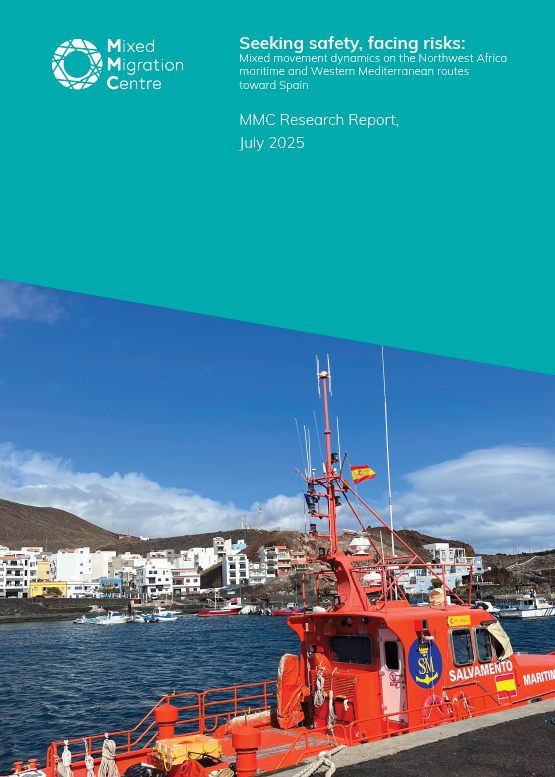
Seeking safety, facing risks. Mixed movement dynamics on the Northwest Africa maritime and Western Mediterranean routes toward Spain

By Giulia Bruschi

While most of the immigration towards Spain come from South American countries, the Western Mediterranean and the Atlantic remain the most important mixed migration routes from Africa toward Spain, and Europe more in general.

The steady increase in irregular arrivals via the Canary Islands since 2020 has catalysed the attention of EU policymaking and has continued to strain the reception system in the Canary Islands. In 2025, crackdowns on departures from Mauritania led to a reduction in irregular crossings. However, the Atlantic remains one of the deadliest sea crossings worldwide, and the land journeys to embarkation points also remain fraught with risks.

Meanwhile, the Western Mediterranean route continues to be used by migrants from West African countries, who must cross North Africa to reach the Mediterranean shores, and also poses several risks.

In this context, throughout 2024, MMC, in partnership with UNHCR, interviewed 497 migrants recently arrived in Spain via the Canary Islands, the Mediterranean, or via the land crossing in Ceuta and Melilla. The interviews aimed to explore their migration drivers, journeys, as protection risks in transit, asylum and onward movement intentions from Spain.

Mixed Migration Centre, 2025. 31p.

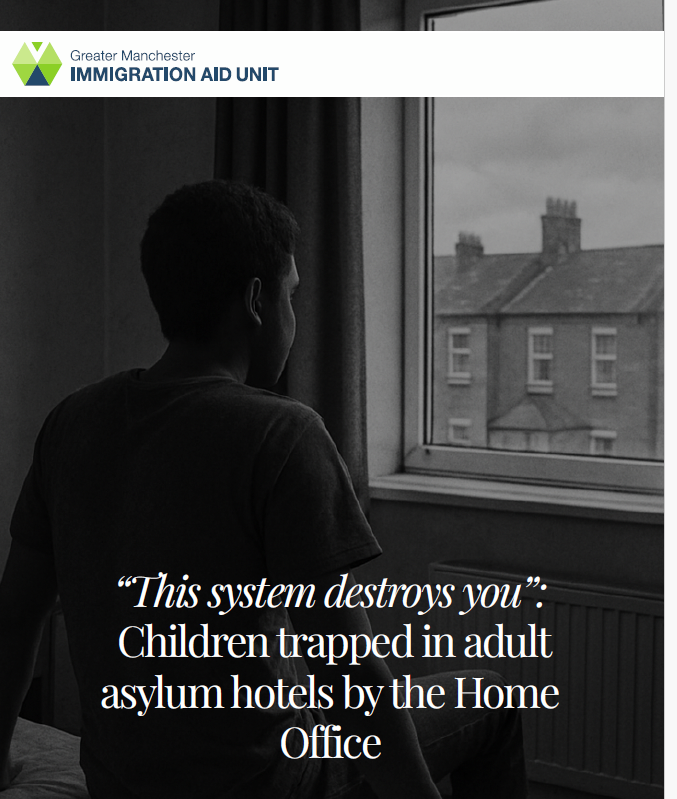
This system destroys you”: Children trapped in adult asylum hotels

By The 

Greater Manchester Immigration Aid Unit

Over recent years, thousands of children have been wrongly treated as adults by the Home Office. These children are in the UK on their own seeking asylum. Following decisions made by UK border officials that they are “significantly over 18” they have been sent alone to adult asylum accommodation, usually hotels. This is a report about children housed in adult hotels after these decisions at the border, based on Greater Manchester Immigration Aid Unit’s legal and place-based expertise and experience, and on the experiences that the children we work with have shared.  EXECUTIVE SUMMARY “You can’t stop feeling sad. You have to feel sad and angry when someone says you are a liar. It is in your heart.” Between January 2024 and February 2025, at least 296 children were wrongly sent to adult asylum accommodation, usually hotels, in the North West. This is a report about what children experience in asylum hotels, how theyare sentthere,andthe supportthey needtoget out. We are sounding the alarm – as others have done before us – that these children are being put at significant risk. Much harm has already been done, and must be acknowledged; and the government, local authorities andaccommodationprovidersmustact now topreventfurther harm. We are sounding the alarm – as others have done before us – that these children are being put at significant risk. Much harm has already been done, and must be acknowledged; and the government, local authorities and accommodation providers must act now to prevent further harm.

Our recommendations:

To the Home Office:

  • The Home Office must admit children are wrongly treated as adults at the border and suspend all “significantly over 18” decisions until investigated.

  • Repeal recent changes to age assessments introduced by the Nationality and Borders Act, and end the for-profit asylum housing model.

  • Meanwhile, the Home Office should notify local authorities when children are placed in hotels and publish clearer data on age disputes.

To accommodation providers:

  • Immediately refer to the local authority when staff become aware that a potential child is in adult asylum accommodation.

  • Take all possible measures to safeguard potential children.

  • Update training for hotel staff so they are aware of the high likelihood of children being treated as adults.

To local authorities: 

  • Ensure social workers’ decisions and training include an understanding of the child’s experience in the UK, including being traumatised by Home Office age assessment practice.

  • Ensure that potential children are not held to higher thresholds in assessments when local authority capacity is stretched.

  • Do not refer children to the National Age Assessment Board (NAAB).


Manchester, UK: Greater Manchester Immigration Aid Unit, 

2025. 49p.

The Efficacy of Nutritional Interventions in Reducing Childhood/Youth Aggressive and Antisocial Behavior: A Mixed-Methods Systematic Review and Meta-Analysis

By Barna Konkolÿ Thege, Chaz Robitaille, Lujayn Mahmoud, Eden A. Kinzel, Rameen Qamar, Jamie Hartmann-Boyce, Olivia Choy

Aggressive/antisocial behaviors in children and youth may result in impairments in family, social, or academic functioning and lead to long‐term negative consequences for both the individual and society as a whole. The potential of healthy diet and nutritional supplements to reduce aggression and antisocial behavior is an active area of study in nutritional mental health sciences. The goal of this systematic review is to (1) investigate the effectiveness/efficacy of nutritional interventions(dietary manipulation, fortification or supplementation) in reducing excessive aggression, antisocial behaviors, and criminal offending in children/youth (systematic review and meta‐analysis); and (2) provide an overview of implementation barriers and facilitators regarding nutritional interventions in children/youth (qualitative/narrative synthesis). After consulting theCampbell Collaboration's methodological guidelines, a comprehensive search for published and unpublished papers on controlled intervention studies was performed (up to February 26, 2024) using both electronic databases (MEDLINE,Embase, Cochrane Library, APA PsycInfo, Scopus, and the Allied and Complementary Medicine Database) and other resources (e.g., Google Scholar, reference list of included studies and other reviews, websites of public health agencies). This study focuses on children and youth (up to the age of 24) presenting with an above‐average level of aggression/antisocial behavior. In terms of the intervention, we considered both dietary manipulation and nutritional supplementation with aduration long enough (minimum of 1 week) that a significant change in the individual's nutritional status could be expected.We included studies with a controlled design if, for outcomes, they reported on (1) behavioral‐level violence/aggression toward others in real‐life (non‐simulated) settings, (2) antisocial behaviors, or (3) criminal offending. Initial screening,checking for eligibility criteria, data extraction from, and risk of bias assessment for each eligible study were conducted independently by two reviewers. To perform the meta‐analysis, data from each original report were standardized(transformed into Hedges' g) so that results across studies could be meaningfully combined and interpreted. Data con-versions, computation of pooled effect sizes, and estimation of publication bias were conducted using the ComprehensiveMeta‐analysis software (Version 4). Altogether, 51 reports (describing 50 individual studies) met our inclusion criteria, and72 effect sizes were extracted from these reports. Nutritional interventions with a broad target (e.g., broad‐spectrummicronutrient supplementation or general improvement in diet quality) had the most consistent and largest intervention

Campbell Systematic ReviewsVolume 21, Issue 3Sep 2025

Perceptions and experiences with police among people who use drugs in the initial year of British Columbia's decriminalization of illegal drugs policy

By Cayley Russell, Geoff Bardwell, Matthew Bonn, Jade Boyd, Elaine Hyshka, Jurgen Rehm, Farihah Ali

 On January 31, 2023, BritishColumbia (BC) launched a 3-year pilot initiative decrim-inalizing the possession of up to 2.5 g of select illegal drugs. The policy aims to reduce stigma, address racial disparities in drug law enforcement, and improve police relations with people who use drugs (PWUD). As part of a national evaluation, we conducted qualitative inter-views with 100 PWUD who reported using drugs at least three times a week across BC between October 2023 and February 2024. Participants, diverse in sociodemograph-ics, drug use patterns, and police interaction histories,largely reported an adversarial relationship with police,marked by historical mistreatment and the targeting of individuals based on aspects of their social iden-tity, such as ethnicity, housing status, and other visible markers. Despite police generally adhering to the pol-icy, some participants reported unlawful drug seizures,reinforcing mistrust. Although some noted reduced fear of police, most felt their negative perceptions persisted post-decriminalization, highlighting a need for further police education and training to address stigma and inconsistent enforcement.Policy Implications: Our findings underscore the need for improved police education and training through bet-ter standardization, with an emphasis on promoting consistency and increased transparency, particularly in the use of discretion. Training should also address the impact of systemic racism and discriminatory policing practices to foster equitable interactions with PWUD.Further consideration of alternative nonpunitive legal approaches, alongside expanded harm reduction ser-vices, treatment options, social supports (such as hous-ing), and community-based initiatives, could be highly beneficial. Continued monitoring and evaluation of the policy's impact on PWUD is essential.


Criminology & Public Policy. Volume 24, Issue 3 Aug 2025

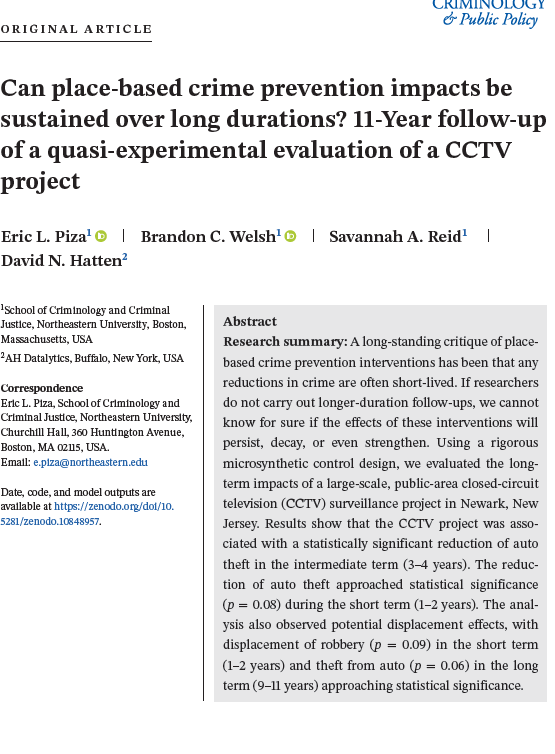
Can place‐based crime prevention impacts be sustained over long durations? 11‐Year follow‐up of a quasi‐experimental evaluation of a CCTV project

By Eric L. Piza, Brandon C. Welsh, Savannah A. Reid, David N. Hatten


A long-standing critique of place-based crime prevention interventions has been that any reductions in crime are often short-lived. If researchers do not carry out longer-duration follow-ups, we cannot know for sure if the effects of these interventions will persist, decay, or even strengthen. Using a rigorous micro synthetic control design, we evaluated the long-term impacts of a large-scale, public-area closed-circuit television (CCTV) surveillance project in Newark, New Jersey. Results show that the CCTV project was associated with a statistically significant reduction of auto theft in the intermediate term (3–4 years). The reduction of auto theft approached statistical significance (= 0.08) during the short term (1–2 years). The analysis also observed potential displacement effects, with displacement of robbery (= 0.09) in the short term (1–2 years) and theft from auto (= 0.06) in the long term (9–11 years) approaching statistical significance.

Policy implications

The results of this study may suggest the potential for a slightly modified view of deterrence decay. The CCTV project's effect on auto theft grew from approaching significant to statistically significant between the short-term and intermediate-term periods. Such “sleeper effects” suggest that an extended period was necessary for CCTV to generate deterrence. The deterrence decay during the long-term period did not occur until after these sleeper effects emerged, which may be understood as deterrence attenuation. Although only approaching statistical significance—and not as pronounced as the reduction of auto theft—the potential displacement of robbery and theft from auto indicates that static CCTV target areas may facilitate offenders taking advantage of nearby crime opportunities while appearing inconspicuous within CCTV viewsheds. In sum, policymakers should be mindful that research evidence limited to short-term impacts may fail to detect nuanced effects relevant for policy and public guidance.

Criminology & Public Policy, Volume 24, Issue 3, Aug 2025, Pages307-497

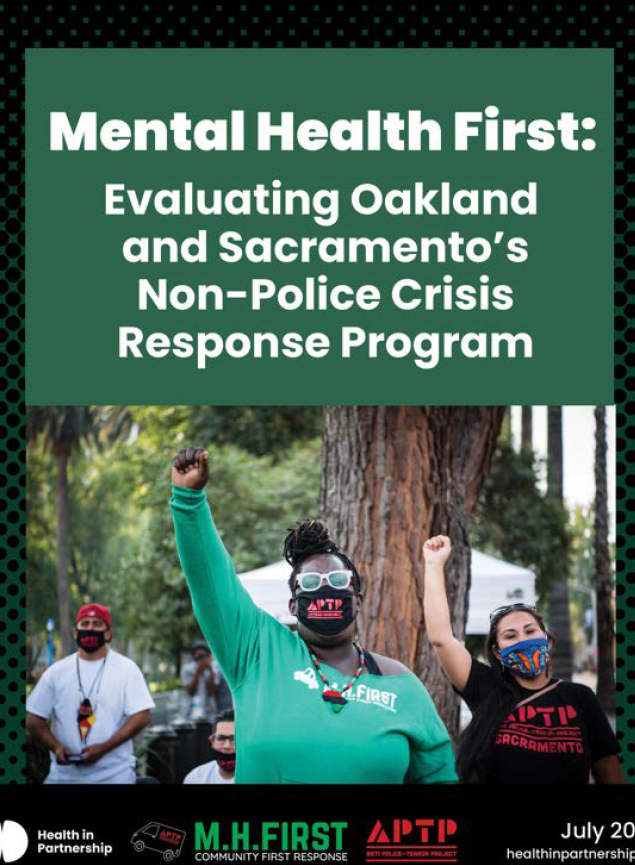
“Mental Health First: Evaluating Oakland and Sacramento’s Non-Police Crisis Response Program.”

By Christine Mitchell, Renae A. Badruzzaman

  When you witness someone in crisis — a mental health emergency or other escalating situation — what are your options to intervene? For most, the only available option is to call 911. And in most places, the 911 system is directly tied to the police department, making police involvement essentially inevitable. But police are not a source of safety, especially for Black, Indigenous, disabled, and people with mental health needs. Policing in the US is a system rooted in violence and punishment, not care. Calling the police can escalate a crisis, turning calls for distress into arrest, violence, or death. Without trusted, community-led alternatives, we are left with a wrenching dilemma: stay silent and unsupportive in moments of crisis, or risk escalation, criminalization, and compounded trauma and violence. Because of this, many communities across the US are working to interrupt police violence against people with mental health needs by building up community-based, community-led, non-police crisis response programs. While more evaluations of each of these types of programs are needed, there is already a body of literature that suggests these alternative models are both more effective at meeting the needs of people in crisis and more trusted by the community. One such program is Mental Health First (MH First), a project of the Anti Police-Terror Project (APTP) launched in 2020 in Oakland and Sacramento, CA. MH First is a community-led crisis response hotline outside of the 911 and police system that community members can call when they, or someone in their community, is experiencing a crisis. The program’s guiding principles include autonomy, healing justice, abolition, intersectionality, disability justice, and harm reduction. This evaluation — conducted while the program is on a strategic planning hiatus — takes a close look at MH First’s first four years of operation to assess how the program is working, what impacts it’s had, and what is needed to grow its reach and deepen effectiveness. Using a mixed-methods process evaluation, we conducted 29 interviews with key stakeholders, and analyzed 167 survey responses from community members in Oakland and Sacramento. Our evaluation focuses on community perceptions of MH First, program strengths, and areas for growth. In particular, we examined the program’s current structure and operations, perceived impact, and potential for deepening and increased services to the Oakland and Sacramento communities Overall, interviewees and survey respondents were very positive about and appreciative of the program. Interviewees noted that the program is trusted by and rooted in the local communities it serves, an essential part of providing appropriate and accessible care to those who call. Trust is further increased by the clear, transparent values of community, autonomy, and abolition that guide MH First’s work. Importantly, MH First is building power and self-efficacy in the local and national community through their trainings, technical assistance, and volunteer recruitment — through which they have trained thousands of volunteers to staff the program. On the national level, interviewees named that MH First provides a strong model that indicates that non-police mental health crisis response programs are practical and possible. Relative to other forms of mental health crisis response, including police and co-response models, MH First is highlighted as more appropriate and more effective at meeting community needs. Our evaluation also identified areas where MH First could grow and improve to better serve the Oakland and Sacramento communities. Interviewees expressed a desire for MH First to increase reliability by expanding their hours of operation to 24/7, rather than during select hours of the week. Some also suggested that MH First transition from a volunteer-only service, to include at least some paid staff. Finally, interviewees felt that MH First should focus on preventative measures and follow-up care, not just crisis management and intervention. In order to be able to meet these areas of growth, interviewees offered suggestions for expanding the program’s reach, including through policy change, a clear narrative and communications strategy, more trainings to build community capacity, and long-term sustainable investment in the program. Two big picture questions remain for the program’s consideration: First, how can MH First avoid the co-optation of their principles and strategy by entities that dilute or stray from MH First’s values and purpose? Interviewees spoke of the inevitability of co-optation and shared strategies for how to reframe or leverage co-optation to expand the program, while still maintaining control over the narrative of the program’s practice. Second, should MH First remain an entity outside of local, county, or state government, or should it be housed under a governmental office or supported with government funds — or some combination of both? Our interviewees had strong opinions on this question, with some feeling that operating within the government and social safety net would allow MH First to be more sustainable and accessible, and others believing that moving under a government agency would cause the program to lose its current spirit and vision. Our evaluation concludes with six recommendations for MH First: 1: Continue to prioritize being deeply rooted in and led by community members in Oakland and Sacramento, particularly Black, Indigenous, Latine, and disabled community members who are most impacted by policing 2: Publicly share more stories of success, including robust qualitative and quantitative data analysis 3: Provide preventative care in order to interrupt pathways to crisis situations and follow-up care in order to ensure people have what they need following crisis 4: Expand hours of operation as much as possible to ensure the hotline is accessible and reliable 5: Increase resources and funding for the program, including considerations of whether MH First is willing and able to receive government funding 6: Pass policy and budget allocations that shift money from the carceral state to non-police grassroots response, including to MH First   

Berkeley, CA: Mental Health First, July 2025.  72p.

The Politics of Violence Reduction: Making and Unmaking the Salvadorean Gang Truce 

By Chris van der Borgh and Wim Savenije

This paper analyses a government-facilitated truce, begun in 2012, between El Salvador’s three principal street gangs. Using field theory and securitisation theory, it maps the evolution of the truce, distinguishing between the three related processes of making the deal, keeping the truce, and resisting it. It analyses the complex and intriguing political processes in which various actors, such as gang leaders, government officials and international organisations, interacted with each other and made deals about the use and visibility of violence and ways of diminishing, preventing or hiding it.  

  Journal of Latin American Studies (2019), 51, 905–928 doi:1

Enhancing State Courts' Efforts to Address Child Abuse and Neglect: A Three-site Evaluation of the Implementation of the Enhanced Resource Guidelines

By: Kristan Russell, Marly Zeigler, Moriah Taylor

Implementing best practices in child welfare court cases is critical to ensuring positive outcomes for youth and families. However, it is also essential that courts are assessed for their fidelity to implement these practices and whether they are having the intended impacts. This article outlines findings from a pre/post evaluation examining the impacts of the implementation of the Enhanced Resource Guidelines (ERGs) in three urban jurisdictions. The findings from this study yield valuable insights regarding the extent to which ERGs implementation positively impacts key outcomes in court practices and case processing. Implications for ongoing practice and future research are discussed. From Volume 76, Issue 2.


Pittsburgh: National Center for Juvenile Justice, National Council of Juvenile and Family Court Judges,, 2025. 18p.

Tribal Youth Incarceration Tribal Youth Almost Four Times As Likely To Be Incarcerated As White Peers 

By Josh Rovner

  Incarceration disparities between Tribal and white youth have increased over the past decade. As of 2023, the most recent year for which data are available, Tribal youth were 3.8 times as likely to be placed in juvenile facilities (i.e., detained or committed) as their white peers. The disparity is now at an all-time high, based on data that starts in 1997. Juvenile facilities held 29,314 youth as of October 2023. This includes placement in one of our nation’s 1,277 detention centers, residential treatment centers, group homes, and youth prisons.2 These numbers do not include the 437 people under age 18 in adult prisons at year-end 2022 or the estimated ,000 people under 18 in adult jails at midyear 2023.3• Nationally, the youth placement rate was 87 per 100,000 youth. • Tribal youth were placed at a rate of 199 per 100,000, compared to the white youth rate of 52 per 100,000. Among the 17 states with a population of at least 5,000 Tribal youth between ages 10 and 17, a cutoff that allows for meaningful comparisons, Tribal youth were at least twice as likely to be in custody than white youth in 10 states.


Latino Youth Incarceration. Latino Youth 25% More Likely to Be Incarcerated Than White Peers

By Josh Rovner


  Following decades-long declines, incarceration disparities between Latino youth and their white peers recently increased. As of 2023, the most recent year for which data are available, Latino youth were 25% more likely to be placed (i.e., detained or committed) in juvenile facilities as their white peers. Juvenile facilities held 29,314 youth as of October 2023. This includes placement in one of our nation’s 1,277 detention centers, residential treatment centers, group homes, and youth prisons. These numbers do not include the 437 people under age 18 in adult prisons at year-end 2022 or the estimated 2,000 people under 18 in adult jails at midyear 2023. • Nationally, the youth placement rate was 87 per 100,000 youth. • Latino youth were placed at a rate of 65 per 100,000, compared to the white youth rate of 52 per 100,000. Among the 48 states and the District of Columbia with a population of at least 5,000 Latino youth between ages 10 and 17, a cutoff that allows for meaningful comparisons, Latino youth were at least twice as likely to be in custody than white youth in 11 states.

Washington, DC: The Sentencing Project 2025. 3p.

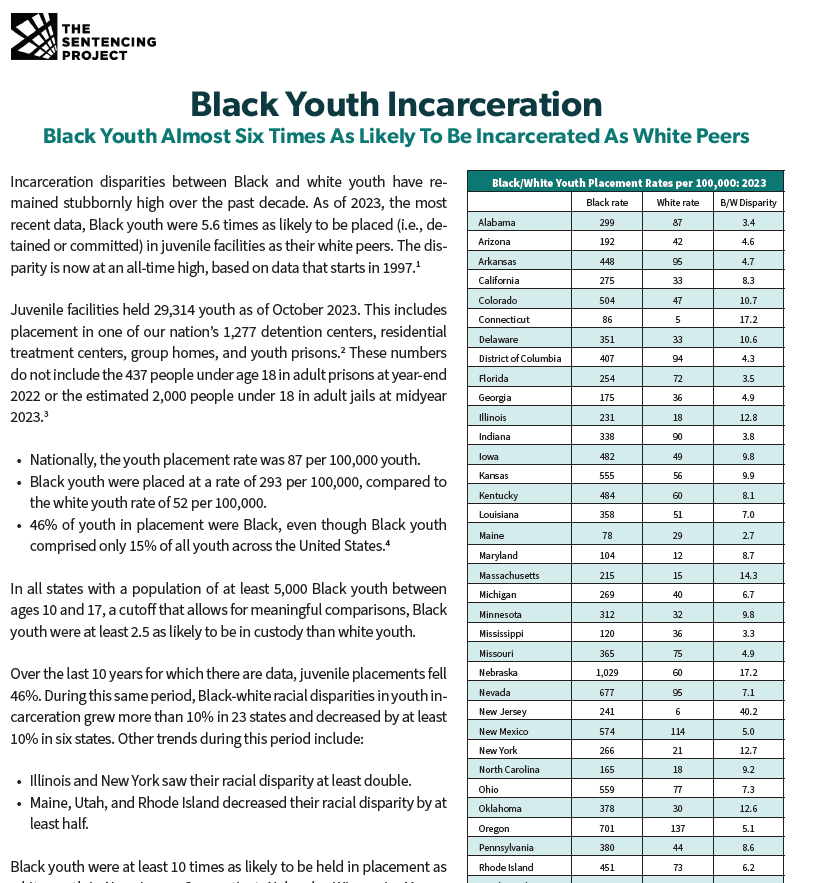
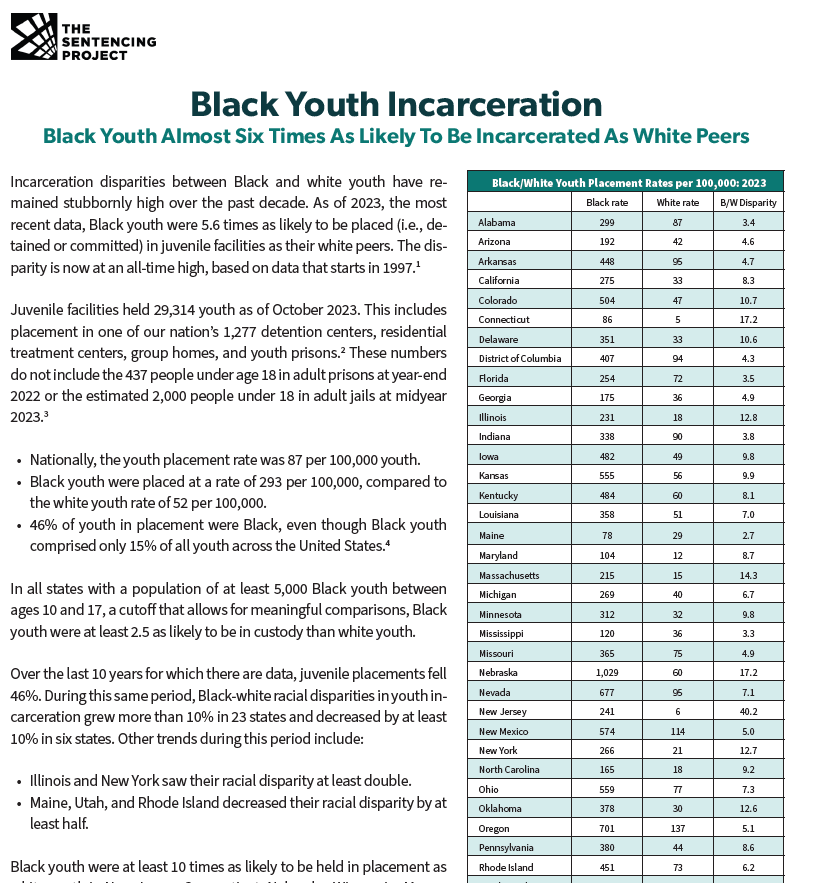
Black Youth Incarceration. Black Youth Almost Six Times As Likely To Be Incarcerated As White Peers

By Josh Rovner

  Incarceration disparities between Black and white youth have remained stubbornly high over the past decade. As of 2023, the most recent data, Black youth were 5.6 times as likely to be placed (i.e., detained or committed) in juvenile facilities as their white peers. The disparity is now at an all-time high, based on data that starts in 1997. Juvenile facilities held 29,314 youth as of October 2023. This includes placement in one of our nation’s 1,277 detention centers, residential treatment centers, group homes, and youth prisons. These numbers do not include the 437 people under age 18 in adult prisons at year-end 2022 or the estimated 2,000 people under 18 in adult jails at midyear 2023. • Nationally, the youth placement rate was 87 per 100,000 youth. • Black youth were placed at a rate of 293 per 100,000, compared to the white youth rate of 52 per 100,000. • 46% of youth in placement were Black, even though Black youth comprised only 15% of all youth across the United States. In all states with a population of at least 5,000 Black youth between ages 10 and 17, a cutoff that allows for meaningful comparisons, Black youth were at least 2.5 as likely to be in custody than white youth. 

Washington, DC: The Sentencing Project, 2025. 3p.

Justice at a Crossroads in New York City Studying Crimes in New York City Using the National Crime Victimization Survey (NCVS) By Min Xie, Preeti Chauhan, Michael Rempel, and Jeremy Travis

By Min Xie, Preeti Chauhan, Michael Rempel, and Jeremy Travis 

This study relies on data from the National Crime Victimization Survey (NCVS) and presents trends from 1996 to 2022 in crime victimization, rates at which victims report crimes to the police, confidence in the police, and victims’ use of services in New York City. This is one of two studies falling under the umbrella of the Crossroads Project. Its goal is to trace New York City’s trends in crime victimization, enforcement, incarceration, and racial disparities from the 1990s to the early 2020s in the hopes that empirical data over a long timeframe might provide a much-needed perspective capable of informing future policy. Both of the two resulting reports and a joint executive summary may be found at the project landing page. What is the NCVS, and why is it important for studying crime? Crime data for cities and communities across the country relies primarily on criminal complaints reported to local police agencies. The many crimes that victims never report to law enforcement are omitted. However, by collecting data directly from crime victims, the National Crime Victimization Survey (NCVS) can provide estimates of both reported and unreported crime. The NCVS is the world’s largest and oldest national victimization survey (Xie, Lynch, & Lauritsen, 2025). It has provided information on the criminal victimization of the U.S. household population for over 50 years (1973 to present). It surveys persons aged 12 years or older from a nationally representative sample of U.S. households randomly selected from a stratified multistage cluster sampling design, with the goal of getting an accurate and representative count of crime victimization in the United States (Cantor, 2025). The U.S. Census Bureau administers the interviews for the Bureau of Justice Statistics (BJS). The primary information from the NCVS includes nonfatal violent crimes (rape or sexual assault, robbery, aggravated assault, and simple assault) and household property crimes (i.e., burglary, motor vehicle theft, and other types of theft), both reported and not reported to the police. Therefore, the estimates for nonfatal violence crimes are by persons, and the estimates for property crimes are by households. The NCVS data is an important complement to the Uniform Crime Reporting (UCR) Summary program and the National Incident-Based Reporting System (NIBRS). The UCR and NIBRS databases, which rely on crimes reported to the police, are often used to follow crime trends by policymakers, journalists, and the general public, and to guide public safety decision making. But nationwide, the NCVS shows that more than 50% of crimes are NOT reported to the police (Xie, Ortiz Solis, & Chauhan, 2024). This is known as the dark figure of crime and shows that relying on police-recorded crimes provides an incomplete picture of crime trends (Lynch & Addington, 2007). The NCVS also provides critical information such as why the crime was not reported to the police. Much information in the NCVS is not available from the UCR summary program or NIBRS, such as the circumstances of crimes based on the victims’ descriptions, the consequences of the victimizations, the victims’ responses to victimization, and their interaction with the criminal justice or victim service systems or lack thereof. These data are critical to policymakers as they think of responses to crime and how to enhance public safety.  

New York: Data Collaborative for Justice, at John Jay College, 2025. 18p.   

Unsportsmanlike Behavior: Examining Variation in Arrests at National Football League Games

By Ryan Bowman


While previous research has explored the relationship between sporting events and crime in larger geographic spaces, research has not comprehensively examined how characteristics of sporting events influence arrests made inside stadiums themselves. Using a dataset of police records encompassing several seasons of the National Football League (NFL), this study explores how individual game characteristics influence the number of arrests made by police within the confines of the stadiums and stadium parking lots. Grounded in the routine activities theory, multilevel regression models suggest that certain game characteristics can influence the number of arrests made at a game.


DEVIANT BEHAVIOR 2025

Characterizing Violence Intervention Street Outreach Participants and Service Dosage: Implications for Measurement and Evaluation

By Marisa Ross, Susan Burtner, and Andrew Papachristos

Community violence intervention street outreach (CVI-SO) is gaining in popularity as a way to prevent gun violence. There is a growing need to better understand these interventions, which starts with documenting their full scope. Analyzing CVI outreach in Chicago from 2017–2023, the researchers find that organizations specialized in long-term mentoring and adjusted services based on participants’ risk levels, providing higher-risk individuals with more frequent and extended support.


Introduction: Community violence intervention street outreach (CVI-SO) strategies are growing in popularity as non-punitive approaches to solving the public health problem of community gun violence. Evidence on the effectiveness of CVI-SO on rates of violence is mixed and faces challenges due to concerns with documentation and data privacy, intentional selection bias in program design, and variation in participant risk and needs. Effective evaluation requires methods that accurately capture the scope and delivery of services, starting with a greater understanding of the services CVI participants receive and how they vary based on individual characteristics.Methods: This study explores the services that participants received from a coalition of Chicago CVI organizations from 2017–2023. Considering administrative and programmatic data from over 4,000 participants’ nearly 200,000 interactions with providers, the researchers examine patterns in demographics, network-based risk factors, and service provision and dosage. They then use descriptive and latent profile analyses to characterize the “typical” participant in Chicago.Results: Results show that CVI work relies heavily on long-term mentoring relationships. Service patterns show that latent groups exist with varying dosage: higher dosage participants with higher risk for gun violence receive more frequent contacts over longer periods, demonstrating how organizations adjust their approach based on participant needs. Profiles that primarily receive behavioral or social supports-related services also emerge.Conclusions: Findings underscore the need for evaluation frameworks that capture both the strategic variation in service delivery and the multiple pathways through which CVI programs influence participant outcomes.Evanston, IL: Northwestern University, Institute for Policy Research, 2025. 36p.

Washington, DC: Council on Criminal Justice., 2025. 7p.

By Luc Leboeuf

The article addresses the consequences of the externalisation of EU border policies on the legal and institutional dynamics that govern those policies. Drawing on the analysis of legal and policy documents and interviews, which were conducted with expert public servants among EU institutions and in one EU member state (Belgium), the article argues that EU border policies are increasingly governed by ‘regimes of invisibility’—which mainly involve expert public servants who cooperate with their counterparts in informal settings and through informal agreements. The article shows how the emergence of those ‘regimes of invisibility’ is deeply connected with the mainstreaming of migration through all components of the EU foreign policy. This leads to broader use of the tools from the foreign policy toolbox, which often rely on informal forms of cooperation, as well as to greater involvement of institutional actors beyond officials within interior ministries, such as diplomats. The article further makes an initial attempt to unpack these ‘regimes of invisibility’ by showing their underlying institutional tensions and dynamics. Therefore, it discusses how public servants, with different institutional background and knowledge, conflict and cooperate in shaping EU relations with third countries in the field.


International Migration, Volume 63, Issue 5Sep 2025

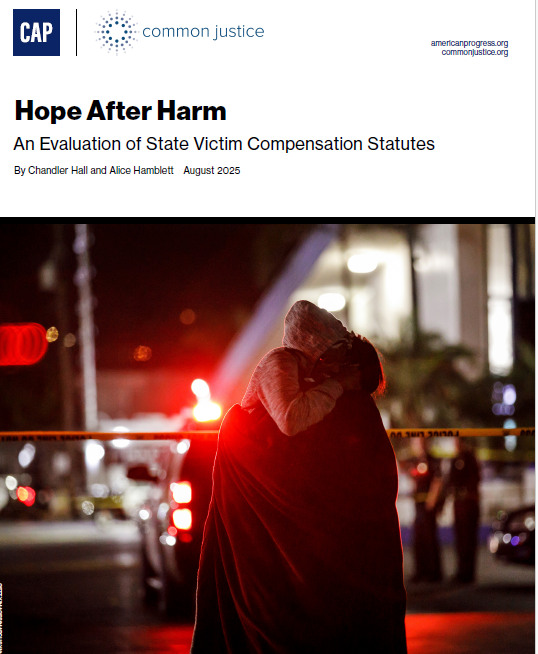
Hope After Harm:  An Evaluation of State Victim Compensation Statutes

By Chandler Hall and Alice Hamblet


  We all have a right to feel safe and be free from violence as we go about our daily lives. However, when violence does occur, few are prepared for the unexpected trauma, injury, and expense that can result. When someone experiences violence in the United States, the criminal legal system too often neglects the immediate and long-term needs of survivors of violence, instead disproportionately focusing resources on punishing the person or persons responsible for causing the harm. To address this imbalance, Congress passed the Victims of Crime Act (VOCA) in 1984, which established the Crime Victims Fund (CVF) to provide financial support to state crime victim compensation (CVC) programs and victim service providers. Currently, there is a 75 percent federal match for state CVC programs, meaning that for every dollar that a state spends on victim compensation grants to survivors, it receives 75 cents from the federal government. Despite the key role that financial relief can play in healing after violence, America continues to fail to make necessary investments supporting victims and survivors of violence. In fiscal year 2021, state and local governments spent a combined $274 billion on police, corrections, and criminal-legal proceedings. That same year, the federal CVF was capped at slightly more than $2 billion. Too often, survivors are left to deal with the lasting and compounding effects of their victimization without support; the results—which can include bankruptcy, chronic illness, depression, and anxiety—are devastating. While financial support alone cannot eliminate the lifelong pain and trauma associated with victimization, research shows that financial-induced stress following harm is a stronger predictor of the development of post-traumatic stress disorder (PTSD) than victimization itself. As such, victim compensation can be lifesaving. By federal law, CVC programs must cover out-of-pocket expenses such as medical bills, burial costs, and lock replacement that are not covered by other means, including private insurance, Medicare, or Medicaid. As such, CVC programs have the potential to aid survivors who have no other means of support. Moreover, victim compensation programs can help to break cycles of violence. The adage “hurt people, hurt people” rings true. While most survivors do not engage in future violence, the fact remains that people who commit violence often have experienced it themselves. This may be the case especially for people living in neighborhoods that experience frequent violence and who, due to systemic disinvestment and inequities, do not have access to healing resources such as adequate social services or medical or mental health care. When survivors receive the support they need to heal, they are less likely to commit harm. What is more, healed people, heal people. Providing survivors with victim compensation to meet unexpected costs associated with experiencing violence opens doors for intergenerational and community healing, as the impacts of untreated trauma and economic instability can ripple and compound to their families and communities at large. Victim compensation programs, therefore, have the potential to not only deliver on the promise to make survivors safer, but to help break cycles of violence, thereby making entire communities safer.   


Washington, DC: Center for American Progress, 2025. 73p.


Why There is Still an Illicit Trade in Cultural Objects and What We Can Do About It

By Neil Brodie,Morag M. Kersel,Simon Mackenzie,Isber Sabrine,Emiline Smith &Donna Yates

Fifty years after the adoption of the 1970 UNESCO Convention, the illicit trade in cultural objects endures, with harmful consequences to local communities, knowledge acquisition, and archaeological landscapes and objects. In this article, we present a gap analysis to assess under-performing policy and practice. We argue that a poor understanding of how the trade is organized and operates and of how it might be regulated hinders effective policy formulation. Funding structures which encourage short-term ad hoc research and inhibit information sharing are in part responsible for some of the gaps. We conclude by suggesting how sustained theoretically informed, evidence-led collaborative analyses might help reduce or mitigate these problems, preventing another 50 years of illicit trade.

Journal of Field Archaeology 


Volume 47, 2022 - Issue 2

Legal and illegal export of cultural heritage artefacts from developing countries: Protection of cultural heritage in South Africa

By Jen Snowball, Alan Collins&Craig Bickerton

Cultural heritage is an important part of the capital of developing countries that can be leveraged for sustainable development. However, it also needs protection as the rise in the illegal trade of cultural artefacts shows. South Africa as an example of a middle-income African country that seeks to promote cultural heritage for development. As part of the attempt to preserve cultural capital, the South African Heritage Resources Agency (SAHRA) is tasked with the protection of cultural heritage that is of special cultural, historical, aesthetic or technical importance to the country, and is thus part of the “national estate”. SAHRA adjudicates applications for the permanent export of cultural artefacts, guided by national policy that defines the attributes of artefacts of national importance. There are also attempts to bypass SAHRA adjudication through illegal smuggling of important art and artefacts, which SAHRA also tracks through a database of artefacts reported stolen. This study analyses the way that SAHRA has applied the policy to make decisions about permanent export applications of cultural heritage artefacts, as well as the attributes of those artefacts reported stolen and thus lost to the national estate. Results showed that the SAHRA permit system seems to be providing effective protection for some of South Africa’s cultural heritage, but only 4% of applications were for art and artefacts representing black African cultures.

Cogent Social Sciences 

Volume 9, 2023 - Issue 1

Social Listening Tools in Disinformation and Online Harms Analysis 

By Tan E-Reng

SYNOPSIS Social listening tools are a vital part of the disinformation and online harms researcher's toolkit, offering both depth and breadth in the insights they provide. However, there are inherent pitfalls that come with their use. This commentary elucidates what these pitfalls are and proposes steps to mitigate them. COMMENTARY Social listening tools, which are software applications that enable end-users to gather and analyse vast amounts of user-generated content propagated online on social media platforms, are a vital component of the toolkit for analysts who study disinformation and online harms. They help analysts to develop a clearer overall understanding of the disinformation and online harms landscape, and support investigations into ongoing information operations. While these tools are undoubtedly essential for the researcher’s toolkit, there are inherent pitfalls that may arise from their use, which could have negative repercussions for national security. This commentaary aims to elucidate some of these pitfalls and offer recommendations to mitigate them 

S. Rajaratnam School of International Studies, NTU Singapore,  2025. 6p.

Legal migration to the EU

By BLAAKMAN , Steven

Europe is one of the world's primary destinations for international migrants. In 2024, the region hosted approximately 94 million migrants, the highest number of any region in the world. The biggest share enter via legal means. The EU is experiencing skills shortages, which is partly because of its ageing population, and migrants could play a role in helping to plug them. The EU shares competence on migration and asylum policies with its Member States; EU legislation plays a significant role in managing legal migration, although its impact varies by type of migration. Nonetheless, data consistently show that most EU legal migration tools are under-used. Blue Cards, an EU initiative to attract highly skilled workers, account for only a fraction of permits issued for employment reasons and few EU countries make significant use of them, which would suggest more work is needed to make them an attractive option. Similarly, the Single Permit, which is a combined work and residency permit, is mostly used by just a handful of EU countries. In recent years, the EU has also launched new initiatives with non-EU countries such as Talent Partnerships and a Talent Pool, but it is too early to say anything about their impact. There is also a directive for seasonal workers, but again only a few EU countries make much use of it. The EU plays an important role when it comes to asylum by setting common standards, clarifying which EU country is responsible for processing an application, and encouraging solidarity. The European Commission has proposed a Return Regulation to make it easer and faster to return non-EU citizens who were unsuccessful in their bid to obtain asylum. It includes the possibility to create return hubs in non-EU countries, which many Member States are interested in. Temporary protection was used for the first time to help Ukrainians after the start of Russia's full-scale invasion in February 2022.

Brussels: EPRS | European Parliamentary Research Service, 2026. 12p.