Open Access Publisher and Free Library
HUMAN RIGHTS.jpeg

HUMAN RIGHTS

Human Rights-Migration-Trafficking-Slavery-History-Memoirs-Philosophy

Posts in Diversity
Unsportsmanlike Behavior: Examining Variation in Arrests at National Football League Games

By Ryan Bowman


While previous research has explored the relationship between sporting events and crime in larger geographic spaces, research has not comprehensively examined how characteristics of sporting events influence arrests made inside stadiums themselves. Using a dataset of police records encompassing several seasons of the National Football League (NFL), this study explores how individual game characteristics influence the number of arrests made by police within the confines of the stadiums and stadium parking lots. Grounded in the routine activities theory, multilevel regression models suggest that certain game characteristics can influence the number of arrests made at a game.


DEVIANT BEHAVIOR 2025

Characterizing Violence Intervention Street Outreach Participants and Service Dosage: Implications for Measurement and Evaluation

By Marisa Ross, Susan Burtner, and Andrew Papachristos

Community violence intervention street outreach (CVI-SO) is gaining in popularity as a way to prevent gun violence. There is a growing need to better understand these interventions, which starts with documenting their full scope. Analyzing CVI outreach in Chicago from 2017–2023, the researchers find that organizations specialized in long-term mentoring and adjusted services based on participants’ risk levels, providing higher-risk individuals with more frequent and extended support.


Introduction: Community violence intervention street outreach (CVI-SO) strategies are growing in popularity as non-punitive approaches to solving the public health problem of community gun violence. Evidence on the effectiveness of CVI-SO on rates of violence is mixed and faces challenges due to concerns with documentation and data privacy, intentional selection bias in program design, and variation in participant risk and needs. Effective evaluation requires methods that accurately capture the scope and delivery of services, starting with a greater understanding of the services CVI participants receive and how they vary based on individual characteristics.Methods: This study explores the services that participants received from a coalition of Chicago CVI organizations from 2017–2023. Considering administrative and programmatic data from over 4,000 participants’ nearly 200,000 interactions with providers, the researchers examine patterns in demographics, network-based risk factors, and service provision and dosage. They then use descriptive and latent profile analyses to characterize the “typical” participant in Chicago.Results: Results show that CVI work relies heavily on long-term mentoring relationships. Service patterns show that latent groups exist with varying dosage: higher dosage participants with higher risk for gun violence receive more frequent contacts over longer periods, demonstrating how organizations adjust their approach based on participant needs. Profiles that primarily receive behavioral or social supports-related services also emerge.Conclusions: Findings underscore the need for evaluation frameworks that capture both the strategic variation in service delivery and the multiple pathways through which CVI programs influence participant outcomes.Evanston, IL: Northwestern University, Institute for Policy Research, 2025. 36p.

Washington, DC: Council on Criminal Justice., 2025. 7p.

By Luc Leboeuf

The article addresses the consequences of the externalisation of EU border policies on the legal and institutional dynamics that govern those policies. Drawing on the analysis of legal and policy documents and interviews, which were conducted with expert public servants among EU institutions and in one EU member state (Belgium), the article argues that EU border policies are increasingly governed by ‘regimes of invisibility’—which mainly involve expert public servants who cooperate with their counterparts in informal settings and through informal agreements. The article shows how the emergence of those ‘regimes of invisibility’ is deeply connected with the mainstreaming of migration through all components of the EU foreign policy. This leads to broader use of the tools from the foreign policy toolbox, which often rely on informal forms of cooperation, as well as to greater involvement of institutional actors beyond officials within interior ministries, such as diplomats. The article further makes an initial attempt to unpack these ‘regimes of invisibility’ by showing their underlying institutional tensions and dynamics. Therefore, it discusses how public servants, with different institutional background and knowledge, conflict and cooperate in shaping EU relations with third countries in the field.


International Migration, Volume 63, Issue 5Sep 2025

Legal and illegal export of cultural heritage artefacts from developing countries: Protection of cultural heritage in South Africa

By Jen Snowball, Alan Collins&Craig Bickerton

Cultural heritage is an important part of the capital of developing countries that can be leveraged for sustainable development. However, it also needs protection as the rise in the illegal trade of cultural artefacts shows. South Africa as an example of a middle-income African country that seeks to promote cultural heritage for development. As part of the attempt to preserve cultural capital, the South African Heritage Resources Agency (SAHRA) is tasked with the protection of cultural heritage that is of special cultural, historical, aesthetic or technical importance to the country, and is thus part of the “national estate”. SAHRA adjudicates applications for the permanent export of cultural artefacts, guided by national policy that defines the attributes of artefacts of national importance. There are also attempts to bypass SAHRA adjudication through illegal smuggling of important art and artefacts, which SAHRA also tracks through a database of artefacts reported stolen. This study analyses the way that SAHRA has applied the policy to make decisions about permanent export applications of cultural heritage artefacts, as well as the attributes of those artefacts reported stolen and thus lost to the national estate. Results showed that the SAHRA permit system seems to be providing effective protection for some of South Africa’s cultural heritage, but only 4% of applications were for art and artefacts representing black African cultures.

Cogent Social Sciences 

Volume 9, 2023 - Issue 1

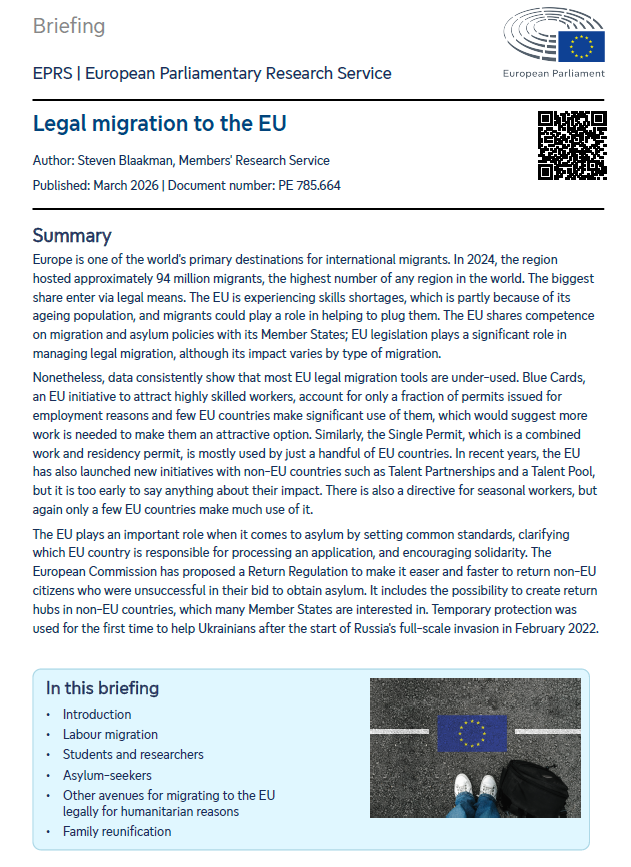
Legal migration to the EU

By BLAAKMAN , Steven

Europe is one of the world's primary destinations for international migrants. In 2024, the region hosted approximately 94 million migrants, the highest number of any region in the world. The biggest share enter via legal means. The EU is experiencing skills shortages, which is partly because of its ageing population, and migrants could play a role in helping to plug them. The EU shares competence on migration and asylum policies with its Member States; EU legislation plays a significant role in managing legal migration, although its impact varies by type of migration. Nonetheless, data consistently show that most EU legal migration tools are under-used. Blue Cards, an EU initiative to attract highly skilled workers, account for only a fraction of permits issued for employment reasons and few EU countries make significant use of them, which would suggest more work is needed to make them an attractive option. Similarly, the Single Permit, which is a combined work and residency permit, is mostly used by just a handful of EU countries. In recent years, the EU has also launched new initiatives with non-EU countries such as Talent Partnerships and a Talent Pool, but it is too early to say anything about their impact. There is also a directive for seasonal workers, but again only a few EU countries make much use of it. The EU plays an important role when it comes to asylum by setting common standards, clarifying which EU country is responsible for processing an application, and encouraging solidarity. The European Commission has proposed a Return Regulation to make it easer and faster to return non-EU citizens who were unsuccessful in their bid to obtain asylum. It includes the possibility to create return hubs in non-EU countries, which many Member States are interested in. Temporary protection was used for the first time to help Ukrainians after the start of Russia's full-scale invasion in February 2022.

Brussels: EPRS | European Parliamentary Research Service, 2026. 12p.

Free Speech as White Privilege: Racialization, Suppression, and the Palestine Exception

By Rene Reyes

Free speech is under siege. This is not to say that all speakers and viewpoints are at equal risk—some voices receive support and protection, while others are subject to threats and suppression.  Pro-Palestinian speech falls into the latter category.  Critics argue that there has long been a “Palestine Exception” to free speech, but efforts to silence pro-Palestinian advocacy on university campuses and elsewhere have dramatically increased since Israel began its assault on Gaza in October of 2023 in response to incursions by Hamas militants.  Many supporters of Israel contend that such restrictions on pro-Palestinian advocacy are justified, and have suggested that there is a double standard between racism and antisemitism at play when universities fail to condemn at least some forms of pro-Palestinian speech. The implication seems to be that anti-Black and Brown speech would never be tolerated on campuses, and that racialized minorities have been a special favorite of legal and institutional protections against hateful expression. The problem with this argument is that it is demonstrably false.  Indeed, this Essay argues that free speech doctrines have consistently functioned to give white people the liberty to engage in hateful speech and to deny Black, Brown, and other racialized individuals the kinds of protections from fear and harm that supporters of Israel are now demanding.  In other words, the Palestine Exception to free speech is real—and it is part of a deeper legal tradition that has enshrined free speech as an element of white privilege.

Virginia Law Review ,Vol 111, June 2025.

An Examination of Public Benefit Enrollment Data in Minnesota Immigrant Households as Evidence of Public Charge Chilling Effect

By Ana Pottratz Acosta

A hallmark of the first Trump Administration was its pervasive attacks against immigrant communities. While President Trump often touts his efforts to ramp up immigration enforcement to secure the southern border, other policies aimed at limiting legal immigration to the U.S. through administrative action had a far greater impact on U.S. immigration policy during his first term. One such action, the promulgation of regulations setting forth more subjective standards to determine if an immigrant was subject to the public charge grounds of inadmissibility, led to the denial of many family-based permanent residence applications that were otherwise approvable under existing law.

In this Article, the Author will examine means tested benefit enrollment data for Minnesota immigrant households to see if this data supports existence of a chilling effect through decreased immigrant household enrollment in these programs following publication of the public charge regulations. Additionally, while several previous studies using survey data support existence of a public charge chilling effect, this Article will build on this previous work by analyzing primary enrollment data provided directly by the Minnesota Department of Human Services (MN-DHS), the agency administering these programs.

 (September 01, 2024).

Knowledge and Punishment: The Prison-industrial Complex and Epistemic Oppression

Epistemic Oppression 

By Lark Mulligan

he police murdered Alton Sterling on camera.2 They also murdered Eric Garner, Laquan McDonald, and many others; the videos of their deaths garnered millions of views.3 Information about some horrors of the criminal legal system is spreading widely, yet White mainstream media outlets frequently dismiss, erase, or demonize Black, Indegenous, and People of Color (“BIPOC”) communities who protest and organize to demand justice through the abolition of or radical changes to the policing and prison systems.4 In response to these racist atrocities and within the broader context of criminal legal reform, activists and academics frequently craft ethical arguments such as: “Solitary confinement is immoral because it inflicts psychological and physical torture” or “Incarceration is unethical because prisons are inherently violent places.”5 Many ethical arguments centeron the racist injustices and harm that affronts human dignity and agency caused by prisons and police.6 Others critique the racist and retributive ethics of “law and order” rhetoric.7 Each argument is well-supported by accessible data that can be found in numerous studies, books, articles, and media.8 However, people often erroneously dismiss these data-driven, logical, ethical reasonings as factually inaccurate, or many respond with a deeply racist ethical-legal rationale, for example: “While there may be abuses in prisons, some people need to be put in solitary or prison and deserve it because [insert classical legal rationales for punishment: deterrence, retribution, rehabilitation, etc.].”9 Ethical and legal arguments are severely limited, however, when they lack an epistemological interrogation into the power structures that determine what qualifies as “knowledge” within the ethical-social conversation. This article demonstrates why anti-prison activists’ ethical arguments generally do not receive the due credibility and weight they deserve unless they pair critical liberatory epistemic practices with material, institutional, and social transformations. Abolitionists claiming to fight the confines of carceral epistemologies cannot merely sit back and point out the already-existing logical contradictions in the criminal legal system—it is not enough. ..continued 

St. Mary’s Law Review on Race & Social Justice , v. 27(2) 2025.

The Long Arc of Justice: Forging a Convention for Crimes Against Humanity

By Leila N. Sadat

This Article presents a comprehensive overview of the development, challenges, and future prospects of creating and ultimately negotiating a global treaty for crimes against humanity. It honors pioneers in the field and acknowledges the contributions of various individuals and entities to the Crimes Against Humanity Initiative the author established in 2007. It traces the historical context of atrocities such as slavery and the slave trade, linking them to the modern concept of crimes against humanity. The Article reviews the evolution of international criminal law, particularly under the Rome Statute of the International Criminal Court (ICC), emphasizing the necessity of a new treaty to fill gaps left by existing frameworks. Highlighting contemporary examples like the Syrian Civil War, it underscores the preventive power of prosecuting crimes against humanity as a move towards preventing the commission of atrocity cascades, before the descent into armed conflict and genocide. The Article describes the multi-decade effort to draft and promote a new treaty, including significant milestones, such as the adoption of the International Law Commission’s (ILC) 2019 Draft Articles, and the protracted and ultimately successful advocacy within the UN General Assembly’s Sixth (Legal) Committee to achieve a consensus resolution in 2022 that allows the process to move forward. The 2024 adoption of GA Resolution 79/122, which authorizes convening a United Nations Diplomatic Conference for crafting a comprehensive legal instrument, was a critical achievement, setting the stage for negotiations over the next several years. The Article reflects upon the enduring struggle for justice and the imperative to adopt, ratify, and enforce a new treaty, drawing historical parallels with the abolition of the transatlantic slave trade. It concludes with a call for continued dedication to ending impunity for crimes against humanity globally.


Washington University Global Studies Law Review, 2025, Vol 25, Issue 2, p302

Sleep Deprivation in Prison

By Sharon Dolovich

This Article is the first scholarly work to identify and describe the experience of sleep deprivation in prison—an experience that, although an inherent feature of prison life, has gone almost entirely unnoticed even by those legal scholars, advocates, and policymakers committed to ensuring humane carceral conditions. Drawing on original data from interviews with people who served time in prisons all over the country, it maps the multiple overlapping conditions that routinely prevent the incarcerated from getting anything close to adequate sleep. Sleep is a basic human need, as fundamental to human survival and adequate human functioning as access to food, water, and shelter. Yet this Article’s findings are unambiguous: chronic sleep deprivation is an intrinsic part of prison life, as constitutive of the carceral penalty as are crowded conditions, grossly inadequate medical care, inedible food, and the ongoing risk of physical and sexual assault. After providing a brief overview of the sleep science, the findings of which make plain the physical and psychological damage caused by insufficient sleep, the Article provides a rich sociological account of the experience of trying to sleep in prison. Drawing on the accounts of interview subjects, it identifies ten distinct causes of sleep deprivation inside: five concrete conditions (fiercely uncomfortable beds, hunger, extremes of heat and cold, noise, and excessive light) and five “meta-conditions” (fear of violence, trauma, poverty, overly intrusive rules enforcement, and daily humiliation). This Article then considers some of the normative implications of the phenomenon explored here, including what the reality of sleep deprivation in prison means for our understanding of prisons and of carceral punishment, the prospects for Eighth Amendment conditions claims grounded in sleep deprivation, and the policy challenges likely to confront efforts to address this problem.

 96 S.Cal.L. Rev. 95, UCLA School of Law, Public Law Research Paper No. 26-06

Measures to combat right-wing extremism in New South Wales: interim report

New South Wales. Legislative Assembly Committee on Law and Safety

An interim report for the inquiry into measures to combat right-wing extremism in New South Wales. The report considers the Crimes and Summary Offences Amendment Bill 2025 and puts forward some considerations for Parliament when debating the Bill. The Bill was introduced on 19 November 2025, following a neo-Nazi protest outside Parliament House on 8 November 2025. The event was widely condemned.

The protest shows the current laws have been failing to prevent right-wing extremists from mobilising and recruiting. Legislative change is required to address the worrying rise of right-wing extremism.

The Crimes and Summary Offences Amendment Bill 2025 is an important step in combatting right-wing extremism. The Committee has considered the Bill in the context of a broader inquiry into measures to combat right-wing extremism in New South Wales. 

The Committee strongly supports the Bill as a key measure to combat right-wing extremism in New South Wales. At the same time, the Committee acknowledges the risk of constitutional challenge to any law that may restrict the implied freedom of political communication.

Parliament of New South Wales, 2026. 21p.

Measures to prohibit slogans that incite hatred

By New South Wales. Legislative Assembly Committee on Law and Safety

Following the December 2025 Bondi terror attack, the NSW government is strengthening laws against hate speech, specifically targeting slogans like "globalize the intifada" and prohibited terrorist symbols in public. A January 2026 Parliamentary inquiry recommended legislation to ban this specific slogan and similar hate speech to combat violence, with proposals including amending the Crimes Act 1900.

NSW ParliamentNSW Parliament +3

Key Measures and Developments:

Targeted Slogans: The chant "globalize the intifada" is explicitly identified as inciting violence, with moves to prohibit it and similar hateful statements.

Legislative Action: The inquiry recommends amending the Crimes Act 1900 (specifically section 93ZAA) to further prohibit public acts that incite hatred on grounds including religion, race, and sexual orientation.

School Crackdown: Immediate, stricter conduct rules are in place across NSW schools (government, independent, and Catholic), with potential for dismissal for staff engaging in hate speech.

Symbol Prohibition: Legislation is being developed to outlaw the public display of symbols associated with proscribed terrorist organizations.

Inquiry Recommendations: The Parliamentary committee advised monitoring UK hate speech laws, ensuring new legislation is robust against constitutional challenges, and reviewing any new laws within 12 months.

Context: These actions follow the 2025 Bondi incident and focus on balancing anti-racism with existing legal frameworks.

Justice and Equity CentreJustice and Equity Centre +7

Parliament of NSW. 2026. 56p.

Bail Reform at Five Years: Pretrial Decision-Making in New York State

By Michael Rempel, Olive Lu, & Sarah Monaghan

In January 2020, New York’s landmark bail reform law went into effect. This report provides a definitive examination of how bail reform reshaped the pretrial landscape after five full years of implementation. Covering all regions of the state, and drawing on court data from 2018 to 2024 (spanning pre- and post-reform timeframes), the report examines bail reform’s impact on:

  • Pretrial Decision-Making at Arraignment: Rates of release on recognizance, supervised release, bail, and pretrial detention; and estimated numbers of cases not resulting in pretrial detention due to changing practices under bail reform.

  • Affordability of Bail: For cases that continue to be assigned bail, median bail amounts, bail posting rates, and judges’ use of “alternative” payment methods (partially secured bonds and unsecured bonds) that legislators intended to ease people’s ability to pay.

  • Racial and Ethnic Disparities: Disparities among Black, Hispanic, and white people in judges’ rates of continuing to set bail or remand people directly to jail.

  • Three Rounds of Bail Amendments: Effects of amendments respectively put into effect in July 2020, May 2022, and June 2023 (entailing a first-ever analysis of the 2022 and 2023 amendments).

New York: Data Collaborative for Justice, 2026. 47p.

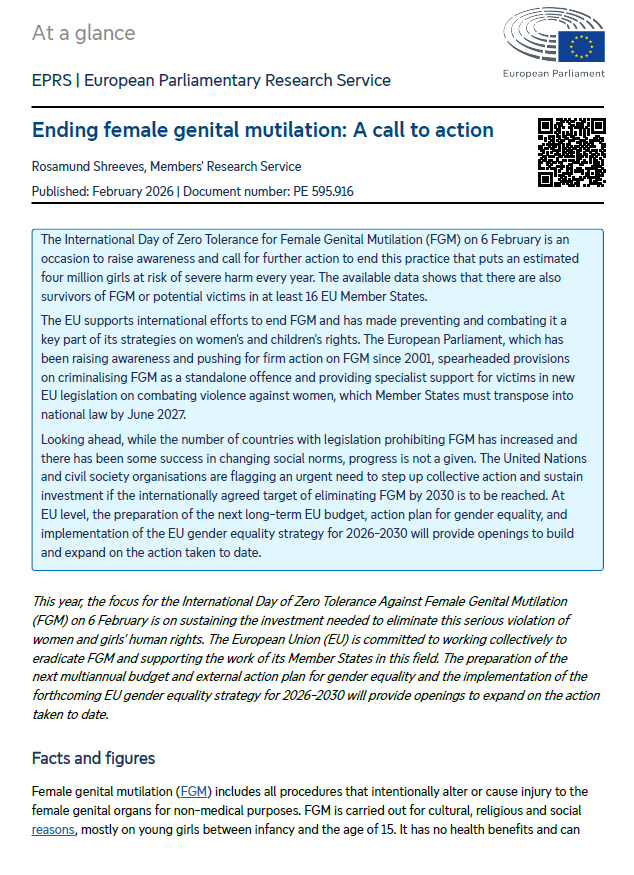
Ending female genital mutilation: A call to action

By  Rosamund SHREEVES 

The International Day of Zero Tolerance for Female Genital Mutilation (FGM) on 6 February is an occasion to raise awareness and call for further action to end this practice that puts an estimated four million girls at risk of severe harm every year. The available data shows that there are also survivors of FGM or potential victims in at least 16 EU Member States. The EU supports international efforts to end FGM and has made preventing and combating it a key part of its strategies on women's and children's rights. The European Parliament, which has been raising awareness and pushing for firm action on FGM since 2001, spearheaded provisions on criminalising FGM as a standalone offence and providing specialist support for victims in new EU legislation on combating violence against women, which Member States must transpose into national law by June 2027. Looking ahead, while the number of countries with legislation prohibiting FGM has increased and there has been some success in changing social norms, progress is not a given. The United Nations and civil society organisations are flagging an urgent need to step up collective action and sustain investment if the internationally agreed target of eliminating FGM by 2030 is to be reached. At EU level, the preparation of the next long-term EU budget, action plan for gender equality, and implementation of the EU gender equality strategy for 2026-2030 will provide openings to build and expand on the action taken to date.

EPRS | European Parliamentary Research Service, 2026. 4p.

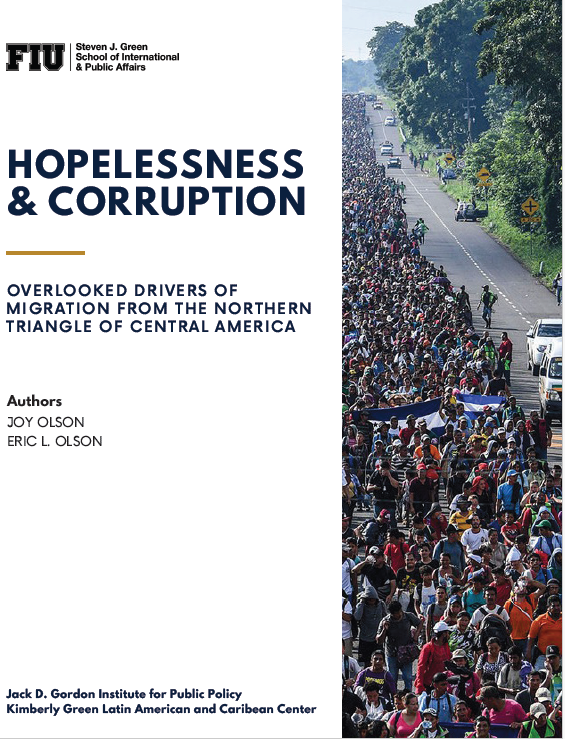
HOPELESSNESS & CORRUPTION OVERLOOKED DRIVERS OF MIGRATION FROM THE NORTHERN TRIANGLE OF CENTRAL AMERICA 

By JOY OLSON and ERIC L. OLSON

This paper analyzes the drivers of migration hypothesizing that persistent government failure driven in large part by corruption produces a sense of hopelessness among Central Americans that contributes to and propels their decision to migrate. Traditionally, corruption and its contribution to hopelessness have not been studied as drivers of migration. The authors conclude that addressing weak governance and corruption helps create a national context in which individuals can see a future in their own country. Central Americans from the Northern Triangle countries have a complex set of motivations for migration. Traditionally studied push factors include poverty, violence and natural disasters. Pull factors include economic opportunity/upward mobility, protection, and family reunification. The weight given to each factor is as varied as the number of people migrating. The intention to migrate is often based on one’s calculation of personal challenges and opportunities. Decisions are also influenced bylarger social, political, and economic factors. While it is an individual that migrates, it is their experience within their community and nation that informs their decision. Contextual factors contributing to migration include respect for human rights, governance and corruption. The State Department’s human rights reports paint a clear picture of the deplorable human rights situation in each Northern Triangle country and highlights the high level of impunity and, conversely, low expectations for justice that the majority can expect from their governments and justice systems. According to surveys of both experts and individuals, government corruption and/or the perception of corruption is widespread and endemic across the Northern Triangle. Weak governance can be the result of poor planning, lack of resources, and limited workforce capacity, but in many instances, it is also the result of corruption. While more research is needed, the thrust of the studies cited suggest that corruption can be both a direct and indirect driver of migration. The authors identify hopelessness as contributing to migration from the Northern Triangle. Since little research has been done in this area, proxies like Subjective Wellbeing (SWB) are considered. Hope, optimism, and SWB are concepts based not only on personal experience, but on one’s interaction with and perceptions of broader society. One’s experience with endemic corruption can contribute to a sense hopelessness. The authors argue that endemic corruption in Central America, and the destruction of mechanisms to control corruption, undermine peoples’ confidence in government and contribute to a lack of hope that their lives will improve. While the work done to date is insufficient to establish direct correlations. If the citizens of Central America believe that good governance and anti-corruption measures can be successful and see the results of such efforts reflected in improved healthcare, education, access to education, and justice, it could improve theirlives will improve. While the work done to date is insufficient to establish direct correlations. If the citizens of Central America believe that good governance and anti-corruption measures can be successful and see the results of such efforts reflected in improved healthcare, education, access to education, and justice, it could improve their sense of hope for the future and improve feelings of SWB thus lessening an underlying push factor from Central America. More must be done to address government corruption in the region and to learn about the relationship of hopelessness to migration.

Miami: jack D. Gordon Institute for Public Policy. Florida International University,  2021.

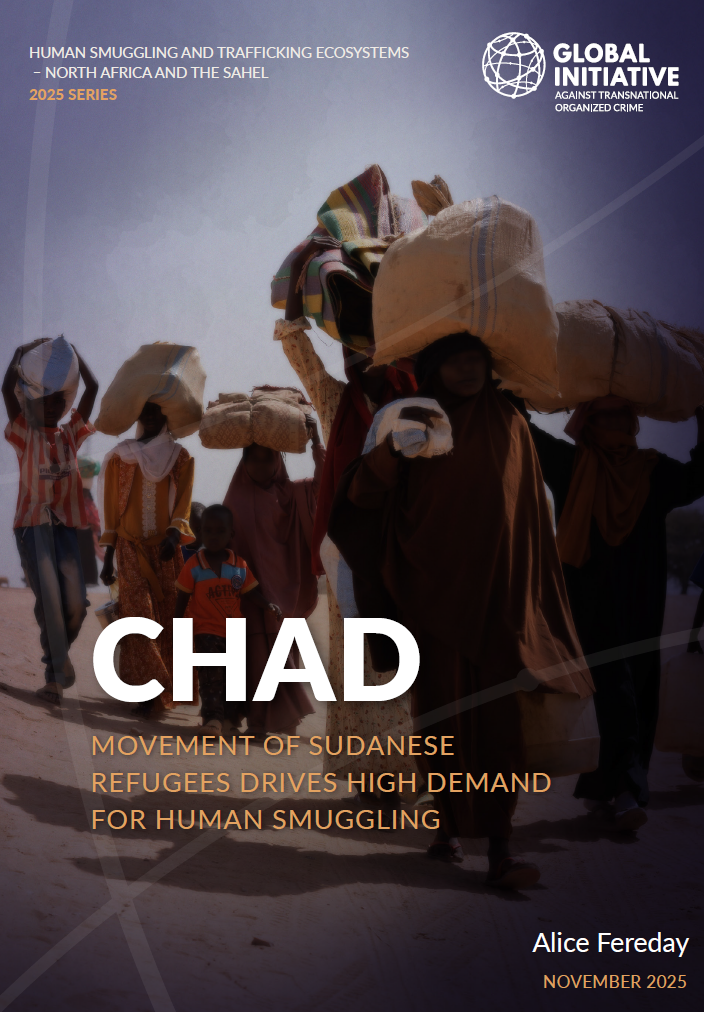
Chad: MOVEMENT OF SUDANESE REFUGEES DRIVES HIGH DEMAND FOR HUMAN SMUGGLING

By Alice Fereday

Chad’s role as a departure and transit country for northbound migration to North Africa and Europe is often overlooked, particularly in comparison to neighbouring Niger and Sudan. However, the country’s position at the crossroads of routes connecting central and eastern Africa to Libya and Niger makes it a significant transit corridor for regional migration, and its role as a bastion of relative stability in an increasingly volatile region has further increased its importance in recent years. Since 2023, the conflict in Sudan and a major influx of refugees into Chad have further shaped these mobility dynamics, making the country a major destination and transit point for Sudanese refugee displacement in the region. At the same time, Chad is navigating a fractious and contested political transition. Political violence escalated in 2024 and remains an important source of tension and political instability. The combination of these complex internal and regional dynamics, and their impact on human smuggling dynamics, make Chad a key country to monitor. A major component of human smuggling dynamics in Chad is internal movements to the country’s northern goldfields. These mobility patterns have typically been shaped by internal factors, including political instability, rebel activity and gold mining.1 This changed in 2023 with the outbreak of the conflict in Sudan and the massive influx of refugees and returnees into eastern Chad. Though northbound movements were temporarily hindered by this shift, which resulted in a relative decrease in demand for northbound travel from eastern Chad in the early months of the conflict, by the end of 2023 human smuggling had picked up again as many Sudanese began leaving refugee camps with the intention of travelling to northern Chad, Libya, Niger and Tunisia, often with the help of smugglers.2 In 2024, these movements escalated further and human smuggling between eastern and northern Chad saw significant growth, due in large part to increasing demand among Sudanese refugees for travel to northern Chad and Libya. However, the movement of Sudanese refugees through Chad also involved travel to Niger via N’Djamena or northern Chad. Northbound movements in Chad were also driven by increasing demand for travel to the Kouri Bougoudi goldfield. The flow of prospective gold miners, which began after the goldfield reopened at the end of 2022, was also facilitated by decreased restrictions on northbound travel as risks of rebel incursions in northern Chad remained contained in 2024. This encouraged the activities of passeurs, who catered to increasing demand for northbound travel, particularly from eastern Chad.Overall, Chad recorded progressively increasing movement levels in 2024 compared to previous years, presaging its emergence as an important space to watch for migrant and refugee movement, and associated protection risks. This is the latest GI-TOC monitoring report on human smuggling in Chad. It builds on a series of annual reports – issued since 2019 – which track the evolution of human smuggling in Chad and the political, security and economic dynamics that influence it

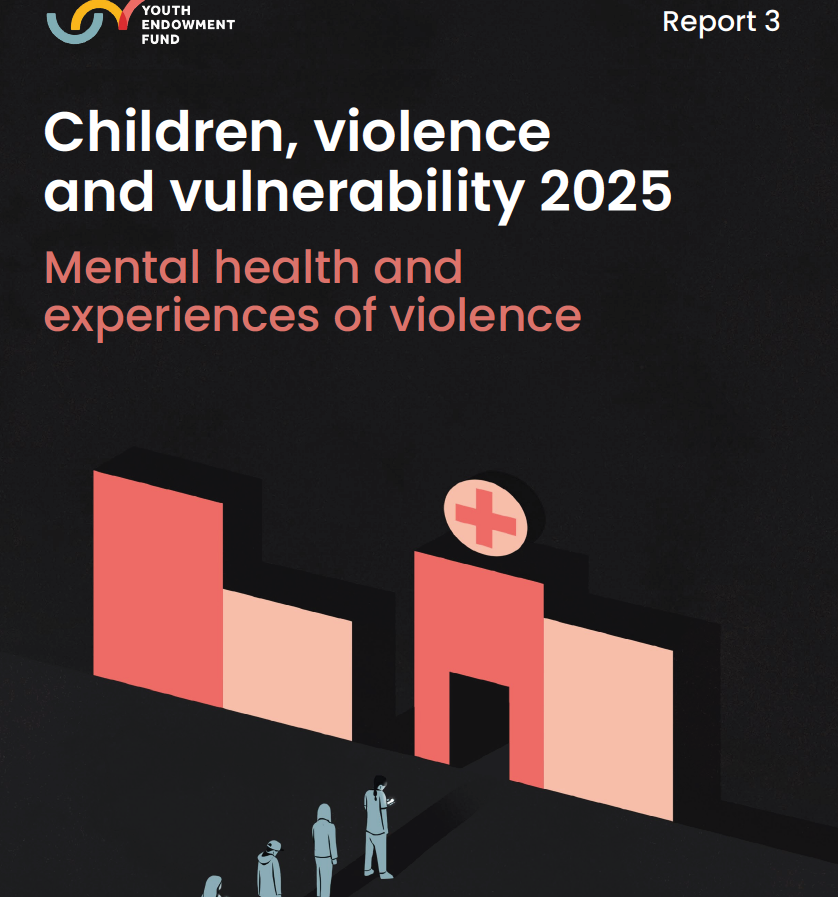
Mental health and experiences of violence. Children, violence and vulnerability 2025 Report 3

By The Youth Endowment Fund

The Youth Endowment Fund (YEF) surveyed nearly 11,000 children aged 13–17 in England and Wales to hear directly about their experiences of violence. The findings are being shared across several reports, each exploring a different theme. This third report focuses on mental health and experiences of violence. For the first time, we asked detailed questions about mental health, including using the Strengths and Difficulties Questionnaire (SDQ), a 25-item questionnaire that measures the scale of children’s struggles. Combined with data on victimisation and perpetration, this provides an unprecedented picture of how violence and mental health are linked — and the complex ways they shape young people’s lives. Here’s what we found. Teenage children affected by serious violence face a dramatically higher risk of mental health problems. The scale of poor mental health among teenagers is alarming. More than one in four 13-17-year-olds reported high or very high levels of mental health difficulties, as measured by the SDQ — the equivalent of nearly a million teenage children struggling with their well-being. Behind this figure lie serious and often complex needs. A quarter of teenage children reported a diagnosis of at least one mental health or neurodevelopmental condition, such as depression, attention deficit hyperactivity disorder or speech and communication difficulties. A further 21% suspected they had a condition but had not been formally diagnosed — suggesting large numbers of teenage children are facing difficulties without recognition or support

Interventions to Address Racism in Disciplinary Actions in K-12 Schools: A Systematic Review

By Briana A. Scott, Sarah M. Stilwell, Zaida V. Pearson, Marc A. Zimmerman


Students of color are disciplined for behavioral infractions at higher rates than white students in K-12 schools in the USA. The consequences of racism in K-12 schools include mental health problems, school dropout, and disproportionate disciplinary practices, leading to the school-to-prison pipeline. Many school personnel implement interventions to address student behavior rather than racism and other implicit biases. Furthermore, culturally relevant practices are imperative to address the root causes of racial disparities in student discipline. For these reasons, a systematic and comprehensive review of the published literature on school-based interventions in the USA (including public and private K-12 schools) was conducted to identify interventions to remedy racial disparities in school discipline, as well as the research designs used to test their efficacy. The final sample includes 48 studies that directly or indirectly attempt to address the race discipline gap. There were only three studies that reduced race disparities in school discipline with a culturally relevant intervention. Future researchers may consider the importance of the school’s cultural context and intervention audience when developing and testing efforts to reduce racial disproportionality

Are Trump Judges Different? Evidence from Immigration Cases

By Daniel M. Klerman

Judges appointed by President Trump are more likely to vote in favor of the government in cases challenging the second Trump administration's immigration policies. While Trump's Supreme Court nominees behave like other Republican nominees on the Court, Trump's lower court nominees are twice as likely to vote in favor of the government as nominees of other Republican presidents; in contrast, other Republican nominees to the lower courts are statistically indistinguishable from Democratic nominees. The difference between Trump nominees and other judges is driven almost entirely by judges 55 years old or younger, who may be influenced by the prospect of promotion to the Supreme Court.

 USC CLASS Research Paper No. 2522, 2025, 

Ransomware HR: Human Resources Practices and Organizational Support in the Conti Ransomware Group

By James Martin , Chad Whelan , and David Brigh
Ransomware is widely regarded as one of the most economically damaging cybercrimes. Existing criminological research has focused largely on the structure, routines, and activities of ransomware groups, or traced financial transactions to advance understanding of their associated harms. This paper explores how the Conti ransomware group employed human resources (HR)practices and other organizational supports to recruit, retain, and motivate its employees. Data is drawn from a leaked dataset containing tens of thousands of messages between employees and affiliates of Conti. We analyze this dataset through the lens of organizational support theory(OST), one of the most influential theories in the field of organization and management psychology. Our analysis shows that Conti employed a variety of HR practices to improve worker satisfaction and commitment, many of which are supported by OST research. By better understanding these practices, we aim to provide a novel, theoretically informed perspective through which the operations of ransomware groups can be better understood. The paper concludes with a discussion of how this knowledge can be used to inform the development of law enforcement strategies intended to disrupt ransomware groups

DEVIANT BEHAVIOR 2025, VOL. 46, NO. 9, 1088–1103