Open Access Publisher and Free Library
CRIME+CRIMINOLOGY.jpeg

CRIME

Violent-Non-Violent-Cyber-Global-Organized-Environmental-Policing-Crime Prevention-Victimization

Posts in Conflict Resolution
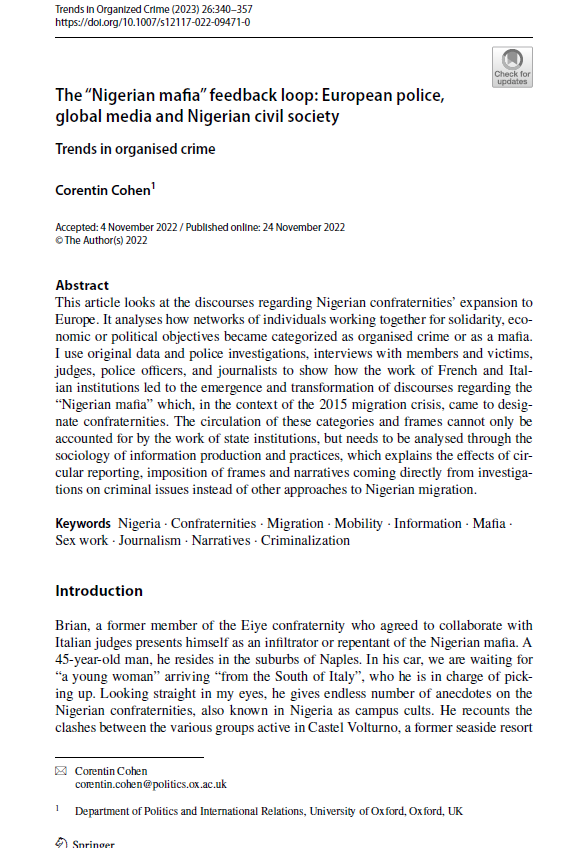
The “Nigerian mafia” feedback loop: European police, global media and Nigerian civil society

By Corentin Cohen

This article looks at the discourses regarding Nigerian confraternities’ expansion to Europe. It analyses how networks of individuals working together for solidarity, economic or political objectives became categorized as organised crime or as a mafia. I use original data and police investigations, interviews with members and victims, judges, police officers, and journalists to show how the work of French and Italian institutions led to the emergence and transformation of discourses regarding the “Nigerian mafia” which, in the context of the 2015 migration crisis, came to designate confraternities. The circulation of these categories and frames cannot only be accounted for by the work of state institutions, but needs to be analysed through the sociology of information production and practices, which explains the effects of circular reporting, imposition of frames and narratives coming directly from investigations on criminal issues instead of other approaches to Nigerian migration.


Trends Organ Crim 26, 340–357 (2023

 MONITORING ONLINE ILLEGAL WILDLIFE TRADE. Featuring rhino horn pills and wildlife substitutions

By The Global Initiative Against Transnational Organized CrimeGlobal Initiative Against Transnational Organized Crime,Global Initiative Against Transnational Organized Crime,

Online illegal wildlife trade (IWT) continues to expand across social media and e-commerce platforms, with 13,254 wildlife advertisements detected between April 2024 and August 2025 across Africa, the Americas, Asia and the Middle East. Our monitoring shows a persistent concentration on Facebook, which accounts for 83.8% of all detections, alongside growing activity on e-commerce and business-to-business platforms. The rise in both volume and geographic coverage underscores how sellers exploit online environments, regulatory loopholes and shifting demand to reach consumers and adapt rapidly to enforcement efforts.

Drawing on structured monitoring by ten regional data hubs, this new iteration of the Global Trend Report highlights how species, platforms and market drivers differ widely across regions. Mammals dominate detections, led by elephants, big cats and African grey parrots, and many adverts involve species listed under CITES Appendix I or II without accompanying permit information. Hubs recorded diverse tactics: Facebook Stories designed for 24-hour visibility, coded emojis in Colombia, claims of official registration in Mexico, children’s YouTube channels in South Asia that normalize protected wildlife as pets, and loopholes around legally owned lions in Thailand.

A central focus of the report is North Korea’s Angong Niuhuang Wan (ANW) pills, whose packaging explicitly lists “rhinoceros horn” as an ingredient. Open-source intelligence shows these pills are produced in Pyongyang and moved through Sinuiju and Namyang into China before circulating across markets in Japan, Hong Kong, Singapore, Malaysia, Cambodia, Thailand, Laos, Vietnam and Myanmar. Embedding small amounts of rhino horn into labelled traditional medicine significantly amplifies value and demand, while illustrating how the rhino horn trade intersects with conservation and security concerns, including sanctions evasion and illicit revenue streams linked to North Korean entities.

The report also documents how markets pivot when supply declines or regulations tighten. After all pangolin species were uplisted to CITES Appendix I in 2016, Mexican export data shows an exponential rise in pirarucu leather exports, with pirarucu now positioned as a visually similar substitute. Online markets show mislabelled and misidentified leathers, such as pirarucu sold as pangolin and vice versa, revealing laundering risks along supply chains. Traceability gaps, especially once skins are processed, make verification difficult and complicate enforcement.

Taxidermy and leatherworking form another blind spot. In Mexico, highly active social-media groups advertise mounted specimens, ivory figurines and worked products derived from rhinos, elephants, manta rays, crocodilians, jaguars, pangolins, pirarucu and primates. Adverts frequently lack documentation, rely on coded language and misspellings, and exploit enforcement priorities that remain focused on live trade rather than processed parts.

Finally, declining availability of tiger products has driven substitutions such as lion canines in Thai amulet Facebook groups and jaguar parts sourced from Latin America. Cross-border movements of lion bones and skeletons, and online offers for jaguar skins, teeth and paste show how big-cat parts circulate as substitutes, shaped by availability and legal risk.

Across all hubs and product types, the report demonstrates how online IWT can be linked to global security and sanctions evasion issues, and how it adapts through substitutions, processed wildlife products and regulatory loopholes, reinforcing the need for coordinated monitoring, enforcement and policy responses.

Geneva: Global Initiative Against Transnational Organized Crime, 2025. 35p.

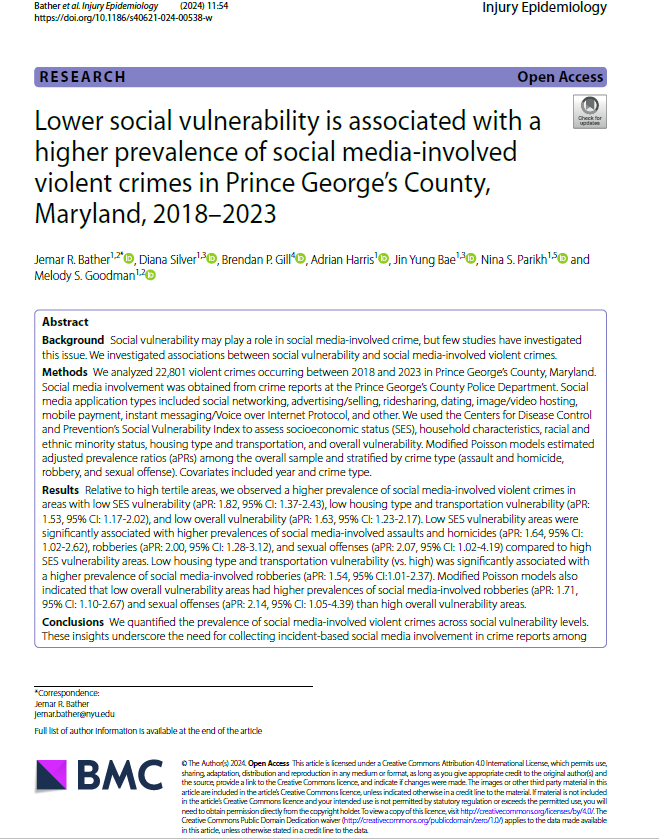
Lower social vulnerability is associated with a higher prevalence of social media-involved violent crimes in Prince George’s County, Maryland, 2018–2023

By Jemar R. Bather, Diana Silver, Brendan P. Gill, Adrian Harris, Jin Yung Bae, Nina S. Parikh & Melody S. Goodman 

Background

Social vulnerability may play a role in social media-involved crime, but few studies have investigated this issue. We investigated associations between social vulnerability and social media-involved violent crimes.

Methods

We analyzed 22,801 violent crimes occurring between 2018 and 2023 in Prince George’s County, Maryland. Social media involvement was obtained from crime reports at the Prince George’s County Police Department. Social media application types included social networking, advertising/selling, ridesharing, dating, image/video hosting, mobile payment, instant messaging/Voice over Internet Protocol, and other. We used the Centers for Disease Control and Prevention’s Social Vulnerability Index to assess socioeconomic status (SES), household characteristics, racial and ethnic minority status, housing type and transportation, and overall vulnerability. Modified Poisson models estimated adjusted prevalence ratios (aPRs) among the overall sample and stratified by crime type (assault and homicide, robbery, and sexual offense). Covariates included year and crime type.

Results

Relative to high tertile areas, we observed a higher prevalence of social media-involved violent crimes in areas with low SES vulnerability (aPR: 1.82, 95% CI: 1.37-2.43), low housing type and transportation vulnerability (aPR: 1.53, 95% CI: 1.17-2.02), and low overall vulnerability (aPR: 1.63, 95% CI: 1.23-2.17). Low SES vulnerability areas were significantly associated with higher prevalences of social media-involved assaults and homicides (aPR: 1.64, 95% CI: 1.02-2.62), robberies (aPR: 2.00, 95% CI: 1.28-3.12), and sexual offenses (aPR: 2.07, 95% CI: 1.02-4.19) compared to high SES vulnerability areas. Low housing type and transportation vulnerability (vs. high) was significantly associated with a higher prevalence of social media-involved robberies (aPR: 1.54, 95% CI:1.01-2.37). Modified Poisson models also indicated that low overall vulnerability areas had higher prevalences of social media-involved robberies (aPR: 1.71, 95% CI: 1.10-2.67) and sexual offenses (aPR: 2.14, 95% CI: 1.05-4.39) than high overall vulnerability areas.

Conclusions

We quantified the prevalence of social media-involved violent crimes across social vulnerability levels. These insights underscore the need for collecting incident-based social media involvement in crime reports among law enforcement agencies across the United States and internationally. Comprehensive data collection at the national and international levels provides the capacity to elucidate the relationships between neighborhoods, social media, and population health.

Inj. Epidemiol. 11, 54 (2024

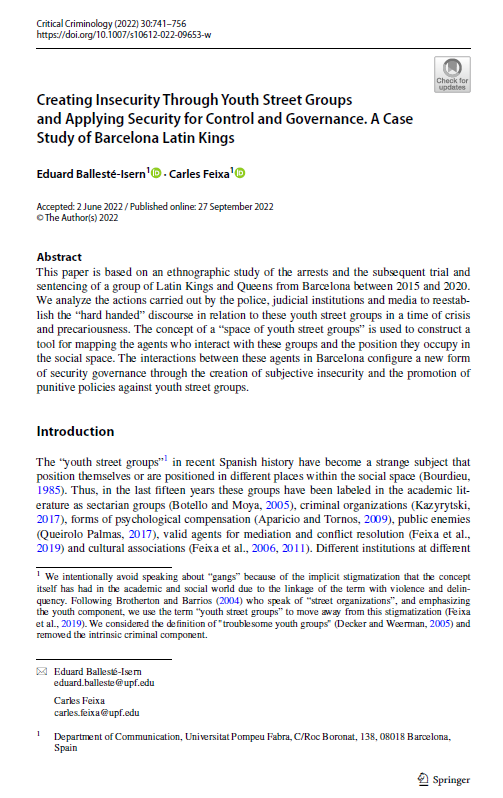
Creating Insecurity Through Youth Street Groups and Applying Security for Control and Governance. A Case Study of Barcelona Latin Kings

By Eduard Ballesté-Isern & Carles Feixa 

This paper is based on an ethnographic study of the arrests and the subsequent trial and sentencing of a group of Latin Kings and Queens from Barcelona between 2015 and 2020. We analyze the actions carried out by the police, judicial institutions and media to reestablish the “hard handed” discourse in relation to these youth street groups in a time of crisis and precariousness. The concept of a “space of youth street groups” is used to construct a tool for mapping the agents who interact with these groups and the position they occupy in the social space. The interactions between these agents in Barcelona configure a new form of security governance through the creation of subjective insecurity and the promotion of punitive policies against youth street groups.

Crit Crim 30, 741–756 (2022)

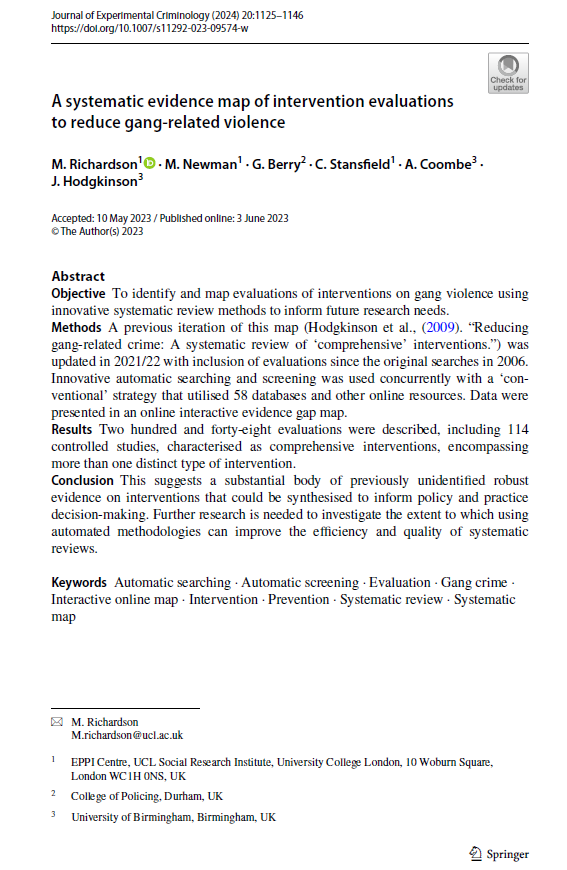
A systematic evidence map of intervention evaluations to reduce gang-related violence


By : M. Richardson, M. Newman, G. Berry, C. Stansfield, A. Coombe & J. Hodgkinson

  • Objective

    To identify and map evaluations of interventions on gang violence using innovative systematic review methods to inform future research needs.

    Methods

    A previous iteration of this map (Hodgkinson et al., (2009). “Reducing gang-related crime: A systematic review of ‘comprehensive’ interventions.”) was updated in 2021/22 with inclusion of evaluations since the original searches in 2006. Innovative automatic searching and screening was used concurrently with a ‘conventional’ strategy that utilised 58 databases and other online resources. Data were presented in an online interactive evidence gap map.

    Results

    Two hundred and forty-eight evaluations were described, including 114 controlled studies, characterised as comprehensive interventions, encompassing more than one distinct type of intervention.

    Conclusion

    This suggests a substantial body of previously unidentified robust evidence on interventions that could be synthesised to inform policy and practice decision-making. Further research is needed to investigate the extent to which using automated methodologies can improve the efficiency and quality of systematic reviews.

  •  J Exp Criminol 20, 1125–1146 (2024).

Gang Phantasmagoria: How Racialized Gang Allegations Haunt Immigration Legal Work

By Ana Muñiz

Through an analysis of interviews with Southern California attorneys, supplemented by archival materials, this article contributes to the literature on gangs, critical criminology, and Gothic tropes by examining how the ambiguous nature of gang profiling allows state actors to target racialized others in various legal and administrative venues with little evidence and few procedural protections. I conceptualize gang phantasmagoria as the constant, amorphous, unpredictable, and haunting threat of racialized gang allegations and argue that the dynamic shapes the work of legal practitioners and constitutes a state mechanism of racial terror. Specifically, first I argue that government officials deploy the specter of gangs to both portray asylum seekers as monstrous threats and justify restrictions in asylum eligibility. I then illustrate how the potential for gang phantasmagoria to upend asylum applications and trigger the deportation of their clients elicits constant low-grade anxiety for attorneys. Consequently, attorneys are forced to adopt more cautious approaches to legal work in a way that indirectly facilitates the social control of young Latinx immigrants.


Critical Criminology, olume 30, pages 159–175, (2022

  Miracle or Mirage? Gangs and Plunging Violence in El Salvador Latin America 


By The International Crisis Group

  Principal Findings : What’s new? In President Nayib Bukele’s first year in office, El Salvador has seen a sharp drop in what long were sky-high murder rates. While the public celebrates his well-known “iron fist” policies, the reasons for success might lie in quiet, informal understandings between gangs and the government. Why does it matter? It is a major feat to reduce killings by the three main gangs in one of the world’s most violent countries. But the precise causes of the decline are complex and often unclear. Recent outbreaks of gang violence and political mudslinging underline the fragility and reversibility of this achievement. What should be done? Sustaining violence reduction is key. The government should prioritise community-focused development, rehabilitation of jailed gang members and more sophisticated policing efforts, including internal checks on security forces. Should gangs keep violence down and cooperate with authorities during the pandemic, Bukele should consider opening channels for local dialogue with them.   

  After decades of harrowing gang crime, homicides have plunged in El Salvador on the watch of the new president, Nayib Bukele. Faced with the growth of the MS-13 and 18th Street gangs, previous governments resorted to “iron fist” policies to crush them, only to find these fuelled a backlash. Since his 2019 election, President Bukele, a self-styled outsider, has won huge public support by presiding over a 60 per cent fall in murders. Yet prospects that this achievement will endure are in doubt. The collapsing homicide rate may stem not only from the government’s public security policies, but also from the gangs’ own decision to curb bloodshed, possibly due to a fragile non-aggression deal with authorities. In addition, Bukele’s confrontational style, which has been exacerbated during the COVID-19 pandemic, risks entangling his security reforms in political battles. Broadly backed efforts to support affected communities, assist members wishing to leave gangs and encourage local peacebuilding are more likely to end definitively El Salvador’s cycle of violence. The Bukele administration argues that the plummeting murder rate – with daily killings now standing at their lowest rate since the end of the country’s civil war (1980- 1992) – represents the crowning achievement of a new security strategy. In theory, the government’s Territorial Control Plan couples robust law enforcement with violence prevention schemes. It has reinforced joint police and military patrols in 22 municipalities suffering high rates of crime, while toughening confinement measures in jails in a bid to sever communications between inmates and the outside world. At the same time, the government’s goal of building dozens of “cubes” – glass-walled recreational and education centres – represents the flagship effort to brighten the lives of young people growing up under gang dominion and prevent recruitment into their ranks. The precise reasons for the nationwide drop in homicides are hard to pin down. Statistical studies show that the Territorial Control Plan is most likely not the sole cause; specific local falls in murder rates do not correspond precisely to those areas where the plan has been implemented. Instead, in large part, gangs appear to have themselves decided to scale back their use of lethal violence. Unassailable control over communities, declining gang rivalry and increasingly autonomous gang leadership outside jails may explain this decision more than the Territorial Control Plan. Yet other government policies might have played a role: numerous analysts and local activists ascribe the gangs’ move to an informal understanding between them and the authorities, who have allegedly ordered security forces to dial back their clashes with these groups. A sudden killing spree attributed to MS-13 in April illustrated just how precarious the gangs’ commitment to reducing violence can be. Bukele’s reaction to the attacks, which left over 80 dead in a five-day span, reaffirmed his inclination to adopt punitive measures to force gangs into submission. Images shared around the world from inside El Salvador’s high-security jails revealed inmates huddled together or forced into shared cells without any access to daylight. Although murder rates have since fallen again, the risk remains that gangs, now short of extortion income due to lockdown measures and indignant at the government’s crackdown, will once again resort to extreme violence.  

  Crisis Group Latin America Report N°81, 8 July 2020  

Brussels: International Crisis Group, 2020. 46p.

Undoing Haiti’s Deadly Gang Alliance Latin America & Caribbean 

By The International Crisis Group

Born of Port-au-Prince’s most powerful gangs, Viv Ansanm has raised the criminal threat overhanging Haiti’s state and civilians to alarming heights. The gang coalition announced itself to the world by besieging the Haitian capital in early 2024, triggering former Prime Minister Ariel Henry’s resignation. After consolidating its hold on much of the city, Viv Ansanm has expanded into neighbouring departments, tightened its grip on the main roads connecting Port-au-Prince to the rest of the country and mounted attacks on the airport, essentially cutting Haiti off. Gangs’ violent offensives have killed over 16,000 people since 2022. But a rising death toll and diversifying criminal portfolio, now including extortion, piracy and drug trafficking, have not stopped gangs from claiming to represent the country’s downtrodden, especially on social media. UN approval of a new foreign force to combat the gangs could shift the balance of power. But it is vital that plans are in place not just to overpower the gangs but also to persuade them to demobilise. Haitian business and political elites have relied on paramilitary forces to protect their interests since the 1950s dictatorship of Francois Duvalier, or “Papa Doc”. But in the wake of the assassination of President Jovenel Moïse in July 2021, gangs have mutated, evolving from tools in the hands of the most powerful to overlords of Haiti. Two main gang groupings – the G-9, whose most public figure was Jimmy Chérizier, alias Barbecue, and the Gpèp, under Gabriel Jean Pierre, known as “Ti Gabriel” – fought for supremacy after Moïse’s murder. Even as the two faced off, gang leaders discussed whether to strike agreements to scale down the death toll among their members and spare resources. Mediators managed to craft several pacts among local groups to divvy up coveted turf. Late in 2023, reports emerged that the country’s two main gang coalitions had merged into one platform; their first joint offensive began months later replace the current transitional government. The concrete result they aspire to is a general amnesty for leaders and members. Haiti and its foreign partners are looking to beef up their ability to respond to the gangs with force. The UN Security Council has approved a new security operation, dubbed the Gang Suppression Force, to replace the Kenya-led Multinational Security Support Mission, which started up in 2024 but has never had the personnel or resources needed to check the gangs. The new force aims to incorporate 5,500 military personnel and expects to draw on reliable funding. Its mandate appears to give it more operational independence and the leeway to adopt more aggressive tactics. But until the force’s deployment, which is expected to commence around April 2026, Haiti’s authorities will have to turn to other methods. A task force, led by Haiti’s prime minister and powered by U.S. private military companies, has already used drones to hit gang members in their urban strongholds, killing over 200 people. Foreign partners are also providing training to the newly reconstituted army. Meanwhile, citizens exhausted by the threat to their neighbourhoods have established self-defence groups, provoking a brutal riposte from the gangs. Alongside its violent expansion, Viv Ansanm has sought to transform its public profile from that of a predatory criminal force into that of an ideological crusader. Crime bosses say their mission is to protect the poorest Haitians from rapacious elites and colonial powers that historically have oppressed this black Caribbean nation. Chérizier and other gang leaders have even announced the creation of a new political party, albeit without taking the steps needed to register it formally. While continuing to enrich themselves at the expense of Haitians rich and poor, their message has nevertheless become more overtly political: they appear intent on guaranteeing that their allies are part of the next administration, which should be formed by 7 February 2026 toreplace the current transitional government. The concrete result they aspire to is a general amnesty for leaders and members. Haiti and its foreign partners are looking to beef up their ability to respond to the gangs with force. The UN Security Council has approved a new security operation, dubbed the Gang Suppression Force, to replace the Kenya-led Multinational Security Support Mission, which started up in 2024 but has never had the personnel or resources needed to check the gangs. The new force aims to incorporate 5,500 military personnel and expects to draw on reliable funding. Its mandate appears to give it more operational independence and the leeway to adopt more aggressive tactics. But until the force’s deployment, which is expected to commence around April 2026, Haiti’s authorities will have to turn to other methods. A task force, led by Haiti’s prime minister and powered by U.S. private military companies, has already used drones to hit gang members in their urban strongholds, killing over 200 people. Foreign partners are also providing training to the newly reconstituted army. Meanwhile, citizens exhausted by the threat to their neighbourhoods have established self-defence groups, provoking a brutal riposte from the gangs. A well-resourced, properly informed and expertly commanded Gang Suppression Force could help change the balance of force on the ground and push the gangs onto the back foot. Port-au-Prince and its foreign counterparts, however, must take care to mitigate the dangers of civilian casualties and violations of human rights, ensuring that robust accountability systems are in place. Once the force is up and running, the Haitian government should also overcome the coordination failures that have plagued previous security campaigns. In particular, the government should appoint members to the National Security Council and ask them to design a strategy that lays out each institution’s role in fighting the gangs. Even so, it remains unlikely that force aone will entirely extricate gangs from the communities they control or sever the nexus with politics that has bedevilled Haiti for over half a century. Though informal negotiations with gangs take place on a regular basis – to gain access to people in need of humanitarian aid or to keep businesses open – many Haitians oppose the idea of formal dialogue with the perpetrators of crimes they consider unforgivable. Government officials have correctly said the Haitian state cannot engage in talks from a position of weakness. But if the new multinational force and revamped Haitian security forces allow the authorities to gain the upper hand and broadcast their armed superiority, state officials should look to use dialogue as a means of convincing the gangs to cut their losses, reduce violence against civilians and, eventually, demobilise

While that happens, the administration, with the support of donors, should expand the program that is now providing exit ramps for minors in the gangs’ ranks. In cooperation with international experts, it should also start to design a transitional justice system that provides benefits and a measure of judicial reprieve to those who disarm and cooperate with the authorities, while also guaranteeing that there will be no general impunity. It is hard to understate the damage gangs have wrought in Haiti, killing and raping thousands, creating the hemisphere’s worst humanitarian crisis and destroying the lives of millions. Understandably, many Haitians refuse to contemplate responding to the horrors they have endured with anything less than crushing retaliation. But even if the Gang Suppression Force lives up to its promise, it is hard to compute the possible cost in lives and resources of a campaign to destroy the gangs. At some stage, negotiations from a position of strength aimed at protecting civilians and disarming the gangs would serve Haiti far better as a first step on the long path to stability.


Port-au-Prince/New York/London/Brussels: International Crisis Group, 2025. 49p.

A ‘Lens of Labor’: Re-Conceptualizing Young People’s Involvement in Organized Crime

By Sally Atkinson-Sheppard

Millions of the world’s children engage in labor, often exploitative and essential to their survival. Child labor is closely related to crime; global discourse illustrates how young people are victims of forced and bonded labor and recent studies from the global South demonstrate how young people are hired as the ‘illicit laborers’ of organized crime groups. Despite this, there is a tendency to consider young people, not as laborers but as victims of trafficking or as offenders (often in relation to gangs). To address this lacuna, the article draws on data from 3 studies conducted in the global South to develop a conceptual framework suitable for understanding the intersection between labor and crime. The article develops a metaphorical ‘labor lens’, a lens which centers and prioritizes labor and instrumental drivers for crime, embedded within wider structures of illicit markets, established organized crime, state:crime collaboration and the need for children to work to survive. The article integrates economic drivers for involvement in organized crime with the moral economy, within the context of ecological frameworks of crime, embedded with wider issues of coloniality. In doing so, the article develops a new conceptual framework for considering young people’s involvement in organized crime.


  Critical Criminology (2023) 31:467–487

Criminal Procedure Without Consent

By Kate Weisburd


Scholars and advocates have long argued that a person's consent to a warrantless police search is often so inherently coerced, uninformed, and shaped by race, class, gender, citizenship status, and disability that to call it a "choice" is fiction. This critique is not limited to police searches based on consent. Waiving rights and consenting to otherwise unconstitutional state action permeates criminal procedure. The definition of a seizure, the third-party doctrine, custodial confessions, plea bargains, and agreements to alternatives to incarceration (such as GPS ankle monitoring) all hinge on the idea of voluntary choices-choices that are often just as coerced and uninformed as the choice to consent to a search.Given these concerns, this Article asks: What would happen if consent were eliminated from criminal procedure doctrines? This question is not merely academic. In recent years, a number of jurisdictions have substantially limited or eliminated traditional police searches based on consent. These reform efforts allow us to consider if there is something uniquely coercive or inequitable about consent searches that makes them especially amenable to reform or if we should consider eliminating consent in other criminal procedure doctrines as well.This Article takes on these questions. Drawing on both an original national survey of recent consent-search reforms and a transsubstantive analysis of consent and waiver in a range of criminal procedure doctrines, this Article analyzes the potential ramifications of eliminating (or limiting) consent. In doing so, this Article reveals the extent to which consent plays a pivotal role in upholding—and justifying—the entire operation of the criminal justice system.


.California Law Review (2025), UC Law San Francisco Research Paper Forthcoming,

The curious case of vandals: Brazil’s environmental and regional policies in the Bolsonaro years

By Monika Sawicka


This paper aims to contribute to the debate on foreign policy strategies of state actors in the international system with a particular focus onpolicies pursued by far-right populist leaders. On the theoretical level,it builds on role theory and status-seeking strategies drawn from social identity theory (SIT) to offer an enhanced conceptual framework suit-able for scrutinising more radical forms of international activism. Thetheoretical points are then illustrated empirically by exposing the find-ings from content analysis of Brazilian policymakers’ speeches and their juxtaposition with the Bolsonaro government’s policies in the areas of environmental protection and regional cooperation. The author’s main claim is that President Jair Bolsonaro and his Foreign Affairs MinisterErnesto Araújo, through their rhetoric about cooperation in SouthAmerica and the Amazon and the actions undertaken by the adminis-tration in these fields, envisioned for Brazil the role of vandal. This had substantial consequences for the country’s international standing.

GEOPOLITICS, 2023, VOL. 28, NO. 2, 619–640

SexWork.DK: a comparative study of citizenship and working hours among sex workers in Denmark

By Rasmus Munksgaard, Kim Moeller & Theresa Dyrvig Henriksen

Sex workers in Europe are increasingly of nonnational origin. The Schengen cooperation allows internal migration within the European Union, but many migrant sex workers originate from outside the EU. While sex workers are already in precarious positions, nonnationals risk deportation, dependent on their citizenship status, and may have debts to smugglers. Consequently, they may be more likely to work longer hours to increase short-term profits. Using a dataset of sex work advertisements from one Danish website (n = 2,594), we estimate the association between inferred citizenship status and a) advertised hours on shift using ordinary least squares regression, and b) the probability of advertising 24/7 availability using a linear probability model. Compared to Danish sex workers, we find migrants advertise almost twice as many hours on shift and are more likely to advertise 24/7 availability. These results shed light on the inequalities that persist between national and nonnational sex workers.

Global Crime, Volume 26, 2025 - Issue 1

Come at the king, you best not miss: criminal network adaptation after law enforcement targeting of key players

By Giulia Berlusconi

This paper investigates the impact of the targeting of key players by law enforcement on the structure, communication strategies, and activities of a drug trafficking network. Data are extracted from judicial court documents. The unique nature of the investigation – which saw a key player being arrested mid-investigation but police monitoring continuing for another year – allows to compare the network before and after targeting. This paper combines a quantitative element where network statistics and exponential random graph models are used to describe and explain structural changes over time, and a qualitative element where the content of wiretapped conversations is analysed. After law enforcement targeting, network members favoured security over efficiency, although criminal collaboration continued after the arrest of the key player. This paper contributes to the growing literature on the efficiency-security trade-off in criminal networks, and discusses policy implications for repressive policies in illegal drug markets.

Global Crime, Volume 23, 2022 - Issue 1

An exploratory study of victimisation and near misses in online shopping fraud

By Matthew Edwards,Jack Mark Whittaker, Cassandra Cross & Mark Button


The internet has revolutionised retail sales, with online shopping a common practice globally. While convenient, offenders have also embraced the opportunity to target potential victims and their shopping carts. Online shopping fraud occurs when offenders represent themselves as legitimate online sellers to gain sales from unsuspecting victims, both by impersonating genuine retailers and creating fictional retailers with non-existent products. The current article explores the victimisation and near misses of consumers to online shopping fraud. Based on survey responses of 1011 Australians, the article examines the online shopping activities of individuals as well as any victimisation or near miss experiences. The results indicate a high level of victimisation and near misses across this sample. It further examines a range of impacts experienced by these consumers and considers the implications of these results for the retail sector and prevention practices into the future.

 Global Crime26(1), 69–89.

The state and the legalisation of illicit financial flows: trading gold in Bolivia

By Fritz Brugger, Joschka J. Proksik & Felicitas Fischer

Most research on illicit financial flows (IFFs) has focused on illicit outflows from low-income countries and the role of non-state actors in generating IFFs. Less attention has been paid to processes through which IFFs enter formal value chains – in effect being legalised before leaving the country – or the crucial role of state institutions as gatekeepers. We develop a novel explanatory approach to account for the enabling role of state institutions in the legalisation of IFFs. Building on political settlement theory, we explain the performance of institutions in regulating IFFs as a function to maintain political power. Taking the case of Bolivia, we examine how legalising illicit value flows works in practice and analyse the motives and underlying conditions that lead state institutions to permit the formal export of gold shipments that have been illicitly sourced or transferred. We find that the legalisation of IFFs accommodates the interests of powerful cooperatives dominating the gold-mining sector, which are critical to maintaining the political settlement on which the incumbent government’s power is based. By maintaining a status quo of non-enforcement, legal ambiguity, and informality, gold-mining cooperatives reap higher benefits from resource extraction at the expense of domestic revenue mobilisation.

New Political Economy, Volume 29, 2024 - Issue 4

Community supervision during Oregon’s partial decriminalization Measure 110: Criminal legal system involvement, overdose, and naloxone access

Bt Hope M. Smiley-McDonald,  Esther O. Chung , Lynn D. Wenger, Danielle Good , Gillian Leichtling c, Barrot H. Lambdin , Alex H. Kral 

Background

In 2020, the U.S. state of Oregon passed Measure 110 (M110), which aimed to address substance use disorder as a public health issue and reduce disparities in the criminal legal system by decriminalizing personal drug possession and increasing services. The impact of partial drug decriminalization on individuals under community supervision—whose release conditions often prohibit drug use and who M110 excluded—is understudied.

Methods

We used targeted sampling to recruit and survey people who use drugs (PWUD; N=468) in eight Oregon counties in 2023. We compared PWUD under community supervision to those who were not to assess opioid-related overdose, naloxone access, and law enforcement engagement.

Results

Compared to PWUD who were not under community supervision, those under supervision had higher prevalence of past year opioid-related overdose. There were no differences by naloxone access. Eighty-two percent (82%) of PWUD on community supervision were stopped by law enforcement in the past year. PWUD on community supervision were more likely than those not on community supervision to report in the past year being searched by law enforcement at least once (adjusted prevalence differences [APD]=0.33; 95% CI: 0.23, 0.43), spent time in jail at least once (APD=0.33; 95% CI: 0.23, 0.43), and to have concerns about getting into trouble if they called 911 for a drug-related health problem (APD=0.12; 95% CI: 0.00, 0.18).

Conclusion

Under M110, Oregon PWUD experienced more police engagement and overdoses. Findings have implications for less police presence at overdose scenes, greater access to naloxone and support services, and protections under future decriminalization laws.

Drug and Alcohol Dependence Reports

Available online 15 March 2026, 100430

In Press, Journal Pre-proof

Drugs Most Frequently Involved in Drug Overdose Deaths: United States, 2017–2023

By Matthew F. Garnett, Jodi A. Cisewski, Farida B. Ahmad

Objective:

This report identifies the specific drugs most frequently involved in drug overdose deaths in the United States from 2017 through 2023.

Methods:

Data from the 2017–2023 National Vital Statistics System mortality files were linked to literal text data from death certificates. Drug overdose deaths were identified using the International Classification of Diseases, 10th Revision underlying cause-of-death codes X40–X44, X60–X64, X85, and Y10–Y14. Specific drugs were identified by searching three literal text fields of the death certificate: the causes of death from Part I, significant conditions contributing to death from Part II, and the description of how the injury occurred. Contextual information was used to determine drug involvement in the death. Descriptive statistics were calculated for the most frequently mentioned drugs involved in drug overdose deaths. Deaths involving multiple drugs were counted in all relevant drug categories.

Results:

Among drug overdose deaths with mention of at least one specific drug, the most frequently mentioned drugs during 2017–2023 included: fentanyl, heroin, oxycodone, morphine, methadone, hydrocodone, alprazolam, diphenhydramine, cocaine, methamphetamine, amphetamine, gabapentin, and xylazine. Fentanyl ranked first across all years and was the most common concomitant drug found with other top drugs, ranging from 99.0% of xylazine-involved drug overdose deaths to 48.3% of oxycodone-involved drug overdose deaths. Cocaine and methamphetamine were also frequent concomitant drugs. Trends in age-adjusted rates across the 2017 to 2023 period varied by drug, but notably the rate for heroin-involved deaths sharply declined, while the rate for fentanyl-involved deaths increased and then stabilized between 2022 and 2023. In 2023, the most frequently mentioned drugs in unintentional drug overdose deaths were fentanyl, methamphetamine, and cocaine, while the most frequently mentioned drugs for suicide-related drug overdoses were diphenhydramine, oxycodone, and bupropion.

Conclusions:

This report identifies patterns in the specific drugs most frequently involved in drug overdose deaths from 2017 through 2023.National Vital Statistics Reports; CDC National Center for Health Statistics; 2026.

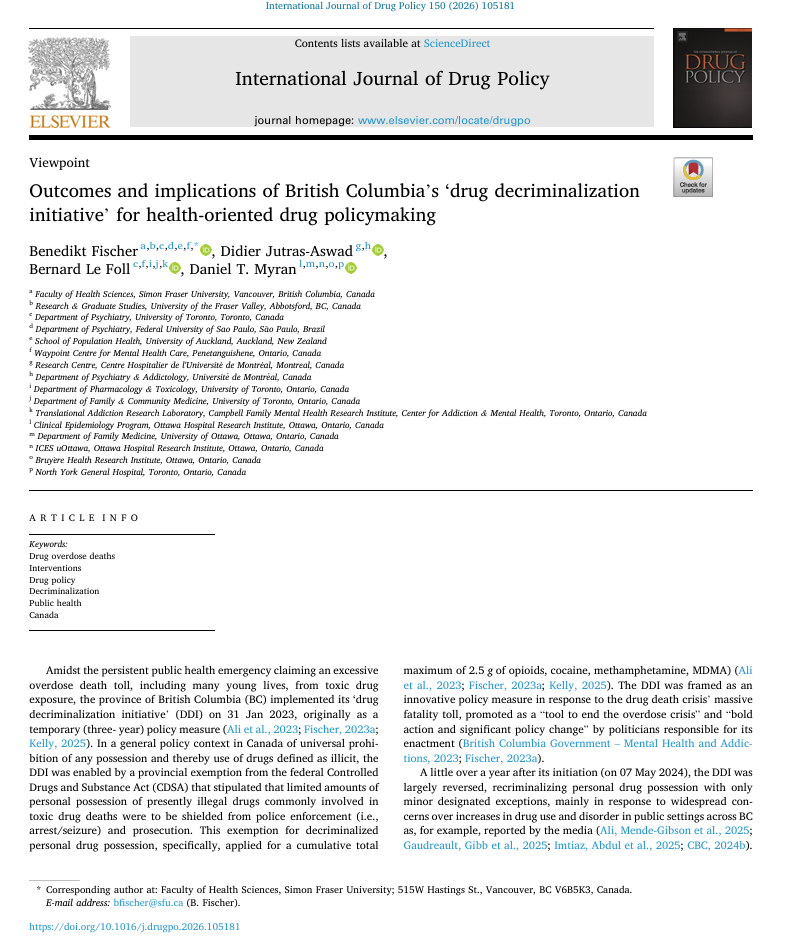
Outcomes and implications of British Columbia’s ‘drug decriminalization initiative’ for health-oriented drug policymaking

By lBenedikt Fischer,  Didier Jutras-Aswad, Bernard Le Foll, Daniel T. Myra

Highlights

The province of British Columbia (Canada) temporarily implemented a decriminalization initiative for personal drug possession/use (2023–2024) in contexts of a toxic drug death crisis.

  1. The decriminalization initiative was a priori promoted as a “tool to end the overdose crisis” and widely expected to reduce adverse health outcomes from toxic drug use.

  2. Emerging evaluation data indicate that the drug decriminalization initiative was not associated with population-level changes in drug use-related mortality (e.g., overdose deaths) or morbidity (e.g., hospitalizations).

  3. Drug use decriminalization remains an essential step to align prohibition-based drug policy frameworks with public health and human rights principles, but must be approached realistically and designed sensibly.

  4. To tangibly address toxic drug use-related harms, expanded measures are required that are effectively capable of preventing and reducing PWUDs’ exposure to and use of toxic drugs
    International Journal of Drug Policy

Volume 150, April 2026, 105181

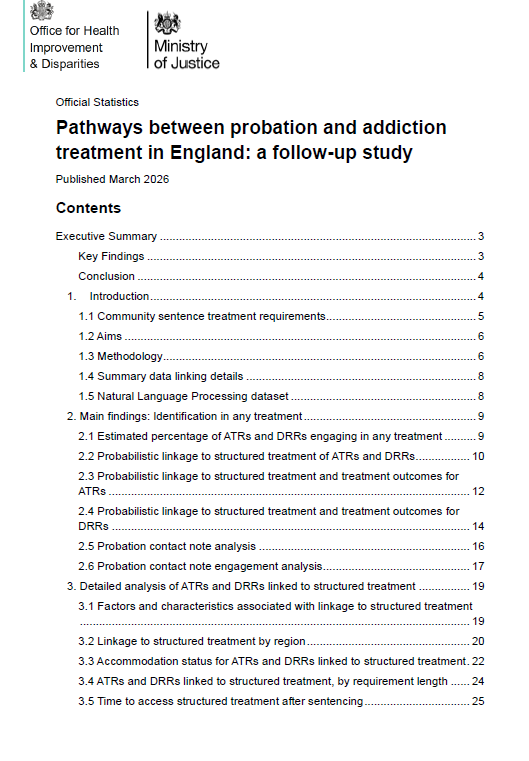
Pathways between probation and addiction treatment in England: a follow-up study

By the U.K.Ministry of Justice, and the Office of Health Improvement and Disparities


Executive Summary This report presents follow-up analysis building on Pathways between probation and addiction treatment in England: report - GOV.UK focusing on people sentenced to community orders (COs) and suspended sentence orders (SSOs) with an Alcohol Treatment Requirement (ATR) or Drug Rehabilitation Requirement (DRR). It examines engagement with alcohol and drug treatment, how engagement relates to reconvictions https://www.sciencedirect.com/science/article/pii/S0955395926000332 outcomes, and their characteristics. The analysis covers all ATRs and DRRs issued between August 2018 and March 2023. The study linked probation case management records with the National Drug Treatment Monitoring System (NDTMS) using probabilistic data linkage. This was supplemented by Natural Language Processing (NLP) analysis of probation contact notes. This approach aimed to assess whether the absence of ATRs and DRRs in structured treatment data reflected a true lack of treatment or gaps in data linkage. A total of 45,943 ATR and DRR requirements were issued during the period. Of these, 22,636 were linked to structured treatment through data linkage. The NLP approach derived an engagement rate from the unlinked sample. This was then applied to all unlinked records, resulting in an estimated 18,712 requirements with evidence of treatment engagement. Key Findings 1. Up to 90%1 of ATRs and DRRs were estimated to involve some form of treatment engagement. This is based on 49% linked to structured treatment through probabilistic data linking and an additional 41% of unlinked records showing treatment engagement in probation contact notes. Engagement was estimated to be higher for ATRs (93%) than for DRRs (88%). 2. Reconviction was less common following ATRs and DRRs linked to structured treatment. Within 12 months of sentencing, 36% of those linked to structured treatment were reconvicted, compared with 44% of those not linked to structured treatment. 

3. Characteristics associated with being more likely to be linked to structured treatment included being: • aged over 50 • female • in settled accommodation, (least likely when associated with rough sleeping) • engaged by treatment services within: 


▪ 3 weeks of an ATR, ▪ 3–6 weeks of a DRR 4. Reconviction outcomes varied by treatment outcome: • Reconvictions associated with ATRs and DRRs were lowest when they remained in structured treatment at the end of the observation period (13% for ATR; 26% for DRR). • Reconvictions associated with ATRs and DRRs were highest when they dropped out of structured treatment (41% for ATR; 60% for DRR). • Reconvictions associated with ATRs and DRRs that were not identified in structured treatment were higher than completed or remained in structured treatment but lower than those that dropped out of structured treatment (37% for ATR; 51% for DRR). Conclusion The analysis shows clear associations between treatment engagement and both individual characteristics and justice system factors. Individuals with ATRs and DRRs who completed or remained in structured treatment had better reconviction outcomes than those who dropped out of or had no identified structured treatment. This highlights the value of sustained engagement. The report also demonstrates the value of AI based NLP methods to strengthen insight by identifying treatment activity not captured through data linkage alone.

London: U.K. Ministry of Justice and the Office of Health Improvement and Disparities, 2026. 47p.

Your Money or Your Life:  London’s Knife Crime, Robbery and Street Theft Epidemic 

By David Spencer

A new report from Policy Exchange demonstrates how London is in the grip of a street crime epidemic and makes seventeen recommendations to show how the Metropolitan Police, City Hall and the Government can turn the tide.  

The report shows that:

  • Knife crime in London increased by 58.5% in only three years between 2021 and 2024;

  • Only 1 in 20 robberies and 1 in 170 “theft person” crimes in the capital were solved last year.

  • 60% of the knife crimes committed in the capital were robberies – with over 81,000 mobile phones stolen in robberies and thefts last year.

  • In 2024 one small geographic area of around 20 streets in London’s West End near Oxford Circus and Regent Street had more knife crime than nearly 15% of the rest capital combined; in 2023 these streets had more knife crime than 23% of the capital combined.

  •  

 The report identifies the top 20 neighbourhoods (technically known as Lower Layer Super Output Areas or LSOAs of about 15-20 streets each) in London which had the highest levels of knife crime in 2024. One in 15 of every knife crime offence in the capital in 2024 occurred in one of these 20 neighbourhoods (908 knife crimes). In 2024 only 4% of neighbourhoods accounted for nearly a quarter of all knife crime offences in the capital (3,615 knife crimes) and 15% of neighbourhoods accounted for half of all knife crime offences (7055 knife crimes).

The report identifies that within the Metropolitan Police there are least 850 police officers currently in non-frontline posts which could be redeployed to the policing frontline to tackle knife crime, robbery and theft in the areas where criminals are most prolific. This includes police officers currently posted to the following departments: Transformation (142 officers), Human Resources (24 officers), Culture, Diversity and Inclusion (20 officers) and Digital, Data & Technology (34 officers).  

Policy Exchange rejects the suggestion that stop and search is being deployed in a “racist” way. While only 39.5% of those stopped and searched by the police are black, 43.6% of those charged with murder are black, 45.6% of non-domestic knife-crime murder victims are black and 48.6% of robbery suspects are black. 13.5% of London’s population are black. Policy Exchange asserts that it is not “racist” when the police are merely responding to the demographic breakdown of serious and violent offending in the capital.  

Policy Exchange analysis shows that the courts are taking a dangerously lax approach to the most prolific criminals. Despite already having 46 or more previous convictions, “Hyper-Prolific Offenders” are sent to prison on less than half of all occasions (44.5%) on conviction for a further indictable or either-way offence – 4,555 such criminals walked free from court in 2024. For “Super-Prolific Offenders” (those with 26 to 45 previous offences) this falls to 42.1% with 9,483 such criminals walking free from court in 2024. Despite there being mandatory sentencing provisions for repeat knife-carriers to be sent to prison over a third are not sentenced to a term of immediate custody