Open Access Publisher and Free Library
CRIME+CRIMINOLOGY.jpeg

CRIME

Violent-Non-Violent-Cyber-Global-Organized-Environmental-Policing-Crime Prevention-Victimization

Posts in Crime
  Miracle or Mirage? Gangs and Plunging Violence in El Salvador Latin America 


By The International Crisis Group

  Principal Findings : What’s new? In President Nayib Bukele’s first year in office, El Salvador has seen a sharp drop in what long were sky-high murder rates. While the public celebrates his well-known “iron fist” policies, the reasons for success might lie in quiet, informal understandings between gangs and the government. Why does it matter? It is a major feat to reduce killings by the three main gangs in one of the world’s most violent countries. But the precise causes of the decline are complex and often unclear. Recent outbreaks of gang violence and political mudslinging underline the fragility and reversibility of this achievement. What should be done? Sustaining violence reduction is key. The government should prioritise community-focused development, rehabilitation of jailed gang members and more sophisticated policing efforts, including internal checks on security forces. Should gangs keep violence down and cooperate with authorities during the pandemic, Bukele should consider opening channels for local dialogue with them.   

  After decades of harrowing gang crime, homicides have plunged in El Salvador on the watch of the new president, Nayib Bukele. Faced with the growth of the MS-13 and 18th Street gangs, previous governments resorted to “iron fist” policies to crush them, only to find these fuelled a backlash. Since his 2019 election, President Bukele, a self-styled outsider, has won huge public support by presiding over a 60 per cent fall in murders. Yet prospects that this achievement will endure are in doubt. The collapsing homicide rate may stem not only from the government’s public security policies, but also from the gangs’ own decision to curb bloodshed, possibly due to a fragile non-aggression deal with authorities. In addition, Bukele’s confrontational style, which has been exacerbated during the COVID-19 pandemic, risks entangling his security reforms in political battles. Broadly backed efforts to support affected communities, assist members wishing to leave gangs and encourage local peacebuilding are more likely to end definitively El Salvador’s cycle of violence. The Bukele administration argues that the plummeting murder rate – with daily killings now standing at their lowest rate since the end of the country’s civil war (1980- 1992) – represents the crowning achievement of a new security strategy. In theory, the government’s Territorial Control Plan couples robust law enforcement with violence prevention schemes. It has reinforced joint police and military patrols in 22 municipalities suffering high rates of crime, while toughening confinement measures in jails in a bid to sever communications between inmates and the outside world. At the same time, the government’s goal of building dozens of “cubes” – glass-walled recreational and education centres – represents the flagship effort to brighten the lives of young people growing up under gang dominion and prevent recruitment into their ranks. The precise reasons for the nationwide drop in homicides are hard to pin down. Statistical studies show that the Territorial Control Plan is most likely not the sole cause; specific local falls in murder rates do not correspond precisely to those areas where the plan has been implemented. Instead, in large part, gangs appear to have themselves decided to scale back their use of lethal violence. Unassailable control over communities, declining gang rivalry and increasingly autonomous gang leadership outside jails may explain this decision more than the Territorial Control Plan. Yet other government policies might have played a role: numerous analysts and local activists ascribe the gangs’ move to an informal understanding between them and the authorities, who have allegedly ordered security forces to dial back their clashes with these groups. A sudden killing spree attributed to MS-13 in April illustrated just how precarious the gangs’ commitment to reducing violence can be. Bukele’s reaction to the attacks, which left over 80 dead in a five-day span, reaffirmed his inclination to adopt punitive measures to force gangs into submission. Images shared around the world from inside El Salvador’s high-security jails revealed inmates huddled together or forced into shared cells without any access to daylight. Although murder rates have since fallen again, the risk remains that gangs, now short of extortion income due to lockdown measures and indignant at the government’s crackdown, will once again resort to extreme violence.  

  Crisis Group Latin America Report N°81, 8 July 2020  

Brussels: International Crisis Group, 2020. 46p.

RE-PUNISHED FOR THE PAST How Criminal Records Increase Prison Terms and Racial Injustice

By: Nazgol Ghandnoosh, Ph.D., Director of Research, Bobby Boxerman, Ph.D., former Extreme Sentencing Research Fellow, and Celeste Barry, former Program Associate at The Sentencing Project.

Although it is a widespread practice in the United States to increase criminal penalties for people with prior convictions, there is little evidence that this practice advances public safety.1 Research by the Robina Institute has shown that state and federal sentencing guidelines dramatically increase sentence lengths based on individuals’ prior criminal records. This effect is even more pronounced for African Americans. Given the limited public safety benefits from criminal record “enhancements” and the accompanying harms to incarcerated individuals, their families, and communities — and the steep financial costs — this further lengthening of sentences should be reconfigured.

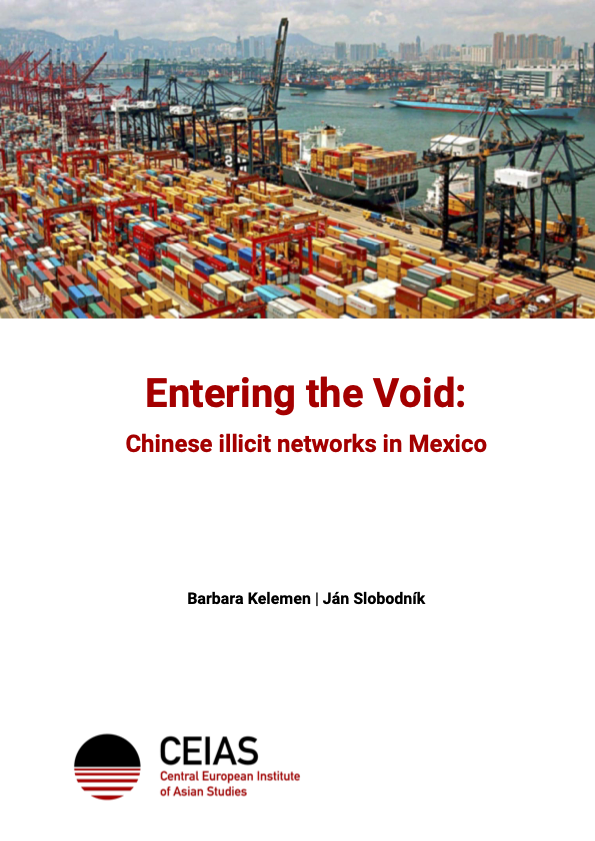
Entering the Void: Chinese illicit networks in Mexico 

By Barbara Kelemen | Ján Slobodník

Summary ▪ Mexico’s macroeconomic stability and abundant natural resources have made the country into an attractive destination for Chinese businesses. ▪ The country still suffers from a lack of internal security, most of it stemming from the Mexican Drug War, an ongoing multilateral lowintensity conflict between the Mexican government and a large number of criminal organizations. ▪ In some of Mexico’s states, pervasive violence and instability have resulted in a power vacuum. With the government being unable to guarantee security, non-state actors such as criminal organizations and/or civilian militias seize the opportunity to establish their own rule. ▪ When foreign companies operate in such troubled areas, they inevitably run into problems caused by Mexico’s security issues. ▪ Within this trend of foreign companies operating in Mexico, some level of tacit cooperation has been observed between Chinese businesses and non-state actors. This cooperation is often an outcome of localized security vacuums that are exploited by alternative security providers, such as criminal organizations, that can fill them and provide operational safety for local businesses. ▪ A growing body of research has identified the existence of Chinese illicit networks and their involvement in the trafficking of people, narcotics, and contraband goods, as well as money laundering and illegal arms trade in Mexico. ▪ Concealed under the guise of legal commercial activity, networks of Mexican criminal organizations and their Chinese business partners exploit the dire security situation in some areas of Mexico. ▪ Despite attempts by the Chinese and the Mexican governments to regulate certain sectors that contribute to the existence of the illicit networks in Mexico, there are still substantial opportunities that are ripe for exploitation by the criminal group-legitimate business partnerships.

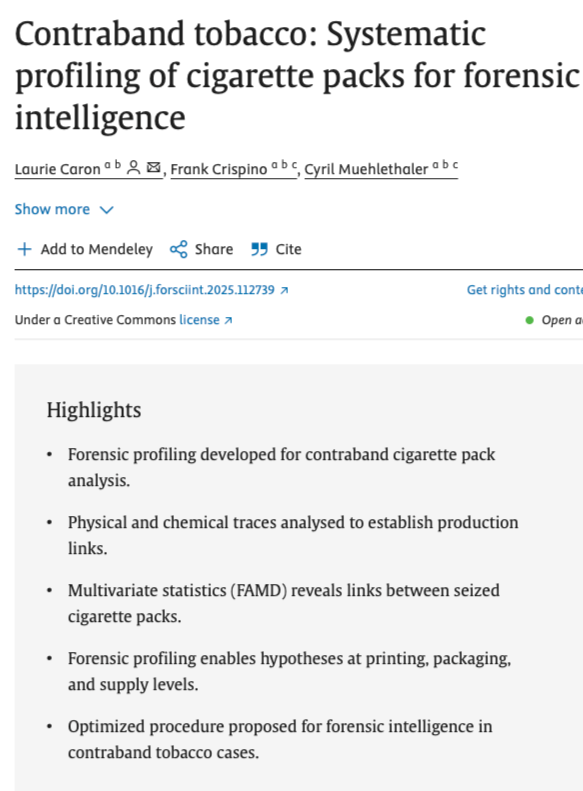
Contraband tobacco: Systematic profiling of cigarette packs for forensic intelligence

By: Laurie Caron, Frank Crispino, Cyril Muehlethaler 

Tobacco smuggling remains a widespread illegal activity in Canada, associated with important social and economic impacts, and often linked to organized crime. This study explores the application of forensic profiling as an intelligence tool to support the analysis of contraband cigarette production and distribution. Physical and chemical manufacturing characteristics of seized contraband cigarette packs, provided by police forces, were observed and coded using macroscopic, microscopic, and spectroscopic techniques. Multivariate statistical analyses were then conducted to compare manufacturing characteristics between packs and identify potential links. The analyses highlighted links between cigarette packs and seizures based on shared manufacturing characteristics. The results and the identified groups were also compared with seizure data provided by our collaborator. The results demonstrate the relevance of forensic profiling to formulate hypotheses regarding shared production processes or supply networks. These hypotheses provide information that contributes to understanding tobacco smuggling and aim to examine how forensic intelligence can support law enforcement and measures to prevent and disrupt this criminal activity. A preliminary optimal procedure for applying forensic profiling in operational contexts targeting contraband tobacco was finally proposed. Despite limitations in the dataset creation that were beyond our control, this study represents a starting point for applying this scientific approach to tobacco smuggling.

Huachicoleros: Criminal Cartels, Fuel Theft, and Violence in Mexico

By Nathan P. Jones and John P. Sullivan

Criminal cartels and gangs dominate the illicit economy in Mexico. These organized crime groups challenge the solvency (specifically capacity and legitimacy) of the state in Mexico. Organized crime in Mexico is involved in a range of activities including extortion, drug trafficking, human trafficking, and petroleum theft. Criminal cartels, often called drug trafficking organizations, have diversified into other illicit activities specifically petroleum theft. This paper provides an overview of the rise of a specialized organized criminal entity: huachicoleros. Huachicoleros specialize in fuel theft and like their narco counterparts use corruption and violence to protect their illicit market. The rise of Cártel de Santa Rosa Lima (CSRL) is discussed as a salient case study. The volatile mix of corruption, violence, and economic instability will be assessed, and government and national oil company (PEMEX) response is discussed

Transnational Organized Crime in Mexico and the Government's Response

By Evan Ellis

The U.S. government threats of tariffs on the Mexican government if it did not do more to control illicit fentanyl ows into the United States have cast new attention on the growing problem of transnational organized crime that has wrought violence and corruption at all levels in Mexico. This work, based on the authors research in interviews with senior Mexican security ofcials in Mexico City in March 2025, examines the evolution of transnational organized crime in the country, and the Mexican government’s response, with the support of the United States and other partners.The principal drivers of transnational organized crime dynamics in Mexico are ows of cocaine through the country, largely destined for European and Asian markets, as well as the production of fentanyl there from Chinese and other precursors, mostly oriented toward export to the United States. In addition, other illicit activities including petroleum theft (huachicol), smuggling and exploitation of migrants transiting the country, extortion and kidnapping, illegal mining and money laundering, have also fueled Mexico’s evolving illicit economy. With respect to murders and other violence in Mexico, arms, including long arms imported from the United States, arms obtained on the black market from Central American and other global wars, drones and other military products principally from the People’s Republic of China (PRC), as well as a large, welldeveloped illicit domestic industry for military vehicles and supplies all contribute to the lethality of multiple ongoing conict within the country.The organized crime dynamics in Mexico, the domestic and international groups involved, in the pattern of violence has evolved signicantly in the almost two decades since 2006 when Mexican president Felipe Calderon declared war on the drug cartels for their escalating violence and deployed federal troops into Michoacan to respond. This work analyzes of those dynamics, their evolution, and the response of the Mexican government, in conjunction with the US and other partners.

The Crime Conundrum in the Caribbean 

By Ivelaw Lloyd Griffith

High crime—especially intentional homicide—has posed a clear and present danger for the Caribbean for some time. However, soaring homicide rates across the region and the fact that many are committed using weapons from the United States have caused the matter to attract more attention in recent months, with a recent symposium in Trinidad and Tobago on the subject shining the most recent spotlight. CARICOM leaders are concerned about the growing homicide rates and the number of arms entering the region—issues raised both at the February 2023 CARICOM Summit in the Bahamas as well as at a recent special meeting on April 18 and 19 on the subject convened by Prime Minister Keith Rowley of Trinidad and Tobago, who holds the portfolio for security within the CARICOM quasi cabinet. The conference framed crime and violence as a public health crisis. Unlike at the Bahamas meeting—which featured government leaders—experts from within and outside the Caribbean were invited to the symposium to discuss options to address the issue. The Caribbean leaders declared a “war on guns to combat the illegal trade which provides the weapons that contribute significantly to crime and violence in our region causing death, disabilities and compromising the safety of our citizens” and implored the United States to support their efforts to halt illegal arms trafficking. They also lamented the disproportionate shares of their national budgets they are obligated to allocate to national security, especially to combat crime and violence while also grappling with mental and other health-related challenges spurned by the arms trafficking business.1 This report offers an analysis of the contemporary Caribbean crime landscape. Particular attention is paid to intentional homicides and murders. This is not because domestic violence, burglary, rape, larceny, money laundering, and other crimes are unimportant or have not increased in some places. Indeed, there have been troubling surges in domestic violence in Guyana, Puerto Rico, Jamaica, and elsewhere. Murder, however, commands attention here because it constitutes the “ultimate crime”—taking a life as well as having powerful economic, public security, and other consequences. Yet, the region’s crime scene is troubling not just because of the volume of murders, but also because of the heinous nature of some of the criminal acts. Thus, we first provide a portrait of the murder scene and then offer examples of some of the horrible ways in which crimes have been prosecuted. Next, we discuss the significant use of weapons, the source of the weapons, and the actionsand the actions being pursued by Caribbean and other leaders to stem the flow of arms into the region. In this respect, we focus on the crime symposium held this past April in Trinidad and Tobago. This report has taken into account a few policy considerations that might be considered as the region’s policymakers and practitioners address the perennial challenge of crime, violence, and arms trafficking.

Exploring Overlaps of Cultural Property Crime with Organised Crime in EU Policy Documents

By Patricia Faraldo Cabana

In recent years the interrelation of the trafficking of cultural property with other forms of organised crime has gained prominence in EU policies on the protection of cultural heritage. This article analyses how the EU has conceptualized and operationalized this overlap in terms of describing the phenomenon and designing countermeasures. Through a content analysis, we evaluate the articulation and use of this connection in EU policy documents published from 1993 to 2023 that include both organised crime and trafficking of cultural property or similar terms (n = 58). The analysis demonstrates conceptual and organizational deficits and a correspondingly weak foundation for EU policy. Misunderstandings related to the organised nature of trafficking of cultural property and its overlaps with other forms of organised crime, particularly the financing of terrorism, may result in misguided policies with the potential to undermine law enforcement efforts. Conversely, the addition to the list of obliged entities and persons in the anti-money laundering framework of persons trading or acting as intermediaries in the trade of works of art opens new opportunities to disrupt the illicit financial flow in the art and antiquities market.

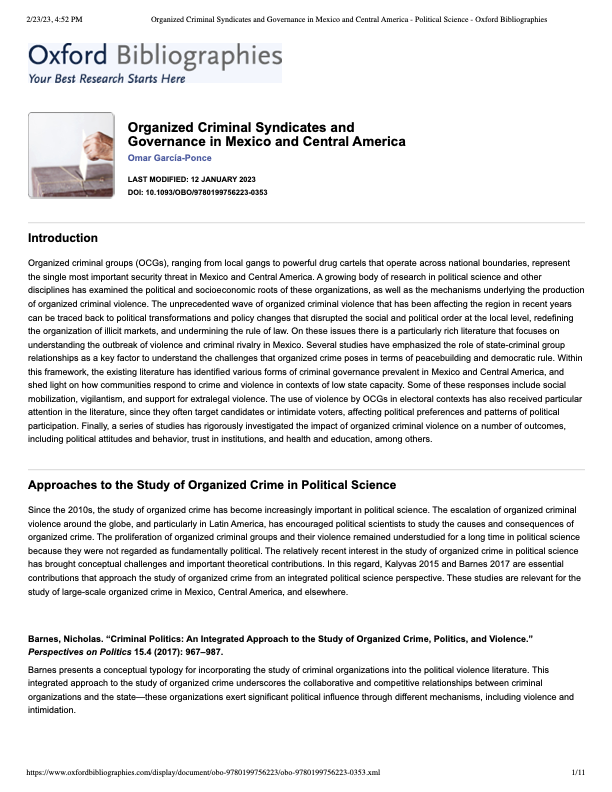
Organized Criminal Syndicates and Governance in Mexico and Central America

By Omar García-Ponce 

Organized criminal groups (OCGs), ranging from local gangs to powerful drug cartels that operate across national boundaries, represent the single most important security threat in Mexico and Central America. A growing body of research in political science and other disciplines has examined the political and socioeconomic roots of these organizations, as well as the mechanisms underlying the production of organized criminal violence. The unprecedented wave of organized criminal violence that has been affecting the region in recent years can be traced back to political transformations and policy changes that disrupted the social and political order at the local level, redefining the organization of illicit markets, and undermining the rule of law. On these issues there is a particularly rich literature that focuses on understanding the outbreak of violence and criminal rivalry in Mexico. Several studies have emphasized the role of state-criminal group relationships as a key factor to understand the challenges that organized crime poses in terms of peacebuilding and democratic rule. Within this framework, the existing literature has identified various forms of criminal governance prevalent in Mexico and Central America, and shed light on how communities respond to crime and violence in contexts of low state capacity. Some of these responses include social mobilization, vigilantism, and support for extralegal violence. The use of violence by OCGs in electoral contexts has also received particular attention in the literature, since they often target candidates or intimidate voters, affecting political preferences and patterns of political participation. Finally, a series of studies has rigorously investigated the impact of organized criminal violence on a number of outcomes, including political attitudes and behavior, trust in institutions, and health and education, among others.

An Obscured Conflict: The role of the Mexican Armed Forces in the Fight Against Organised Crime (2001-2016

By Jan Slobodník

This study examines the militarised approach of the Mexican government in its struggle against organised crime between 2001 and 2016, focusing on the deployment of the armed forces and the implementation of the so-called kingpin strategy. It argues that the removal of cartel leaders, rather than weakening criminal networks, produced fragmentation, diversification, and militarisation within Mexico’s underworld—a process defined here as zetafication. The thesis uses the rise and evolution of Los Zetas as a case study to analyse how a criminal organisation born from army deserters introduced military tactics, hierarchical discipline, and extreme violence into organised crime, transforming the conflict’s character and the state’s response. Drawing on government reports, interviews with Mexican military officers and civilians, and contemporary scholarship, the study situates this phenomenon within Mexico’s political, legal, and socio-economic context, including the influence of U.S. security policy. It concludes that the use of the military as a policing tool produces short-term tactical gains but undermines long-term state stability, erodes public trust, and perpetuates cycles of violence.

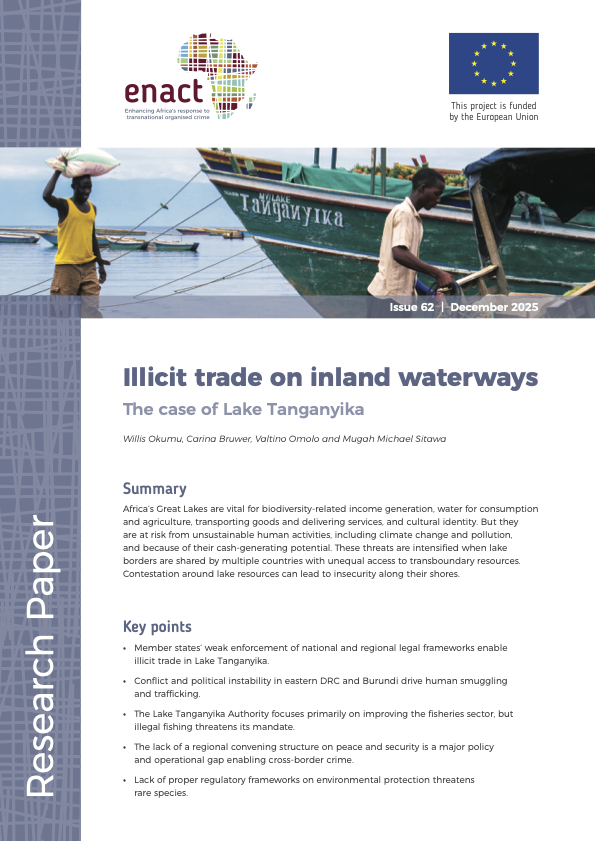
Illicit trade on inland waterways. The case of Lake Tanganyika 

By Willis Okumu, Carina Bruwer, Valtino Omolo and Mugah Michael Sitawa

Africa’s Great Lakes are vital for biodiversity-related income generation, water for consumption and agriculture, transporting goods and delivering services, and cultural identity. But they are at risk from unsustainable human activities, including climate change and pollution, and because of their cash-generating potential. These threats are intensified when lake borders are shared by multiple countries with unequal access to transboundary resources. Contestation around lake resources can lead to insecurity along their shores.

TD Bank US Money Laundering Case - Deep Dive Review & Summary 

By Financial Crime News

Background & Context: TD is the 2nd largest Bank in Canada, the 6th largest in North America and 10th largest in the USA, with globally 28 million customers, and total assets of US$1.52 trillion. TD employs around 90,000 people and is present in many financial centres around the world with retail businesses in Canada and the USA. RBC is the 5th largest in North America, with Scotiabank 9th and Bank of Montreal 10th. The TD Group had been led by CEO, Bharat Masrani who was appointed to the role in November 2014. Masrani spent all his professional life at TD in front facing leadership roles, in Canada and overseas. In 2003 he became Chief Risk Officer of TD Bank Group. Once TD entered the US market he became CEO of it’s US operations. In 2013 Masrani was appointed COO and CEO designate following the then CEO’s announced retirement. This followed the fine by the OCC against TD bank USA (for more see below). In 2018, Masrani was the highest-paid Big 5 Canada CEO with C$15.3 million in total compensation. In 2023, he took a pay cut due to U.S. regulatory issues and the bank's termination of its First Horizon acquisition, which saw his compensation drop to C$13.4 million ($9.93 million) in 2023. Masrani had championed TD Groups ambitious U.S. expansion strategy as it looks for growth opportunities outside of Canada. The C$13.4 billion (US$10 billion) First Horizon deal, which was announced in February 2022, if completed, would have given TD access to 12 states across the U.S. Southeast. It was called off in May 2023 when it’s US AML issues meant US would not be approving the transaction. Whilst Masrani has announced his early retirement he is still in post until a planned succession by insider Raymond Chun, a 30 year TD veteran and Head of Canadian Personal Banking can be finalised at next years AGM on 10 April, 2025 TD Bank USA, uses the moniker, “America's Most Convenient Bank”, and provides 10 million customers with a full range of retail, small business and commercial banking products and services at more than 1,100 convenient locations throughout the Northeast, Mid-Atlantic, Metro D.C., the Carolinas and Florida. In addition, TD Auto Finance, a division of TD Bank, N.A., offers vehicle financing and dealer commercial services. TD Bank and its subsidiaries also offer customised private banking and wealth management services through TD Wealth. TD Bank USA is headquartered in Cherry Hill, New Jersey. Total revenues in 2023 of C$51,8 billion (US$37.6 billion), up from C$46.1 billion (US$33.5 billion) in 2022, with costs of C$27.4 bullion (US$20 billion), up from C$24.3 billion (US$17.6 billion) in 2022 (non interest expenses) and net income or profit of C$15.1 billion (US$11 billion) down from C$15.4 billion (US$11.2 billion) in 2022. Increased costs in 2023 in terms of non intere

Public Opinion on Legalizing Psychedelics

By Ben Senator, Michelle Priest, Beau Kilmer

Nearly one in four U.S. adults think psilocybin “magic” mushrooms should be legal, according to a new RAND study. This level of support mirrors attitudes toward cannabis in the mid‑1990s—just before states began allowing medical use.

The study, which draws on data from the 2025 RAND Psychedelics Survey, finds that public attitudes vary greatly depending on the substance: While 23 percent of respondents support legal use of psilocybin mushrooms, only about 10 percent said the same about LSD and MDMA.

Among those who support making psilocybin use legal, 56 percent favor its use for treating mental or physical health conditions, but just 42 percent believe adults should be free to use it for any reason. And among those opposed to legalizing psilocybin, 62 percent believe it should be illegal for any reason.

The survey also asked about how legal psilocybin should be obtained: 49 percent of respondents favor supervised use in a medical facility, 28 percent support dispensary sales, and 23 percent endorse allowing adults to grow or forage for personal use.

These findings highlight the complexity of Americans' views on psychedelics, particularly psilocybin. And although it remains to be seen whether public opinion—and public policy—on psilocybin will follow a similar path as cannabis, such insights can help inform policy discussions.

The process of Transnationalization of Drug Trafficking Organisations: The case of the Mexican Cartels

By Diorella Islas

This thesis seeks to develop a better understanding of the transnational behaviour of drug trafficking organisations (DTOs) by documenting the role that Mexican DTOs had in the cocaine trafficking to Europe after 2008. This was the year when the Italian authorities announced their discoveries that there were business interaction between the Mexican DTOs and the Italian mafia groups. At the same time the Italian authorities were announcing their findings, my literature review showed a lack of analysis and documentation regarding the transnationalization of Mexican DTOs to Europe. While most of the literature focuses on the explanation of the cartels inside Mexico, my research question focused on clarifying whether or not the Mexican DTOs are expanding their cocaine trafficking activities to Europe. At this point I considered the reports of the Italian authorities that affirm that the Mexican DTOs are relevant drug trafficking intermediaries in the cocaine trafficking routes to Europe. To answer my research question, and to systematically describe the evolution of DTOs, a qualitative methods approach was deployed (Mohajan, 2018) with a case study design adapted from Yin (2003). My analysis was carried out through the use of multiple triangulation techniques that helped me to collect and study different types of data to understand the subject. I collected empirical information through 28 interviews with security personnel with experience in countering Mexican DTOs or in the cocaine routes to Europe. The information gathered from the security personnel, complemented by official reports and open source information, was useful to answer my research question and test my hypothesis. The analysis showed that despite Italian authorities’ claims and perceptions, the power of the Mexican cartels is very limited when talking about their presence and links in Europe, and resulted in four key findings. Firstly, that the perception of the Mexican DTOs as having trans-Atlantic powers is erroneous, because the evidence showed that there is no transatlantic expansion. Secondly, the analysis uncovered the internal, national and international variables that were observed to alter the evolution and behaviour of the Mexican DTOs. At the internal level, the variables included the loss of leadership and the grievances between groups. At the national level the identified variables were the democratic transitions, corruption and impunity networks. And at the international level the variables were the international drug demand, the changes in the international illicit world, the situation of governance and corruption in foreign countries and the geography of theregion where the illicit business are taking place. The third finding was that the transatlantic cocaine trafficking routes are not controlled by an specific actor, but they are horizontal structures that are highly adaptative. The final key finding refers to a methodological observation which I describe as the “paradox of referencing”; when many sources reference something that was true in the past –like the links between Mexican DTOs and Italian mafia discovered in 2008– they help to perpetuate the present perception of a past phenomenon.

A Race-Specific Synthetic Control Analysis of Oregon’s Measure 110

By Roland Neil, Bonnie Ghosh-Dastidar, Beau Kilmer, Michael W. Robbins, Kristin Warren

Objectives

Racial disparities in arrests are a major concern, particularly when it comes to drug enforcement. In 2021, Oregon decriminalized the possession of controlled substances as part of Measure 110 (M-110), an unprecedented policy change in the United States. We estimate how M-110 affected five types of arrests, overall and by race.

Methods

National Incident-Based Reporting System data covering 3,642 police agencies from 43 states for 2018-2023 are combined with 2020 Census data. We extend a synthetic control methodology developed for micro-level data to test whether policy effects differ across groups and whether policies affect disparities, using permutation inference to quantify uncertainty.

Results

M-110 reduced drug possession arrest rates in Oregon for the overall population (67.8%) and for the three racial groups we focus on: Black (75.6%), Hispanic (77.5%); and White (66.2%), with the reduction being statistically significantly larger for Hispanic and Black than White individuals. M-110 reduced disorder arrest rates by 30.9% for Black individuals, which is statistically significantly different from zero and the White estimate. Black-White rate differences in drug possession arrests fell by 79.5% and in disorder arrests by 41.7%. In general, M-110 did not affect arrest rates for violent, property, or drug trafficking offenses.

Conclusions

M-110 reduced drug possession arrests while reducing Black-White rate differences. M-110 led to a decrease in disorder arrests for Black individuals, suggesting police did not substitute one arrest type for another for this population. Our method offers a new approach for examining heterogeneous policy effects and how policies affect disparities.

Hybrid violence and criminal governance in Latin America

By Kees Koonings, Dirk Kruijt

Show moreSince the turn of the century more people in Latin America have been killed or otherwise afflicted by violence and insecurity than during the times of dictatorship, repressive regimes, guerrilla uprisings, and armed conflict (1960s–1990s). Latin America has turned into what is on average the most lethal region in the world in terms of homicide rates. The 2013 Regional Human Development Report (UNDP 2013, v) mentions that “in the last decade, more than one million people have died in Latin America and the Caribbean as a result of criminal violence”. In 2012, Latin America’s citizens represented only 8 percent of the world’s population; however, they produced around 37 percent of the world’s homicides in that year (Chioda, 2017, 1). Since then, regional statistics have not really improved.1 Formally at peace and formally democratic, one of the most salient aspects of this violence is that it is not explicitly directed at acquiring or defending state power. Rather, it is labelled ‘criminal’ or ‘social’ and includes not only everyday forms of direct violence and coercion but also institutional and symbolic forms of violence. These dimensions, in turn, rest upon a long history of social inequality, exclusion, and elite privileges that are often enveloped as structural violence. Except for drug-related violence corridors in Colombia, Central America and Mexico, Latin American violence is largely urban (Koonings & Kruijt, 2015). According to the Mexican NGO Seguridad, Justicia y Paz (2020), of the 10 most lethal cities of 300,000 inhabitants or more in the world in 2020, seven are Mexican. Of the 50 most lethal cities, 40 are Latin American or Caribbean: 17 are Mexican, 11 Brazilian, six Venezuelan, two Honduran, two Colombian, one Jamaican, and one Puerto Rican. Of the remaining cities, five are American and five SouthAfrican.2 What is behind these dismal statistics? After the disappearance of the dictatorships and the re-democratisation process in the course of the 1980s new and violent non-state actors emerged, not aiming at revolutionary political transformations like the former guerrilla groups but aspiring to become a ‘regular’ element with prestige and negotiating power in the economy and society. They operate in criminal, violent, clandestine or at least extra-legal ambiences. But they are not hidden or invisible. They vigorously put forth their claims to local, municipal, regional, and national involvement. They control larger or smaller territories or commercial corridors for smuggling, levy taxes on ‘their’ people, provide ‘protection’ by eliminating ‘adversaries’ (legal or illegal competitors) and try to establish an economy of uninterrupted profits and a society of continued legal impunity, replacing official rule of law by criminal justice and extra-legal order making. So, despite the apparent non-political nature of this system of violence, it does have farreaching repercussions for social life as well as for politics, governance, the law, and the state. In this contribution we seek to examine the implications of contemporary violence in Latin America for order making and governance. The article is developed as follows. As a starting point we combine two concepts, namely protracted hybrid conflict and criminal governance, to frame the paradox of violence in Latin America. This paradox rests on the proposition that chronic violence coincides with formally democratic states that are, in a conventional sense, not at war. We will then look briefly at the historical context of violence, state and hybrid order making in Latin America. Subsequently we will explore three specific and intersecting mechanisms of criminal governance in Latin America: state capture, layered micro-sovereignty, and statetransgression.

Confiscations, Public Health Obstructions, and Perpetual Displacement

By: Tyson Singh Kelsall, Caitlin Shane, Kelsey A. Speed, et al.

People and communities in Vancouver, British Columbia (BC) have been profoundly impacted by the toxic drug crisis, which has driven a province-wide public health emergency since 2016. In 2023, BC implemented a “Decriminalization Pilot,” which temporarily removed criminal sanctions for the possession of small amounts of certain substances. In May 2024, the Decriminalization Pilot was amended to exclude its application in almost any urban outdoor space; a reform colloquially referred to as “Recriminalization.” This study sought to address gaps in understanding how law enforcement practices towards people who use criminalized drugs may have changed during the Decriminalization Pilot and subsequent Recriminalization periods.

Methods

We undertook a community-based, qualitative study. We conducted 21 interviews with people who use criminalized drugs and who interacted with law enforcement in Vancouver between January and May 2025. We employed combined reflexive thematic and interpretative phenomenological analyses.

Results

We derived five main themes: 1) confusion over the Decriminalization Pilot; 2) selective enforcement and pervasiveness of policing; 3) police interference with overdose response and other public health interventions; 4) seizures of belongings, including government-supplied resources; and 5) displacement from public space.

Conclusion

Our findings illustrate how harmful law enforcement practices that target people who use criminalized drugs, particularly those relying on public spaces for survival, persisted during the evolving drug policy periods. Together, these law enforcement practices along with the lack of understanding regarding the shifting Decriminalization Pilot, may have undermined the potential success of a policy dedicated to decriminalizing drug possession in BC

Immunity on Trial: Ethiopian Courts, Chinese Corporations, and Contestations over Sovereignty

By Miriam Driessen 


Political and legal immunity are justified by the principle that certain social aims outweigh the value of imposing liability. To be exempt from the rules, however, is a privilege granted to or demanded by the powerful. The structural disparities that underpin immunity can turn it into an unjust prerogative, one that is inscribed by global inequalities.  Set against the backdrop of an extraordinary wave of litigation against Chinese corporations in Ethiopia, Immunity on Trial probes the question of immunity in everyday encounters steeped in highly asymmetrical power relations. Drawing on observations from the courthouse, interviews with litigants, judges, and court support staff, and analyses of case files, Miriam Driessen demonstrates how immunity is debated and delegitimized—or affirmed—by those who fight, exact, grant, or weigh it. From the construction site to the police station, from the registrar’s office into the courtroom, she documents tussles over immunity, unraveling the politics of dignity on which they are founded.


Oakland: : University of California Press, 2026. 

Changes In Crime Surrounding An Urban Home Renovation and Rebuild Programme

By Michelle Kondo , Michelle Degli Esposti , Jonathan Jay etc.

Neighbourhood environments are a known social determinant of health. Vacant and abandoned buildings and lots and poor or hazardous housing conditions, combined with crime and violence, can affect residents’ health and wellbeing. Nationwide Children’s Hospital and its partners launched the Healthy Homes initiative in 2008, which sought to improve nearby residents’ health and wellbeing by rejuvenating vacant and abandoned properties and increasing homeownership in the South Side neighbourhood of Columbus, Ohio. Between 2008 and mid-2019 the initiative funded 273 repairs or renovations in this neighbourhood. We conducted a ZIP-code-level comparative case study of the Healthy Homes housing interventions using synthetic control methodology to evaluate changes in crime rate in the intervention area compared with those in a synthetic control area. While findings were mixed, we found some evidence of reduced thefts in the Healthy Homes area, relative to its synthetic control. This initiative to repair, rebuild and increase ownership of housing has the potential to reduce crime rates for neighbours of the Nationwide Children’s Hospital.  


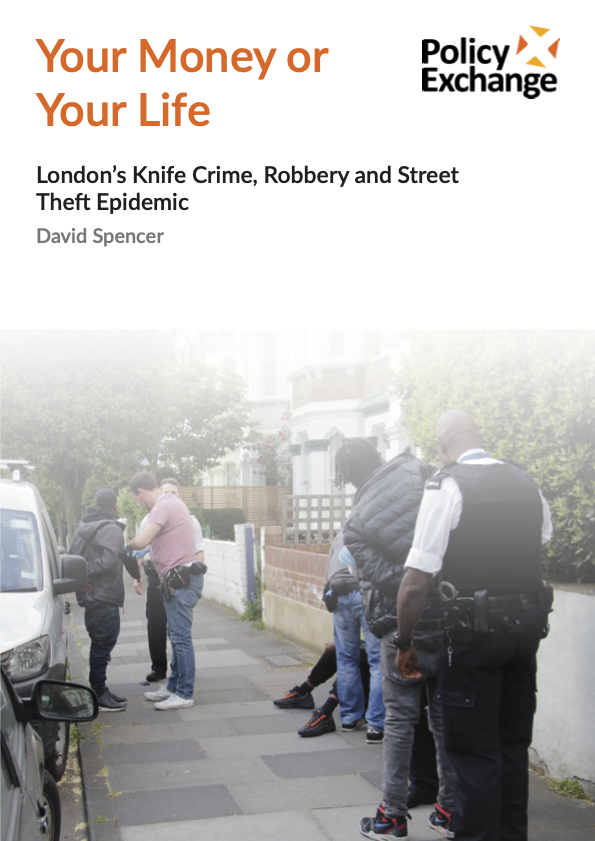
Your Money or Your Life London’s Knife Crime, Robbery and Street Theft Epidemic

By David Spencer

London is in the grip of a crime wave of robbery, knife crime and theft. Police chiefs have prioritised other issues while allowing the streets to be surrendered to criminals and thugs. Political leaders have sacrificed effective policing to ideological preferences. Bodies such as the Independent Office for Police Conduct have shown themselves only too willing to criticise and pursue police officers doing their best to enforce the law. Given this confluence it should be no surprise that knife crime, robbery and “theft person” offences have rocketed in recent years. This report examines what has gone wrong – and importantly, what the police and government must do now to stem the tide. Chapter 1 examines the rates of knife crime, robbery and theft person offences both nationally and in London. We show that knife crime in England and Wales has risen sharply over the past decade, increasing by 78% since 2013/14, with 50,510 offences recorded in 2023/24. Even accounting for population growth, this represents a 68.3% rise over the last decade. London accounts for a disproportionate share of knife crime offences, representing 32.1% of all knife crime and 45.9% of knife-point robberies in England, compared to only 15.5% of the population. Within the capital, knife crime is highly concentrated: 4% of neighbourhoods accounted for nearly a quarter of offences and 15% accounted for half of offences in 2024. One small geographic area – consisting of around 20 streets around Oxford Circus and Regent Street in the City of Westminster – recorded more knife crime offences than the 716 (or 14.35%) least-affected of London’s 4,988 LSOAs combined. Most knife crime in London involves robbery, with mobile phones the most common target. In 2024, 61.6% of knife crime offences were robberies. Combined robbery and theft person offences led to over 81,000 mobile phone thefts in the capital last year. There are clear insights which can guide the law enforcement and policy response. Within London: knife crime offending is highly geographically concentrated, a significant majority of knife crime offences are robberies, and mobile phones are one of the items most commonly targeted by robbers and thieves. Chapter 2 examines how effective, or otherwise, the Metropolitan Police is at catching robbers, knife crime offenders and thieves alongside the criminal courts approach to sentencing for those who are prosecuted and convicted. The proportion of criminals caught by the Metropolitan Police is pitiful – with only 1 in 20 robberies and 1 in 170 theft person offences solved in 2024. Even for those few who are caught the proportion of offenders being sentenced to immediate cusLondon is in the grip of a crimewave of robbery, knife crime and theft. Police chiefs have prioritised other issues while allowing the streets to be surrendered to criminals and thugs. Political leaders have sacrificed effective policing to ideological preferences. Bodies such as the Independent Office for Police Conduct have shown themselves only too willing to criticise and pursue police officers doing their best to enforce the law. Given this confluence it should be no surprise that knife crime, robbery and “theft person” offences have rocketed in recent years. This report examines what has gone wrong – and importantly, what the police and government must do now to stem the tide. Chapter 1 examines the rates of knife crime, robbery and theft person offences both nationally and in London. We show that knife crime in England and Wales has risen sharply over the past decade, increasing by 78% since 2013/14, with 50,510 offences recorded in 2023/24. Even accounting for population growth, this represents a 68.3% rise over the last decade. London accounts for a disproportionate share of knife crime offences, representing 32.1% of all knife crime and 45.9% of knife-point robberies in England, compared to only 15.5% of the population. Within the capital, knife crime is highly concentrated: 4% of neighbourhoods accounted for nearly a quarter of offences and 15% accounted for half of offences in 2024. One small geographic area – consisting of around 20 streets around Oxford Circus and Regent Street in the City of Westminster – recorded more knife crime offences than the 716 (or 14.35%) least-affected of London’s 4,988 LSOAs combined. Most knife crime in London involves robbery, with mobile phones the most common target. In 2024, 61.6% of knife crime offences were robberies. Combined robbery and theft person offences led to over 81,000 mobile phone thefts in the capital last year. There are clear insights which can guide the law enforcement and policy response. Within London: knife crime offending is highly geographically concentrated, a significant majority of knife crime offences are robberies, and mobile phones are one of the items most commonly targeted by robbers and thieves. Chapter 2 examines how effective, or otherwise, the Metropolitan Police is at catching robbers, knife crime offenders and thieves alongside the criminal courts approach to sentencing for those who are prosecuted and convicted. The proportion of criminals caught by the Metropolitan Police is pitiful – with only 1 in 20 robberies and 1 in 170 theft person offences solved in 2024. Even for those few who are caught the proportion of offenders being sentenced to immediate cusLondon is in the grip of a crimewave of robbery, knife crime and theft. Police chiefs have prioritised other issues while allowing the streets to be surrendered to criminals and thugs. Political leaders have sacrificed effective policing to ideological preferences. Bodies such as the Independent Office for Police Conduct have shown themselves only too willing to criticise and pursue police officers doing their best to enforce the law. Given this confluence it should be no surprise that knife crime, robbery and “theft person” offences have rocketed in recent years. This report examines what has gone wrong – and importantly, what the police and government must do now to stem the tide. Chapter 1 examines the rates of knife crime, robbery and theft person offences both nationally and in London. We show that knife crime in England and Wales has risen sharply over the past decade, increasing by 78% since 2013/14, with 50,510 offences recorded in 2023/24. Even accounting for population growth, this represents a 68.3% rise over the last decade. London accounts for a disproportionate share of knife crime offences, representing 32.1% of all knife crime and 45.9% of knife-point robberies in England, compared to only 15.5% of the population. Within the capital, knife crime is highly concentrated: 4% of neighbourhoods accounted for nearly a quarter of offences and 15% accounted for half of offences in 2024. One small geographic area – consisting of around 20 streets around Oxford Circus and Regent Street in the City of Westminster – recorded more knife crime offences than the 716 (or 14.35%) least-affected of London’s 4,988 LSOAs combined. Most knife crime in London involves robbery, with mobile phones the most common target. In 2024, 61.6% of knife crime offences were robberies. Combined robbery and theft person offences led to over 81,000 mobile phone thefts in the capital last year. There are clear insights which can guide the law enforcement and policy response. Within London: knife crime offending is highly geographically concentrated, a significant majority of knife crime offences are robberies, and mobile phones are one of the items most commonly targeted by robbers and thieves. Chapter 2 examines how effective, or otherwise, the Metropolitan Police is at catching robbers, knife crime offenders and thieves alongside the criminal courts approach to sentencing for those who are prosecuted and convicted. The proportion of criminals caught by the Metropolitan Police is pitiful – with only 1 in 20 robberies and 1 in 170 theft person offences solved in 2024. Even for those few who are caught the proportion of offenders being sentenced to immediate cusfalling – dropping from 66.1% in 2014 to 55.4% in 2024. For violencerelated offences, imprisonment rates have also decreased, with just 36.5% of offenders sentenced to custody in 2024. Despite laws mandating prison for repeat knife offenders, around a third evade immediate incarceration. It appears likely that these rates of incarceration will fall even further in the coming years given the Government’s apparent intention to send fewer offenders to prison following the Independent Sentencing Review led by Rt Hon David Gauke1 and the Independent Review of the Criminal Courts led by Rt Hon Sir Brian Leveson.2 The failure to adequately deal with the most prolific offenders presented before the courts is perhaps the gravest sign of the permissiveness with which the criminal justice system treats those most dedicated to committing crime. In the year to December 2024, of the 8,207 “hyperprolific” offenders who already had 46 or more previous criminal convictions or cautions, only 44.5% were sentenced to an immediate term of imprisonment on conviction for a further indictable or “eitherway” criminal offence – 4,555 hyper-prolific offenders were released on conviction without receiving an immediate term of imprisonment. Of the 16,386 “super-prolific” offenders with between 26 and 45 previous convictions or cautions, only 42.1% were sentenced to an immediate term of imprisonment on conviction for a further indictable or “eitherway” criminal offence – 9,483 super-prolific offenders were released on conviction without receiving an immediate term of imprisonment. It is difficult to conceive of a collection of statistics which better demonstrates the contempt with which the criminal justice system is treating the lawabiding majority. Chapter 3 examines the effectiveness of high-visibility policing in crime “hotspots” – citing evidence which demonstrates that the tactic is highly effectively at reduces crime. However, the use of a key element of proactive police patrolling – stop and search – has fallen significantly over the last decade, partly because of the policies of the Conservative-led coalition government (supported by the now Home Secretary Rt Hon Yvette Cooper MP). The reduction in stop and search coincided with substantial increases knife crime, suggesting the reforms introduced in all likelihood significantly undermined the fight against crime. We cite research by the criminologists Piquero and Sherman (2025) which demonstrates that increased stop and search correlates with reduced knife crime. Stop and search in London has been widely criticised for racial disproportionality, often framed as evidence of “racist” policing. Critics argue that black Londoners are unfairly targeted – claims we robustly challenge. Data shows that black people are “over-represented” among victims of the most serious knife crime – within London black people are 3.38 times more likely to be killed in a knife-enabled non-domestic homicide than white people. Similarly black people are 5.0 times more likely than white people in London to be charged with murder. While only 13.5% of London’s population are black, 48.6% of robbery suspects are described as black by victims when reporting the crime to the police. Incontrast to allegations of police “racism”, outcomes of stop and search in London reveal that black suspects are 64% more likely than white suspects to receive ‘community resolutions’ when a prohibited item is found when searching for a weapon (rather than be charged or summonsed and sent to court). This suggests there may well be a leniency being shown towards black suspects compared to white suspects. It is not the role of policing to correct for all of society’s ills – to quote the Chief Constable of Greater Manchester Police Sir Stephen Watson QPM: “It’s really important in policing that you play the ball that is bowled – you describe the problem, you faithfully attack the various ingredients of the problem and you do so without fear or favour in the public interest”.3 We agree and strongly reject the political ideology and timidity of police leaders which has led to the precipitous reductions in stop and search. As part of better serving the law-abiding majority there should be a surge in stop and search within those parts of London where knife crime, robbery and theft is most prevalent. Chapter 4 examines how offenders can be targeted – specifically through innovative Live Facial Recognition technology and innovations in court orders which limit the activities of known offenders. The Metropolitan Police’s deployment of Live Facial Recognition as a tool to identify wanted individuals, particularly within crime hotspots, has been remarkably successful. In 2023 the force undertook 24 deployments in the capital – in 2024 there were 179 deployments and by mid-June 2025 there had been 94 deployments. An Independent evaluation by the National Physical Laboratory confirmed that the technology can be deployed with a high degree of accuracy and – notably, an absence of significant demographic bias when properly configured. Despite demonstrable results – including 1,045 arrests since 2023 – several London councils have passed motions opposing its use. This includes Islington Council which at the time was led by Kaya Comer-Schwartz – who was subsequently appointed by the Mayor of London Sir Sadiq Khan as the Deputy Mayor for Policing and Crime. The chapter also reviews a series of legal tools, including Knife Crime Prevention Orders and Serious Violence Reduction Orders, which can be utilised to restrict repeat offenders’ behaviours but have seen limited or inconsistent application. We recommend that their application is made mandatory for certain violent and knife-carrying offenders. Londoners and visitors to the capital face a street crime epidemic – one which includes a very real risk of becoming a victim of seriousviolence, robbery or theft. The steps taken by the Metropolitan Police, Mayor of London and Government have so far been unequal to the task. The Metropolitan Police must take an unequivocal “Crime Fighting First” approach – in those locations where rates of knife crime, robbery and theft are highest that should mean a “Zero Tolerance” approach to crime and criminals. The Government and Mayor of London must demonstrate the necessary political leadership to explicitly reject the policies and ideologies which have led us to this point.The law-abiding majority of people do not accept the status quo, and neither do we at Policy Exchange – this report should act as a call to action for political leaders and police chiefs alike.