

By Diorella Islas
This thesis seeks to develop a better understanding of the transnational behaviour of drug trafficking organisations (DTOs) by documenting the role that Mexican DTOs had in the cocaine trafficking to Europe after 2008. This was the year when the Italian authorities announced their discoveries that there were business interaction between the Mexican DTOs and the Italian mafia groups. At the same time the Italian authorities were announcing their findings, my literature review showed a lack of analysis and documentation regarding the transnationalization of Mexican DTOs to Europe. While most of the literature focuses on the explanation of the cartels inside Mexico, my research question focused on clarifying whether or not the Mexican DTOs are expanding their cocaine trafficking activities to Europe. At this point I considered the reports of the Italian authorities that affirm that the Mexican DTOs are relevant drug trafficking intermediaries in the cocaine trafficking routes to Europe. To answer my research question, and to systematically describe the evolution of DTOs, a qualitative methods approach was deployed (Mohajan, 2018) with a case study design adapted from Yin (2003). My analysis was carried out through the use of multiple triangulation techniques that helped me to collect and study different types of data to understand the subject. I collected empirical information through 28 interviews with security personnel with experience in countering Mexican DTOs or in the cocaine routes to Europe. The information gathered from the security personnel, complemented by official reports and open source information, was useful to answer my research question and test my hypothesis. The analysis showed that despite Italian authorities’ claims and perceptions, the power of the Mexican cartels is very limited when talking about their presence and links in Europe, and resulted in four key findings. Firstly, that the perception of the Mexican DTOs as having trans-Atlantic powers is erroneous, because the evidence showed that there is no transatlantic expansion. Secondly, the analysis uncovered the internal, national and international variables that were observed to alter the evolution and behaviour of the Mexican DTOs. At the internal level, the variables included the loss of leadership and the grievances between groups. At the national level the identified variables were the democratic transitions, corruption and impunity networks. And at the international level the variables were the international drug demand, the changes in the international illicit world, the situation of governance and corruption in foreign countries and the geography of theregion where the illicit business are taking place. The third finding was that the transatlantic cocaine trafficking routes are not controlled by an specific actor, but they are horizontal structures that are highly adaptative. The final key finding refers to a methodological observation which I describe as the “paradox of referencing”; when many sources reference something that was true in the past –like the links between Mexican DTOs and Italian mafia discovered in 2008– they help to perpetuate the present perception of a past phenomenon.
By Roland Neil, Bonnie Ghosh-Dastidar, Beau Kilmer, Michael W. Robbins, Kristin Warren
Objectives
Racial disparities in arrests are a major concern, particularly when it comes to drug enforcement. In 2021, Oregon decriminalized the possession of controlled substances as part of Measure 110 (M-110), an unprecedented policy change in the United States. We estimate how M-110 affected five types of arrests, overall and by race.
Methods
National Incident-Based Reporting System data covering 3,642 police agencies from 43 states for 2018-2023 are combined with 2020 Census data. We extend a synthetic control methodology developed for micro-level data to test whether policy effects differ across groups and whether policies affect disparities, using permutation inference to quantify uncertainty.
Results
M-110 reduced drug possession arrest rates in Oregon for the overall population (67.8%) and for the three racial groups we focus on: Black (75.6%), Hispanic (77.5%); and White (66.2%), with the reduction being statistically significantly larger for Hispanic and Black than White individuals. M-110 reduced disorder arrest rates by 30.9% for Black individuals, which is statistically significantly different from zero and the White estimate. Black-White rate differences in drug possession arrests fell by 79.5% and in disorder arrests by 41.7%. In general, M-110 did not affect arrest rates for violent, property, or drug trafficking offenses.
Conclusions
M-110 reduced drug possession arrests while reducing Black-White rate differences. M-110 led to a decrease in disorder arrests for Black individuals, suggesting police did not substitute one arrest type for another for this population. Our method offers a new approach for examining heterogeneous policy effects and how policies affect disparities.
By Kees Koonings, Dirk Kruijt
Show moreSince the turn of the century more people in Latin America have been killed or otherwise afflicted by violence and insecurity than during the times of dictatorship, repressive regimes, guerrilla uprisings, and armed conflict (1960s–1990s). Latin America has turned into what is on average the most lethal region in the world in terms of homicide rates. The 2013 Regional Human Development Report (UNDP 2013, v) mentions that “in the last decade, more than one million people have died in Latin America and the Caribbean as a result of criminal violence”. In 2012, Latin America’s citizens represented only 8 percent of the world’s population; however, they produced around 37 percent of the world’s homicides in that year (Chioda, 2017, 1). Since then, regional statistics have not really improved.1 Formally at peace and formally democratic, one of the most salient aspects of this violence is that it is not explicitly directed at acquiring or defending state power. Rather, it is labelled ‘criminal’ or ‘social’ and includes not only everyday forms of direct violence and coercion but also institutional and symbolic forms of violence. These dimensions, in turn, rest upon a long history of social inequality, exclusion, and elite privileges that are often enveloped as structural violence. Except for drug-related violence corridors in Colombia, Central America and Mexico, Latin American violence is largely urban (Koonings & Kruijt, 2015). According to the Mexican NGO Seguridad, Justicia y Paz (2020), of the 10 most lethal cities of 300,000 inhabitants or more in the world in 2020, seven are Mexican. Of the 50 most lethal cities, 40 are Latin American or Caribbean: 17 are Mexican, 11 Brazilian, six Venezuelan, two Honduran, two Colombian, one Jamaican, and one Puerto Rican. Of the remaining cities, five are American and five SouthAfrican.2 What is behind these dismal statistics? After the disappearance of the dictatorships and the re-democratisation process in the course of the 1980s new and violent non-state actors emerged, not aiming at revolutionary political transformations like the former guerrilla groups but aspiring to become a ‘regular’ element with prestige and negotiating power in the economy and society. They operate in criminal, violent, clandestine or at least extra-legal ambiences. But they are not hidden or invisible. They vigorously put forth their claims to local, municipal, regional, and national involvement. They control larger or smaller territories or commercial corridors for smuggling, levy taxes on ‘their’ people, provide ‘protection’ by eliminating ‘adversaries’ (legal or illegal competitors) and try to establish an economy of uninterrupted profits and a society of continued legal impunity, replacing official rule of law by criminal justice and extra-legal order making. So, despite the apparent non-political nature of this system of violence, it does have farreaching repercussions for social life as well as for politics, governance, the law, and the state. In this contribution we seek to examine the implications of contemporary violence in Latin America for order making and governance. The article is developed as follows. As a starting point we combine two concepts, namely protracted hybrid conflict and criminal governance, to frame the paradox of violence in Latin America. This paradox rests on the proposition that chronic violence coincides with formally democratic states that are, in a conventional sense, not at war. We will then look briefly at the historical context of violence, state and hybrid order making in Latin America. Subsequently we will explore three specific and intersecting mechanisms of criminal governance in Latin America: state capture, layered micro-sovereignty, and statetransgression.
By U.S. Congressional Research Service
For over a decade, the synthetic opioid fentanyl and fentanyl-related substances have been key drivers of the U.S. opioid crisis. Countering the illicit trafficking of fentanyl and the precursor chemicals ("precursors") used to make it has been a U.S. priority. In 2015, the Drug Enforcement Administration (DEA) first identified the People's Republic of China (PRC, or China) as the main source of U.S.-bound fentanyl and fentanyl precursors. Since the PRC imposed domestic controls on fentanyl-related substances in 2019, which curtailed almost all direct shipments of fentanyl from China to the United States, many U.S. policymakers have shifted focus. Their chief concern today is the role of China—the global leader in chemical sales—as the primary source of precursors used by transnational criminal organizations (TCOs) to synthesize fentanyl and its analogues in third countries (chiefly Mexico). Congress has sought to address China's shifting role in the illicit drug trade, including through provisions in the BUST Fentanyl Act in the National Defense Authorization Act for FY2026.
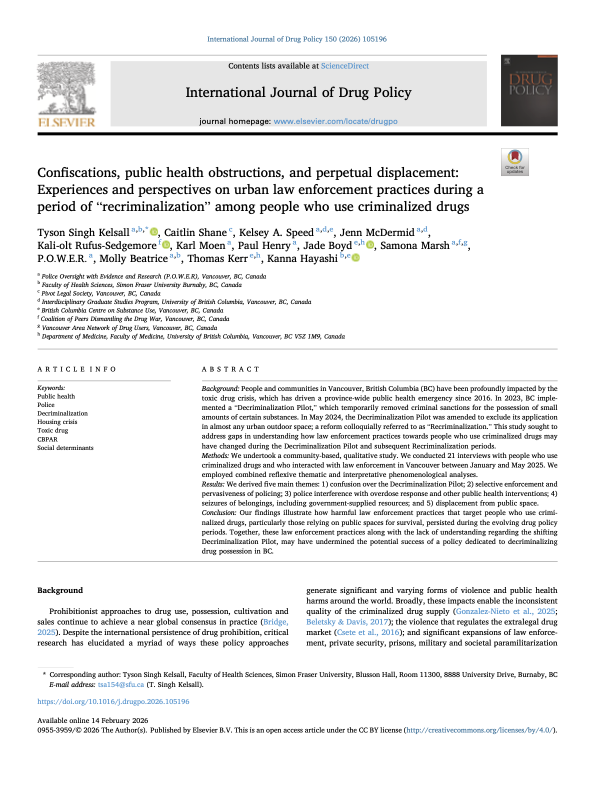
By: Tyson Singh Kelsall, Caitlin Shane, Kelsey A. Speed, et al.
People and communities in Vancouver, British Columbia (BC) have been profoundly impacted by the toxic drug crisis, which has driven a province-wide public health emergency since 2016. In 2023, BC implemented a “Decriminalization Pilot,” which temporarily removed criminal sanctions for the possession of small amounts of certain substances. In May 2024, the Decriminalization Pilot was amended to exclude its application in almost any urban outdoor space; a reform colloquially referred to as “Recriminalization.” This study sought to address gaps in understanding how law enforcement practices towards people who use criminalized drugs may have changed during the Decriminalization Pilot and subsequent Recriminalization periods.
Methods
We undertook a community-based, qualitative study. We conducted 21 interviews with people who use criminalized drugs and who interacted with law enforcement in Vancouver between January and May 2025. We employed combined reflexive thematic and interpretative phenomenological analyses.
Results
We derived five main themes: 1) confusion over the Decriminalization Pilot; 2) selective enforcement and pervasiveness of policing; 3) police interference with overdose response and other public health interventions; 4) seizures of belongings, including government-supplied resources; and 5) displacement from public space.
Conclusion
Our findings illustrate how harmful law enforcement practices that target people who use criminalized drugs, particularly those relying on public spaces for survival, persisted during the evolving drug policy periods. Together, these law enforcement practices along with the lack of understanding regarding the shifting Decriminalization Pilot, may have undermined the potential success of a policy dedicated to decriminalizing drug possession in BC
By the U.K. Ministry of Justice and Department of Health & Social Care
1 In April 2025, approximately 40,000 people in prisons in England and Wales (50%) had an identified drug problem. Misuse of illicit drugs by people in prison creates or exacerbates risks to their health, well-being and personal safety. Between December 2022 and December 2024, the Prisons and Probation Ombudsman investigated 833 deaths, of which 136 (16%) were drug-related. Conveyance, supply and use of illicit drugs also increase risks to the safety and stability of the prison regime. Availability of drugs inside prisons creates an illicit economy that can fuel debt, which can lead to assault, extortion or self-harm. Prisoners who are using illicit drugs often reoffend after leaving prison. 2 Effective interventions require HM Prison and Probation Service (HMPPS) and health service providers, commissioned for prisons in England by NHS England (NHSE), to work closely together. • HMPPS is primarily responsible for action to detect illicit drugs and prevent their conveyance into prisons, and it also seeks to reduce demand for drugs through initiatives to encourage positive behaviour changes. • Health service providers deliver drug treatment and recovery services inside prisons. • The overall prison environment can support prisoners by providing a rehabilitative culture; education and other purposeful activities; building relationships; delivering a safe regime; and facilitating access to health interventions, including addressing mental health needs. Focus of our report 3 This report focuses on how the prison and health services are using public funds to tackle drug harms in prisons. It examines: • how well the Ministry of Justice (MoJ), HMPPS, Department of Health & Social Care (DHSC), NHSE and wider government understand the scale and nature of drug harms in prisons (Part One); • the funding available for HMPPS and NHSE to tackle drug harms in prisons, and how resources are prioritised (Part Two); and • how effectively resources have been used and how well the prison and health services work together (Part Three).4 The report focuses only on illicit drug harms in prisons. We do not cover national and international work by the police and others to counter criminal activity supplying drugs to prisons, nor do we review interventions for people on community orders or the continuity of drug treatment services for prison leavers. ‘Substance misuse’ is a broader term often used in healthcare, which includes misuse of alcohol and diversion of prescription medicines, as well as illicit drugs. We touch on these broader issues where relevant, but they are not the focus of our report. While HMPPS is responsible for prisons in England and Wales, healthcare in Wales is a devolved function provided by NHS Wales, and therefore falls outside the scope of this report
By The United States Government Accountability Office
Agencies at the federal, state, and local levels have facilities capable of analyzing emerging street drugs—psychoactive substances newly circulating in the drug market. For example, the Drug Enforcement Administration and U.S. Customs and Border Protection have forensic laboratories that can analyze seized drugs and identify emerging substances. Current laboratory-based technologies can detect and identify emerging street drugs when appropriate methods (protocols) and reference standards are available. Portable technologies can detect drugs at the point of seizure but face accuracy challenges due, in part, to user error. Technology manufacturers told GAO they are developing more lay-friendly user interfaces and operational methods.
From fiscal year 2019 through 2024, the Departments of Justice and Health and Human Services awarded a combined total of about $12.5 million in grants for the development of new methods and technologies for analyzing emerging street drugs. New methods and technologies may make laboratory processes more consistent, among other enhancements. Method development can be done on faster timelines than technology development.
While new methods and technologies could enhance some capabilities, forensic scientists face key challenges with analyzing emerging street drugs, including:
Lack of resources. Laboratories GAO spoke to consistently referenced insufficient staffing and time.
Unstandardized reporting. According to stakeholders, varying reporting requirements at thestate and local levels can lead to gaps in data.
Limited information sharing. Law enforcement may not always share up-to-date information about emerging drugs with medical examiners and hospitals.
If these challenges could be addressed, laboratories could be in a better position to meet the nation’s needs for emerging drug analysis. However, GAO is not making recommendations to address these challenges because they are primarily faced by state and local laboratories.
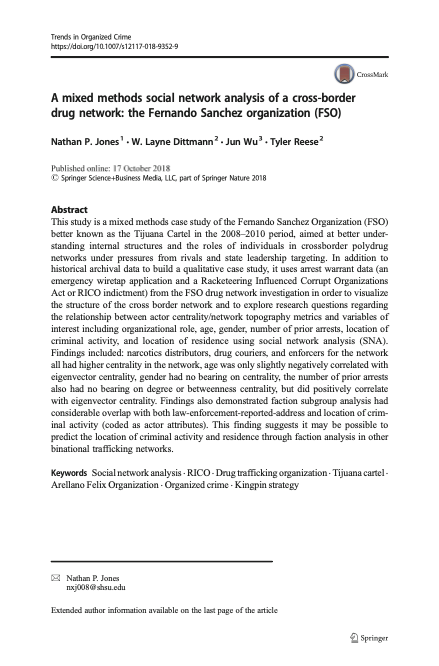
By: Nathan P. Jones1 & W. Layne Dittmann2 & Jun Wu3 & Tyler Reese2
This study is a mixed methods case study of the Fernando Sanchez Organization (FSO) better known as the Tijuana Cartel in the 2008–2010 period, aimed at better understanding internal structures and the roles of individuals in crossborder polydrug networks under pressures from rivals and state leadership targeting. In addition to historical archival data to build a qualitative case study, it uses arrest warrant data (an emergency wiretap application and a Racketeering Influenced Corrupt Organizations Act or RICO indictment) from the FSO drug network investigation in order to visualize the structure of the cross border network and to explore research questions regarding the relationship between actor centrality/network topography metrics and variables of interest including organizational role, age, gender, number of prior arrests, location of criminal activity, and location of residence using social network analysis (SNA). Findings included: narcotics distributors, drug couriers, and enforcers for the network all had higher centrality in the network, age was only slightly negatively correlated with eigenvector centrality, gender had no bearing on centrality, the number of prior arrests also had no bearing on degree or betweenness centrality, but did positively correlate with eigenvector centrality. Findings also demonstrated faction subgroup analysis had considerable overlap with both law-enforcement-reported-address and location of criminal activity (coded as actor attributes). This finding suggests it may be possible to predict the location of criminal activity and residence through faction analysis in other binational trafficking networks.
By The International Drug Policy Consortium
The 2016 UN General Assembly Special Session (UNGASS) on drugs was a watershed moment in global drug policy. It created a rare opportunity to reconsider the prevailing international paradigm on drugs and to chart a new direction.
The UNGASS process was notable for the unprecedented involvement of civil society, affected communities, UN entities and human rights experts. It helped place public health, human rights and communities closer to the centre of drug policy-making, and paved the way for better alignment between the UN drug control regime and the wider UN system. The process also generated valuable momentum for new debates and advocacy at the national level.
However, the UNGASS ultimately fell short of introducing genuine reform of the norms and institutions underpinning the international drug control system.
This report examines progress made since the 2016 UNGASS to assess the role of the global drug control regime in shaping change. It draws on UN data and reporting, academic research, contributions from civil society and community organisations, and a dedicated civil society survey conducted among IDPC members and partners.
Key conclusions
The report concludes with four forward-looking findings:
Civil society and community organisations play a critical role in drug policy, yet continue to be sidelined, underfunded, and increasingly exposed to threats and attacks.
The UN drug control treaties require urgent modernisation in order to respond to new realities and remain fit for purpose.
A drug control system oriented towards human rights, health and development requires a thorough reconfiguration of the existing architecture, including strong and systematic inter-agency cooperation across the UN system.
Regular discussion of drug policy at the UN is essential, but the agenda and working methods of the Commission on Narcotic Drugs (CND) must change to enable meaningful progress.
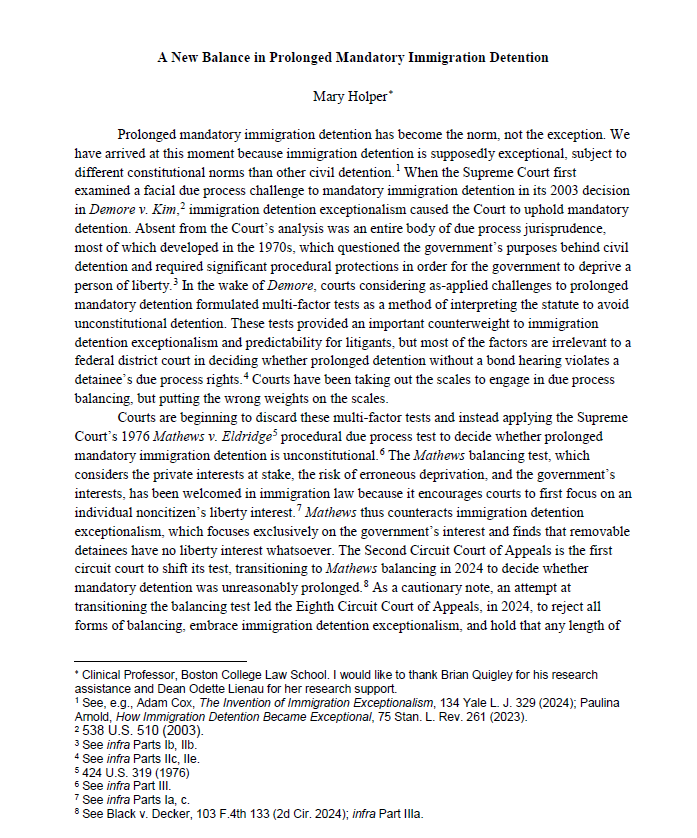
By Mary Holper
Prolonged mandatory immigration detention has become the norm, not the exception. We have arrived at this moment because immigration detention is supposedly exceptional, subject to different constitutional norms than other civil detention. When the Supreme Court first examined a facial due process challenge to mandatory immigration detention in its 2003 decision in Demore v. Kim, immigration detention exceptionalism caused the Court to uphold mandatory detention. Absent from the Court's analysis was an entire body of due process jurisprudence, most of which developed in the 1970s, which questioned the government's purposes behind civil detention and required significant procedural protections in order for the government to deprive a person of liberty. In the wake of Demore, courts considering as-applied challenges to prolonged mandatory detention formulated multi-factor tests as a method of interpreting the statute to avoid unconstitutional detention. These tests provided an important counterweight to immigration detention exceptionalism and predictability for litigants, but most of the factors are irrelevant to a federal district court in deciding whether prolonged detention without a bond hearing violates a detainee's due process rights. Courts have been taking out the scales to engage in due process balancing, but putting the wrong weights on the scales.
Courts are beginning to discard these multi-factor tests and instead applying the Supreme Court's 1976 Mathews v. Eldridge procedural due process test to decide whether prolonged mandatory immigration detention is unconstitutional. The Mathews balancing test, which considers the private interests at stake, the risk of erroneous deprivation, and the government's interests, has been welcomed in immigration law because it encourages courts to first focus on an individual noncitizen's liberty interest. Mathews thus counteracts immigration detention exceptionalism, which focuses exclusively on the government's interest and finds that removable detainees have no liberty interest whatsoever. The Second Circuit Court of Appeals is the first circuit court to shift its test, transitioning to Mathews balancing in 2024 to decide whether mandatory detention was unreasonably prolonged. As a cautionary note, an attempt at transitioning the balancing test led the Eighth Circuit Court of Appeals, in 2024, to reject all forms of balancing, embrace immigration detention exceptionalism, and hold that any length of mandatory detention is acceptable during removal proceedings. This Article argues that courts can make prolonged mandatory immigration detention exceptional by continuing the work of the Second Circuit in applying the Mathews procedural due process balancing test instead of the existing multi-factor tests.
Boston College Law School Legal Studies Research Paper No. 662
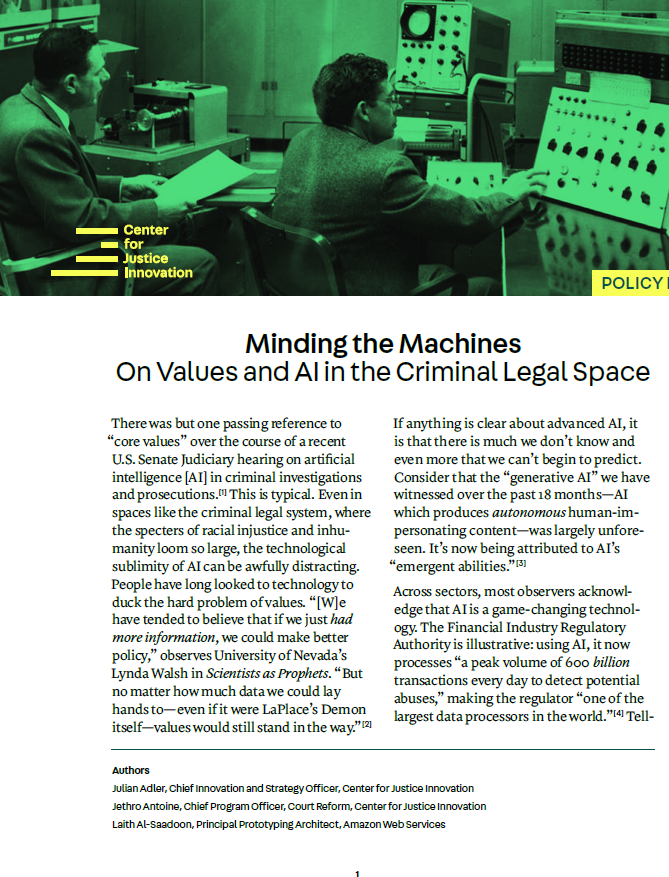
By Julian Adler, Jethro Antoine, Laith Al-Saadoon
There was but one passing reference to “core values” over the course of a recent U.S. Senate Judiciary hearing on artificial intelligence [AI] in criminal investigations and prosecutions.[1] This is typical. Even in spaces like the criminal legal system, where the specters of racial injustice and inhumanity loom so large, the technological sublimity of AI can be awfully distracting. People have long looked to technology to duck the hard problem of values. “[W]e have tended to believe that if we just had more information, we could make better policy,” observes University of Nevada’s Lynda Walsh in Scientists as Prophets. “But no matter how much data we could lay hands to—even if it were LaPlace’s Demon itself—values would still stand in the way.”[2] If anything is clear about advanced AI, it is that there is much we don’t know and even more that we can’t begin to predict. Consider that the “generative AI” we have witnessed over the past 18 months—AI which produces autonomous human-impersonating content—was largely unforeseen. It’s now being attributed to AI’s “emergent abilities.”
Nwq York: Center for Justice Innovation, 2024. 8p.
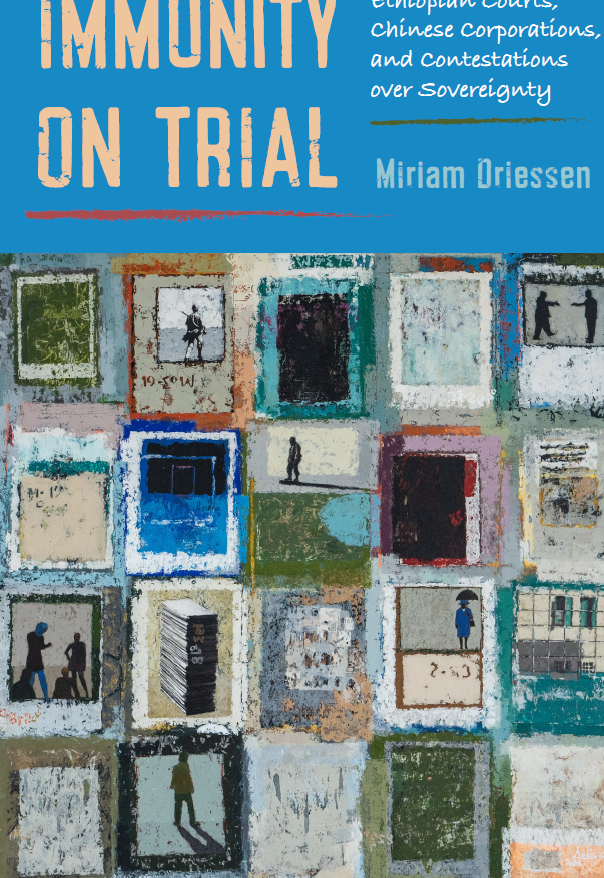
By Miriam Driessen
Political and legal immunity are justified by the principle that certain social aims outweigh the value of imposing liability. To be exempt from the rules, however, is a privilege granted to or demanded by the powerful. The structural disparities that underpin immunity can turn it into an unjust prerogative, one that is inscribed by global inequalities. Set against the backdrop of an extraordinary wave of litigation against Chinese corporations in Ethiopia, Immunity on Trial probes the question of immunity in everyday encounters steeped in highly asymmetrical power relations. Drawing on observations from the courthouse, interviews with litigants, judges, and court support staff, and analyses of case files, Miriam Driessen demonstrates how immunity is debated and delegitimized—or affirmed—by those who fight, exact, grant, or weigh it. From the construction site to the police station, from the registrar’s office into the courtroom, she documents tussles over immunity, unraveling the politics of dignity on which they are founded.
Oakland: : University of California Press, 2026.
By David Abrams and Priyanka Goonetilleke
Like most locally governed activities, police stops are evaluated, if at all, using data from a single municipality. This paper aggregates data on over 8 million pedestrian and vehicle police stops from 16 U.S. cities between 2019 and 2023 to better understand how the widely used police tactic varies by place, time, and race. We find immense variation in the implementation of these policies across cities, something that has not been previously highlighted in the literature. Stop rates vary across cities by almost two orders of magnitude, well in excess of inputs like funding and size of police force vary far less, or outcomes like different measures of crime. Contraband discovery rates (hit rates) for pedestrian stops are consistently low, with gun hit rates never exceeding 10% of frisks in any city. Consistent with optimizing models of policing, hit rates rise over time as frisk rates fall substantially. However, this result is concentrated in gun contraband, and for other types - mostly drugs - hit rates do not vary much even with vast declines in frisks, suggesting police are not optimizing for other types of contraband. This supports the notion that frisks are consistent with the law, which requires they be based on suspicion that an individual is armed and dangerous. Consistent with prior work, there are substantial racial disparities in all examined cities, with Blacks frisked as much as 10 times more frequently than Whites in some locations. Taken together, these facts point to a standard practice that seemingly has no standards, given the massive variation across the country. This suggests there are potentially large gains in efficiency and fairness from sharing best practices and nationwide data collection on police stops.
U of Penn, Inst for Law & Econ Research Paper No. 26-01,
By Kate Weisburd
Scholars and advocates have long argued that a person's consent to a warrantless police search is often so inherently coerced, uninformed, and shaped by race, class, gender, citizenship status, and disability that to call it a "choice" is fiction. This critique is not limited to police searches based on consent. Waiving rights and consenting to otherwise unconstitutional state action permeates criminal procedure. The definition of a seizure, the third-party doctrine, custodial confessions, plea bargains, and agreements to alternatives to incarceration (such as GPS ankle monitoring) all hinge on the idea of voluntary choices-choices that are often just as coerced and uninformed as the choice to consent to a search.Given these concerns, this Article asks: What would happen if consent were eliminated from criminal procedure doctrines? This question is not merely academic. In recent years, a number of jurisdictions have substantially limited or eliminated traditional police searches based on consent. These reform efforts allow us to consider if there is something uniquely coercive or inequitable about consent searches that makes them especially amenable to reform or if we should consider eliminating consent in other criminal procedure doctrines as well.This Article takes on these questions. Drawing on both an original national survey of recent consent-search reforms and a transsubstantive analysis of consent and waiver in a range of criminal procedure doctrines, this Article analyzes the potential ramifications of eliminating (or limiting) consent. In doing so, this Article reveals the extent to which consent plays a pivotal role in upholding—and justifying—the entire operation of the criminal justice system.
.California Law Review (2025), UC Law San Francisco Research Paper Forthcoming,
By Bernard Harcourt
Fifty years after its publication, Discipline and Punish (1975) remains as controversial as ever. Anyone writing about the prison today, in no matter what discipline, feels obliged to position themselves vis-à-vis Michel Foucault’s book. As a result, new studies and books regularly criticize Discipline and Punish, most often for misleading the reader about the history of the prison. As Adam Gopnik recently writes in the New Yorker, scholars are “turning decisively against Foucault,” contending “that incarceration may be a facet of every hierarchical, complex society. In other words, it’s always been with us.”However, Discipline and Punish was never intended to be a history of the prison. It was instead a genealogy of a particular mode of governing in modern times—what Foucault called “disciplinary power” or “panopticism.” And rather than trace the history of the prison, the book proposed a contemporary way to understand how power circulates in society and it paved the way for the study of contemporary modes of governing. Drawing on a wealth of new Foucault archives, public lectures, manuscripts, and historical documents that have surfaced over the past 50 years, it is possible now to identify the true import of Foucault’s book. Just as the Leviathan of Thomas Hobbes captured the turn in modern political philosophy to theories of sovereignty and representation, Discipline and Punish marked the end of modern political theory and launched a new approach to analyze relations of power in society. In this essay, I redefine the central contribution of Discipline and Punish and explore how to use Foucault’s book today—and also, how to go beyond it.
Columbia Public Law Research Paper No. 6044574,
By James Lewis, Sarah Marsden, James Hewitt, Chloe Squires, Anna Stefaniak
Reliability and Validity of Risk Assessment Tools for Violent Extremism: A Systematic Review
By Sébastien Brouillette-Alarie, Ghayda Hassan, Wynnpaul Varela, Emmanuel Danis, Sarah Ousman, Pablo Madriaza, Inga Lisa Pauls, Deniz Kilinc, David Pickup, Robert Pelzer, Eugene Borokhovski, the CPN-PREV team
Assessment of the risk of engaging in a violent radicalization/extremism trajectory has evolved quickly in the last 10 years. Guided by what has been achieved in psychology and criminology, scholars from the field of preventing violent extremism (PVE) have tried to import key lessons from violence risk assessment and management, while bearing in mind the idiosyncrasies of their particular field. However, risk tools that have been developed in the PVE space are relatively recent, and questions remain as to their level of psychometric validation. Namely, do these tools consistently and accurately assess risk of violent extremist acting out? To answer this question, we systematically reviewed evidence on the reliability and validity of violent extremism risk tools. The main objective of this review was to gather, critically appraise, and synthesize evidence regarding the appropriateness and utility of such tools, as validated with specific populations and contexts. Searches covered studies published up to December 31, 2021. They were performed in English and German across 17 databases, 45 repositories, Google, other literature reviews on violent extremism risk assessment, and references of included studies. Studies in all languages were eligible for inclusion in the review. We included studies with primary data resulting from the quantitative examination of the reliability and validity of tools used to assess the risk of violent extremism. Only tools usable by practitioners and intended to assess an individual's risk were eligible. We did not impose any restrictions on study design, type, method, or population. We followed standard methodological procedures outlined by the Campbell Collaboration for data extraction and analysis. Risk of bias was assessed using a modified version of the COSMIN checklist, and data were synthesized through meta-analysis when possible. Otherwise, narrative synthesis was used to aggregate the results. Among the 10,859 records found, 19 manuscripts comprising 20 eligible studies were included in the review. These studies focused on the Terrorist Radicalization Assessment Protocol (TRAP-18), the Extremism Risk Guidance Factors (ERG22+), the Multi-Level Guidelines (MLG-V2), the Identifying Vulnerable People guidance (IVP guidance), and the Violent Extremism Risk Assessment (VERA)—all structured professional judgment tools—as well as Der Screener—Islamismus, an actuarial scale. Studies mostly involved adult male participants susceptible to violent extremism (N = 1106; M = 58.21; SD = 55.14). The types of extremist ideologies endorsed by participants varied, and the same was true for ethnicity and country/continent of provenance. Encouraging results were found concerning the inter-rater agreement of scales in research contexts (kappas between 0.76 and 0.93), but one of the two studies that examined it in a field setting obtained disappointing results (kappas ranging between of 0.47 and 0.80). Content validity studies indicated that PVE risk tools adequately cover the risk factors and offending processes of individuals who go on to commit extremist violence. Construct validity analyses were few and far between, with results indicating that empirical divisions of scales did not match their conceptual divisions. The internal consistency of subscales was lackluster (Cronbach's alphas between 0.19 and 0.85), whereas full scales demonstrated acceptable internal consistency when assessed (0.80 for the ERG22+ and 0.64 for the IVP guidance). Only one study examined convergent validity, and it revealed a lack of convergence, primarily due to particularities of the scale under study (the MLG-V2). Discriminant validity analyses were exploratory in nature, but suggested that PVE risk tools might not be ideology-specific and may apply to both group and lone actors. Finally, although the TRAP-18 showed a relatively strong postdictive effect size (pooled r = 0.62 [0.35–0.77], p = 0.000), the results were highly heterogeneous (I2 = 86%), and all studies used retrospective designs, meaning the outcome was already known at the time of assessment. As such, no included study evaluated true predictive validity (i.e., the ability to forecast future violent extremist outcomes based on prospective risk assessment). This represents a significant evidence gap. Threats to validity were substantial: (a) Many studies were case studies or had very small samples, (b) nearly all samples were constituted through the triangulation of publicly available data, and (c) convenience outcome measures were often used. Although having imperfect data is better than having no data, the current state of empirical validation precludes the recommendation of one tool over another for specific populations and contexts, and calls for higher-quality validation studies for PVE risk assessment tools. Nevertheless, these tools constitute useful checklists of relevant risk and protective factors that could be taken into account by evaluators who wish to assess the risk of violent extremism and identify intervention targets.
Campbell Systematic Reviews, Volume21, Issue4
December 2025, 2025.
By Michelle Kondo , Michelle Degli Esposti , Jonathan Jay etc.
Neighbourhood environments are a known social determinant of health. Vacant and abandoned buildings and lots and poor or hazardous housing conditions, combined with crime and violence, can affect residents’ health and wellbeing. Nationwide Children’s Hospital and its partners launched the Healthy Homes initiative in 2008, which sought to improve nearby residents’ health and wellbeing by rejuvenating vacant and abandoned properties and increasing homeownership in the South Side neighbourhood of Columbus, Ohio. Between 2008 and mid-2019 the initiative funded 273 repairs or renovations in this neighbourhood. We conducted a ZIP-code-level comparative case study of the Healthy Homes housing interventions using synthetic control methodology to evaluate changes in crime rate in the intervention area compared with those in a synthetic control area. While findings were mixed, we found some evidence of reduced thefts in the Healthy Homes area, relative to its synthetic control. This initiative to repair, rebuild and increase ownership of housing has the potential to reduce crime rates for neighbours of the Nationwide Children’s Hospital.
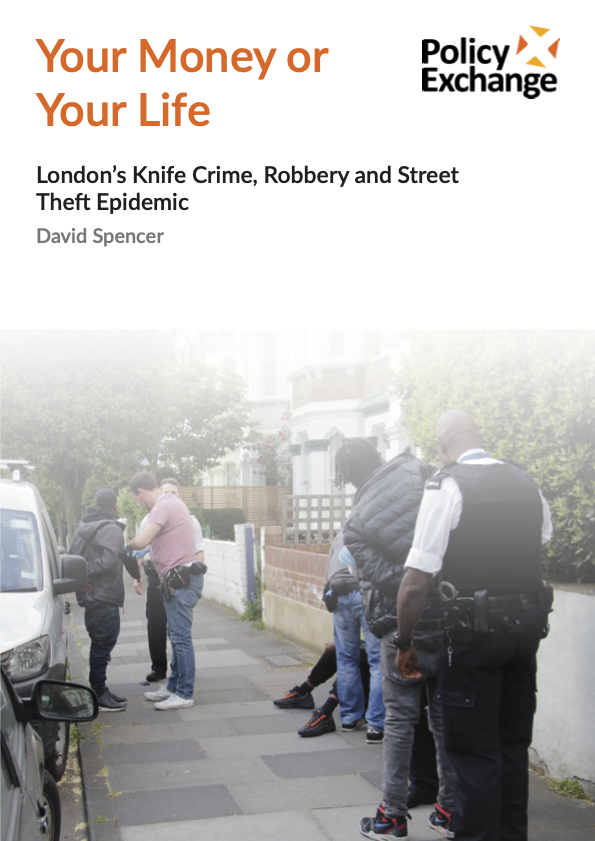
By David Spencer
London is in the grip of a crime wave of robbery, knife crime and theft. Police chiefs have prioritised other issues while allowing the streets to be surrendered to criminals and thugs. Political leaders have sacrificed effective policing to ideological preferences. Bodies such as the Independent Office for Police Conduct have shown themselves only too willing to criticise and pursue police officers doing their best to enforce the law. Given this confluence it should be no surprise that knife crime, robbery and “theft person” offences have rocketed in recent years. This report examines what has gone wrong – and importantly, what the police and government must do now to stem the tide. Chapter 1 examines the rates of knife crime, robbery and theft person offences both nationally and in London. We show that knife crime in England and Wales has risen sharply over the past decade, increasing by 78% since 2013/14, with 50,510 offences recorded in 2023/24. Even accounting for population growth, this represents a 68.3% rise over the last decade. London accounts for a disproportionate share of knife crime offences, representing 32.1% of all knife crime and 45.9% of knife-point robberies in England, compared to only 15.5% of the population. Within the capital, knife crime is highly concentrated: 4% of neighbourhoods accounted for nearly a quarter of offences and 15% accounted for half of offences in 2024. One small geographic area – consisting of around 20 streets around Oxford Circus and Regent Street in the City of Westminster – recorded more knife crime offences than the 716 (or 14.35%) least-affected of London’s 4,988 LSOAs combined. Most knife crime in London involves robbery, with mobile phones the most common target. In 2024, 61.6% of knife crime offences were robberies. Combined robbery and theft person offences led to over 81,000 mobile phone thefts in the capital last year. There are clear insights which can guide the law enforcement and policy response. Within London: knife crime offending is highly geographically concentrated, a significant majority of knife crime offences are robberies, and mobile phones are one of the items most commonly targeted by robbers and thieves. Chapter 2 examines how effective, or otherwise, the Metropolitan Police is at catching robbers, knife crime offenders and thieves alongside the criminal courts approach to sentencing for those who are prosecuted and convicted. The proportion of criminals caught by the Metropolitan Police is pitiful – with only 1 in 20 robberies and 1 in 170 theft person offences solved in 2024. Even for those few who are caught the proportion of offenders being sentenced to immediate cusLondon is in the grip of a crimewave of robbery, knife crime and theft. Police chiefs have prioritised other issues while allowing the streets to be surrendered to criminals and thugs. Political leaders have sacrificed effective policing to ideological preferences. Bodies such as the Independent Office for Police Conduct have shown themselves only too willing to criticise and pursue police officers doing their best to enforce the law. Given this confluence it should be no surprise that knife crime, robbery and “theft person” offences have rocketed in recent years. This report examines what has gone wrong – and importantly, what the police and government must do now to stem the tide. Chapter 1 examines the rates of knife crime, robbery and theft person offences both nationally and in London. We show that knife crime in England and Wales has risen sharply over the past decade, increasing by 78% since 2013/14, with 50,510 offences recorded in 2023/24. Even accounting for population growth, this represents a 68.3% rise over the last decade. London accounts for a disproportionate share of knife crime offences, representing 32.1% of all knife crime and 45.9% of knife-point robberies in England, compared to only 15.5% of the population. Within the capital, knife crime is highly concentrated: 4% of neighbourhoods accounted for nearly a quarter of offences and 15% accounted for half of offences in 2024. One small geographic area – consisting of around 20 streets around Oxford Circus and Regent Street in the City of Westminster – recorded more knife crime offences than the 716 (or 14.35%) least-affected of London’s 4,988 LSOAs combined. Most knife crime in London involves robbery, with mobile phones the most common target. In 2024, 61.6% of knife crime offences were robberies. Combined robbery and theft person offences led to over 81,000 mobile phone thefts in the capital last year. There are clear insights which can guide the law enforcement and policy response. Within London: knife crime offending is highly geographically concentrated, a significant majority of knife crime offences are robberies, and mobile phones are one of the items most commonly targeted by robbers and thieves. Chapter 2 examines how effective, or otherwise, the Metropolitan Police is at catching robbers, knife crime offenders and thieves alongside the criminal courts approach to sentencing for those who are prosecuted and convicted. The proportion of criminals caught by the Metropolitan Police is pitiful – with only 1 in 20 robberies and 1 in 170 theft person offences solved in 2024. Even for those few who are caught the proportion of offenders being sentenced to immediate cusLondon is in the grip of a crimewave of robbery, knife crime and theft. Police chiefs have prioritised other issues while allowing the streets to be surrendered to criminals and thugs. Political leaders have sacrificed effective policing to ideological preferences. Bodies such as the Independent Office for Police Conduct have shown themselves only too willing to criticise and pursue police officers doing their best to enforce the law. Given this confluence it should be no surprise that knife crime, robbery and “theft person” offences have rocketed in recent years. This report examines what has gone wrong – and importantly, what the police and government must do now to stem the tide. Chapter 1 examines the rates of knife crime, robbery and theft person offences both nationally and in London. We show that knife crime in England and Wales has risen sharply over the past decade, increasing by 78% since 2013/14, with 50,510 offences recorded in 2023/24. Even accounting for population growth, this represents a 68.3% rise over the last decade. London accounts for a disproportionate share of knife crime offences, representing 32.1% of all knife crime and 45.9% of knife-point robberies in England, compared to only 15.5% of the population. Within the capital, knife crime is highly concentrated: 4% of neighbourhoods accounted for nearly a quarter of offences and 15% accounted for half of offences in 2024. One small geographic area – consisting of around 20 streets around Oxford Circus and Regent Street in the City of Westminster – recorded more knife crime offences than the 716 (or 14.35%) least-affected of London’s 4,988 LSOAs combined. Most knife crime in London involves robbery, with mobile phones the most common target. In 2024, 61.6% of knife crime offences were robberies. Combined robbery and theft person offences led to over 81,000 mobile phone thefts in the capital last year. There are clear insights which can guide the law enforcement and policy response. Within London: knife crime offending is highly geographically concentrated, a significant majority of knife crime offences are robberies, and mobile phones are one of the items most commonly targeted by robbers and thieves. Chapter 2 examines how effective, or otherwise, the Metropolitan Police is at catching robbers, knife crime offenders and thieves alongside the criminal courts approach to sentencing for those who are prosecuted and convicted. The proportion of criminals caught by the Metropolitan Police is pitiful – with only 1 in 20 robberies and 1 in 170 theft person offences solved in 2024. Even for those few who are caught the proportion of offenders being sentenced to immediate cusfalling – dropping from 66.1% in 2014 to 55.4% in 2024. For violencerelated offences, imprisonment rates have also decreased, with just 36.5% of offenders sentenced to custody in 2024. Despite laws mandating prison for repeat knife offenders, around a third evade immediate incarceration. It appears likely that these rates of incarceration will fall even further in the coming years given the Government’s apparent intention to send fewer offenders to prison following the Independent Sentencing Review led by Rt Hon David Gauke1 and the Independent Review of the Criminal Courts led by Rt Hon Sir Brian Leveson.2 The failure to adequately deal with the most prolific offenders presented before the courts is perhaps the gravest sign of the permissiveness with which the criminal justice system treats those most dedicated to committing crime. In the year to December 2024, of the 8,207 “hyperprolific” offenders who already had 46 or more previous criminal convictions or cautions, only 44.5% were sentenced to an immediate term of imprisonment on conviction for a further indictable or “eitherway” criminal offence – 4,555 hyper-prolific offenders were released on conviction without receiving an immediate term of imprisonment. Of the 16,386 “super-prolific” offenders with between 26 and 45 previous convictions or cautions, only 42.1% were sentenced to an immediate term of imprisonment on conviction for a further indictable or “eitherway” criminal offence – 9,483 super-prolific offenders were released on conviction without receiving an immediate term of imprisonment. It is difficult to conceive of a collection of statistics which better demonstrates the contempt with which the criminal justice system is treating the lawabiding majority. Chapter 3 examines the effectiveness of high-visibility policing in crime “hotspots” – citing evidence which demonstrates that the tactic is highly effectively at reduces crime. However, the use of a key element of proactive police patrolling – stop and search – has fallen significantly over the last decade, partly because of the policies of the Conservative-led coalition government (supported by the now Home Secretary Rt Hon Yvette Cooper MP). The reduction in stop and search coincided with substantial increases knife crime, suggesting the reforms introduced in all likelihood significantly undermined the fight against crime. We cite research by the criminologists Piquero and Sherman (2025) which demonstrates that increased stop and search correlates with reduced knife crime. Stop and search in London has been widely criticised for racial disproportionality, often framed as evidence of “racist” policing. Critics argue that black Londoners are unfairly targeted – claims we robustly challenge. Data shows that black people are “over-represented” among victims of the most serious knife crime – within London black people are 3.38 times more likely to be killed in a knife-enabled non-domestic homicide than white people. Similarly black people are 5.0 times more likely than white people in London to be charged with murder. While only 13.5% of London’s population are black, 48.6% of robbery suspects are described as black by victims when reporting the crime to the police. Incontrast to allegations of police “racism”, outcomes of stop and search in London reveal that black suspects are 64% more likely than white suspects to receive ‘community resolutions’ when a prohibited item is found when searching for a weapon (rather than be charged or summonsed and sent to court). This suggests there may well be a leniency being shown towards black suspects compared to white suspects. It is not the role of policing to correct for all of society’s ills – to quote the Chief Constable of Greater Manchester Police Sir Stephen Watson QPM: “It’s really important in policing that you play the ball that is bowled – you describe the problem, you faithfully attack the various ingredients of the problem and you do so without fear or favour in the public interest”.3 We agree and strongly reject the political ideology and timidity of police leaders which has led to the precipitous reductions in stop and search. As part of better serving the law-abiding majority there should be a surge in stop and search within those parts of London where knife crime, robbery and theft is most prevalent. Chapter 4 examines how offenders can be targeted – specifically through innovative Live Facial Recognition technology and innovations in court orders which limit the activities of known offenders. The Metropolitan Police’s deployment of Live Facial Recognition as a tool to identify wanted individuals, particularly within crime hotspots, has been remarkably successful. In 2023 the force undertook 24 deployments in the capital – in 2024 there were 179 deployments and by mid-June 2025 there had been 94 deployments. An Independent evaluation by the National Physical Laboratory confirmed that the technology can be deployed with a high degree of accuracy and – notably, an absence of significant demographic bias when properly configured. Despite demonstrable results – including 1,045 arrests since 2023 – several London councils have passed motions opposing its use. This includes Islington Council which at the time was led by Kaya Comer-Schwartz – who was subsequently appointed by the Mayor of London Sir Sadiq Khan as the Deputy Mayor for Policing and Crime. The chapter also reviews a series of legal tools, including Knife Crime Prevention Orders and Serious Violence Reduction Orders, which can be utilised to restrict repeat offenders’ behaviours but have seen limited or inconsistent application. We recommend that their application is made mandatory for certain violent and knife-carrying offenders. Londoners and visitors to the capital face a street crime epidemic – one which includes a very real risk of becoming a victim of seriousviolence, robbery or theft. The steps taken by the Metropolitan Police, Mayor of London and Government have so far been unequal to the task. The Metropolitan Police must take an unequivocal “Crime Fighting First” approach – in those locations where rates of knife crime, robbery and theft are highest that should mean a “Zero Tolerance” approach to crime and criminals. The Government and Mayor of London must demonstrate the necessary political leadership to explicitly reject the policies and ideologies which have led us to this point.The law-abiding majority of people do not accept the status quo, and neither do we at Policy Exchange – this report should act as a call to action for political leaders and police chiefs alike.
By Cristina Bellés-Obrero, Giulia La Mattina, Han Ye
The prevalence and determinants of intimate partner violence (IPV) among older women are understudied. This paper documents that the incidence of IPV remains high at old ages and provides the first evidence of the impact of access to income on IPV for older women. We leverage a Mexican reform that lowered the eligibility age for a non-contributory pension and a difference-in-differences approach. Women’s eligibility for the pension increases their probability of being subjected to economic, psychological, and physical/sexual IPV. In con- trast, we show that IPV does not increase when men become eligible. Looking at potential mechanisms, we find suggestive evidence that men use violence as a tool to control women’s resources. Additionally, women reduce paid employment after becoming eligible for the pen- sion, which may indicate that they spend more time at home, leading to greater exposure to potentially violent partners.
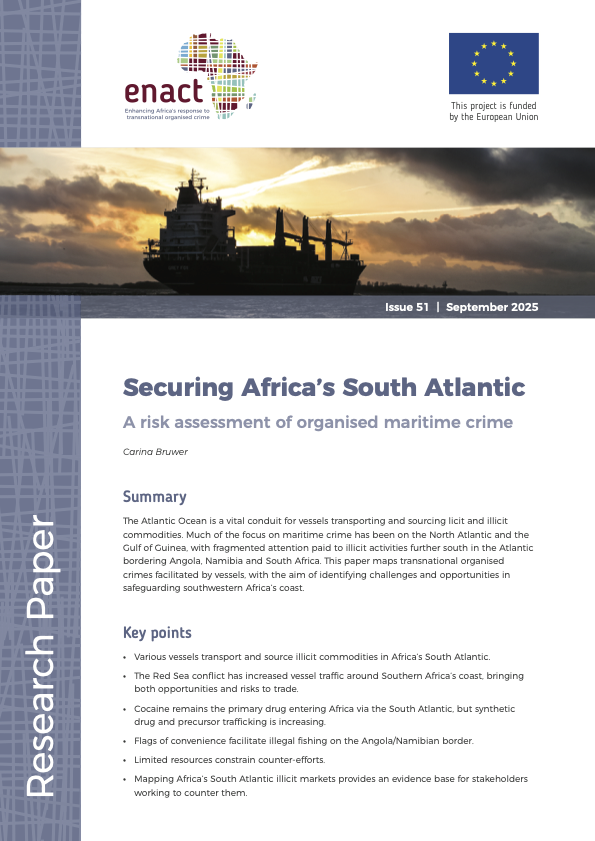
By Carina Bruwer
The Atlantic Ocean is a vital conduit for vessels transporting and sourcing licit and illicit commodities. Much of the focus on maritime crime has been on the North Atlantic and the Gulf of Guinea, with fragmented attention paid to illicit activities further south in the Atlantic bordering Angola, Namibia and South Africa. This paper maps transnational organised crimes facilitated by vessels, with the aim of identifying challenges and opportunities in safeguarding southwestern Africa’s coast. Key points • Various vessels transport and source illicit commodities in Africa’s South Atlantic. • The Red Sea conflict has increased vessel traffic around Southern Africa’s coast, bringing both opportunities and risks to trade. • Cocaine remains the primary drug entering Africa via the South Atlantic, but synthetic drug and precursor trafficking is increasing. • Flags of convenience facilitate illegal fishing on the Angola/Namibian border. • Limited resources constrain counter-efforts. • Mapping Africa’s South Atlantic illicit markets provides an evidence base for stakeholders working to counter them.