Open Access Free Library
CRIME+CRIMINOLOGY.jpeg

CRIME

Violent-Non-Violent-Cyber-Global-Organized-Environmental-Policing-Crime Prevention-Victimization

Posts in Crime Analysis
Improving Policing and Public Safety: Problems Presented by Police and Vehicle Pursuits

By Letitia James

  Every day, millions of New Yorkers take to the roads. They deserve traffic safety and policing that is fair and effective. This report describes some of the harms that can arise from police vehicle pursuits and high-speed vehicle chases and proposes reforms to help keep New Yorkers safe. Police chases have been shown to increase danger and result in injury or fatalities to drivers, passengers, bystanders, and police. We offer the following recommendations: Pass legislation to increase transparency New York law enforcement agencies should be required to track and publish a standardized set of data about traffic pursuits and high-speed chases. This should be facilitated by a centralized agency such as the Division of Criminal Justice Services (DCJS). Ban high-speed police pursuits, with very narrow exceptions High-speed chases can be deadly. Chases may be necessary when a serious or violent felony has been or will be committed, and when the driver’s conduct poses an imminent threat of death. But, in large part, ordinary speeding or minor traffic infractions should not lead to a high-speed, dangerous chase.  

Albany:  Office of the New York State Attorney General Letitia James, 2025. 11p.

Police Use of Force Policies Across America

Regulations from 100 Cities, Post-Floyd Policy Reforms, and Revisiting Constitutional Standards

By Dan Sutton, Fatima Dahir

Five years after George Floyd’s killing sparked unprecedented demands for police reform, questions persist about the changes that have—and haven’t—been made to American policing. Many Americans may be surprised to learn that policing rules vary significantly across jurisdictions, with stark differences in how officers are permitted to use force. One city may require officers to try de-escalating a traffic stop before using any force, while another city may permit officers to immediately draw their weapons without attempting alternatives.

The post-Floyd reform movement has produced a complex landscape of change: departments have largely converged on reforms like chokehold bans and requiring officers to intervene against excessive force, but they remain deeply divided on fundamental questions of when and how force should be used. Our study, which we believe represents the largest systematic analysis of American force regulations to date, examines 22 distinct policy dimensions across the nation’s 100 largest cities, comprising 2,200 total regulations collected through 2023. See Figure 1. This research was motivated by the troubling and well-documented relationship between race and police violence and the ongoing need to address systemic issues at the intersection of race, policy, and use of force.

Palo Alto, CA: Stanford Center for Racial Justice, 2025. 34p.By Dan Sutton, Fatima Dahir

Exploring ‘positive policing’: creating a space for (contextual) safeguarding

Sandra Walklate , Charlotte Barlow

The purpose of this paper is to develop an understanding of positive policing in relation to domestic abuse by opening up what is meant by this approach through an examination of what is taken for granted about it within much of the academic literature. Using data from a small-scale study involving case file analysis and interviews with police officers, the paper suggests in practice, positive policing involves a wide range of actions on the part of police officers. In exploring this data, the paper introduces the concept of ‘contextual safeguarding’ as a key feature of ‘positive policing’ in relation to domestic abuse. The paper makes the case for understanding ‘positive policing’ in the context of domestic abuse through the lens of ‘contextual safeguarding’ and that this would have beneficial consequences for wider debates on this issue.

Policing: A Journal of Policy and Practice, Volume 19, 2025,

INCB Narcotic Drugs 2025 report: Persistent inequities and rising synthetic opioid threats, alongside improved global reporting

 By the United Nations: International Narcotics Control Board

Supported efforts to secure borders, strengthen trusted private sector partners and disrupt trafficking in dangerous new psychoactive substances, synthetic opioids and related chemicals by: • Exchanging, as of 2025, over 125,000 government intelligence pieces on seizures in real time, involving over 3 million trafficking signals through the IONICS suite of tools, in line with mandates in article 35, subparagraph (g), of the 1961 Convention as amended • Facilitating the action of 95 national law and regulatory enforcement agencies and six international partner organizations in Operation Zeneth, in which over 1.5 million lethal doses of nitazenes were detected and seized in 2024 • Coordinating the agencies of Kenya and Uganda in Operation African Star II, which detected 48,000 falsified, unauthorized or illicitly manufactured pharmaceutical products entering East Africa, with detection through United States law enforcement agencies, the Pulse platform of the National Association of Boards of Pharmacy, the IONICS suite of tools and the Scanning of Novel Opioids on Online Platforms (SNOOP) systems and related technologies • Providing early-warning alerts to Governments, for enforcement actions, on ketamine trafficking, MDMB-INACA and related chemicals, vaping products containing new psychoactive substances, new psychoactive substances, performance-enhancing substances and 7-hydroxymitragynine • Delivering 115 INCB GRIDS Programme expert meetings and training events increasing enforcement capabilities and access to state-of-the-art tools and technologies to over 880 agencies, thereby securing borders and strengthening the resilience of communities and businesses at risk of being targeted by drug traffickers • Coordinating operational responses through its regional technical officers posted in Abuja, Almaty (Kazakhstan), Bangkok, Cairo, Mexico City and New Delhi, and at the GRIDS Cyber-Communications Centre in Vienna.........Strengthened the knowledge and capacity of national authorities1 to implement the drug control conventions by: • Delivering training on the drug control conventions to more than 1,500 officials from 160 countries in all regions by means of five e-modules and online and in-person training • Engaging Governments, international and regional organizations, and civil society actors in an ongoing dialogue on treaty implementation in the areas of the availability of controlled substances for licit purposes, supply reduction and demand reduction • Providing countries with the knowledge and capacity to implement the international drug control conventions, including through the findings and recommendations contained in the Board’s annual report and report on precursors for 2024, which were launched globally by its members, as well as its technical publications on narcotic drugs and psychotropic substances • Participating in the regular session of the Commission on Narcotic Drugs, including in thematic discussions and in a special event to commemorate the International Day against Drug Abuse and Illicit Trafficking and launch the UNODC World Drug Report 2025, as well as in side events and an informal dialogue with the Vienna NGO Committee on Drugs held on the margins of the session, and in intersessional meetings

Vienna: UNODC, 2026. 166p.

Ketamine in Europe, EMPACT situation report

By the European Union Drugs Agency (EUDA);


This report was prepared within the framework of Operational Action 1.5 of the 2024/2025 EMPACT Synthetic Drugs and New Psychoactive Substances action plan, entitled ’Intelligence picture on the trafficking of ketamine in the EU.’ The action was led by Belgium and co-led by Germany and the European Union Drugs Agency (EUDA). It was initiated in response to concerns raised by several Member States regarding indications that ketamine may represent an emerging drug-related issue in Europe.

Increasing challenges related to the availability, supply, non-medical use and associated risks of ketamine have been observed at the global and EU levels. As ketamine is listed by the World Health Organization as an essential medicine and is not subject to international control, systematic reporting is not required in most jurisdictions, creating monitoring blind spots. Within this context, the operational action focused on supporting situational awareness, early identification of potential security risks and, where appropriate, suggesting possible ways forward. This report is based on information contributions from 32 countries.

Luxembourg: Publications Office of the European Union, 2026. 41p.

Protesting Against Crime and Insecurity: High-Risk Activism in Mexico's Drug War

By  Sandra J. Ley Gutiérre

When do protests against crime and insecurity take place, regardless of the risks that such mobilization may entail? This paper argues that while violence provides an initial motivation for participating in protests, social networks play a fundamental role in incentivizing citizen mobilization against insecurity. Socialization within networks helps generate solidarity and empathy among participants, while at the same time transforming emotions associated with living in a violent context into potential for action. Also, through networks, individuals share information about opportunities for collective action and change their perceptions about the effectiveness and risks of such activism. These distinct mechanisms are valuable for the activation of protest against crime across levels of violence. Supporting evidence is derived from an original dataset on protest events in reaction to violence in Mexico between 2006 and 2012. Additionally, I rely on qualitative in-depth interviews and participant observation to illustrate the role of networks in protest against crime across several Mexican states. This paper contributes to the growing literature on criminal violence and political participation.Notre Dame, IN: The Kellogg Institute for International Studies
University of Notre Dame, 2022.

Shifting Cartel powers: an examination of the impact on U.S. and Mexican law enforcement


By: Ghaleb Krame, Amanda Davies, Magdalena García & Noé Cuervo Vázquez 

This paper explores the power struggle between the Chapitos and Mayiza factions of the Sinaloa Cartel and its implications for U.S. and Mexican law enforcement. Employing scenario analysis, payoff matrices, and Nash equilibria, the study evaluates potential outcomes of this conflict and their impact on cartel power dynamics. While the Cartel de Jalisco Nueva Generación (CJNG) is poised to exploit instability and expand its influence over fentanyl trafficking and key territories, for the United States of America (U.S.A.), this internal fragmentation complicates efforts to control the opioid crisis. In Mexico, Omar García Harfuch faces the challenge of stabilizing cartel-affected regions and countering CJNG’s growth. A Mayiza victory is seen as the most favorable outcome, reducing violence and curbing CJNG’s expansion. Coordinated intelligence-sharing and strategic responses are essential for regional stability.

Security Journal (2025) 38:57

Creating Insecurity Through Youth Street Groups and Applying Security for Control and Governance. A Case Study of Barcelona Latin Kings

By Eduard Ballesté-Isern & Carles Feixa 

This paper is based on an ethnographic study of the arrests and the subsequent trial and sentencing of a group of Latin Kings and Queens from Barcelona between 2015 and 2020. We analyze the actions carried out by the police, judicial institutions and media to reestablish the “hard handed” discourse in relation to these youth street groups in a time of crisis and precariousness. The concept of a “space of youth street groups” is used to construct a tool for mapping the agents who interact with these groups and the position they occupy in the social space. The interactions between these agents in Barcelona configure a new form of security governance through the creation of subjective insecurity and the promotion of punitive policies against youth street groups.

Crit Crim 30, 741–756 (2022)

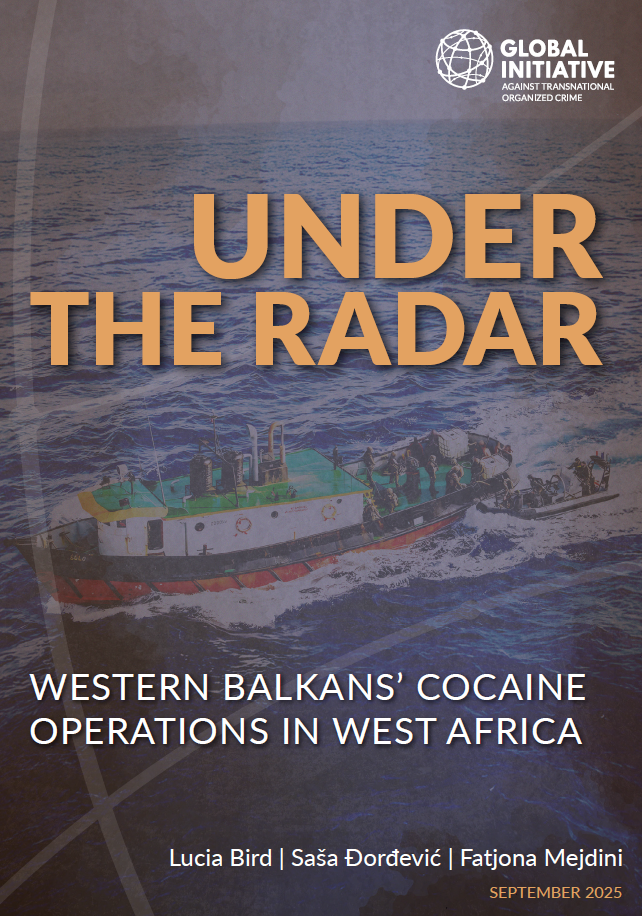
  UNDER THE RADAR.  WESTERN BALKANS’ COCAINE OPERATIONS IN WEST AFRICA 


By  Lucia Bird | Saša Đorđević | Fatjona Mejdini 

Western Balkans criminal groups, comprising both Albanian- and Slavic-speaking networks, have become dominant players in the global cocaine trade. While their influence in Europe and Latin America has been well documented, their growing role in West Africa has largely flown under the radar. Since 2019, these groups have expanded their operations in West Africa, using the region as a critical logistical, storage and redistribution hub for cocaine shipments en route to European consumption markets and beyond. This expansion has been shaped by their effective leverage of geography, governance weaknesses and infrastructure, both hard and digital. Initially limited to occasional trafficking links, the Western Balkan groups have deepened their presence across West Africa’s coastal states, including Senegal, Sierra Leone, Gambia, Guinea-Bissau and Cabo Verde. This growing focus on West Africa was driven by rising demand for cocaine in Europe, increased enforcement on direct routes to Europe and strengthened partnerships with Latin American cartels, especially Brazil’s Primeiro Comando da Capital (PCC). Western Balkan groups now operate through multiple trafficking methods in West Africa, exploiting fully containerized routes, non-containerized shipments (i.e. shipments not stored in containers, but hidden elsewhere on vessels) by other types of vessels, trans-shipments at sea and in-region containerization to conceal the cocaine’s origin. They have embedded brokers in West African countries who organize logistics, establish infrastructure and liaise with local actors. In Sierra Leone, for example, they have reportedly established companies to launder funds and warehouses to store and repackage cocaine, coordinating onward shipments through formal seaports using legitimate cargo. These brokers are key to operations and are often shared among the different groups. The groups’ structures are flexible and typically consist of small, trusted units supported by collaborators. Groups leverage local vulnerabilities to build relationships with corrupt law enforcement, port operators and security services. Particularly significant Western Balkan groups in West Africa include the Montenegrin Kavač clan and its rival, the Škaljari clan. The Kavač clan’s operations have been linked to ports in Brazil and Sierra Leone, with brokers overseeing logistics from Freetown. As we explain in this report, in some cases a single broker will work with more than one group from the Western Balkans. In parallel, Albanian-speaking groups, which have a strong presence in Spain and Brazil, have been operating through countries including Senegal and Gambia, sometimes collaborating with the Italian ‘Ndrangheta or the PCC. The example of an Albanian national who, according to Brazilian law enforcement investigations, is a major European supplier coordinating shipments through West Africa from Brazil, exemplifies the growing use of multi-tonne cocaine operations routed through the Gulf of Guinea. Looking ahead, Western Balkan groups are likely to further entrench themselves in West Africa, gradually relying less on their alliances with the ‘Ndrangheta, the PCC and other Western Balkan groups and instead investing directly in infrastructure and protection mechanisms. As in Latin America, their growing presence is likely to be accompanied by deeper corruption, potential violence and fragmentation into more autonomous cells. To address the growing role of Western Balkan criminal groups in West Africa, a coordinated response should focus on three key pillars. First, strategic cross-continental partnerships should be built with law enforcement, port authorities and international actors, underpinned by a political-economy analysis, to strengthen cooperation and to identify aligned priorities. Second, an enhanced data picture, drawing on a wider range of formal and informal sources, is needed to map trafficking routes and financial flows more effectively and to empower regional and international actors to tailor their risk assessments of specific routes, to profile criminal actors and to develop viable strategies for detection and disruption. Third, smart targeting strategies that prioritize brokers should be adopted, supported by parallel financial and criminal investigations. 

Geneva:  Global Initiative Against Transnational Organized Crime   2025. 61p.

Undoing Haiti’s Deadly Gang Alliance Latin America & Caribbean 

By The International Crisis Group

Born of Port-au-Prince’s most powerful gangs, Viv Ansanm has raised the criminal threat overhanging Haiti’s state and civilians to alarming heights. The gang coalition announced itself to the world by besieging the Haitian capital in early 2024, triggering former Prime Minister Ariel Henry’s resignation. After consolidating its hold on much of the city, Viv Ansanm has expanded into neighbouring departments, tightened its grip on the main roads connecting Port-au-Prince to the rest of the country and mounted attacks on the airport, essentially cutting Haiti off. Gangs’ violent offensives have killed over 16,000 people since 2022. But a rising death toll and diversifying criminal portfolio, now including extortion, piracy and drug trafficking, have not stopped gangs from claiming to represent the country’s downtrodden, especially on social media. UN approval of a new foreign force to combat the gangs could shift the balance of power. But it is vital that plans are in place not just to overpower the gangs but also to persuade them to demobilise. Haitian business and political elites have relied on paramilitary forces to protect their interests since the 1950s dictatorship of Francois Duvalier, or “Papa Doc”. But in the wake of the assassination of President Jovenel Moïse in July 2021, gangs have mutated, evolving from tools in the hands of the most powerful to overlords of Haiti. Two main gang groupings – the G-9, whose most public figure was Jimmy Chérizier, alias Barbecue, and the Gpèp, under Gabriel Jean Pierre, known as “Ti Gabriel” – fought for supremacy after Moïse’s murder. Even as the two faced off, gang leaders discussed whether to strike agreements to scale down the death toll among their members and spare resources. Mediators managed to craft several pacts among local groups to divvy up coveted turf. Late in 2023, reports emerged that the country’s two main gang coalitions had merged into one platform; their first joint offensive began months later replace the current transitional government. The concrete result they aspire to is a general amnesty for leaders and members. Haiti and its foreign partners are looking to beef up their ability to respond to the gangs with force. The UN Security Council has approved a new security operation, dubbed the Gang Suppression Force, to replace the Kenya-led Multinational Security Support Mission, which started up in 2024 but has never had the personnel or resources needed to check the gangs. The new force aims to incorporate 5,500 military personnel and expects to draw on reliable funding. Its mandate appears to give it more operational independence and the leeway to adopt more aggressive tactics. But until the force’s deployment, which is expected to commence around April 2026, Haiti’s authorities will have to turn to other methods. A task force, led by Haiti’s prime minister and powered by U.S. private military companies, has already used drones to hit gang members in their urban strongholds, killing over 200 people. Foreign partners are also providing training to the newly reconstituted army. Meanwhile, citizens exhausted by the threat to their neighbourhoods have established self-defence groups, provoking a brutal riposte from the gangs. Alongside its violent expansion, Viv Ansanm has sought to transform its public profile from that of a predatory criminal force into that of an ideological crusader. Crime bosses say their mission is to protect the poorest Haitians from rapacious elites and colonial powers that historically have oppressed this black Caribbean nation. Chérizier and other gang leaders have even announced the creation of a new political party, albeit without taking the steps needed to register it formally. While continuing to enrich themselves at the expense of Haitians rich and poor, their message has nevertheless become more overtly political: they appear intent on guaranteeing that their allies are part of the next administration, which should be formed by 7 February 2026 toreplace the current transitional government. The concrete result they aspire to is a general amnesty for leaders and members. Haiti and its foreign partners are looking to beef up their ability to respond to the gangs with force. The UN Security Council has approved a new security operation, dubbed the Gang Suppression Force, to replace the Kenya-led Multinational Security Support Mission, which started up in 2024 but has never had the personnel or resources needed to check the gangs. The new force aims to incorporate 5,500 military personnel and expects to draw on reliable funding. Its mandate appears to give it more operational independence and the leeway to adopt more aggressive tactics. But until the force’s deployment, which is expected to commence around April 2026, Haiti’s authorities will have to turn to other methods. A task force, led by Haiti’s prime minister and powered by U.S. private military companies, has already used drones to hit gang members in their urban strongholds, killing over 200 people. Foreign partners are also providing training to the newly reconstituted army. Meanwhile, citizens exhausted by the threat to their neighbourhoods have established self-defence groups, provoking a brutal riposte from the gangs. A well-resourced, properly informed and expertly commanded Gang Suppression Force could help change the balance of force on the ground and push the gangs onto the back foot. Port-au-Prince and its foreign counterparts, however, must take care to mitigate the dangers of civilian casualties and violations of human rights, ensuring that robust accountability systems are in place. Once the force is up and running, the Haitian government should also overcome the coordination failures that have plagued previous security campaigns. In particular, the government should appoint members to the National Security Council and ask them to design a strategy that lays out each institution’s role in fighting the gangs. Even so, it remains unlikely that force aone will entirely extricate gangs from the communities they control or sever the nexus with politics that has bedevilled Haiti for over half a century. Though informal negotiations with gangs take place on a regular basis – to gain access to people in need of humanitarian aid or to keep businesses open – many Haitians oppose the idea of formal dialogue with the perpetrators of crimes they consider unforgivable. Government officials have correctly said the Haitian state cannot engage in talks from a position of weakness. But if the new multinational force and revamped Haitian security forces allow the authorities to gain the upper hand and broadcast their armed superiority, state officials should look to use dialogue as a means of convincing the gangs to cut their losses, reduce violence against civilians and, eventually, demobilise

While that happens, the administration, with the support of donors, should expand the program that is now providing exit ramps for minors in the gangs’ ranks. In cooperation with international experts, it should also start to design a transitional justice system that provides benefits and a measure of judicial reprieve to those who disarm and cooperate with the authorities, while also guaranteeing that there will be no general impunity. It is hard to understate the damage gangs have wrought in Haiti, killing and raping thousands, creating the hemisphere’s worst humanitarian crisis and destroying the lives of millions. Understandably, many Haitians refuse to contemplate responding to the horrors they have endured with anything less than crushing retaliation. But even if the Gang Suppression Force lives up to its promise, it is hard to compute the possible cost in lives and resources of a campaign to destroy the gangs. At some stage, negotiations from a position of strength aimed at protecting civilians and disarming the gangs would serve Haiti far better as a first step on the long path to stability.


Port-au-Prince/New York/London/Brussels: International Crisis Group, 2025. 49p.

Criminal Procedure Without Consent

By Kate Weisburd


Scholars and advocates have long argued that a person's consent to a warrantless police search is often so inherently coerced, uninformed, and shaped by race, class, gender, citizenship status, and disability that to call it a "choice" is fiction. This critique is not limited to police searches based on consent. Waiving rights and consenting to otherwise unconstitutional state action permeates criminal procedure. The definition of a seizure, the third-party doctrine, custodial confessions, plea bargains, and agreements to alternatives to incarceration (such as GPS ankle monitoring) all hinge on the idea of voluntary choices-choices that are often just as coerced and uninformed as the choice to consent to a search.Given these concerns, this Article asks: What would happen if consent were eliminated from criminal procedure doctrines? This question is not merely academic. In recent years, a number of jurisdictions have substantially limited or eliminated traditional police searches based on consent. These reform efforts allow us to consider if there is something uniquely coercive or inequitable about consent searches that makes them especially amenable to reform or if we should consider eliminating consent in other criminal procedure doctrines as well.This Article takes on these questions. Drawing on both an original national survey of recent consent-search reforms and a transsubstantive analysis of consent and waiver in a range of criminal procedure doctrines, this Article analyzes the potential ramifications of eliminating (or limiting) consent. In doing so, this Article reveals the extent to which consent plays a pivotal role in upholding—and justifying—the entire operation of the criminal justice system.


.California Law Review (2025), UC Law San Francisco Research Paper Forthcoming,

An Updated Reading (2025) of Michel Foucault's Discipline and Punish (1975)

By Bernard Harcourt


Fifty years after its publication, Discipline and Punish (1975) remains as controversial as ever. Anyone writing about the prison today, in no matter what discipline, feels obliged to position themselves vis-à-vis Michel Foucault’s book. As a result, new studies and books regularly criticize Discipline and Punish, most often for misleading the reader about the history of the prison. As Adam Gopnik recently writes in the New Yorker, scholars are “turning decisively against Foucault,” contending “that incarceration may be a facet of every hierarchical, complex society. In other words, it’s always been with us.”However, Discipline and Punish was never intended to be a history of the prison. It was instead a genealogy of a particular mode of governing in modern times—what Foucault called “disciplinary power” or “panopticism.” And rather than trace the history of the prison, the book proposed a contemporary way to understand how power circulates in society and it paved the way for the study of contemporary modes of governing.  Drawing on a wealth of new Foucault archives, public lectures, manuscripts, and historical documents that have surfaced over the past 50 years, it is possible now to identify the true import of Foucault’s book. Just as the Leviathan of Thomas Hobbes captured the turn in modern political philosophy to theories of sovereignty and representation, Discipline and Punish marked the end of modern political theory and launched a new approach to analyze relations of power in society. In this essay, I redefine the central contribution of Discipline and Punish and explore how to use Foucault’s book today—and also, how to go beyond it.


 Columbia Public Law Research Paper No. 6044574,

Non-Criminal Justice Interventions for Countering Cognitive and Behavioural Radicalisation Amongst Children and Adolescents: A Systematic Review of Effectiveness and Implementation

By James Lewis, Sarah Marsden, James Hewitt, Chloe Squires, Anna Stefaniak


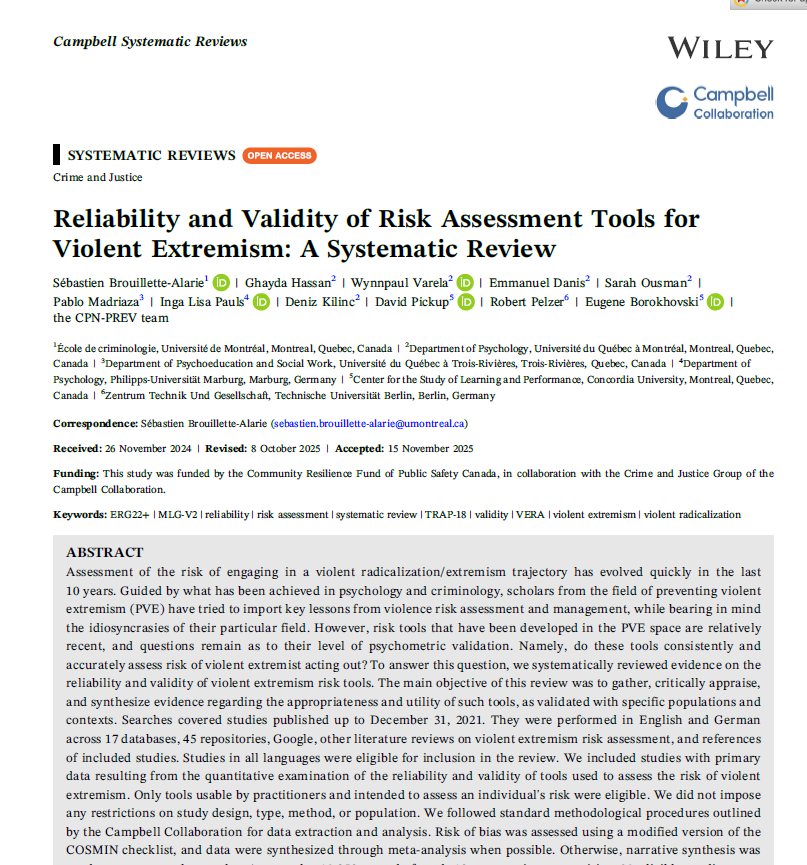
Reliability and Validity of Risk Assessment Tools for Violent Extremism: A Systematic Review


By Sébastien Brouillette-Alarie, Ghayda Hassan, Wynnpaul Varela, Emmanuel Danis, Sarah Ousman, Pablo Madriaza, Inga Lisa Pauls, Deniz Kilinc, David Pickup, Robert Pelzer, Eugene Borokhovski, the CPN-PREV team


Assessment of the risk of engaging in a violent radicalization/extremism trajectory has evolved quickly in the last 10 years. Guided by what has been achieved in psychology and criminology, scholars from the field of preventing violent extremism (PVE) have tried to import key lessons from violence risk assessment and management, while bearing in mind the idiosyncrasies of their particular field. However, risk tools that have been developed in the PVE space are relatively recent, and questions remain as to their level of psychometric validation. Namely, do these tools consistently and accurately assess risk of violent extremist acting out? To answer this question, we systematically reviewed evidence on the reliability and validity of violent extremism risk tools. The main objective of this review was to gather, critically appraise, and synthesize evidence regarding the appropriateness and utility of such tools, as validated with specific populations and contexts. Searches covered studies published up to December 31, 2021. They were performed in English and German across 17 databases, 45 repositories, Google, other literature reviews on violent extremism risk assessment, and references of included studies. Studies in all languages were eligible for inclusion in the review. We included studies with primary data resulting from the quantitative examination of the reliability and validity of tools used to assess the risk of violent extremism. Only tools usable by practitioners and intended to assess an individual's risk were eligible. We did not impose any restrictions on study design, type, method, or population. We followed standard methodological procedures outlined by the Campbell Collaboration for data extraction and analysis. Risk of bias was assessed using a modified version of the COSMIN checklist, and data were synthesized through meta-analysis when possible. Otherwise, narrative synthesis was used to aggregate the results. Among the 10,859 records found, 19 manuscripts comprising 20 eligible studies were included in the review. These studies focused on the Terrorist Radicalization Assessment Protocol (TRAP-18), the Extremism Risk Guidance Factors (ERG22+), the Multi-Level Guidelines (MLG-V2), the Identifying Vulnerable People guidance (IVP guidance), and the Violent Extremism Risk Assessment (VERA)—all structured professional judgment tools—as well as Der Screener—Islamismus, an actuarial scale. Studies mostly involved adult male participants susceptible to violent extremism (N = 1106; M = 58.21; SD = 55.14). The types of extremist ideologies endorsed by participants varied, and the same was true for ethnicity and country/continent of provenance. Encouraging results were found concerning the inter-rater agreement of scales in research contexts (kappas between 0.76 and 0.93), but one of the two studies that examined it in a field setting obtained disappointing results (kappas ranging between of 0.47 and 0.80). Content validity studies indicated that PVE risk tools adequately cover the risk factors and offending processes of individuals who go on to commit extremist violence. Construct validity analyses were few and far between, with results indicating that empirical divisions of scales did not match their conceptual divisions. The internal consistency of subscales was lackluster (Cronbach's alphas between 0.19 and 0.85), whereas full scales demonstrated acceptable internal consistency when assessed (0.80 for the ERG22+ and 0.64 for the IVP guidance). Only one study examined convergent validity, and it revealed a lack of convergence, primarily due to particularities of the scale under study (the MLG-V2). Discriminant validity analyses were exploratory in nature, but suggested that PVE risk tools might not be ideology-specific and may apply to both group and lone actors. Finally, although the TRAP-18 showed a relatively strong postdictive effect size (pooled r = 0.62 [0.35–0.77], p = 0.000), the results were highly heterogeneous (I2 = 86%), and all studies used retrospective designs, meaning the outcome was already known at the time of assessment. As such, no included study evaluated true predictive validity (i.e., the ability to forecast future violent extremist outcomes based on prospective risk assessment). This represents a significant evidence gap. Threats to validity were substantial: (a) Many studies were case studies or had very small samples, (b) nearly all samples were constituted through the triangulation of publicly available data, and (c) convenience outcome measures were often used. Although having imperfect data is better than having no data, the current state of empirical validation precludes the recommendation of one tool over another for specific populations and contexts, and calls for higher-quality validation studies for PVE risk assessment tools. Nevertheless, these tools constitute useful checklists of relevant risk and protective factors that could be taken into account by evaluators who wish to assess the risk of violent extremism and identify intervention targets.


Campbell Systematic Reviews, Volume21, Issue4

December 2025, 2025.

SexWork.DK: a comparative study of citizenship and working hours among sex workers in Denmark

By Rasmus Munksgaard, Kim Moeller & Theresa Dyrvig Henriksen

Sex workers in Europe are increasingly of nonnational origin. The Schengen cooperation allows internal migration within the European Union, but many migrant sex workers originate from outside the EU. While sex workers are already in precarious positions, nonnationals risk deportation, dependent on their citizenship status, and may have debts to smugglers. Consequently, they may be more likely to work longer hours to increase short-term profits. Using a dataset of sex work advertisements from one Danish website (n = 2,594), we estimate the association between inferred citizenship status and a) advertised hours on shift using ordinary least squares regression, and b) the probability of advertising 24/7 availability using a linear probability model. Compared to Danish sex workers, we find migrants advertise almost twice as many hours on shift and are more likely to advertise 24/7 availability. These results shed light on the inequalities that persist between national and nonnational sex workers.

Global Crime, Volume 26, 2025 - Issue 1

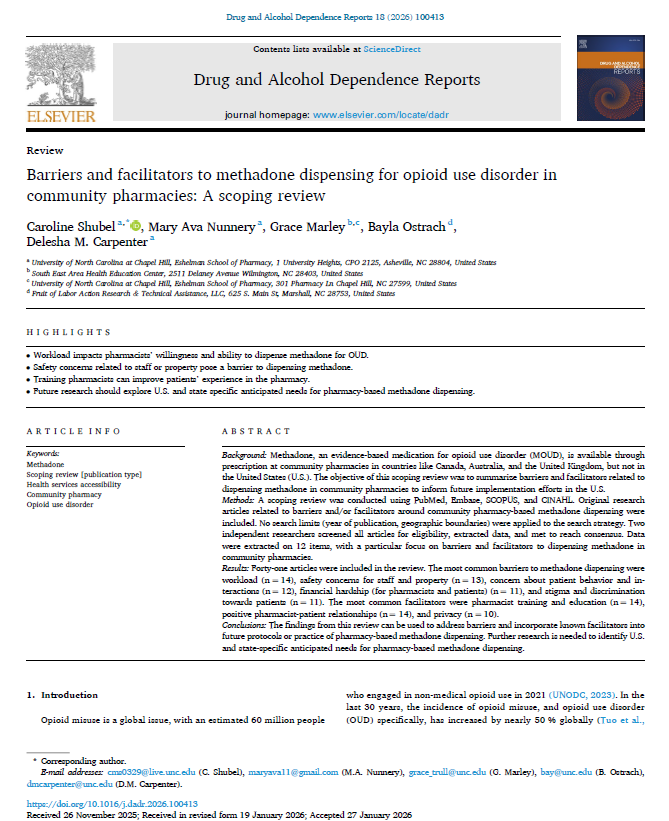
Barriers and facilitators to methadone dispensing for opioid use disorder in community pharmacies: A scoping review

By Caroline Shubel , Mary Ava Nunnery , Grace Marley, Bayla Ostrach , Delesha M. Carpenter

Background: Methadone, an evidence-based medication for opioid use disorder (MOUD), is available through prescription at community pharmacies in countries like Canada, Australia, and the United Kingdom, but not in the United States (U.S.). The objective of this scoping review was to summarize barriers and facilitators related to dispensing methadone in community pharmacies to inform future implementation efforts in the U.S. Methods: A scoping review was conducted using PubMed, Embase, SCOPUS, and CINAHL. Original research articles related to barriers and/or facilitators around community pharmacy-based methadone dispensing were included. No search limits (year of publication, geographic boundaries) were applied to the search strategy. Two independent researchers screened all articles for eligibility, extracted data, and met to reach consensus. Data were extracted on 12 items, with a particular focus on barriers and facilitators to dispensing methadone in community pharmacies. Results: Forty-one articles were included in the review. The most common barriers to methadone dispensing were workload (n = 14), safety concerns for staff and property (n = 13), concern about patient behavior and interactions (n = 12), financial hardship (for pharmacists and patients) (n = 11), and stigma and discrimination towards patients (n = 11). The most common facilitators were pharmacist training and education (n = 14), positive pharmacist-patient relationships (n = 14), and privacy (n = 10). Conclusions: The findings from this review can be used to address barriers and incorporate known facilitators into future protocols or practice of pharmacy-based methadone dispensing. Further research is needed to identify U.S. and state-specific anticipated needs for pharmacy-based methadone dispensing

:Drug Alcohol Depend Rep. 2026 Jan 29;18:100413. doi: 10.1016/j.dadr.2026.100413. PMID: 41695144; PMCID: PMC12906019

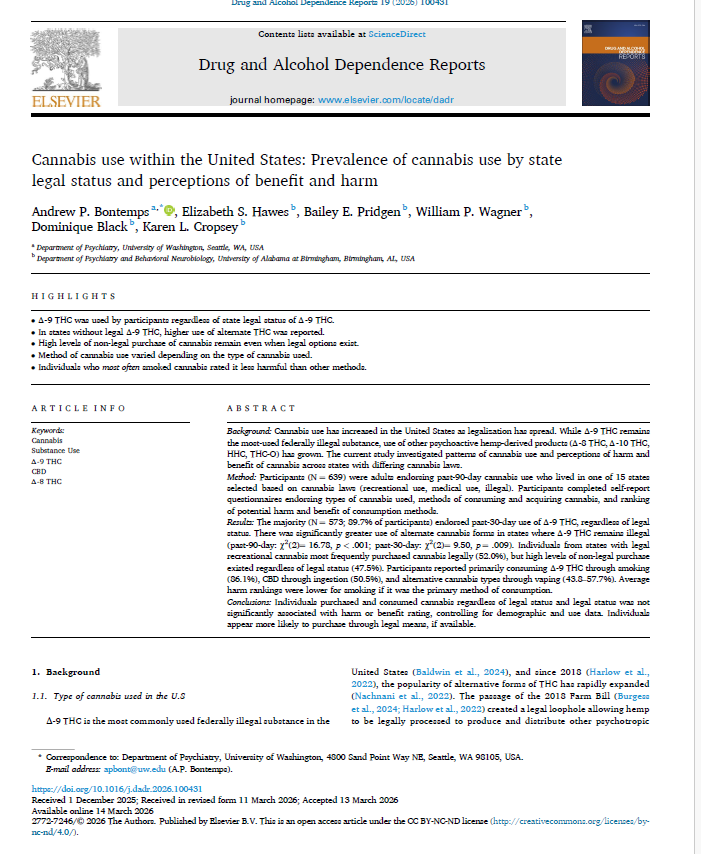
Cannabis use within the United States: Prevalence of cannabis use by state legal status and perceptions of benefit and harm

By Andrew P. Bontemps, Elizabeth S. Hawes, Bailey E. Pridgen, William P. Wagner, Dominique Black, Karen L. Cropsey

Background:Cannabis use has increased in the United States as legalization has spread. While Δ-9 THC remains the most-used federally illegal substance, use of other psychoactive hemp-derived products (Δ-8 THC, Δ-10 THC, HHC, THC-O) has grown. The current study investigated patterns of cannabis use and perceptions of harm and benefit of cannabis across states with differing cannabis laws.


Method

Participants (N=639) were adults endorsing past-90-day cannabis use who lived in one of 15 states selected based on cannabis laws (recreational use, medical use, illegal). Participants completed self-report questionnaires endorsing types of cannabis used, methods of consuming and acquiring cannabis, and ranking of potential harm and benefit of consumption methods.


Results

The majority (N=573; 89.7% of participants) endorsed past-30-day use of Δ-9 THC, regardless of legal status. There was significantly greater use of alternate cannabis forms in states where Δ-9 THC remains illegal (past-90-day: χ2(2)=16.78, p<.001; past-30-day: χ2(2)=9.50, p=.009). Individuals from states with legal recreational cannabis most frequently purchased cannabis legally (52.0%), but high levels of non-legal purchase existed regardless of legal status (47.5%). Participants reported primarily consuming Δ-9 THC through smoking (86.1%), CBD through ingestion (50.5%), and alternative cannabis types through vaping (43.8-57.7%). Average harm rankings were lower for smoking if it was the primary method of consumption.


Conclusions

Individuals purchased and consumed cannabis regardless of legal status and legal status was not significantly associated with harm or benefit rating, controlling for demographic and use data. Individuals appear more likely to purchase through legal means, if available.


Drug and Alcohol Dependence Reports

Available online 14 March 2026, 100431


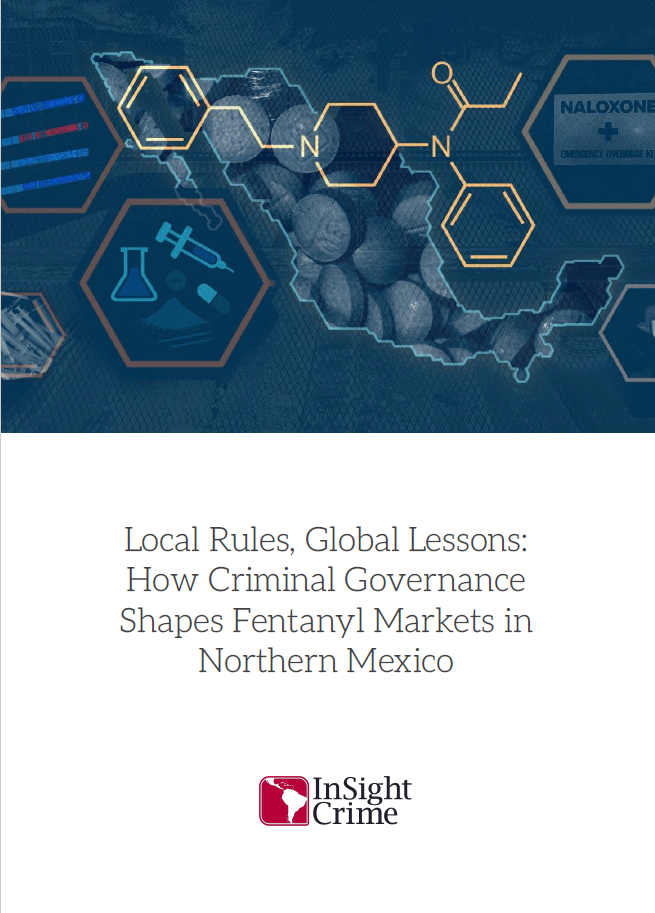
Local Rules, Global Lessons: How Criminal Governance Shapes Fentanyl Markets in Northern Mexico

By Steven Dudley, et al.


Although traditional synthetic opioid strongholds like the United States and Canada appear to be experiencing a stabilization of their illicit fentanyl market—evidenced by a historic reduction in overdose deaths 1—synthetic opioids continue to expand across the globe, creating widespread health and security concerns. Existing explanations for the rise and stabilization of these markets focus on economic incentives, supply-chain disruption, precursor controls, consumption patterns, and public-health interventions. But the role of organized crime in structuring retail distribution has been largely overlooked. The experience of Mexico’s northern border illustrates that local criminal governance can be a decisive factor in determining where and how new drug markets take root. Fentanyl, for example, has quietly reshaped drug markets in Mexico and upended some widely held assumptions of how larger criminal groups interact with these markets. As local criminal organizations became major producers and exporters of the synthetic opioid to the United States, domestic consumption also emerged in key trafficking corridors. In Tijuana and Mexicali in Baja California, Hermosillo and Nogales in Sonora, and Ciudad Juárez in Chihuahua, the transnational fentanyl economy has taken root locally, generating unprecedented public health and security pressures. This expansion, however, has been uneven, and the criminal actors who control local drug economies are far from monolithic. Across northern Mexico, fragmented local factions—sometimes linked to larger organizations, sometimes operating with considerable autonomy—determine what reaches consumers and under what conditions. Retail fentanyl markets have therefore expanded not simply in response to demand or price signals, but according to thestrategic decisions of local criminal groups. In Baja California, these groups actively promoted fentanyl sales, enabling the market to consolidate. In Sonoran cities and Ciudad Juárez, they restricted distribution, confining consumption to specific user niches.Overall, the impact on the ground has been substantial. The introduction of fentanyl triggered waves of overdose deaths and serious health effects among users. Although there are signs that the crisis may have stabilized in some areas, the risks persist, and the problem remains underestimated in official statistics, limiting the effectiveness of institutional responses that are already ill-equipped to address it. This report aims to provide a deeper understanding of this issue. It examines fentanyl consumption dynamics in the cities mentioned, traces the evolution of the market, and outlines the distribution networks that sustain it. Additionally, it analyzes the models of criminal control over local drug markets and assesses the state’s response to date. A central question running through the analysis is why fentanyl did not spread uniformly across these cities and what role local criminal structures played in that divergence.

Washington DC: Insight Crime, 2026. 66p.

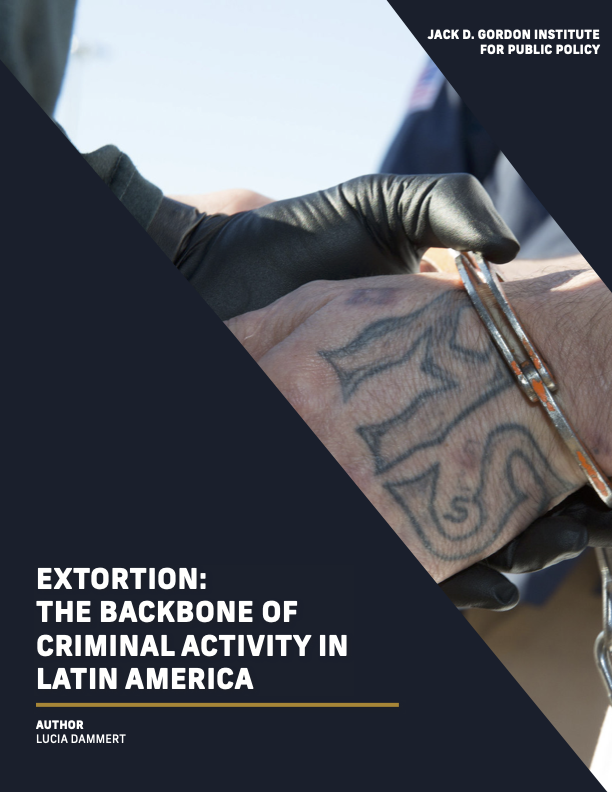
Extortion: The Backbone of Criminal Activity in Latin America

By Lucia Dammert

Extortion is a phenomenon that can be understood from various disciplines, such as economics, criminology, the political sciences, and sociology. Each of these fields of knowledge emphasizes either the system or economic models under which extortionists and victims operate, the short- or long-term relationship sought by establishing simple or complex extortion mechanisms, the political relationship between extortionists and victims, or citizens’ perceptions of the institutional framework, which can serve as a gateway for criminal groups to create ties of protection through extortion. The complexity of extortion, given the different forms it can take and the ease with which it can be confused or linked with other crimes, such as kidnapping or corruption, calls for an open discussion and the establishment of research agendas. This report sheds light on the importance of extortive practices in Latin America. It is based on qualitative research since 2019 that includes 36 interviews of academics, public officials, police, professionals, and victims of extortion in 10 countries,5 along with a review of all official public information and newspapers in five countries during 2019.6 The research also focuses on working groups and reviews official and civil society documents related to extortion as a criminal phenomenon throughout Latin America. The report is part of a long-term research project that focuses on the importance of this criminal activity, its possible links to organized crime organizations, and the policies designed to tackle its impact on businesses and citizens alike.

The report shows that extortive practices are a regionwide trend, albeit with national, specific characteristics. Although it is primarily a non-violent crime, an increasing tendency— specifically linked to practices against women—should make it a priority for the public security agenda. Furthermore, extortion could be depicted as the “perfect crime” since it is hardly reported, let alone investigated. High levels of impunity have allowed for this practice to move into criminal organizations, prisons, and street gangs; also, state officials and even business partners use extortive practices to finance their activities. There is a clear impact on democracy since corruption, fear of crime, and a general sense of freedom from punishment corroborate the idea that there is no rule of law. Efforts toward understanding extortion remain limited and need to take a central role in most national and regional public security policies. 

Fighting Organised Crime: Recovering Illicit Assets in Chile

By Pilar Lizana , Maria Nizzero and Carlos Solar

This paper highlights the critical need for Chile to strengthen its asset-recovery frameworks to combat the growing threat of organised crime and money laundering. It provides an in-depth analysis of the structural challenges hindering Chile's ability to trace, seize and recover illicit assets, and situates these findings within the broader Latin American and global security context. The authors identify key obstacles, including limited risk understanding, weak state governance, gaps in cooperation and information sharing and deficiencies in asset recovery systems. The paper offers actionable recommendations to enhance Chile's institutional resilience and contribute to regional and international security efforts.

Key Recommendations

  • Establish a centralised asset-management office to ensure effective administration and preservation of confiscated assets.

  • Invest in training and capacity building to improve risk understanding and investigative capabilities across public and private sectors.

  • Strengthen public–private cooperation to enhance information sharing and risk mitigation strategies.

  • Increase human, financial and technological resources for agencies combating organised crime and recovering assets.

  • Update legislation to include extended confiscation and non-conviction-based confiscation mechanisms, aligning with international standards.

This paper underscores the importance of sustained reforms and international cooperation to disrupt transnational criminal networks and safeguard democratic governance in Chile and beyond.

Asian Gangs in the United States: A Meta-Synthesis 

By Sou Lee 

The purpose of this study is to gain a holistic understanding of the Asian gang phenomenon through the application of a meta-synthesis, which is seldom utilized within the criminal justice and criminology discipline. Noblit and Hare’s (1988) seven step guidelines for synthesizing qualitative research informed this methodology. Through this process, 15 studies were selected for synthesis. The synthesis of these studies not only identified prevalent themes across the sample, but also provided the basis for creating overarching metaphors that captured the collective experience of Asian gang members. Through the interpretive ordering of these metaphors, a line of synthesis argument was developed in which three major inferences about the Asian gang experience were made. First, regardless of ethnic and geographic differences, the experiences of Asian gangs and their members are similar. Second, although extant literature has applied different theories to explain gang membership for individual ethnic gangs (e.g. Chinese, Vietnamese), this synthesis revealed that the dominant theory for explaining the onset and persistence of Asian gangs is Vigil’s (1988) multiple marginality theory. Finally, in comparison to the broader literature, Asian gangs are more similar than they are different to non-Asian gangs because of their overlap in values.

Thesis, 2016. 127p.