
Open Access Free Library
Fiction+Mediajpg.jpg

FICTION and MEDIA

CRIME AND MEDIA — TWO PEAS IN A POD

Posts in violence
The Gold Coast Regiment In The East African Campaign

By Hugh Clifford.. Introduction by Graeme Newman

The East African Campaign of the First World War remains one of the most demanding and least understood theatres of that global conflict. Far removed from the trenches of Europe, it unfolded across vast expanses of dense bush, swamps, mountains, and savannah—lands where climate, terrain, and disease were often deadlier adversaries than the enemy’s rifles. In this harsh environment, the soldiers of the Gold Coast Regiment distinguished themselves with a fortitude and endurance that earned them a lasting place in the annals of imperial military history.

The Gold Coast Regiment, drawn predominantly from the peoples of West Africa and led by British officers, brought to East Africa a unique blend of discipline, adaptability, and martial tradition. Their participation in the long pursuit of General Paul von Lettow‑Vorbeck’s elusive Schutztruppe represented both a severe test of their abilities and a defining moment in their collective identity. The campaign demanded not only courage under fire but also the capacity to march extraordinary distances, survive with minimal supplies, and maintain cohesion amid the ravages of tropical disease and the unpredictable rhythms of guerrilla warfare.

Sir Hugh Clifford, K.C.M.G.—administrator, colonial governor, and a man deeply familiar with West Africa—brings a rare perspective to this narrative. His closeness to the region and its peoples lends the work a depth of understanding that extends beyond the purely military. Clifford’s account is not merely a chronicle of battles and maneuvers; it is also a tribute to the character, loyalty, and steadfastness of the African soldiers who served with such distinction. He illuminates how, in the face of profound hardship, these men forged bonds of trust and cooperation with their officers, contributing decisively to the eventual success of British and Allied arms in the region.

This book therefore stands as both a historical record and a testament—an effort to ensure that the bravery and sacrifices of the Gold Coast Regiment are neither forgotten nor overshadowed by more widely known campaigns. In revisiting their story, readers gain insight not only into a pivotal chapter of African military history but also into the wider, often overlooked global dimensions of the First World War. The narrative that follows invites us to honour the endurance, resilience, and unyielding spirit of a regiment that marched far from home and left an indelible mark on the course of the war in Africa.
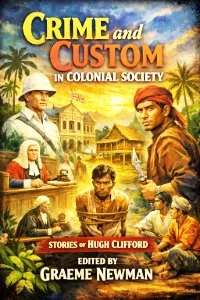
Crime And Custom In Colonial Society: The Stories Of Sir Hugh Clifford

Edited By Graeme R. Newman

Crime and Custom in Colonial Society brings together, for the first time in a single volume, the complete stories from In Court and Kampong and In Days That Are Dead by Hugh Clifford—newly introduced and contextualized by Graeme Newman for modern readers.

Set in British Malaya at the height of empire, these vivid and often unsettling narratives explore a world where radically different systems of law, morality, and social obligation collide. In the kampong villages, life is governed by custom, kinship, and deeply rooted traditions. In the colonial courts, British officials impose formal legal codes that claim universality but often fail to grasp the lived realities of the people they judge. Between these two worlds lies a fraught and morally ambiguous terrain—one in which the meaning of “crime” itself is constantly contested.

Taking its title as a deliberate echo of Crime and Custom in Savage Society by Bronisław Malinowski, this volume invites readers to reconsider one of the central questions of legal and social theory: how do societies define wrongdoing, and what gives law its authority? Where Malinowski revealed the internal coherence of indigenous systems of custom, Clifford’s stories expose the tensions, misunderstandings, and injustices that arise when those systems are overridden by colonial power.

These tales are more than historical curiosities. They are gripping human dramas—stories of loyalty and betrayal, honor and punishment, authority and resistance—told with the insight of a colonial administrator who witnessed firsthand the complexities of governing a plural society. At the same time, they offer a profound meditation on legal pluralism, cultural conflict, and the limits of imposed justice—issues that remain urgently relevant in today’s globalized world.

This new edition features a substantial scholarly introduction by Graeme Newman, situating Clifford’s work within the broader traditions of criminology, anthropology, and colonial history. Crime and Custom in Colonial Society will appeal to readers of historical fiction, students of law and sociology, and anyone interested in the enduring question of how law is shaped by culture—and how it, in turn, shapes human lives.

Read-Me.Org Inc. New York-Philadelphia-Australia. 2026. 297p.

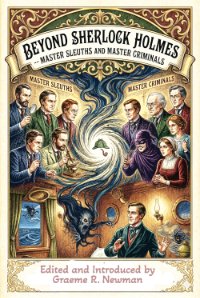
Beyond Sherlock Holmes

Edited by Graeme R. Newman

Step out of the shadow of 221B Baker Street and into the gaslit world of the "Great Detectives."

While Sherlock Holmes reigned supreme in the pages of The Strand, he was far from the only mind at work in the fog-choked streets of Victorian London. "Beyond Sherlock Holmes: The Rivals, Rogues, and Rationalists of the Golden Age" is a definitive collection of public domain masterpieces that defined the evolution of the modern thriller.

From the "ratiocination" of Edgar Allan Poe to the forensic laboratories of Dr. Thorndyke, this anthology gathers the brilliant specialists who refined, subverted, and occasionally haunted the detective genre. These are the stories that gave Holmes his fiercest competition—characters who used logic, science, and even the occult to solve the "impossible."

Inside this collection, you will discover:

  • The Forensic Pioneers: Join Dr. Thorndyke as he utilizes the first true "mobile crime lab" to solve murders through microscopic analysis.

  • The Logic Masters: Witness The Thinking Machine prove that "two and two make four" by thinking his way out of an inescapable prison cell.

  • The Shadow Detectives: Meet Max Carrados, the blind investigator whose heightened senses allow him to observe truths that even Holmes would miss.

  • The Occult Investigators: Follow Thomas Carnacki as he bridges the gap between science and the supernatural to hunt "monsters" through the lens of logic.

  • The Mastermind Villains: Face the terrifying ambition of Dr. Nikola, the Victorian "supervillain" whose global reach predates Bond villains by half a century.

  • The Gentleman Thieves: Cross the line with A.J. Raffles and Arsène Lupin, the brilliant "cracksmen" who prove that the detective’s mind is just as effective when applied to the perfect heist.

A Must-Have for Fans of Classic Mystery

Whether you are a scholar of criminology or a lover of "Victorian Shockers," this volume offers a panoramic view of an era defined by gaslight, cobblestones, and the birth of forensic science. Curated with an extensive introduction detailing the history and impact of these "Rivals of Sherlock," this book is more than a collection—it is a journey through the evolution of the human mind at work.

Stories included in this edition: THE MURDERS IN THE RUE MORGUE, Edgar Allan Poe-- THE CASE OF LAKER, ABSCONDED, Arthur Morrison-- THE CASE OF THE DIXON TORPEDO, Arthur Morrison-- THE PROBLEM OF CELL 13, Jacques Futrelle-- THE SILENT BULLET, Austin Freeman-- THE COIN OF DIONYSIUS, Ernest Bramah-- THE GATEWAY OF THE MONSTER, Wiliam Hope Hodgson-- THE RED LODGE, Russell Wakefield-- THE ADVENTURE OF THE SPECKLED BAND, Arthur Conan Doyle-- THE IDES OF MARCH, E.W.Hornung-- THE ARREST OF ARSÈNE LUPIN, Maurice Leblanc.

Read-Me.Org Inc. New York-Philadelphia-Australia. 2026. 330p.

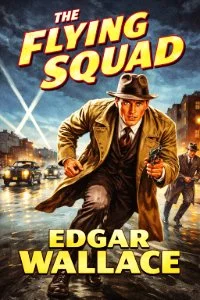
The Flying Squad

By Edgar Wallace. Edited and Introduced by Graeme R. Newman

The Flying Squad by Edgar Wallace is a fast-paced and compelling crime novel that captures the excitement of modern policing at a time when organized crime was becoming more daring and sophisticated.

At the heart of the story is the Metropolitan Police’s elite Flying Squad, a special unit created to respond swiftly to robberies and high-stakes criminal operations. When a series of bold and carefully planned crimes begins to unsettle London, the Squad is called into action. Moving quickly across the city, they pursue a network of criminals whose intelligence and audacity make them a formidable adversary.

As the investigation unfolds, secrets emerge, alliances shift, and danger lurks at every turn. Wallace’s trademark storytelling—sharp, direct, and filled with tension—drives the narrative forward with relentless energy. The novel blends action, mystery, and suspense, offering readers both the thrill of the chase and the intrigue of a cleverly constructed plot.

Written during the golden age of crime fiction, The Flying Squad reflects a turning point in detective storytelling, where teamwork, rapid response, and coordinated strategy replace the lone investigator. Wallace’s vivid depiction of London and his insight into both criminal enterprise and police procedure give the novel a sense of realism that remains engaging today.

This classic edition invites modern readers to experience one of Edgar Wallace’s most dynamic works—a gripping tale of crime, pursuit, and justice that continues to influence the thriller genre nearly a century after its first publication.

Read-Me.Org Inc. New York-Philadelphia-Australia. 2026. p.213..

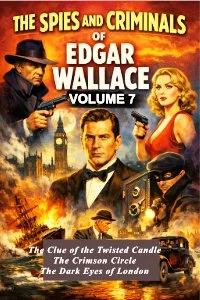
The Spies And Criminals Of Edgar Wallace -Volume 7

BEYOND SCOTLAND YARD

By Edgar Wallace. Edited and Introduced by Graeme R. Newman

The Spies and Criminals of Edgar Wallace — More Than Scotland Yard — Volume 7 brings together three of Edgar Wallace’s most gripping and atmospheric crime novels: The Clue of the Twisted Candle, The Crimson Circle, and The Dark Eyes of London. Each story reveals a different facet of Wallace’s extraordinary ability to craft suspenseful, fast-moving narratives filled with mystery, danger, and unforgettable characters.

In The Clue of the Twisted Candle, a baffling locked-room murder sets the stage for a clever and intricate investigation where appearances deceive and every clue leads deeper into uncertainty. The Crimson Circle introduces a shadowy organization operating beyond the reach of the law, weaving a tense story of blackmail, secrecy, and hidden power that keeps readers guessing until the final page. In The Dark Eyes of London, Wallace delivers one of his most chilling tales, exposing a sinister criminal scheme concealed beneath a façade of respectability, where vulnerability is exploited with ruthless precision.

Together, these novels move beyond the traditional boundaries of Scotland Yard detection and into a wider world of conspiracy, psychological tension, and hidden networks of crime. Wallace’s trademark style—swift pacing, sharp dialogue, and ingenious plotting—drives each story forward with relentless energy.

This volume offers a powerful showcase of Edgar Wallace at his most compelling, blending classic mystery with darker, more complex themes that continue to resonate with modern readers. For fans of vintage thrillers, detective fiction, and suspenseful storytelling, Volume 7 delivers three unforgettable journeys into the heart of crime and intrigue.

Read-Me.Org Inc. New York-Philadelphia-Australia. 2026. p.417..

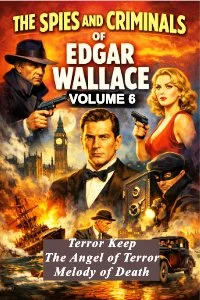
The Spies And Criminals Of Edgar Wallace -Volume 6

BEYOND SCOTLAND YARD

By Edgar Wallace. Edited and Introduced by Graeme R. Newman

THE SHADOW OF THE YARD

From the fog-bound labyrinth of a madman’s lair to the sun-drenched deception of the Riviera, Volume 6 of The Spies and Criminals of Edgar Wallace brings together three masterclasses in suspense. Here, the "King of the Thriller" pits the unassuming brilliance of Scotland Yard’s allies against the most cold-blooded predators of the jazz age.
Terror Keep
The genius of the "criminal mind" returns. J.G. Reeder—the mild-mannered investigator with the tightly furled umbrella—faces his deadliest foe: a homicidal mastermind escaped from Broadmoor and hungry for revenge. It is a race through a house of traps where death waits behind every door.
The Angel of Death
She has the face of a saint and the soul of a sociopath. Jean Briggerland is a predator who uses her beauty to mask a trail of broken lives and stolen fortunes. Can justice touch a woman who makes the law her accomplice?
The Melody of Death
A haunting tune signals a countdown to doom. Driven by a desperate secret, a man plunges into the underworld to secure a future for the woman he loves. But in Wallace’s London, every crime has a rhythm, and every rhythm has a price.
Three novels. Two legendary detectives. One master of mystery. "Whether it’s a master forger or a murderous socialite, Wallace never misses a beat."

Read-Me.Org Inc. New York-Philadelphia-Australia. 2026. p.373..

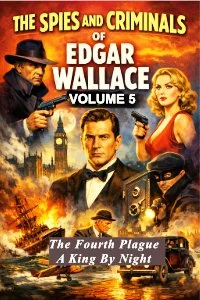
The Spies And Criminals Of Edgar Wallace -Volume 5

BEYOND SCOTLAND YARD

By Edgar Wallace. Edited and Introduced by Graeme R. Newman
Welcome to the fifth volume of The Spies and Criminals of Edgar Wallace — Beyond Scotland Yard., Volume 5. As we continue our journey through the vast, thrilling archives of the man who once had a book on every bedside table in England, we move away from the procedural confines of the Yard and into the shadowy territories of global conspiracies and nocturnal terrors. Edgar Wallace was never just a writer of "whodunnits." He was a pioneer of the "thriller" in its most visceral form—a master of the ticking clock, the hidden organization, and the villain whose reach spans continents.
The Fourth Plague (1913). One of Wallace’s most ambitious early works, The Fourth Plague introduces us to the "Red Hand," a sinister Italian secret society that holds London in a grip of terror. This isn't a mere case of theft or individual murder; the Red Hand threatens the very fabric of society with a biological ultimatum. Wallace masterfully blends the tropes of the "Yellow Peril" and Italian vendetta narratives of his era into a high-stakes race against time. It is a proto-techno-thriller that showcases Wallace’s fascination with how easily modern civilization can be brought to its knees by a dedicated few.
A King by Night (1925). Written at the height of his fame and dedicated to his close friend P.G. Wodehouse, A King by Night is a different beast entirely. When a young woman from Sacramento arrives in London searching for her missing uncle, she is swept into a nightmare involving a mysterious, legendary criminal known as "The King." Set against a backdrop of fog-drenched streets and eerie country estates, this novel highlights Wallace’s ability to create a sense of mounting dread. It is a classic example of his "terror" novels—where the villain is not just a man, but a looming, almost supernatural presence.
Why "Beyond Scotland Yard"? While the "Blue Eyed Boy" of the C.I.D. often made appearances in Wallace’s work, these stories remind us that the most dangerous criminals don't always leave a trail the police can follow. Sometimes, it takes an adventurer, a victim’s desperate relative, or a rogue investigator to venture into the places where the law fears to tread.
In Volume 5, the stakes are higher, the villains are bolder, and the mysteries are shrouded in the dark corners of the world. Turn the page, and prepare to meet the criminals who thought they were beyond the reach of justice—only to find that Edgar Wallace was waiting for them.

Read-Me.Org Inc. New York-Philadelphia-Australia. 2026. p.395..

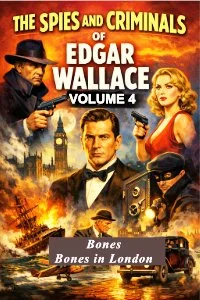
The Spies And Criminals Of Edgar Wallace -Volume 4

BEYOND SCOTLAND YARD

By Edgar Wallace. Edited and Introduced by Graeme R. Newman

The Spies and Criminals of Edgar Wallace: Scotland Yard and Beyond — Volume 4 brings readers two of Edgar Wallace’s most entertaining and unusual adventure novels: Bones and Bones in London. Blending humor, mystery, and crime with the author’s trademark pace and vivid storytelling, these stories reveal a lighter but no less thrilling side of Wallace’s imagination.

At the center of both novels is the unforgettable character Bones, a well-meaning but wildly unpredictable figure whose adventures unfold amid colonial intrigue, bureaucratic mishaps, and unexpected encounters with criminals and conspirators. In Bones, readers travel to the colorful and often chaotic world of colonial Africa, where the enthusiastic but frequently misguided Bones attempts to prove his courage and competence while stumbling into one outrageous situation after another.

In Bones in London, the action moves to the heart of the British capital. Far from the jungles and rivers of Africa, Bones finds himself navigating the complexities of metropolitan life, where his talent for attracting trouble follows him wherever he goes. What begins as a simple visit soon becomes entangled with crime, deception, and the watchful presence of Scotland Yard.

Filled with sharp dialogue, comic mishaps, and moments of genuine suspense, these two novels showcase Edgar Wallace’s remarkable range as a storyteller. Famous for his crime thrillers and detective tales, Wallace was equally skilled at creating characters whose humanity and humor shine through even in the midst of danger.

Volume 4 of The Spies and Criminals of Edgar Wallace offers readers another captivating installment in this series celebrating the work of one of the most widely read writers of the early twentieth century. For fans of classic adventure, crime fiction, and unforgettable characters, these lively stories remain as engaging and entertaining today as when they were first published.

Read-Me.Org Inc. New York-Philadelphia-Australia. 2026. p.304..

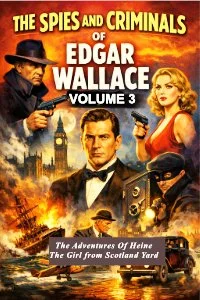
The Spies And Criminals Of Edgar Wallace -Volume 3

SCOTLAND YARD AND BEYOND

By Edgar Wallace. Edited and Introduced by Graeme R. Newman

The Spies and Criminals of Edgar Wallace: Scotland Yard and More — Volume 3 brings together two exciting works by one of the most prolific and entertaining masters of crime fiction. Edgar Wallace’s stories of clever criminals, daring investigators, and ingenious plots captivated millions of readers in the early twentieth century, and they continue to deliver suspense and adventure today.

This volume features The Adventures of Heine, a lively collection of tales centered on one of Wallace’s most intriguing characters. Moving through the underworld of international intrigue and high-stakes deception, Heine encounters spies, smugglers, and master criminals in stories filled with wit, danger, and unexpected twists. Wallace’s fast-paced storytelling and sharp dialogue make each episode a memorable adventure.

Also included is the gripping novel The Girl from Scotland Yard, a thrilling story that places a determined investigator at the center of a web of mystery and crime. As secrets unfold and danger closes in, the story showcases Wallace’s remarkable ability to blend suspense, clever plotting, and dramatic tension.

Together these works reveal the rich variety of Wallace’s crime fiction—from clever short adventures to full-length mystery. Filled with secret schemes, daring investigations, and the ever-present struggle between crime and justice, Volume 3 of The Spies and Criminals of Edgar Wallace offers another exciting glimpse into the world of classic detective storytelling.

Perfect for readers who enjoy classic mysteries, Scotland Yard investigations, and the golden age of crime fiction, this collection continues the tradition of suspense and adventure that made Edgar Wallace one of the most widely read thriller writers of his time.

Read-Me.Org Inc. New York-Philadelphia-Australia. 2026. p.373..

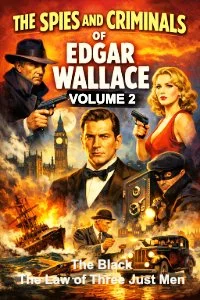
The Spies And Criminals Of Edgar Wallace -Volume 2

SCOTLAND YARD AND BEYOND

By Edgar Wallace. Edited and Introduced by Graeme R. Newman

The Spies and Criminals of Edgar Wallace — Volume 2 brings together one of Edgar Wallace’s most intriguing crime novels alongside the stories that introduced one of his most famous creations. At the center of this volume is the gripping novel The Black, a tale of mystery, intrigue, and shadowy power in which a secretive criminal force challenges the authority of the law and tests the ingenuity of those determined to bring it down. Filled with unexpected twists, daring schemes, and Wallace’s trademark rapid pacing, the novel showcases the author at the height of his storytelling powers.

Complementing the novel are the classic stories of The Law of the Three Just Men, the remarkable vigilante trio who became one of Wallace’s most celebrated inventions. Acting outside the formal machinery of government, the Three Just Men intervene when justice fails. Their warnings are precise, their judgments uncompromising, and their reach seems limitless. Governments tremble when they speak, for their word is always followed by action.

Together, The Black and the stories of The Law of the Three Just Men reveal Wallace’s extraordinary ability to create suspenseful plots and unforgettable characters. His world is one where spies, secret societies, and daring investigators move through a landscape of danger and intrigue, where justice may come from unexpected quarters, and every page brings a new surprise.

In this second volume of The Spies and Criminals of Edgar Wallace, readers are invited to rediscover the excitement, ingenuity, and narrative brilliance that made Wallace one of the most widely read thriller writers of his time—and whose stories continue to entertain audiences around the world.

Read-Me.Org Inc. New York-Philadelphia-Australia. 2026. 299p.

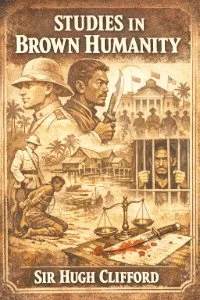
Studies in Brown Humanity: :Being Scrawls and Smudges in Sepia, White, and Yellow

By Hugh Clifford (Author), Graeme Newman (Introduction)

Studies in Brown Humanity by Sir Hugh Clifford is a striking collection of literary sketches drawn from the author’s experiences as a British colonial administrator in the Malay Peninsula during the late nineteenth century. Blending storytelling with observation, Clifford presents a series of vivid portraits of village life, local customs, personal conflicts, and dramatic encounters shaped by the social structures of colonial Southeast Asia. The narratives explore themes of honor, betrayal, justice, and authority, often focusing on moments when traditional Malay codes of conduct collide with the legal and moral framework imposed by the British colonial state.

Although written as literary sketches rather than formal social analysis, the book provides revealing insights into the ways communities understand wrongdoing and punishment. Clifford’s stories depict acts of violence, disputes over reputation, and conflicts between individuals and authority, illustrating how social norms, kinship ties, and communal expectations shape both criminal behavior and responses to it. In this sense, the work can be read not only as colonial literature but also as an early, informal contribution to the sociological study of crime and social control.

At the same time, Studies in Brown Humanity reflects the attitudes and assumptions of its imperial context. Clifford’s interpretations are filtered through the perspective of a European observer, and the book reveals much about the intellectual climate of the British Empire at the turn of the twentieth century. For modern readers, the volume is therefore both a vivid narrative of colonial life and a historical document that illuminates how crime, justice, and cultural difference were understood within the framework of empire.

Rich in atmosphere and dramatic detail, Clifford’s work remains valuable today as a window into the complex social worlds of colonial Southeast Asia and as a reminder of how early narratives about crime and punishment were shaped by the cultural and political conditions of their time.

Read-Me.Org Inc. New York-Philadelphia-Australia. 2026. 291p.

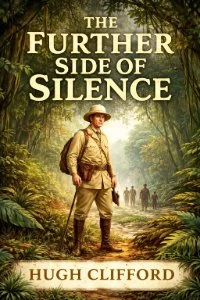
The Further Side of Silence

Sir Hugh Clifford, K. C. M. G.

The Further Side of Silence by Hugh Clifford is a collection of interrelated stories set in the Malay Peninsula during the late nineteenth century, a period when traditional Malay societies were increasingly encountering the expanding authority of the British Empire. Drawing heavily on Clifford’s own experiences as a colonial administrator in the region, the book portrays the lives, customs, conflicts, and moral dilemmas of the people who inhabited the jungles, villages, and royal courts of Malaya.

Through dramatic narratives and vivid descriptions of the tropical landscape, Clifford explores themes of loyalty, honor, justice, and power within a society shaped by ancient traditions and emerging colonial rule. His stories depict Malay chiefs, warriors, villagers, and forest peoples whose lives are entangled in political intrigue, personal rivalries, and the pressures of a changing world.

Part adventure literature and part social observation, the book offers modern readers a window into the cultural and political realities of Southeast Asia during a transformative historical moment. At the same time, it stands as an example of early twentieth-century colonial literature, reflecting both the fascination and the assumptions with which Western writers interpreted the societies they governed.

Read-Me.Org Inc. New York-Philadelphia-Australia. 2026. 198p.

Dr. NIKOLA - The Complete Saga: Volume 2


by Guy Boothby (Author), Graeme Newman (Editor), Colin Heston (Introduction)

. When the enigmatic Dr. Nikola first stepped onto the literary stage in 1895, clutching his sinister black cat Apollyon and weaving schemes that stretched from the back alleys of Shanghai to the hidden monasteries of Tibet, he didn't just capture the Victorian imagination—illegally or otherwise, he colonized it.
These volumes bring together, for the first time in a single definitive collection, the complete saga of Dr. Nikola: A Bid for Fortune, Dr. Nikola, The Lust of Hate, Dr. Nikola’s Experiment, and Farewell, Nikola. To read them in succession is to witness the birth of the modern "super-villain" and to appreciate the unique, rugged perspective Boothby brought to the crowded field of late-Victorian sensation fiction.
Born in Adelaide in 1867, Guy Newell Boothby was the son of a prominent South Australian parliamentarian. While he eventually found fame in the drawing rooms of London, his formative years were spent in the wide-open, often unforgiving landscapes of the Australian colonies.
In the 1890s, the literary world was reeling from "Sherlock-mania." While Sir Arthur Conan Doyle gave the world the ultimate champion of logic, Boothby gave it the ultimate agent of chaos. Dr. Nikola is not merely a criminal; he is a polymath, an occultist, and a man of immense physical and intellectual magnetism.
Across these five novels, we see Nikola evolve:
Volume 1:
A Bid for Fortune (1895): We are introduced to the Doctor through the eyes of Richard Hattasall. Here, Nikola is a vengeful shadow, a man whose "vendetta" drives a globe-trotting chase.
Dr. Nikola (1896): Arguably the centerpiece of the series, Boothby takes us into the forbidden heart of Tibet. It remains one of the finest examples of the "Lost World" genre, enriched by Stanley L. Wood’s iconic illustrations.
The Lust of Hate (1898): A darker, more psychological turn where Nikola manipulates a broken man’s desire for revenge.
Volume 2
Dr. Nikola’s Experiment (1899): Here, Boothby touches on the "mad scientist" tropes that would later define 20th-century sci-fi, as Nikola attempts to conquer death itself.
Farewell, Nikola (1901): The swan song of the character, providing a sense of closure to a man who lived his life in the liminal space between genius and madness.
Guy Boothby died tragically young at the age of 37, leaving behind a staggering 53 novels written in just over a decade. For years, his work languished in the shadows of more "academic" Victorian literature. However, as these works have entered the public domain, a new generation of readers—and editors—has rediscovered the sheer, unadulterated joy of his storytelling.
Boothby’s Dr. Nikola remains a vital link in the evolution of popular fiction. Without Nikola, would we have Sax Rohmer’s Fu Manchu? Would we have the sophisticated antagonists of James Bond? Probably not. By centering this edition on Boothby’s Australian roots, we acknowledge that the "King of Sensation" wasn't just a product of London’s Fleet Street, but a traveler of the world who brought the wild energy of the Antipodes to the heart of the Empire. This collection aims to preserve the thrill of the original serialization while providing the context necessary for a modern reader. As you follow the Doctor through the mist-shrouded streets of London and the sun-bleached ports of the Pacific, remember that you are in the hands of a master who knew those ports firsthand.
Welcome to the world of Dr. Nikola. Tread carefully—Apollyon is watching!

Read-Me.Org Inc. New York-Philadelphia-Australia. 2026. 292p.

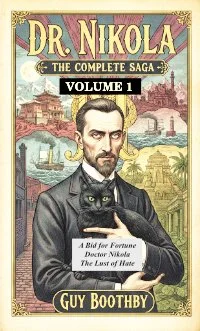
Dr. NIKOLA: The Complete Saga: Volume 1

by Guy Boothby (Author), Graeme Newman (Editor), Colin Heston (Introduction)

When the enigmatic Dr. Nikola first stepped onto the literary stage in 1895, clutching his sinister black cat Apollyon and weaving schemes that stretched from the back alleys of Shanghai to the hidden monasteries of Tibet, he didn't just capture the Victorian imagination—illegally or otherwise, he colonized it. Behind this towering figure of Gothic villainy was a prolific, whirlwind talent from the edge of the British Empire: the South Australian-born Guy Boothby.

These two volumes bring together, for the first time in a single definitive collection, the complete saga of Dr. Nikola: A Bid for Fortune, Dr. Nikola, The Lust of Hate, Dr. Nikola’s Experiment, and Farewell, Nikola. To read them in succession is to witness the birth of the modern "super-villain" and to appreciate the unique, rugged perspective Boothby brought to the crowded field of late-Victorian sensation fiction.

Born in Adelaide in 1867, Guy Newell Boothby was the son of a prominent South Australian parliamentarian. While he eventually found fame in the drawing rooms of London, his formative years were spent in the wide-open, often unforgiving landscapes of the Australian colonies. Unlike many of his contemporaries—who wrote of "The Orient" or the "South Seas" from the comfort of an English study—Boothby had the red dust of the Flinders Ranges and the salt of the Southern Ocean in his blood. In 1891, he and his brother famously crossed Australia from north to south, an arduous journey that informed the visceral, kinetic energy of his prose. This "Australian-ness" manifests in the Nikola series through a distinct lack of Victorian stuffiness; his heroes and villains alike are defined by their competence, their physical endurance, and a certain democratic grit that felt fresh to a British audience.

Guy Boothby died tragically young at the age of 37, leaving behind a staggering 53 novels written in just over a decade. For years, his work languished in the shadows of more "academic" Victorian literature. However, as these works have entered the public domain, a new generation of readers—and editors—has rediscovered the sheer, unadulterated joy of his storytelling. Boothby’s Dr. Nikola remains a vital link in the evolution of popular fiction. Without Nikola, would we have Sax Rohmer’s Fu Manchu? Would we have the sophisticated antagonists of James Bond? Probably not. By centering this edition on Boothby’s Australian roots, we acknowledge that the "King of Sensation" wasn't just a product of London’s Fleet Street, but a traveler of the world who brought the wild energy of the Antipodes to the heart of the Empire.

This collection published in two volumes aims to preserve the thrill of the original serialization while providing the context necessary for a modern reader. As you follow the Doctor through the mist-shrouded streets of London and the sun-bleached ports of the Pacific, remember that you are in the hands of a master who knew those ports firsthand.
Welcome to the world of Dr. Nikola. Tread carefully—Apollyon is watching!

Read-Me.Org Inc. New York-Philadelphia-Australia. 2026. 471p.

A Bid For Fortune: Dr. Nikola's Vendetta

by Guy Boothby (Author), Colin Heston (Introduction)

In the landscape of late-Victorian sensation fiction, few figures loom as large or as shadow-drenched as Dr. Nikola. Before the world had a definitive supervillain archetype, Guy Boothby introduced a mastermind who combined the cold intellect of Sherlock Holmes with the occult ambitions of a sorcerer. A Bid for Fortune, published in 1895 and often subtitled Dr. Nikola’s Vendetta, marks the debut of this iconic antagonist in a high-stakes adventure that spans the globe, moving restlessly from the dusty streets of Sydney to the high society of London and the secretive corners of the East.
The narrative follows Richard Hatteras, a rugged Australian sailor who finds himself accidentally entangled in a web of international intrigue. Hatteras is a man of action, yet he is fundamentally out of his depth when he crosses paths with the enigmatic Doctor. Nikola is not interested in mere petty theft or local power; he is obsessed with uncovering the ancient secrets of a mysterious Tibetan sect. To achieve his ends, he requires a specific Chinese stick—a relic of immense power—and he proves himself willing to manipulate, kidnap, and destroy anyone standing in his way.
Guy Boothby was a pioneer of the "Yellow Back" thrillers, and in Dr. Nikola, he created a character who fascinated readers as much as he terrified them. Accompanied by a massive, sinister black cat named Apollyon, Nikola is a master of science, hypnotism, and disguise, driven by a personal code that sits entirely outside conventional law. This work is more than a simple chase; it is a quintessential example of the "New Imperial" gothic style, blending the era's anxiety about the unknown with the thrill of global exploration.
Readers should prepare for a narrative that moves at a breakneck pace, as Boothby excels at building atmosphere through his descriptions of Nikola’s cat-like movements and calculated calm. As Hatteras attempts to protect the woman he loves while outmaneuvering a man who seems to see five steps ahead, the audience is invited into a world where the line between science and magic is dangerously thin. It is a story where the hero is constantly shadowed by a man who, as the text suggests, is just as dangerous to have as a friend as he is as an enemy.

Read-Me.Org Inc. New York-Philadelphia-Australia. 2026. 232p.

True Stories of Crime from the District Attorney’s Office

By Arthur Train. Introduction by Graeme R. Newman

The transition of the American legal system from the rough-and-tumble nineteenth century into the more structured, investigative era of the early twentieth century is nowhere more vividly captured than in Arthur Train’s True Stories of Crime from the District Attorney’s Office. As an Assistant District Attorney for New York County during a period of rapid urbanization and social upheaval, Train occupied a unique vantage point that allowed him to witness the collision of old-world criminal archetypes with the emerging complexities of modern life. This collection of narratives serves as a clinical yet deeply compelling autopsy of the era’s most notorious legal battles, offering readers a rare glimpse into the machinery of justice at a time when forensic science was in its infancy and the power of the prosecutor’s office was expanding into new, uncharted territories.

Train’s work is particularly significant for its early exploration of what would eventually be termed white-collar crime. While the public imagination of 1908 was often captured by tales of blunt violence and physical daring, Train directs his focus toward the "super-criminal"—the manipulative mastermind who utilized the administrative and financial structures of the city as their primary tools of exploitation. Through these accounts, we see the emergence of a new kind of threat that required a equally sophisticated response from the legal establishment. Train describes a landscape where economic desperation and social isolation were the primary drivers of criminal behavior, yet he also highlights the systemic vulnerabilities that allowed institutional fraud to flourish. By documenting these cases, he provides a foundation for the study of victimology, illustrating how the legal system often struggled to keep pace with the evolving ingenuity of those who sought to undermine it.

Beyond their historical and legal value, these stories possess a narrative vitality that reflects the tension between the sensationalism of early tabloid journalism and the rigorous demands of the courtroom. Train’s prose is informed by his experiences on the front lines of the District Attorney’s office, where the outcome of a trial often hinged as much on rhetorical flair and personal intuition as it did on physical evidence. In revisiting these cases today, we are invited to consider the persistent challenges of defining and delivering justice within a complex bureaucracy. Train does not shy away from the moral ambiguities of his profession, and his reflections on the nature of guilt and the limitations of the law remain strikingly relevant. This volume stands not only as a record of forgotten crimes but as an enduring meditation on the social fabric of a metropolis in flux, capturing the moment when the modern era of criminal justice truly began.

Read-Me.Org Inc. 2026. 184p.

The La Chance Mine Mystery

By S. Carleton. Introduction by Colin Heston.

The 1920 publication of The La Chance Mine Mystery by S. Carleton, the pseudonym for Susan Morrow Jones, represents a pivotal moment in the evolution of the North American thriller. By weaving the Victorian Gothic tradition into the rugged landscape of the Canadian wilderness, Carleton created a narrative that serves as a sophisticated precursor to modern psychological suspense. In contemporary literature, this work remains highly relevant as a masterclass in atmospheric isolation, where the "frozen North" acts not merely as a setting but as a primary antagonist. This technique mirrors modern "Environment as Character" tropes seen in current survivalist fiction, reminding readers that the primitive fear of being trapped in a vast, uncaring wilderness transcends technological advancement and remains a powerful literary hook.

From a criminological perspective, the novel offers a compelling study of frontier anomie. In the absence of formal state policing, the isolated mine becomes a vacuum where white-collar crimes like corporate fraud and title theft inevitably devolve into violence. This lack of social control forces characters into a state of informal justice, predating modern investigative frameworks through "bushcraft forensics." In an era before chemical analysis or DNA, Carleton’s characters rely on environmental reconstruction—analyzing the crust of snowdrifts or the set of a footprint—to determine the timing of a crime. This reliance on natural preservation within a crime scene provides a proto-historical look at how physical environment shapes both criminal opportunity and the subsequent forensic analysis used to untangle it.

The social dynamics of the mine also provide deep insights into early 20th-century victimology. Carleton highlights a hierarchy of vulnerability, focusing on how marginalized laborers and isolated individuals are targeted by those with institutional power. In this setting, victims are often chosen specifically because their disappearances can be conveniently blamed on the harsh climate rather than foul play. This exploration of "invisible victims" and structural exploitation resonates with modern social justice themes regarding labor and corporate overreach. By subverting the "hard-boiled" male tropes of her time, Carleton used her unique perspective as a female author to provide an emotional depth and keen eye for power imbalances that continue to inform the DNA of modern suspense and elevated horror.

Read-Me.Org Inc. New York-Philadelphia-Australia. 2026. 192p.

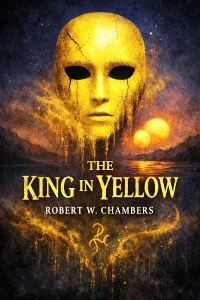
The King in Yellow

By ROBERT W. CHAMBERS. Introduction by Colin Heston

When The King in Yellow appeared in 1895, it slipped quietly into a literary world already saturated with decadence, occult enthusiasms, and the fin-de-siècle’s peculiar blend of anxiety and intoxication. Yet Robert W. Chambers’s strange mosaic of tales—united by a fictional forbidden play that unhinges those who read it—swiftly distinguished itself from its contemporaries. In the decades since, this slim volume has grown into one of the foundational works of the American weird tradition, prefiguring H. P. Lovecraft, influencing generations of modern horror writers, and unexpectedly resurfacing in the twenty-first century as a cultural touchstone.

What makes Chambers’s book so unusual is its deliberate blurring of boundaries: between reality and hallucination, sanity and delusion, art and contagion. The collection opens with “The Repairer of Reputations,” a tale set in an imagined New York of 1920—an unsettling mixture of futurism, authoritarian regulation, and manic delusion. It is here that the mysterious “King in Yellow” first exerts his influence. The narrator, a deeply unreliable figure, is convinced of his noble birthright and guided by an enigmatic “repairer” who traffics in scandal and blackmail. The narrative unfolds as a case study in self-deception, political paranoia, and the fragility of identity—yet nothing in the story is easily dismissed as mere fantasy. Reality itself buckles under the weight of the narrator’s convictions.

The Mask, perhaps the most haunting of the early tales, shifts the setting to the Latin Quarter of Paris, where art, science, and obsession converge. The grotesque beauty of Boris Yvain’s alchemical solution—capable of transforming living beings into flawless marble—creates a collision of aesthetics and mortality that typifies Chambers’s most powerful work. The story’s dreamlike quality reflects the decadent movement’s fascination with artificiality, transformation, and the erotic pull of the inanimate. Throughout, the shadow of the forbidden play hovers, never fully seen but always felt.

Other sections—“In the Court of the Dragon,” “The Yellow Sign,” and additional sketches—extend the book’s architecture of dread. Chambers never provides the text of the play itself, only its aftershocks, its “second act” whispered about as a psychic abyss from which there is no return. This structural absence is one of the book’s great innovations: The horror lies not in spectacle but in suggestion, in the void where meaning should be. The King in Yellow, the Pallid Mask, and the Lost City of Carcosa are not fully explained but instead exist as fragments of a mythology the reader assembles intuitively, as though the stories themselves are encoded with an infectious idea.

The power of The King in Yellow endures because it is not simply a collection of supernatural tales—it is a meditation on contagion: of ideas, of aesthetics, of inner instability. Chambers’s fictional play does not merely frighten; it corrodes. It reveals hidden fractures in those who encounter it and amplifies their darkest impulses. In this sense, the book mirrors its age. The 1890s were marked by the collapse of old certainties, the rise of new sciences of the mind, and an artistic fascination with decadence, degeneration, and the beautiful ruin of the self. Chambers captured that atmosphere with uncanny acuity.

Today, amidst digital conspiracies, fractured identities, and a renewed cultural fascination with alternate realities, The King in Yellow feels more relevant than ever. It invites the reader to step into a world where truth is unstable, where art is dangerous, and where the boundaries of perception are mercilessly thin. The book’s whispered mythology has become larger than the text itself, seeding later works, reappearing in unexpected media, and reminding us that the most enduring horrors are those we cannot fully see.

To open these stories is to risk a glimpse of the Yellow Sign—a symbol of beauty, madness, and forbidden knowledge. Chambers offers no assurances. He only extends an invitation to enter Carcosa, where twin suns sink over black waters and where, once the play begins, the mask cannot be removed.

Read-Me.Org Inc. New York-Philadelphia-Australia. 2026 p.209

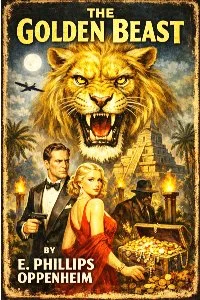
The Golden Beast

By E. Phillips Oppenheim. Introduction by Colin Heston.

When E. Phillips Oppenheim published The Golden Beast in 1926, he was already firmly established as the "Prince of Storytellers," a title earned by his uncanny ability to blend high-society glamour with the cold mechanics of crime. This novel, however, stands as a particularly striking waypoint in the history of the genre, moving beyond the simple "whodunnit" to explore the darker, more systemic shadows of the human psyche. For the modern reader, and especially for the student of criminology, the book serves as a fascinating precursor to contemporary theories on the intersection of power, wealth, and deviance.

The narrative significance of the work lies primarily in its early exploration of the "Power Elite" as a distinct criminal class. Long before modern criminology formalized the study of white-collar crime and corporate sociopathy, Oppenheim was illustrating how extreme financial leverage could create a vacuum of accountability. The "Beast" of the title is not merely a man, but a symbol of the socio-economic predator who views the law as an inconvenience to be bypassed rather than a boundary to be respected. This mirrors modern discussions on "moral insanity" in elite spaces, where the perpetrator’s perceived status grants them a psychological immunity to the social contract.

Furthermore, The Golden Beast captures a pivotal moment in forensic evolution. Written during a decade of rapid scientific advancement, the plot reflects the transition from Victorian-era intuition to the more clinical, methodical approach of forensic science. Oppenheim flirts with themes of biological erasure and chemical disposal, tapping into the 1920s anxiety that science, in the wrong hands, could facilitate the "perfect crime." It also ventures into early criminal profiling, as the narrative shifts focus from the physical evidence of the crime to the warped mental architecture of the criminal.

By examining the concept of the "disappearing victim," Oppenheim also prefigures modern victimology. He explores how a sophisticated offender can manipulate social structures to make an individual vanish not just physically, but legally and socially. This focus on the systemic nature of crime—how it is hidden, how it is financed, and how it is rationalized by the perpetrator—makes the novel an enduring piece of literature that remains relevant to our current understanding of the psychology of the super-criminal. It is a cautionary tale of a world where the law is always one step behind the man with the means to reinvent it.

Read-Me.Org Inc. New York-Philadelphia-Australia. 2026. p.255.

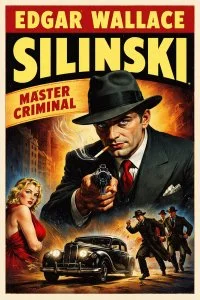
Silinski- Master Criminal

By Edgar Wallace. Introduction by Colin Heston

In Silinski – Master Criminal, Wallace constructs the titular character not as a creature of impulse, but as a precursor to the modern white-collar sociopath, defined by what can be termed "organized intellect." Unlike the flamboyant villains of Gothic tradition, Silinski’s power is derived from his mastery of systems—legal, financial, and social. He treats crime as a rigorous administrative discipline, employing a level of detachment that mirrors the very corporate structures he seeks to exploit. This intellectualization of villainy creates a chilling paradox: Silinski is most dangerous when he is at his most rational. Wallace highlights this by contrasting the frantic, reactive energy of the police with Silinski’s own glacial composure. His "mastery" is not merely a matter of successful theft, but of an informational asymmetry where he remains several steps ahead of the law by treating the world as a chessboard of predictable variables. Consequently, the tension of the novel arises not from the "whodunnit" element, but from the terrifying efficiency of a mind that has completely divorced morality from logic.
The conclusion of the narrative solidifies the "super-criminal" archetype not as a mere antagonist, but as a necessary mirror to the evolution of the modern state. By weaving together the threads of bureaucratic mastery and economic manipulation, Wallace posits that the transition of the criminal from the physical to the cerebral reflects a broader societal shift toward abstraction. Silinski represents the dark potential of the burgeoning 20th century: the realization that true power is no longer found in the strength of one's arm, but in the reach of one's influence over the systems that sustain public life. As the novel draws to its close, the resolution of the plot serves as a pyrrhic victory for the law, acknowledging that while one man may be stopped, the systemic vulnerabilities he exposed remain inherent to the fabric of global society. Ultimately, Silinski – Master Criminalstands as a definitive exploration of the modern villain, suggesting that in an age of complexity, the most profound threat to order is the very intelligence required to maintain it.

Read-Me.Org Inc. New York-Philadelphia-Australia. 2026. 188p.