Open Access Publisher and Free Library
CRIME+CRIMINOLOGY.jpeg

CRIME

Violent-Non-Violent-Cyber-Global-Organized-Environmental-Policing-Crime Prevention-Victimization

Posts in Analysis
Community supervision during Oregon’s partial decriminalization Measure 110: Criminal legal system involvement, overdose, and naloxone access

Bt Hope M. Smiley-McDonald,  Esther O. Chung , Lynn D. Wenger, Danielle Good , Gillian Leichtling c, Barrot H. Lambdin , Alex H. Kral 

Background

In 2020, the U.S. state of Oregon passed Measure 110 (M110), which aimed to address substance use disorder as a public health issue and reduce disparities in the criminal legal system by decriminalizing personal drug possession and increasing services. The impact of partial drug decriminalization on individuals under community supervision—whose release conditions often prohibit drug use and who M110 excluded—is understudied.

Methods

We used targeted sampling to recruit and survey people who use drugs (PWUD; N=468) in eight Oregon counties in 2023. We compared PWUD under community supervision to those who were not to assess opioid-related overdose, naloxone access, and law enforcement engagement.

Results

Compared to PWUD who were not under community supervision, those under supervision had higher prevalence of past year opioid-related overdose. There were no differences by naloxone access. Eighty-two percent (82%) of PWUD on community supervision were stopped by law enforcement in the past year. PWUD on community supervision were more likely than those not on community supervision to report in the past year being searched by law enforcement at least once (adjusted prevalence differences [APD]=0.33; 95% CI: 0.23, 0.43), spent time in jail at least once (APD=0.33; 95% CI: 0.23, 0.43), and to have concerns about getting into trouble if they called 911 for a drug-related health problem (APD=0.12; 95% CI: 0.00, 0.18).

Conclusion

Under M110, Oregon PWUD experienced more police engagement and overdoses. Findings have implications for less police presence at overdose scenes, greater access to naloxone and support services, and protections under future decriminalization laws.

Drug and Alcohol Dependence Reports

Available online 15 March 2026, 100430

In Press, Journal Pre-proof

The Federal Status of Marijuana and the Policy Gap with States

By Lisa N. Sacco, Joanna R. Lampe, Hassan Z. Sheikh

Marijuana is a psychoactive drug that generally consists of leaves and flowers of the cannabis sativa plant. It is a Schedule I controlled substance under the federal Controlled Substances Act (CSA; 21 U.S.C. §§801 et seq.), and thus is strictly regulated by federal authorities. In contrast, over the last several decades, most states and territories have deviated from a comprehensive prohibition of marijuana and have laws and policies allowing for some cultivation, sale, distribution, and possession of marijuana.


Marijuana is the most commonly used illicit drug in the United States. According to data from the National Survey on Drug Use and Health (NSDUH), in 2024 an estimated 64.2 million individuals aged 12 or older used marijuana in the past year, and 44.3 million reported using it in the past month. The percentage of individuals 12 or older who reported past-month marijuana use gradually increased from 6.1% in 2008 to 15.4% in 2024—a time frame during which a majority of states repealed state criminal prohibitions on marijuana and allowed for its recreational and/or medical use. The rate of past-month marijuana use among youth (ages 12-17) was 6.0% in 2024 and since 2008 has fluctuated from a low of 6.0% (in 2023 and 2024) to a high of 7.9% (in 2011), while adult (ages 18+) use steadily increased—from 6.3% in 2008 to 16.3% in 2024.


Washington, DC: Congressional Research Service; March 10, 2026.

Drugs Most Frequently Involved in Drug Overdose Deaths: United States, 2017–2023

By Matthew F. Garnett, Jodi A. Cisewski, Farida B. Ahmad

Objective:

This report identifies the specific drugs most frequently involved in drug overdose deaths in the United States from 2017 through 2023.

Methods:

Data from the 2017–2023 National Vital Statistics System mortality files were linked to literal text data from death certificates. Drug overdose deaths were identified using the International Classification of Diseases, 10th Revision underlying cause-of-death codes X40–X44, X60–X64, X85, and Y10–Y14. Specific drugs were identified by searching three literal text fields of the death certificate: the causes of death from Part I, significant conditions contributing to death from Part II, and the description of how the injury occurred. Contextual information was used to determine drug involvement in the death. Descriptive statistics were calculated for the most frequently mentioned drugs involved in drug overdose deaths. Deaths involving multiple drugs were counted in all relevant drug categories.

Results:

Among drug overdose deaths with mention of at least one specific drug, the most frequently mentioned drugs during 2017–2023 included: fentanyl, heroin, oxycodone, morphine, methadone, hydrocodone, alprazolam, diphenhydramine, cocaine, methamphetamine, amphetamine, gabapentin, and xylazine. Fentanyl ranked first across all years and was the most common concomitant drug found with other top drugs, ranging from 99.0% of xylazine-involved drug overdose deaths to 48.3% of oxycodone-involved drug overdose deaths. Cocaine and methamphetamine were also frequent concomitant drugs. Trends in age-adjusted rates across the 2017 to 2023 period varied by drug, but notably the rate for heroin-involved deaths sharply declined, while the rate for fentanyl-involved deaths increased and then stabilized between 2022 and 2023. In 2023, the most frequently mentioned drugs in unintentional drug overdose deaths were fentanyl, methamphetamine, and cocaine, while the most frequently mentioned drugs for suicide-related drug overdoses were diphenhydramine, oxycodone, and bupropion.

Conclusions:

This report identifies patterns in the specific drugs most frequently involved in drug overdose deaths from 2017 through 2023.National Vital Statistics Reports; CDC National Center for Health Statistics; 2026.

Outcomes and implications of British Columbia’s ‘drug decriminalization initiative’ for health-oriented drug policymaking

By lBenedikt Fischer,  Didier Jutras-Aswad, Bernard Le Foll, Daniel T. Myra

Highlights

The province of British Columbia (Canada) temporarily implemented a decriminalization initiative for personal drug possession/use (2023–2024) in contexts of a toxic drug death crisis.

  1. The decriminalization initiative was a priori promoted as a “tool to end the overdose crisis” and widely expected to reduce adverse health outcomes from toxic drug use.

  2. Emerging evaluation data indicate that the drug decriminalization initiative was not associated with population-level changes in drug use-related mortality (e.g., overdose deaths) or morbidity (e.g., hospitalizations).

  3. Drug use decriminalization remains an essential step to align prohibition-based drug policy frameworks with public health and human rights principles, but must be approached realistically and designed sensibly.

  4. To tangibly address toxic drug use-related harms, expanded measures are required that are effectively capable of preventing and reducing PWUDs’ exposure to and use of toxic drugs
    International Journal of Drug Policy

Volume 150, April 2026, 105181

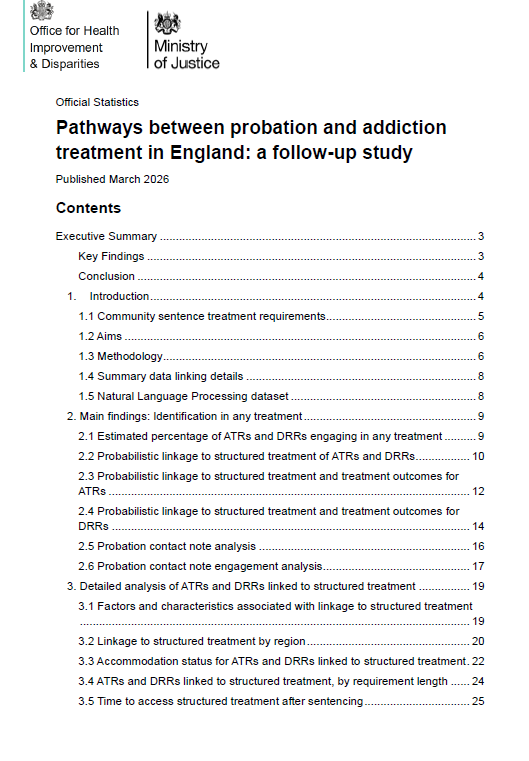
Pathways between probation and addiction treatment in England: a follow-up study

By the U.K.Ministry of Justice, and the Office of Health Improvement and Disparities


Executive Summary This report presents follow-up analysis building on Pathways between probation and addiction treatment in England: report - GOV.UK focusing on people sentenced to community orders (COs) and suspended sentence orders (SSOs) with an Alcohol Treatment Requirement (ATR) or Drug Rehabilitation Requirement (DRR). It examines engagement with alcohol and drug treatment, how engagement relates to reconvictions https://www.sciencedirect.com/science/article/pii/S0955395926000332 outcomes, and their characteristics. The analysis covers all ATRs and DRRs issued between August 2018 and March 2023. The study linked probation case management records with the National Drug Treatment Monitoring System (NDTMS) using probabilistic data linkage. This was supplemented by Natural Language Processing (NLP) analysis of probation contact notes. This approach aimed to assess whether the absence of ATRs and DRRs in structured treatment data reflected a true lack of treatment or gaps in data linkage. A total of 45,943 ATR and DRR requirements were issued during the period. Of these, 22,636 were linked to structured treatment through data linkage. The NLP approach derived an engagement rate from the unlinked sample. This was then applied to all unlinked records, resulting in an estimated 18,712 requirements with evidence of treatment engagement. Key Findings 1. Up to 90%1 of ATRs and DRRs were estimated to involve some form of treatment engagement. This is based on 49% linked to structured treatment through probabilistic data linking and an additional 41% of unlinked records showing treatment engagement in probation contact notes. Engagement was estimated to be higher for ATRs (93%) than for DRRs (88%). 2. Reconviction was less common following ATRs and DRRs linked to structured treatment. Within 12 months of sentencing, 36% of those linked to structured treatment were reconvicted, compared with 44% of those not linked to structured treatment. 

3. Characteristics associated with being more likely to be linked to structured treatment included being: • aged over 50 • female • in settled accommodation, (least likely when associated with rough sleeping) • engaged by treatment services within: 


▪ 3 weeks of an ATR, ▪ 3–6 weeks of a DRR 4. Reconviction outcomes varied by treatment outcome: • Reconvictions associated with ATRs and DRRs were lowest when they remained in structured treatment at the end of the observation period (13% for ATR; 26% for DRR). • Reconvictions associated with ATRs and DRRs were highest when they dropped out of structured treatment (41% for ATR; 60% for DRR). • Reconvictions associated with ATRs and DRRs that were not identified in structured treatment were higher than completed or remained in structured treatment but lower than those that dropped out of structured treatment (37% for ATR; 51% for DRR). Conclusion The analysis shows clear associations between treatment engagement and both individual characteristics and justice system factors. Individuals with ATRs and DRRs who completed or remained in structured treatment had better reconviction outcomes than those who dropped out of or had no identified structured treatment. This highlights the value of sustained engagement. The report also demonstrates the value of AI based NLP methods to strengthen insight by identifying treatment activity not captured through data linkage alone.

London: U.K. Ministry of Justice and the Office of Health Improvement and Disparities, 2026. 47p.

Local Rules, Global Lessons: How Criminal Governance Shapes Fentanyl Markets in Northern Mexico

By Steven Dudley, et al.


Although traditional synthetic opioid strongholds like the United States and Canada appear to be experiencing a stabilization of their illicit fentanyl market—evidenced by a historic reduction in overdose deaths 1—synthetic opioids continue to expand across the globe, creating widespread health and security concerns. Existing explanations for the rise and stabilization of these markets focus on economic incentives, supply-chain disruption, precursor controls, consumption patterns, and public-health interventions. But the role of organized crime in structuring retail distribution has been largely overlooked. The experience of Mexico’s northern border illustrates that local criminal governance can be a decisive factor in determining where and how new drug markets take root. Fentanyl, for example, has quietly reshaped drug markets in Mexico and upended some widely held assumptions of how larger criminal groups interact with these markets. As local criminal organizations became major producers and exporters of the synthetic opioid to the United States, domestic consumption also emerged in key trafficking corridors. In Tijuana and Mexicali in Baja California, Hermosillo and Nogales in Sonora, and Ciudad Juárez in Chihuahua, the transnational fentanyl economy has taken root locally, generating unprecedented public health and security pressures. This expansion, however, has been uneven, and the criminal actors who control local drug economies are far from monolithic. Across northern Mexico, fragmented local factions—sometimes linked to larger organizations, sometimes operating with considerable autonomy—determine what reaches consumers and under what conditions. Retail fentanyl markets have therefore expanded not simply in response to demand or price signals, but according to thestrategic decisions of local criminal groups. In Baja California, these groups actively promoted fentanyl sales, enabling the market to consolidate. In Sonoran cities and Ciudad Juárez, they restricted distribution, confining consumption to specific user niches.Overall, the impact on the ground has been substantial. The introduction of fentanyl triggered waves of overdose deaths and serious health effects among users. Although there are signs that the crisis may have stabilized in some areas, the risks persist, and the problem remains underestimated in official statistics, limiting the effectiveness of institutional responses that are already ill-equipped to address it. This report aims to provide a deeper understanding of this issue. It examines fentanyl consumption dynamics in the cities mentioned, traces the evolution of the market, and outlines the distribution networks that sustain it. Additionally, it analyzes the models of criminal control over local drug markets and assesses the state’s response to date. A central question running through the analysis is why fentanyl did not spread uniformly across these cities and what role local criminal structures played in that divergence.

Washington DC: Insight Crime, 2026. 66p.

Your Money or Your Life:  London’s Knife Crime, Robbery and Street Theft Epidemic 

By David Spencer

A new report from Policy Exchange demonstrates how London is in the grip of a street crime epidemic and makes seventeen recommendations to show how the Metropolitan Police, City Hall and the Government can turn the tide.  

The report shows that:

  • Knife crime in London increased by 58.5% in only three years between 2021 and 2024;

  • Only 1 in 20 robberies and 1 in 170 “theft person” crimes in the capital were solved last year.

  • 60% of the knife crimes committed in the capital were robberies – with over 81,000 mobile phones stolen in robberies and thefts last year.

  • In 2024 one small geographic area of around 20 streets in London’s West End near Oxford Circus and Regent Street had more knife crime than nearly 15% of the rest capital combined; in 2023 these streets had more knife crime than 23% of the capital combined.

  •  

 The report identifies the top 20 neighbourhoods (technically known as Lower Layer Super Output Areas or LSOAs of about 15-20 streets each) in London which had the highest levels of knife crime in 2024. One in 15 of every knife crime offence in the capital in 2024 occurred in one of these 20 neighbourhoods (908 knife crimes). In 2024 only 4% of neighbourhoods accounted for nearly a quarter of all knife crime offences in the capital (3,615 knife crimes) and 15% of neighbourhoods accounted for half of all knife crime offences (7055 knife crimes).

The report identifies that within the Metropolitan Police there are least 850 police officers currently in non-frontline posts which could be redeployed to the policing frontline to tackle knife crime, robbery and theft in the areas where criminals are most prolific. This includes police officers currently posted to the following departments: Transformation (142 officers), Human Resources (24 officers), Culture, Diversity and Inclusion (20 officers) and Digital, Data & Technology (34 officers).  

Policy Exchange rejects the suggestion that stop and search is being deployed in a “racist” way. While only 39.5% of those stopped and searched by the police are black, 43.6% of those charged with murder are black, 45.6% of non-domestic knife-crime murder victims are black and 48.6% of robbery suspects are black. 13.5% of London’s population are black. Policy Exchange asserts that it is not “racist” when the police are merely responding to the demographic breakdown of serious and violent offending in the capital.  

Policy Exchange analysis shows that the courts are taking a dangerously lax approach to the most prolific criminals. Despite already having 46 or more previous convictions, “Hyper-Prolific Offenders” are sent to prison on less than half of all occasions (44.5%) on conviction for a further indictable or either-way offence – 4,555 such criminals walked free from court in 2024. For “Super-Prolific Offenders” (those with 26 to 45 previous offences) this falls to 42.1% with 9,483 such criminals walking free from court in 2024. Despite there being mandatory sentencing provisions for repeat knife-carriers to be sent to prison over a third are not sentenced to a term of immediate custody

Examining the Social and Psychological Impact of Deepfakes: Rapid Evidence Review

By Crest Advisory

Crest Advisory was commissioned by the Accelerated Capability Environment (ACE) on behalf of the Office of the Police Chief Scientific Adviser (OPCSA) to conduct research examining the social and psychological impacts of deepfakes on victims, with a focus on violence against women and girls (VAWG). This rapid evidence review compiles relevant literature which informed our lines of enquiry and refined the scope of our primary research and engagement, including a public attitudes survey. This document has been iterated throughout the commission to ensure it is up to date at the time of writing (July 2025) and captures relevant emerging literature. Deepfakes refer to any audio, image or video which has been digitally altered using machine learning methods. This includes fraudulent, political, or humorous content, as well as intimate images and pornography. However, in line with the focus of this commission, our evidence review focuses on deepfake violence against women and girls (VAWG). This focus reflects evidence that the vast majority of deepfake videos are sexualised in nature, with women being the disproportionate target of this abuse.

The right to be free of corruption: A new frontier in anti-corruption approaches through national courts

By Naomi Roht-Arriaza

Courts in several jurisdictions have recognised corruption as a direct human rights violation, enabling broader legal standing, integrating international law and focusing on victims. Case studies, predominantly from Latin America, illustrate different legal theories used to hold officials accountable and expand access to justice in anti-corruption proceedings. Consequently, the formulation of a stand-alone right has merit despite limitations.

CONTRABAND TOBACCO: SYSTEMATIC PROFILING OF CIGARETTE PACKS FOR FORENSIC INTELLIGENCE

By Laurie Caron, Frank Crispino and Cyril Muehlethaler

Tobacco smuggling remains a widespread illegal activity in Canada, associated with important social and economic impacts, and often linked to organized crime. This study explores the application of forensic profiling as an intelligence tool to support the analysis of contraband cigarette production and distribution. Physical and chemical manufacturing characteristics of seized contraband cigarette packs, provided by the Canada Border Services Agency (CBSA), were observed and coded using macroscopic, microscopic, and spectroscopic techniques. Multivariate statistical analyses were then conducted to compare manufacturing characteristics between packs and identify potential links. The analyses highlighted links between cigarette packs and seizures based on shared manufacturing characteristics. The results and the identified groups were also compared with seizure data provided by the CBSA. The results demonstrate the relevance of forensic profiling to formulate hypotheses regarding shared production processes or supply networks. These hypotheses provide information that contributes to understanding tobacco smuggling and aim to examine how forensic intelligence can support law enforcement and measures to prevent and disrupt this criminal activity. A preliminary optimal procedure for applying forensic profiling in operational contexts targeting contraband tobacco was finally proposed. Despite limitations in the dataset creation that were beyond our control, this study represents a starting point for applying this scientific approach to tobacco smuggling

Uncovering the Biological Toll of Neighborhood Disorder Trajectories: New Evidence Using Machine Learning Methods and Biomarkers in Older Adults

By Jiao Yu Thomas, K.M. Cudjoe , Walter S. Mathis, Xi Chenao 

This study examined the link between neighborhood disorder trajectories and metabolic and inflammatory biomarkers in U.S. older adults. We analyzed data from community-dwelling Medicare beneficiaries in the National Health and Aging Trends Study. Neighborhood physical disorder was assessed annually through interviewer observations over six years. Latent class analysis was used to identify exposure trajectory subgroups. Machine learning based inverse probability weighted (IPW) regression models were conducted to estimate associations with five biomarkers, including body mass index (BMI), waist circumference, hemoglobin A1C (HbA1c), high-sensitivity C-reactive protein (hsCRP), and interleukin-6 (IL-6). Compared to the stable low exposure group, older adults with increased exposure, decreased exposure, and stable high exposure exhibited higher levels of HbA1c. Only stable high exposure was associated with increased hsCRP. No significant associations were found for other biomarke rs. Residential environments play an important role in shaping the biological risk of aging. Incorporating routine screening for neighborhood environmental risks and implementing community-level interventions are pivotal in promoting healthy aging in place.

Female Empowerment and Intimate Partner Violence

By Elisabetta Calabresi and Núria Rodríguez-Planas

The chapter reviews the economic literature on intimate partner violence (IPV), a widespread human rights violation affecting nearly one in three women globally and generating significant societal costs. It focuses on the relationship between various dimensions of female empowerment and IPV. The chapter begins by outlining key theoretical frameworks—including household bargaining, instrumental violence, male backlash, and exposure theories—as well as the main data sources used to study IPV. It then reviews empirical evidence on how factors shaping female empowerment at the individual, relationship, community, and societal levels influence IPV outcomes. Central themes include labor market dynamics, education, income shocks, family formation, legal frameworks, institutional access, and gender norms. The chapter also considers how these factors interact across levels and discusses additional drivers of IPV not directly linked to female empowerment. The goal is to provide an overview of causal evidence from the economic literature on IPV while emphasizing its complexity and the importance of a context-specific, intersectional approach to both its analysis and prevention.

Parental Leave and Intimate Partner Violence

By Dan Anderberg. Line Hjorth Andersen,  N.Meltem Daysal, Mette Ejrnæs

We examine the impact of a 2002 Danish parental leave reform on intimate partner violence (IPV) using administrative data on assault-related hospital contacts. Using a regression discontinuity design, we show that extending fully paid leave increased mothers’ leave-taking and substantially reduced IPV, with effects concentrated among less-educated women. The reform also lengthened birth spacing, while separations remained unchanged and earnings effects were modest. The timing and heterogeneity of impacts point to fertility adjustments—rather than exit options or financial relief—as the key mechanism. Parental leave policy thus emerges as an underexplored lever for reducing IPV.

2025 ACADEMIC ASSOCIATION INTEGRITY INDEX: THE STATE OF ANTISEMITISM IN PROFESSIONAL ACADEMIC ASSOCIATIONS

By The Anti-Defamation League


The State of Antisemitism in Professional Academic Associations, reveals a problem that extends far beyond faculty meetings or disciplinary debates. When bias takes hold in professional academic associations, it shapes the ideas, frameworks, and standards that guide entire fields and seeps into curricula, research, and public discourse, quietly shaping how students, future professionals and the wider public interpret the world. Simply put, the consequences of this reach everyone.

By assessing where antisemitism persists – and how associations are responding – RAI’s 2025 report provides both a warning and a path forward: to ensure that academic spaces remain not only intellectually rigorous, but also ethically sound, inclusive and accountable to the public they ultimately serve – and to the scholars who call these associations their academic homes.


Sovereignty and the Environment: complaints of environmental crimes and the protection of indigenous peoples as mechanisms of international constraint to Brazil

By Tássio Franchi

The text discusses, in an exploratory way, how the environmental issue related to the Brazilian Amazon attracts international attention and potentially serves as a mechanism of external constraint in Brazil’s internal affairs. Complaints of environmental crimes and crimes against indigenous peoples are debated in the international political environment, without considering Brazilian sovereignty on these and other topics. In some cases, such debates are used, as pretexts, to halt negotiations of trade agreements beneficial to the country. In summary, the text explores the concept of national sovereignty in the face of global pressures and the impacts of international agendas on Brazilian government action, pointing out that there are complexities and nuances of this geopolitical interaction, in addition to the common good of environmental preservation or the protection of indigenous peoples. 


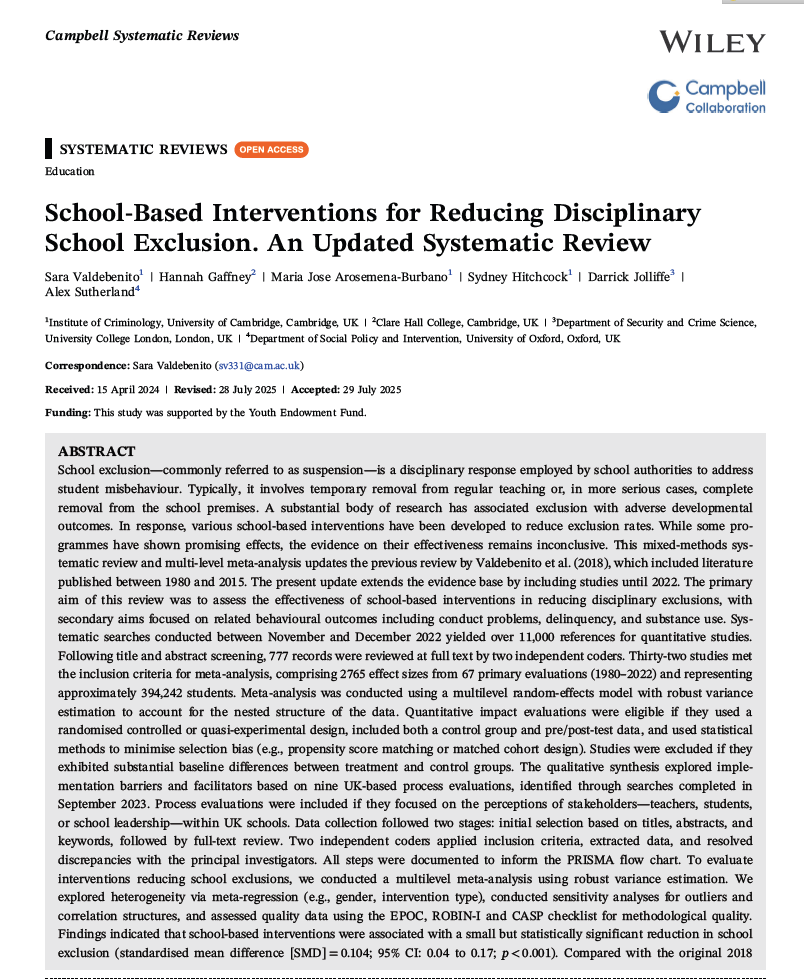
School-Based Interventions for Reducing Disciplinary School Exclusion. An Updated Systematic Review

By

Sara Valdebenito, Hannah Gaffney, Maria Jose Arosemena-Burbano, Sydney Hitchcock, Darrick Jolliffe, Alex Sutherland

School exclusion—commonly referred to as suspension—is a disciplinary response employed by school authorities to address student misbehaviour. Typically, it involves temporary removal from regular teaching or, in more serious cases, complete removal from the school premises. A substantial body of research has associated exclusion with adverse developmental outcomes. In response, various school-based interventions have been developed to reduce exclusion rates. While some programmes have shown promising effects, the evidence on their effectiveness remains inconclusive. This mixed-methods systematic review and multi-level meta-analysis updates the previous review by Valdebenito et al. (2018), which included literature published between 1980 and 2015. The present update extends the evidence base by including studies until 2022. The primary aim of this review was to assess the effectiveness of school-based interventions in reducing disciplinary exclusions, with secondary aims focused on related behavioural outcomes including conduct problems, delinquency, and substance use. Systematic searches conducted between November and December 2022 yielded over 11,000 references for quantitative studies. Following title and abstract screening, 777 records were reviewed at full text by two independent coders. Thirty-two studies met the inclusion criteria for meta-analysis, comprising 2765 effect sizes from 67 primary evaluations (1980–2022) and representing approximately 394,242 students. Meta-analysis was conducted using a multilevel random-effects model with robust variance estimation to account for the nested structure of the data. Quantitative impact evaluations were eligible if they used a randomised controlled or quasi-experimental design, included both a control group and pre/post-test data, and used statistical methods to minimise selection bias (e.g., propensity score matching or matched cohort design). Studies were excluded if they exhibited substantial baseline differences between treatment and control groups. The qualitative synthesis explored implementation barriers and facilitators based on nine UK-based process evaluations, identified through searches completed in September 2023. Process evaluations were included if they focused on the perceptions of stakeholders—teachers, students, or school leadership—within UK schools. Data collection followed two stages: initial selection based on titles, abstracts, and keywords, followed by full-text review. Two independent coders applied inclusion criteria, extracted data, and resolved discrepancies with the principal investigators. All steps were documented to inform the PRISMA flow chart. To evaluate interventions reducing school exclusions, we conducted a multilevel meta-analysis using robust variance estimation. We explored heterogeneity via meta-regression (e.g., gender, intervention type), conducted sensitivity analyses for outliers and correlation structures, and assessed quality data using the EPOC, ROBIN-I and CASP checklist for methodological quality. Findings indicated that school-based interventions were associated with a small but statistically significant reduction in school exclusion (standardised mean difference [SMD] = 0.104; 95% CI: 0.04 to 0.17; p < 0.001). Compared with the original 2018 review, which reported a slightly larger effect size, this update benefits from a broader evidence base and more advanced statistical modelling. However, the results for secondary behavioural outcomes were more limited: effects on conduct problems and delinquency were negligible or non-significant, and the impact on substance use was small and not statistically significant. Risk of bias was assessed using the Cochrane EPOC 2 tool (Higgins and Green 2011) for randomised controlled trials and ROBINS-I (Sterne et al. 2016) for quasi-experimental designs. Randomised studies generally exhibited lower risk of bias, while quasi-experimental studies showed greater variability in quality. Four major themes emerged from the analysis. First, intervention format mattered: flexible, collaborative, and well-structured interventions facilitated implementation, while outdated materials or content misaligned with local context impeded delivery. Second, consistency in school policies and practice enabled smoother implementation, whereas inconsistency acted as a barrier. Third, staff buy-in—particularly among senior leaders—was essential for successful implementation, although resistance from more experienced staff was noted. Finally, perceived effectiveness played a motivational role: visible improvements in pupil behaviour supported continued engagement with the intervention. In summary, the updated review finds that school-based interventions can modestly but significantly reduce school exclusions. While more serious disciplinary sanctions such as permanent exclusions and out-of-school suspensions appear less responsive, in-school exclusion shows greater potential for reduction. Impacts on other behavioural outcomes remain limited. These findings suggest that targeted, context-sensitive interventions supported by strong implementation strategies and whole-school engagement are most likely to achieve sustained reductions in school exclusion.


Evaluating the Texas Risk Assessment System (TRAS) Predictors of Revocation and Early Release in Adult Felony Probation

By Sarah A. El Sayeda, Carley R. Sheltonb, and Michael F. TenEyck

Although much is known about recidivism risk, less is known about factors predicting early release. The current study analyses a sample of 2,070 adult felony probation clients to see if offense characteristics, domains from the Texas Risk Assessment System (TRAS), and demographic variables impact both revocation and successful early release. Results revealed that predictors of early release mirrored those of revocation with one exception—race. Specifically, Black clients were 27% less likely to be granted early release. The findings highlight the TRAS is an effective tool to help mitigate bias for revocation of probation but not for granting early release.

Rikers Island and Mental Health: Pathways Toward Community-Based Diversion and Jail Population Reduction

By

María Fernanda Rodríguez, Nicolás Espejo Yaksic

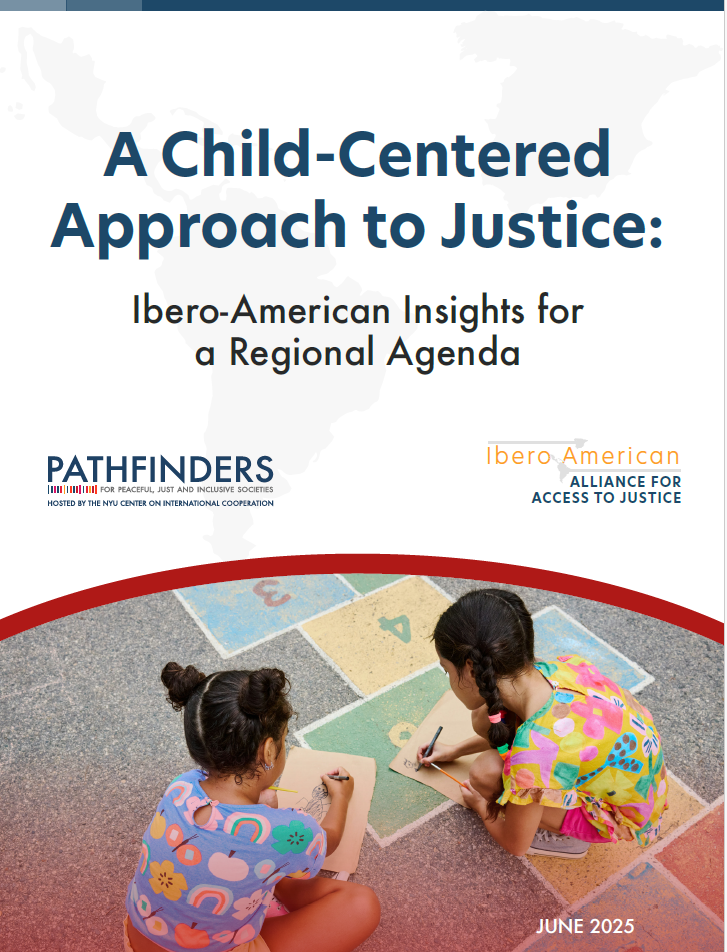
The IBA assumed the challenge of contributing to a profound and urgent transformation, under the conviction that protecting the rights of children is not only a legal and ethical obligation, but also an essential investment in strengthening the rule of law.

As such, this report highlights existing challenges as well as good practices and proposes a roadmap to advance toward a child-centered justice system, as part of the commitment to leave no one behind within the framework of the 2030 Agenda.

Likewise, the report seeks to be a tool for articulation. A meeting point for governments, the judiciary, ombudsmen, prosecutors, civil society, academia, international organizations, but most importantly, for the voices of children and adolescents.

The preparation of this report involved participants from the justice ecosystem across the region. In line with this collective effort, the report includes a detailed analysis of the drafting process of the Ibero-American Common Rules on Restorative Juvenile Criminal Justice, led by the main justice networks and regional bodies.

The report is divided up into the following sections:

Section 1–Regional Context

Section 2–Access to Justice and the Development Agenda: People-Centered and Child-Centered Justice

Section 3–Principles of Child-Centered Justice: Progress in the Region

Section 4–Vision and Regional Agenda


THE MUSLIM BROTHERHOOD’S STRATEGIC ENTRYISM INTO THE UNITED STATES: A SYSTEMIC ANALYSIS

By The Institute for the Study of Global Antisemitism and Policy (ISGAP)

This study investigates the Muslim Brotherhood’s strategy of “civilizational struggle” (jihad) in Western society, with a specific focus on the United States. By analyzing primary documents, including the “Explanatory Memorandum” (1991) and “The Project” (1982), along with comparative historical analysis, it traces the development of the Brotherhood’s doctrine of tamkeen (institutional entrenchment) from its theoretical roots in early twentieth-century Egypt to its more advanced practical application in the United States. The study identifies and thoroughly analyzes four strategic domains of influence: policy impact through government entryism and coalition-building; manipulation of the legal framework via lawfare and the redefinition of core concepts; institutional infiltration across educational and civil society organizations; and the establishment of narrative control through media influence and discourse shaping. Multiple detailed case studies within each domain show how Brotherhoodaligned groups have executed these strategies across different countries and historical periods. The analysis in this study, supported by extensive documentary evidence and organizational network assessments, demonstrates that the Muslim Brotherhood’s long-term strategy is a deliberate, multigenerational effort that closely aligns with its founders’ vision of gradually transforming Western society from within, primarily through nonviolent means. Ideologically speaking, it is also fundamentally opposed to Western democratic values and governance systems. This study offers an important assessment of the key strategic objectives of Islamist extremism and ideological entryism within democratic systems by the Muslim Brotherhood, as well as the intersection of Islamist extremism with religious identity politics that exploit democratic principles, multicultural respect for diversity, and transnational movements in an era of globalization and information warfare. The study concludes with an assessment of the challenges faced by policymakers, security professionals, and civil society leaders who aim to protect democratic values while respecting religious freedoms. In a nutshell, it states that effective responses need to balance security concerns with civil liberties, differentiate between genuine religious practice and ideological extremism, and create more sophisticated frameworks for understanding and addressing radical Islamism.

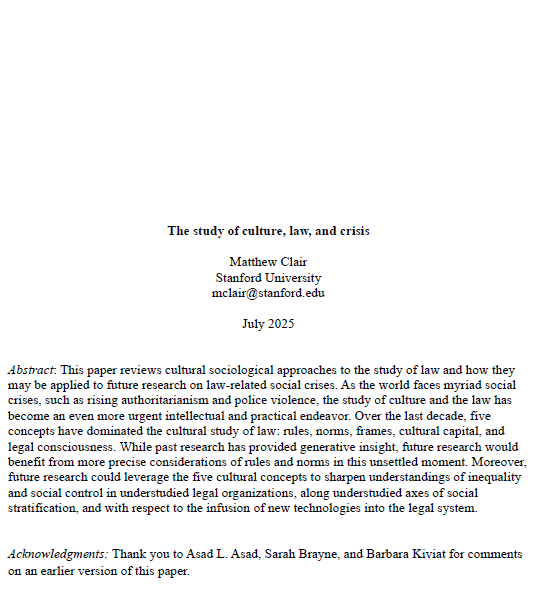
The study of culture, law, and crisis

By Matthew Clair

Abstract: This paper reviews cultural sociological approaches to the study of law and how they may be applied to future research on law-related social crises. As the world faces myriad social crises, such as rising authoritarianism and police violence, the study of culture and the law has become an even more urgent intellectual and practical endeavor. Over the last decade, five concepts have dominated the cultural study of law: rules, norms, frames, cultural capital, and legal consciousness. While past research has provided generative insight, future research would benefit from more precise considerations of rules and norms in this unsettled moment. Moreover, future research could leverage the five cultural concepts to sharpen understandings of inequality and social control in understudied legal organizations, along understudied axes of social stratification, and with respect to the infusion of new technologies into the legal system.