Open Access Free Library
CRIME+CRIMINOLOGY.jpeg

CRIME

Violent-Non-Violent-Cyber-Global-Organized-Environmental-Policing-Crime Prevention-Victimization

Posts in Abuse
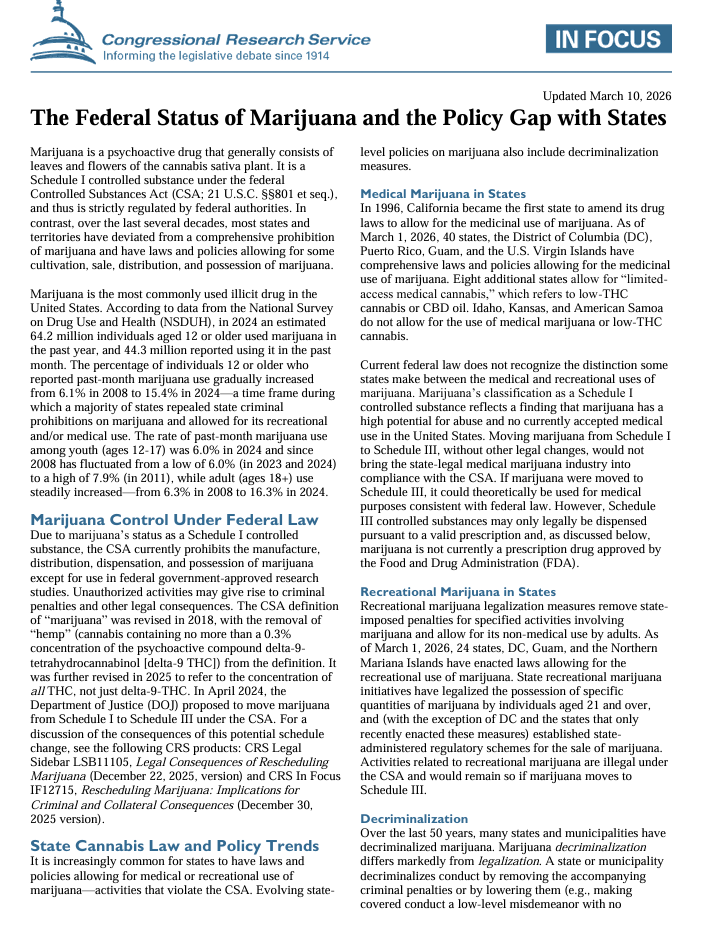
The Federal Status of Marijuana and the Policy Gap with States

By Lisa N. Sacco, Joanna R. Lampe, Hassan Z. Sheikh

Marijuana is a psychoactive drug that generally consists of leaves and flowers of the cannabis sativa plant. It is a Schedule I controlled substance under the federal Controlled Substances Act (CSA; 21 U.S.C. §§801 et seq.), and thus is strictly regulated by federal authorities. In contrast, over the last several decades, most states and territories have deviated from a comprehensive prohibition of marijuana and have laws and policies allowing for some cultivation, sale, distribution, and possession of marijuana.


Marijuana is the most commonly used illicit drug in the United States. According to data from the National Survey on Drug Use and Health (NSDUH), in 2024 an estimated 64.2 million individuals aged 12 or older used marijuana in the past year, and 44.3 million reported using it in the past month. The percentage of individuals 12 or older who reported past-month marijuana use gradually increased from 6.1% in 2008 to 15.4% in 2024—a time frame during which a majority of states repealed state criminal prohibitions on marijuana and allowed for its recreational and/or medical use. The rate of past-month marijuana use among youth (ages 12-17) was 6.0% in 2024 and since 2008 has fluctuated from a low of 6.0% (in 2023 and 2024) to a high of 7.9% (in 2011), while adult (ages 18+) use steadily increased—from 6.3% in 2008 to 16.3% in 2024.


Washington, DC: Congressional Research Service; March 10, 2026.
Drugs Most Frequently Involved in Drug Overdose Deaths: United States, 2017–2023

By Matthew F. Garnett, Jodi A. Cisewski, Farida B. Ahmad

Objective:

This report identifies the specific drugs most frequently involved in drug overdose deaths in the United States from 2017 through 2023.

Methods:

Data from the 2017–2023 National Vital Statistics System mortality files were linked to literal text data from death certificates. Drug overdose deaths were identified using the International Classification of Diseases, 10th Revision underlying cause-of-death codes X40–X44, X60–X64, X85, and Y10–Y14. Specific drugs were identified by searching three literal text fields of the death certificate: the causes of death from Part I, significant conditions contributing to death from Part II, and the description of how the injury occurred. Contextual information was used to determine drug involvement in the death. Descriptive statistics were calculated for the most frequently mentioned drugs involved in drug overdose deaths. Deaths involving multiple drugs were counted in all relevant drug categories.

Results:

Among drug overdose deaths with mention of at least one specific drug, the most frequently mentioned drugs during 2017–2023 included: fentanyl, heroin, oxycodone, morphine, methadone, hydrocodone, alprazolam, diphenhydramine, cocaine, methamphetamine, amphetamine, gabapentin, and xylazine. Fentanyl ranked first across all years and was the most common concomitant drug found with other top drugs, ranging from 99.0% of xylazine-involved drug overdose deaths to 48.3% of oxycodone-involved drug overdose deaths. Cocaine and methamphetamine were also frequent concomitant drugs. Trends in age-adjusted rates across the 2017 to 2023 period varied by drug, but notably the rate for heroin-involved deaths sharply declined, while the rate for fentanyl-involved deaths increased and then stabilized between 2022 and 2023. In 2023, the most frequently mentioned drugs in unintentional drug overdose deaths were fentanyl, methamphetamine, and cocaine, while the most frequently mentioned drugs for suicide-related drug overdoses were diphenhydramine, oxycodone, and bupropion.

Conclusions:

This report identifies patterns in the specific drugs most frequently involved in drug overdose deaths from 2017 through 2023.National Vital Statistics Reports; CDC National Center for Health Statistics; 2026.

Outcomes and implications of British Columbia’s ‘drug decriminalization initiative’ for health-oriented drug policymaking

By lBenedikt Fischer,  Didier Jutras-Aswad, Bernard Le Foll, Daniel T. Myra

Highlights

The province of British Columbia (Canada) temporarily implemented a decriminalization initiative for personal drug possession/use (2023–2024) in contexts of a toxic drug death crisis.

  1. The decriminalization initiative was a priori promoted as a “tool to end the overdose crisis” and widely expected to reduce adverse health outcomes from toxic drug use.

  2. Emerging evaluation data indicate that the drug decriminalization initiative was not associated with population-level changes in drug use-related mortality (e.g., overdose deaths) or morbidity (e.g., hospitalizations).

  3. Drug use decriminalization remains an essential step to align prohibition-based drug policy frameworks with public health and human rights principles, but must be approached realistically and designed sensibly.

  4. To tangibly address toxic drug use-related harms, expanded measures are required that are effectively capable of preventing and reducing PWUDs’ exposure to and use of toxic drugs
    International Journal of Drug Policy

Volume 150, April 2026, 105181

Pathways between probation and addiction treatment in England: a follow-up study

By the U.K.Ministry of Justice, and the Office of Health Improvement and Disparities


Executive Summary This report presents follow-up analysis building on Pathways between probation and addiction treatment in England: report - GOV.UK focusing on people sentenced to community orders (COs) and suspended sentence orders (SSOs) with an Alcohol Treatment Requirement (ATR) or Drug Rehabilitation Requirement (DRR). It examines engagement with alcohol and drug treatment, how engagement relates to reconvictions https://www.sciencedirect.com/science/article/pii/S0955395926000332 outcomes, and their characteristics. The analysis covers all ATRs and DRRs issued between August 2018 and March 2023. The study linked probation case management records with the National Drug Treatment Monitoring System (NDTMS) using probabilistic data linkage. This was supplemented by Natural Language Processing (NLP) analysis of probation contact notes. This approach aimed to assess whether the absence of ATRs and DRRs in structured treatment data reflected a true lack of treatment or gaps in data linkage. A total of 45,943 ATR and DRR requirements were issued during the period. Of these, 22,636 were linked to structured treatment through data linkage. The NLP approach derived an engagement rate from the unlinked sample. This was then applied to all unlinked records, resulting in an estimated 18,712 requirements with evidence of treatment engagement. Key Findings 1. Up to 90%1 of ATRs and DRRs were estimated to involve some form of treatment engagement. This is based on 49% linked to structured treatment through probabilistic data linking and an additional 41% of unlinked records showing treatment engagement in probation contact notes. Engagement was estimated to be higher for ATRs (93%) than for DRRs (88%). 2. Reconviction was less common following ATRs and DRRs linked to structured treatment. Within 12 months of sentencing, 36% of those linked to structured treatment were reconvicted, compared with 44% of those not linked to structured treatment. 

3. Characteristics associated with being more likely to be linked to structured treatment included being: • aged over 50 • female • in settled accommodation, (least likely when associated with rough sleeping) • engaged by treatment services within: 


▪ 3 weeks of an ATR, ▪ 3–6 weeks of a DRR 4. Reconviction outcomes varied by treatment outcome: • Reconvictions associated with ATRs and DRRs were lowest when they remained in structured treatment at the end of the observation period (13% for ATR; 26% for DRR). • Reconvictions associated with ATRs and DRRs were highest when they dropped out of structured treatment (41% for ATR; 60% for DRR). • Reconvictions associated with ATRs and DRRs that were not identified in structured treatment were higher than completed or remained in structured treatment but lower than those that dropped out of structured treatment (37% for ATR; 51% for DRR). Conclusion The analysis shows clear associations between treatment engagement and both individual characteristics and justice system factors. Individuals with ATRs and DRRs who completed or remained in structured treatment had better reconviction outcomes than those who dropped out of or had no identified structured treatment. This highlights the value of sustained engagement. The report also demonstrates the value of AI based NLP methods to strengthen insight by identifying treatment activity not captured through data linkage alone.

London: U.K. Ministry of Justice and the Office of Health Improvement and Disparities, 2026. 47p.

Local Rules, Global Lessons: How Criminal Governance Shapes Fentanyl Markets in Northern Mexico

By Steven Dudley, et al.


Although traditional synthetic opioid strongholds like the United States and Canada appear to be experiencing a stabilization of their illicit fentanyl market—evidenced by a historic reduction in overdose deaths 1—synthetic opioids continue to expand across the globe, creating widespread health and security concerns. Existing explanations for the rise and stabilization of these markets focus on economic incentives, supply-chain disruption, precursor controls, consumption patterns, and public-health interventions. But the role of organized crime in structuring retail distribution has been largely overlooked. The experience of Mexico’s northern border illustrates that local criminal governance can be a decisive factor in determining where and how new drug markets take root. Fentanyl, for example, has quietly reshaped drug markets in Mexico and upended some widely held assumptions of how larger criminal groups interact with these markets. As local criminal organizations became major producers and exporters of the synthetic opioid to the United States, domestic consumption also emerged in key trafficking corridors. In Tijuana and Mexicali in Baja California, Hermosillo and Nogales in Sonora, and Ciudad Juárez in Chihuahua, the transnational fentanyl economy has taken root locally, generating unprecedented public health and security pressures. This expansion, however, has been uneven, and the criminal actors who control local drug economies are far from monolithic. Across northern Mexico, fragmented local factions—sometimes linked to larger organizations, sometimes operating with considerable autonomy—determine what reaches consumers and under what conditions. Retail fentanyl markets have therefore expanded not simply in response to demand or price signals, but according to thestrategic decisions of local criminal groups. In Baja California, these groups actively promoted fentanyl sales, enabling the market to consolidate. In Sonoran cities and Ciudad Juárez, they restricted distribution, confining consumption to specific user niches.Overall, the impact on the ground has been substantial. The introduction of fentanyl triggered waves of overdose deaths and serious health effects among users. Although there are signs that the crisis may have stabilized in some areas, the risks persist, and the problem remains underestimated in official statistics, limiting the effectiveness of institutional responses that are already ill-equipped to address it. This report aims to provide a deeper understanding of this issue. It examines fentanyl consumption dynamics in the cities mentioned, traces the evolution of the market, and outlines the distribution networks that sustain it. Additionally, it analyzes the models of criminal control over local drug markets and assesses the state’s response to date. A central question running through the analysis is why fentanyl did not spread uniformly across these cities and what role local criminal structures played in that divergence.

Washington DC: Insight Crime, 2026. 66p.

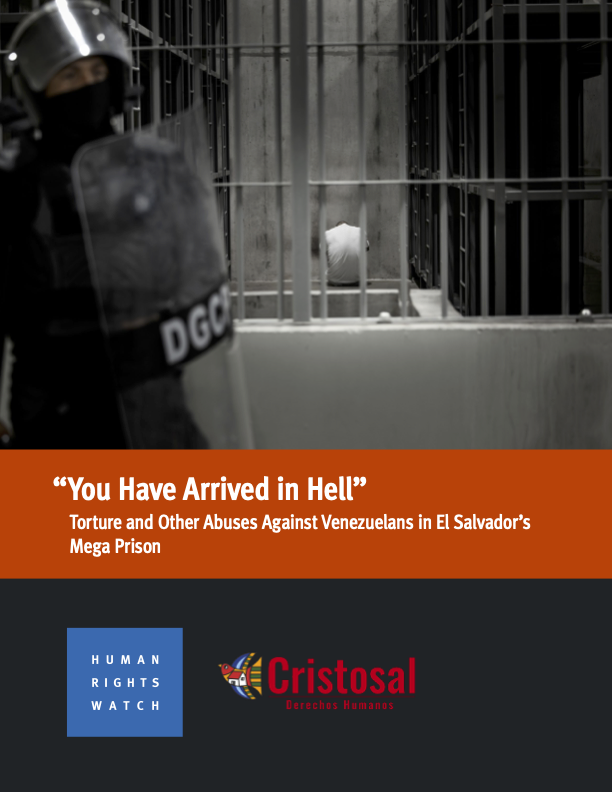
“You Have Arrived in Hell”. Torture and Other Abuses Against Venezuelans in El Salvador’s Mega Prison

By Human Rights Watch

The 81-page report, “‘You Have Arrived in Hell’: Torture and Other Abuses Against Venezuelans in El Salvador’s Mega Prison,” provides a comprehensive account of the treatment of these people in El Salvador. In March and April 2025, the US government sent 252 Venezuelans, including dozens of asylum seekers, to the Center for Terrorism Confinement (Centro de Confinamiento del Terrorismo, CECOT) mega prison in El Salvador, despite credible reports of serious human rights abuses in El Salvador’s prisons. The Venezuelans were subject to refoulement—being sent to where they would face torture or persecution—arbitrary detention, enforced disappearance, torture, inhumane detention conditions and, in some cases, sexual violence.

CONTRABAND TOBACCO: SYSTEMATIC PROFILING OF CIGARETTE PACKS FOR FORENSIC INTELLIGENCE

By Laurie Caron, Frank Crispino and Cyril Muehlethaler

Tobacco smuggling remains a widespread illegal activity in Canada, associated with important social and economic impacts, and often linked to organized crime. This study explores the application of forensic profiling as an intelligence tool to support the analysis of contraband cigarette production and distribution. Physical and chemical manufacturing characteristics of seized contraband cigarette packs, provided by the Canada Border Services Agency (CBSA), were observed and coded using macroscopic, microscopic, and spectroscopic techniques. Multivariate statistical analyses were then conducted to compare manufacturing characteristics between packs and identify potential links. The analyses highlighted links between cigarette packs and seizures based on shared manufacturing characteristics. The results and the identified groups were also compared with seizure data provided by the CBSA. The results demonstrate the relevance of forensic profiling to formulate hypotheses regarding shared production processes or supply networks. These hypotheses provide information that contributes to understanding tobacco smuggling and aim to examine how forensic intelligence can support law enforcement and measures to prevent and disrupt this criminal activity. A preliminary optimal procedure for applying forensic profiling in operational contexts targeting contraband tobacco was finally proposed. Despite limitations in the dataset creation that were beyond our control, this study represents a starting point for applying this scientific approach to tobacco smuggling

Female Empowerment and Intimate Partner Violence

By Elisabetta Calabresi and Núria Rodríguez-Planas

The chapter reviews the economic literature on intimate partner violence (IPV), a widespread human rights violation affecting nearly one in three women globally and generating significant societal costs. It focuses on the relationship between various dimensions of female empowerment and IPV. The chapter begins by outlining key theoretical frameworks—including household bargaining, instrumental violence, male backlash, and exposure theories—as well as the main data sources used to study IPV. It then reviews empirical evidence on how factors shaping female empowerment at the individual, relationship, community, and societal levels influence IPV outcomes. Central themes include labor market dynamics, education, income shocks, family formation, legal frameworks, institutional access, and gender norms. The chapter also considers how these factors interact across levels and discusses additional drivers of IPV not directly linked to female empowerment. The goal is to provide an overview of causal evidence from the economic literature on IPV while emphasizing its complexity and the importance of a context-specific, intersectional approach to both its analysis and prevention.

A familiar offence: how households shape juvenile reoffending

By Tobias Auer and Tom Kirchmaier

In this paper we focus on how the criminal history of a household affects juvenile reoffending. Using detailed administrative data from Greater Manchester Police for 2007-2018, we construct a matched sample of 15,548 juvenile first-time offenders. We show causally that juveniles from a household with a previous criminal record are 26.4 to 29.8 percentage points more likely to reoffend within three years, with the greatest additional risk being in the first year after the initial offence. We show that social learning, co-offending by siblings, and differential processing contribute to this effect. Our findings highlight household criminality as an important driver of criminal persistence, underscoring the need to move beyond individual-level predictors and address the criminogenic dynamics within the home.

In this paper we focus on how the criminal history of a household affects juvenile reoffending. Using detailed administrative data from Greater Manchester Police for 2007-2018, we construct a matched sample of 15,548 juvenile first-time offenders. We show causally that juveniles from a household with a previous criminal record are 26.4 to 29.8 percentage points more likely to reoffend within three years, with the greatest additional risk being in the first year after the initial offence. We show that social learning, co-offending by siblings, and differential processing contribute to this effect. Our findings highlight household criminality as an important driver of criminal persistence, underscoring the need to move beyond individual-level predictors and address the criminogenic dynamics within the home.

Curbing Nigerian-Italian Human Trafficking for Sexual Exploitation

By Alagie Jinkang

Italy’s illegal commercialised sex industry is estimated to be worth 90 million Euro and involves up to 9 million clients annually. The industry depends on migrants from Nigeria, Romania and Albania, many of whom are victims of human trafficking, abuse, exploitation, oppression, extreme educational and economic poverty, and non-integration in Italy. But despite legal and policy interventions, sexual exploitation of migrants is highly tolerated, goes largely unpunished and is increasingly threatening to migrant women's wellbeing throughout the peninsula, as in the case of migrant women from Nigeria. This brief focuses on the NigerianItalian HTSE for two main reasons: (a) Italy’s proximity to the central Mediterranean route serving as key irregular route for migrant smugglers and human traffickers; (b) Italy’s dysfunctional and emergencial asylum systems coupled with its insufficient, untimely and inefficient policy intervention on migrants' sexual exploitation, and; (c) perceptions and misinformation about Europe as source of economic and social opportunities and prestige, which all provide a fertile ground for mafia activities and organised crime to flourish. Therefore, coupled with PERCEPTIONS findings, this brief draws political attention to the intersections between irregular migration and asylum, mafia activities and organised crime, targeted deception and misinformation, abject poverty and traditional practices within the discourse of NigerianItalian HTSE.

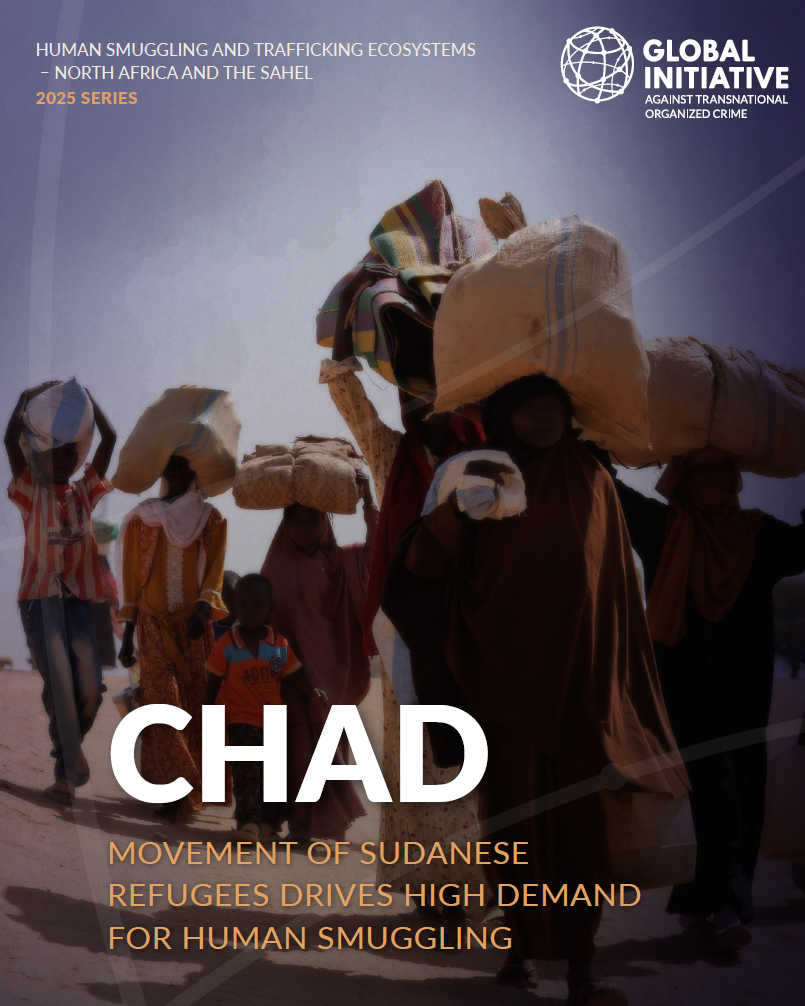
Chad-Movement-of-Sudanese-refugees-drives-high-demand-for-human-smuggling

By Alice Fereday

Chad’s role as a departure and transit country for northbound migration to North Africa and Europe is often overlooked, particularly in comparison to neighbouring Niger and Sudan. However, the country’s position at the crossroads of routes connecting central and eastern Africa to Libya and Niger makes it a significant transit corridor for regional migration, and its role as a bastion of relative stability in an increasingly volatile region has further increased its importance in recent years. Since 2023, the conflict in Sudan and a major influx of refugees into Chad have further shaped these mobility dynamics, making the country a major destination and transit point for Sudanese refugee displacement in the region. At the same time, Chad is navigating a fractious and contested political transition. Political violence escalated in 2024 and remains an important source of tension and political instability. The combination of these complex internal and regional dynamics, and their impact on human smuggling dynamics, make Chad a key country to monitor. A major component of human smuggling dynamics in Chad is internal movements to the country’s northern goldfields. These mobility patterns have typically been shaped by internal factors, including political instability, rebel activity and gold mining.1 This changed in 2023 with the outbreak of the conflict in Sudan and the massive influx of refugees and returnees into eastern Chad. Though northbound movements were temporarily hindered by this shift, which resulted iI emerged as the dominant model of migration in Libya in 2021 and remained so in 2024. Hybrid smuggling refers to the system whereby migrants initially travel to Libya through regular or semi-regular routes, such as flights into airports, and then are moved overland to coastal departure points for the sea crossing to Europe. This system is adaptable to local changes and delivers a consistently high level of attempted departures, despite some localized improvements in security. Critically, the Government of National Unity (GNU), which rules western Libya, continued to struggle with internal division and weak control over crucial areas, especially on the west coast, a key region for human smuggling stretching from the Tunisian border to the city of Zawiya. Political infighting and disputes over state resources 

SELECTING AND VALIDATING OUTCOME MEASURES FOR THE DOMESTIC VIOLENCE AND ABUSE CORE OUTCOME SET (DVA-COS) 

By Jenna Harewell, Elizabeth Dunk Shivi Bains, Emma Howarth, Claire Powell, Lazaros Gonidis

  Background - The domestic abuse core outcome set (DVA-COS) is an agreed set of five outcomes intended for use in evaluations of interventions or services for children and families with experience of domestic violence and abuse (DVA, hereafter referred to as domestic abuse). A COS is a minimum standard for measurement in intervention studies, the purpose of which is to overcome heterogeneity in outcome selection and measurement. The aim of a COS is to maximise the value of a body of evidence by facilitating comparison between and synthesis across studies, thus reducing research wastage. Since the development of the DVA-COS, work has been undertaken to identify, select, and validate outcome measurement instruments (OMIs) to measure the core outcomes. The Warwick– Edinburgh Mental Wellbeing Scale (WEMWBS) was previously identified as acceptable by stakeholders to capture two outcomes: child and caregiver emotional health and wellbeing. This work seeks to extend those findings by validating the measure for use with domestic abuse experienced populations. Aims Foundations, the national What Works Centre for Children & Families, commissioned two work packages to develop and integrate previous work to outline and validate OMIs for use to assess outcomes comprising the DVA-COS. Work package 1 seeks to identify three OMIs, and this report focuses on work package 2, which aimed to validate the Short WEMWBS (SWEMWBS) for use with children and young people (aged 11 to 18) who have experienced domestic abuse. The studies that make up this work package used mixed methods to examine the acceptability, content validity, structural validity, internal consistency, and measurement invariance for the scale in children and young people experiencing domestic abuse. We also report a validation study of the WEMWBS for adults with experience of domestic abuse. Methods The above aims were addressed across four individual studies: two planned and two supplementary. First, a qualitative ‘think aloud’ study assessed the acceptability of the SWEMWBS with children and young people who had experienced domestic abuse. The remaining three studies were quantitative analyses of secondary data on using the SWEMWBS and WEMWBS with children and young people and adult samples. • Study A: a qualitative think aloud study that involved interviews and a focus group to gather feedback from children and young people with domestic abuse experience on use of the SWEMWBS. • Study B: examined cross-sectional data collected by the OxWell Student Survey to validate the SWEMWBS with children and young people affected by domestic abuse. • Study C: examined anonymised longitudinal service data to validate the SWEMWBS with children and young people affected by domestic abuse. • Study D: validated the WEMWBS with adults who have experienced domestic abuse using cross-sectional data from the Adult Psychiatric Morbidity Survey (APMS). Key findings Our findings demonstrate the validity and acceptability of the SWEMWBS and WEMWBS in domestic abuse-experienced child and adult populations respectively. Study A indicated that the SWEMWBS is broadly acceptable for use with children and young people, while raising important considerations regarding respondents’ interpretation of the measure’s items as well as the emotional impact of the measure on this population. Studies B and C demonstrated robust psychometric validity2 of the SWEMWBS with children and young people affected by domestic abuse, and Study D showed robust psychometric validity of the WEMWBS with adult victims of domestic abuse. These are significant findings given the limited number of measures that have been evaluated for use with this population across practice and research contexts. Moreover, this represents an important step forward in the implementation of the DVA-COS, which we hope will help to unify outcome measurement in domestic abuse research and evaluation, as well as service monitoring. Recommendations We recommend that the SWEMWBS and WEMWBS be used to measure wellbeing in the context of evaluation studies (of any quantitative design) seeking to assess the impact of child-focused domestic abuse interventions. To enhance the acceptability of the measure to children and adults we suggest minor adaptations for use in the domestic abuse context. Finally, we recommend the development of guidelines for practitioners and researchers about how to use the tools in a ‘carefirst’ way and how to guard against the tools being used for screening or triaging, or rationing care, as well as guidance for commissioners on how to interpret and use evidence, generated by the completion of the SWEMWBS and WEMWBS, for the basis of decision making. This guidance needs to reflect the balance between the benefits of data-driven decision making and the risk of unduly narrowing the breadth of services or thwarting innovation in the sector. The OMI’s implementation (including the use of guidance) should be closely monitored and evaluated, to inform any associated refinements and to develop an in-depth understanding of the process and outcomes associated with embedding routine measurement in practice. Further work is also required to identify an alternative OMI or adapt the SWEMWBS for appropriate use with children under the age of.   11.

Foundations UK: 2025. 106p.

Garbage in garbage out? Impacts of data quality on criminal network intervention

By Wang Ngai Yeung, Riccardo Di Clemente & Renaud Lambiotte

Criminal networks such as human trafficking rings are threats to the rule of law, democracy and public safety in our global society. Network science provides invaluable tools to identify key players and design interventions for Law Enforcement Agencies (LEAs), e.g., to dismantle their organisation. However, poor data quality and the robustness of criminal networks make effective intervention extremely challenging. Although there exists a large body of work building and applying network scientific tools to green intervene criminal networks, these work often neglect the problems of data incompleteness and inaccuracy. Moreover, there is thus far no comprehensive understanding of the impacts of data quality on the downstream effectiveness of interventions. This work investigates the relationship between data quality and intervention effectiveness based on classical graph theoretic and machine learning-based targeting approaches. Decentralization emerges as a major factor in network robustness, particularly under conditions of incomplete data, which renders intervention strategies largely ineffective. Moreover, the robustness of centralized networks can be boosted using simple heuristics, making targeted intervention more infeasible. Consequently, we advocate for a more cautious application of network science in disrupting criminal networks, the continuous development of an interoperable intelligence ecosystem, and the creation of novel network inference techniques to address data quality challenges.

 EPJ Data Sci. 14, 37 (2025)

THE BUSINESS OF EXPLOITATION:  THE ECONOMICS OF CYBER SCAM OPERATIONS IN SOUTHEAST ASIA

By Kristina Amerhauser | Audrey Thill 

  Cyber scam operations in Southeast Asia rely heavily on information and communications technology, financial fraud, trafficking for forced criminality, corruption and elite capture. This creates what can be described as ‘compound crimes’, reflecting how cyber scam operations are both based in physical compounds and involve multiple criminal markets. While estimates vary, the scale of funds defrauded from scam victims each year is in the tens of billions of US dollars and trending upward. In addition, illicit proceeds are generated from exploitation of trafficked persons, illegal gambling and corruption. The scale of illicit financial flows represents a clear threat to national economies, governance and international security. Cyber scam operations and their enabling networks operate at scale across Southeast Asia and beyond. They have reportedly trapped hundreds of thousands of people inside compounds where they are forced to conduct scams. Some operations retain workers through debt bondage, psychological coercion and financial incentives. Significant diversity in operational models – from high-security compounds to thousands of smaller operations located in apartments and other small premises – creates varied patterns of financial flows across jurisdictions. The money laundering process is part of a sophisticated financial service ecosystem. Most concerning is how networks of actors operate at scale and at the intersection of legitimate and illegitimate economies by using licensed crypto exchanges, registered fintech platforms and traditional banking services. Some are ‘crime as a service’ providers, explicitly providing money laundering services to cyber scam operations and doing so with corporate efficiency. This means that moving and laundering money has evolved into a marketplace-type structure where actors remain anonymous to others within the network. Governments, the private sector and civil society actors have sought innovative responses to disrupt the illicit industry. These include initiatives that ‘follow the money’ and disrupt the money laundering networks used by cyber scam operations. While some work has begun to explore illicit financial flows stemming from scam operations, notably related to cryptocurrencies, important gaps persist. Less is known about the wider set of financial flows, the mechanisms used to transfer proceeds in and out of the region and the networks involved. This policy brief seeks to help fill this gap by mapping wider related payments and providing insights into how money is moved and where it ultimately ends up. It concludes by providing actionable policy recommendations for Southeast Asian governments as well as regional and global financial service providers. Crucially, these recommendations identify entry points for disrupting the operations of the transnational organized crime groups that run cyber scam operations. The key findings include: Actors involved in cyber scams and trafficking for forced criminality often use cryptocurrency to move illicit money. They also use cash, fintech – such as peer-to-peer (P2P) payment apps – gaming or gambling platforms, bank transfers, shell and front companies, credit cards and pre-paid cards. The role of the formal banking sector in these financial flows appears significant, as many scam-related transfers are initiated by the victim from their own bank accounts before being converted into cryptocurrencies at different steps of the laundering process. While most financial institutions likely process these transactions unwittingly, evidence suggests they may be enabled by regulatory loopholes such as weak know-your-customer (KYC) requirements and/or excessively high minimum thresholds for reporting suspicious transactions. After being laundered and converted back into fiat currency4 from cryptocurrency, illicit funds are also likely to be moved again through the formal financial system.

Many of the fintech and cryptocurrency platforms that money laundering networks use to convert cryptocurrencies back into fiat are registered companies and hold financial service licences. Some owners of these platforms have close connections to the political and business elites in the countries of registration, suggesting influence over financial regulation and an interest in maintaining a policy environment amenable to the large-scale laundering of criminal proceeds. Transnational organized crime groups in Southeast Asia generate highly lucrative profits. This creates a vicious cycle: greater profits enable these groups to expand their influence, including over public officials and the financial sector, which in turn reduces scrutiny of cyber scam compounds and related suspicious financial transactions. With their growing wealth, these criminal networks invest further into other types of crime and crime-as-a-service infrastructure, generating additional profits that allow them to strengthen their influence and market position   
Geneva: Global Initiative Against Transnational Organized Crime. 2025. 44p.

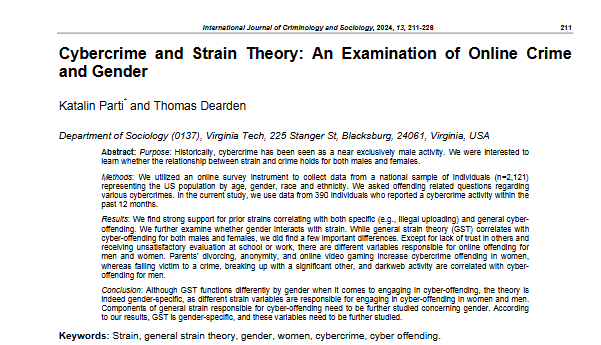
Cybercrime and strain theory: An examination of online crime and gender.

By Katalin Parti, Thomas Dearden

Purpose: Historically, cybercrime has been seen as a near exclusively male activity. We were interested to learn whether the relationship between strain and crime holds for both males and females.

Methods: We utilized an online survey instrument to collect data from a national sample of individuals (n=2,121) representing the US population by age, gender, race and ethnicity. We asked offending related questions regarding various cybercrimes. In the current study, we use data from 390 individuals who reported a cybercrime activity within the past 12 months.

Results: We find strong support for prior strains correlating with both specific (e.g., illegal uploading) and general cyber-offending. We further examine whether gender interacts with strain. While general strain theory (GST) correlates with cyber-offending for both males and females, we did find a few important differences. Except for lack of trust in others and receiving unsatisfactory evaluation at school or work, there are different variables responsible for online offending for men and women. Parents’ divorcing, anonymity, and online video gaming increase cybercrime offending in women, whereas falling victim to a crime, breaking up with a significant other, and darkweb activity are correlated with cyber-offending for men.

Conclusion: Although GST functions differently by gender when it comes to engaging in cyber-offending, the theory is indeed gender-specific, as different strain variables are responsible for engaging in cyber-offending in women and men. Components of general strain responsible for cyber-offending need to be further studied concerning gender. According to our results, GST is gender-specific, and these variables need to be further studied.

International Journal of Criminology and Sociology13, 211–226

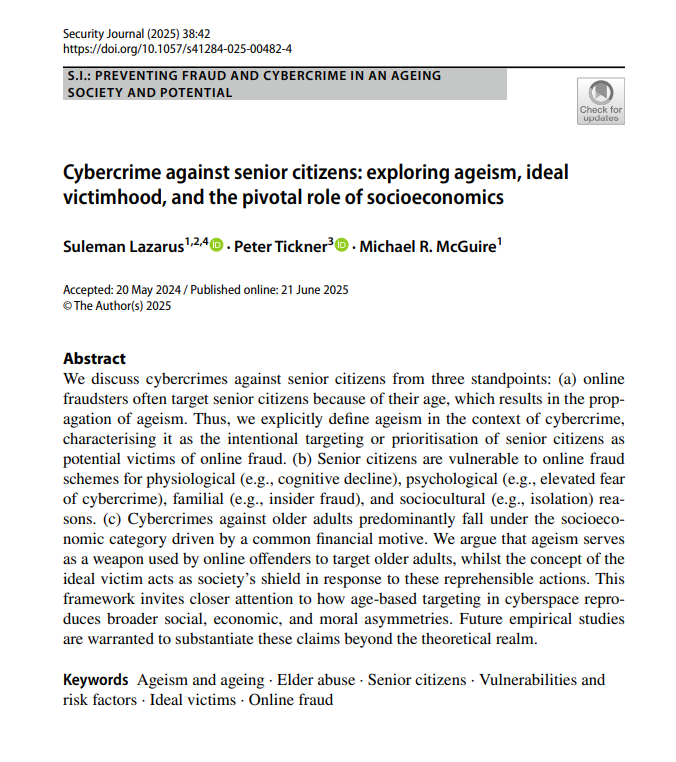
 Cybercrime against senior citizens: exploring ageism, ideal victimhood, and the pivotal role of socioeconomics

By Suleman Lazarus  · Peter Tickner  · Michael R. McGuire1

 We discuss cybercrimes against senior citizens from three standpoints: (a) online fraudsters often target senior citizens because of their age, which results in the propagation of ageism. Thus, we explicitly defne ageism in the context of cybercrime, characterising it as the intentional targeting or prioritisation of senior citizens as potential victims of online fraud. (b) Senior citizens are vulnerable to online fraud schemes for physiological (e.g., cognitive decline), psychological (e.g., elevated fear of cybercrime), familial (e.g., insider fraud), and sociocultural (e.g., isolation) reasons. (c) Cybercrimes against older adults predominantly fall under the socioeconomic category driven by a common fnancial motive. We argue that ageism serves as a weapon used by online offenders to target older adults, whilst the concept of the ideal victim acts as society’s shield in response to these reprehensible actions. This framework invites closer attention to how age-based targeting in cyberspace reproduces broader social, economic, and moral asymmetries.  Future empirical studies are warranted to substantiate these claims beyond the theoretical realm.

Security Journal (2025) 38:42 

An evidence-based plan for addressing childhood vulnerability, crime and justice.

By Brown, K., Crawford, A., Lloyd, C, Birks, D., Capstick, N., Wood, M., et al. (2024).

Children who are victims of crime and those drawn into offending behaviours are amongst the most vulnerable in society. The evidence is clear: life chances of young people are significantly affected by childhood experiences of crime, harm, abuse, and victimisation, as well as engagement with the criminal justice system. This is not deterministic and many children find ways to cope with the adversities they face. However, adverse childhood experiences greatly elevate the probability of a young person becoming involved with the police and we must act to support these children before they become trapped within the criminal justice system. It is therefore of the utmost importance that we promote a whole-child approach to childhood vulnerability that focuses on needs – one that is informed by the evidence base on best practice throughout the UK and internationally. We make three evidence-based recommendations that align with the new government’s Opportunity Mission to improve outcomes for CYP and reduce crime.

Child of the North and the Centre for Young Lives. , 2024. 50p.

Regulating image-based abuse: an examination of Australia’s reporting and removal scheme

By Melanie Burton, Savannah Minihan, Mariesa Nicholas, et al.

eSafety is the first government agency to implement a dedicated scheme responsible for facilitating the removal of non-consensual intimate images posted online via the establishment of an image-based abuse (IBA) reporting portal and a civil penalties scheme. This research examines the operation of eSafety’s IBA scheme from 2018 to 2023. The paper examines what was being reported under the scheme, including who was reporting and changes in report numbers over time.

The increasing number of reports over the first five years of the scheme highlights the importance of community awareness-raising and preventative education, as well as investment in initiatives that destigmatise and de-shame image-based abuse and encourage help-seeking.

The IBA scheme enables eSafety to engage directly with online service and platforms to get the intimate content removed. It finds that the scheme has increasingly helped remove harmful content and enabled Australian victims of image-based abuse to access expert assistance, regain control over their situation and to receive practical support to help them feel safer online.

Key findings

Reports to the IBA scheme increased by more than 960%, from 849 reports in 2018/19 to 9,060 reports in 2022/23.

The increase in reports was led by a 1,332% increase in reports for sexual extortion and a 2,206% increase in reports for child sexual exploitation.

eSafety sent 1,961 removal requests to online services and platforms and were successful in having all or some of the material removed for 89.9% of these requests.

Journal of Online Trust and Safety, April 2025, 37p.

Strengthening Domestic Violence Service for Deaf Survivors: An Evaluation of Barrier Free Living’s Deaf Services Program

By Malore Dusenbery, Jeanette Hussemann, Teresa Crowe

More than 11 million people in the United States are Deaf, deaf, hard of hearing, late-deafened, or Deaf-Blind. Research indicates deaf people report experiencing victimization at higher rates, but a lack of accessible resources and trauma-informed services for American Sign Language (ASL) speakers makes it difficult for deaf people to report crimes and access support. In response to these issues, the Manhattan District Attorney’s Office in 2017 began funding Barrier Free Living (BFL), a provider of services for survivors of domestic violence and their families, to increase access to direct services for deaf survivors and increase local stakeholders’ awareness of deaf survivors’ needs through its Deaf Services (DS) program.

In 2019, Urban, in collaboration with Gallaudet University and NORC at the University of Chicago, began a multimethod process evaluation of BFL’s DS program to document its implementation and assess to what extent it achieved its intended goals. Drawing on information gathered from BFL staff, deaf consumers of BFL’s services, and community partners, we identified the following key findings:

The DS program provided a range of services to meet the diverse needs of deaf survivors, including counseling and support groups, legal services, case management, housing support, employment support, occupational therapy, and child care. Consumers reported overall positive experiences with the services they received and communication accessibility at BFL.

The DS program helped increase BFL’s ability to communicate with deaf survivors by increasing routine use of interpreters, training hearing staff in ASL, and improving communications technology.

The DS program led to increased awareness and collaboration around services provided to deaf clients, but communication and staffing challenges remain.

The DS program partners with a range of external agencies to support referrals or coordinate service provision, provide education and training, and conduct outreach and advocacy.

Funding and staffing are the primary factors that impede the provision of enhanced services for deaf survivors, but a community-wide lack of accessible and available services and housing also hinders providers from meeting their clients’ needs.

Based on these findings, we provide recommendations for

how BFL and similar direct service programs can improve and adapt staffing, services, and outreach to strengthen their response to deaf survivors;

how policymakers, funders, and system-level stakeholders can address societal and policy-level barriers to meeting the needs of deaf survivors; and

how researchers and funders of research can fill critical gaps in research on deaf survivors and deaf-focused services by increasing and improving the research done with the deaf community.

Washington, DC: The Urban Institute, 2022. 83p.

Justice at a Crossroads in New York City. Studying Crimes in New York City Using the National Crime Victimization Survey (NCVS)

By Min Xie, Preeti Chauhan, Michael Rempel, and Jeremy Travis

This study relies on data from the National Crime Victimization Survey (NCVS) and presents trends from 1996 to 2022 in crime victimization, rates at which victims report crimes to the police, confidence in the police, and victims’ use of services in New York City. This is one of two studies falling under the umbrella of the Crossroads Project. Its goal is to trace New York City’s trends in crime victimization, enforcement, incarceration, and racial disparities from the 1990s to the early 2020s in the hopes that empirical data over a long timeframe might provide a much-needed perspective capable of informing future policy. Both of the two resulting reports and a joint executive summary may be found at the project landing page. How was the NCVS used in the present study? Although the NCVS is typically used to assess victimization patterns for the nation as a whole, the data can be used to study New York City victimization trends. This is because the New York City’s population base is greater than 5 million and there are fewer concerns regarding identification of victims within the data and unstable estimates (too small of a population may provide volatile estimates). A small body of research has used the NCVS data for local crime analysis including for Chicago, Los Angeles, Dallas, and Houston (Rezey & Lauritsen, 2023; Xie, Ortiz Solis, & Chauhan, 2024). Other research has examined New York City data (Langan & Durose, 2009; Xie, Ortiz Solis, & Chauhan, 2024) but the analyses was more limited in the scope and did not extend to 2022. Our study examines the NCVS data in New York City from 1996 to 2022 by nonfatal violence and property crimes. We also assess whether these crimes were reported to the police and, if not, what proportion were not reported because the victims believed the police would not help (a proxy for public confidence in the police). Next, we examine what proportion of victims of violence used victim services, regardless of whether the crime was reported to the police or not. Lastly, we compare New York City to the nation as a whole and to other cities with a population over one million. The analyses are also conducted by race/ethnicity with the caution that the sample size may be too small for reliable estimates. This is the first study to unpack New York City victimization data in this way. Table 1 presents the average number of interviews conducted in New York City annually from 1996 to 2022, compared to the number of interviews for the United States and other cities with populations exceeding one million. The sample size decreases when the data is disaggregated by race/ethnicity, which is a limitation of the NCVS as smaller sample sizes result in larger standard errors of estimates, reducing the results’ precision. To further assist with this issue, a data point in this report for a specific year is a three-year moving average. Three-year moving averages produce more reliable estimates because the annual count of violent incidents in a single city tends to be small. The three-year average violence rate in 1997 is the average violence rate from 1996 to 1998, and so on.

New York: Data Collaborative for Justice, at John Jay College, 2025. 18p.