Open Access Free Library
CRIME+CRIMINOLOGY.jpeg

CRIME

Violent-Non-Violent-Cyber-Global-Organized-Environmental-Policing-Crime Prevention-Victimization

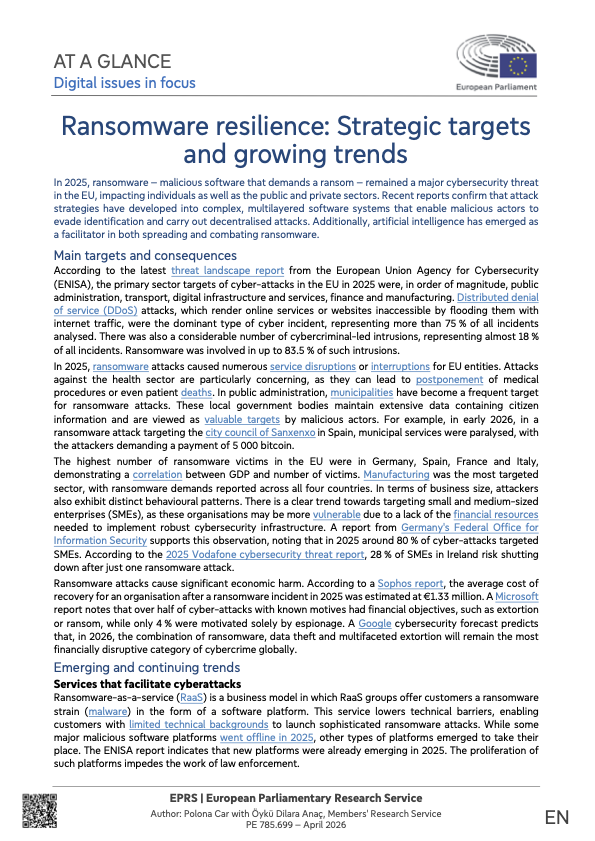
Ransomware resilience: Strategic targets and growing trends

By Polona Car with Öykü Dilara Anaç

In 2025, ransomware – malicious software that demands a ransom – remained a major cybersecurity threat in the EU, impacting individuals as well as the public and private sectors. Recent reports confirm that attack strategies have developed into complex, multilayered software systems that enable malicious actors to evade identification and carry out decentralised attacks. Additionally, artificial intelligence has emerged as a facilitator in both spreading and combating ransomware

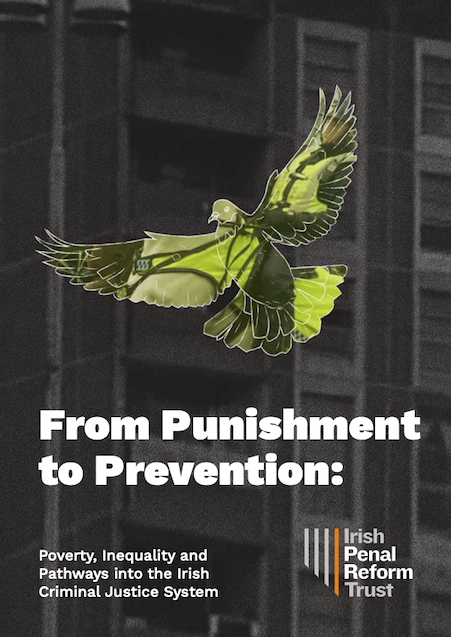
From Punishment to Prevention: Poverty, Inequality and Pathways into the Irish Criminal Justice System

By Clare O’Connor,.et al

In 2012, IPRT published The Vicious Circle of Social Exclusion and Crime: Ireland’s Disproportionate Punishment of the Poor1 setting out how poverty and social exclusion shape exposure to criminalisation, and the case for early intervention and social investment as prevention. In the years since, the effects of austerityera policies have become increasingly visible, particularly in housing, social protection and criminal justice. Ireland faces a deepening housing crisis and cost of living crisis, alongside record levels of prison overcrowding. This report provides an updated evidence base on the overlap between poverty, deprivation and criminalisation in Ireland, examines justice reinvestment approaches, outlines relevant human rights obligations, and identifies evidence-led alternatives to over-reliance on penal sanctions

The availability and purchase of digital firearms products among online Australians

By Alexandra Voce and Anthony Morgan

The Australian Institute of Criminology has released a Statistical Bulletin on the availability and purchase of digital firearms products among online Australians, based on a national survey of 9,951 online Australian adults:

  • More than twice as many respondents (2.4%) had seen digital firearms products for sale on the public internet (clear web) compared with the darknet (0.9%). 

  • Just over one percent (1.1%) of respondents said they or someone they knew had bought or traded digital firearms products online on the public internet (0.7%) or on the darknet (0.8%).

  • Respondents who said they or someone they knew had bought or traded digital firearms products online were more likely than other respondents to have had contact with the criminal justice system, including for violent offences, to own a firearm without a licence, to have intentionally viewed fringe or radical content and to have seen content depicting or calling for violent action.

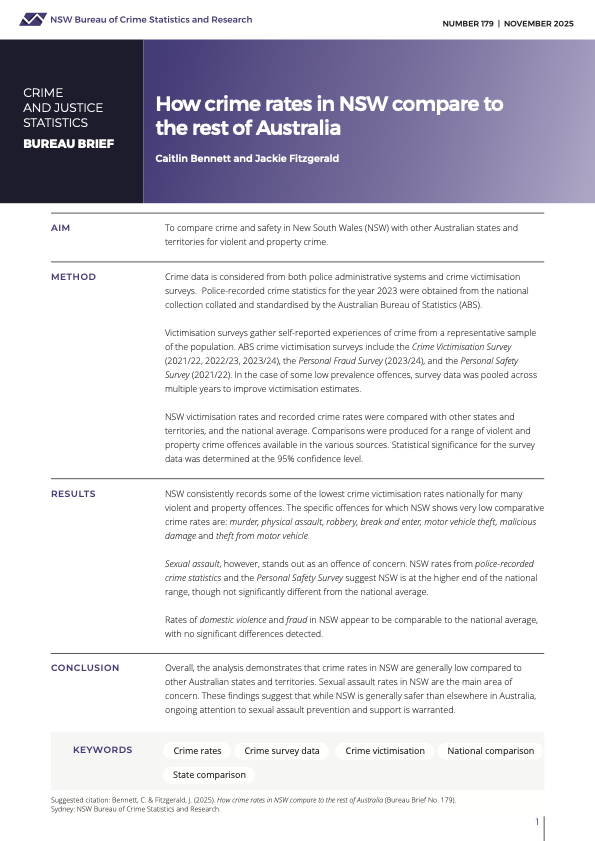
How crime rates in NSW compare to the rest of Australia

By Caitlin Bennett and Jackie Fitzgerald

AIM To compare crime and safety in New South Wales (NSW) with other Australian states and territories for violent and property crime. METHOD Crime data is considered from both police administrative systems and crime victimisation surveys. Police-recorded crime statistics for the year 2023 were obtained from the national collection collated and standardised by the Australian Bureau of Statistics (ABS). Victimisation surveys gather self-reported experiences of crime from a representative sample of the population. ABS crime victimisation surveys include the Crime Victimisation Survey (2021/22, 2022/23, 2023/24), the Personal Fraud Survey (2023/24), and the Personal Safety Survey (2021/22). In the case of some low prevalence offences, survey data was pooled across multiple years to improve victimisation estimates. NSW victimisation rates and recorded crime rates were compared with other states and territories, and the national average. Comparisons were produced for a range of violent and property crime offences available in the various sources. Statistical significance for the survey data was determined at the 95% confidence level. RESULTS NSW consistently records some of the lowest crime victimisation rates nationally for many violent and property offences. The specific offences for which NSW shows very low comparative crime rates are: murder, physical assault, robbery, break and enter, motor vehicle theft, malicious damage and theft from motor vehicle. Sexual assault, however, stands out as an offence of concern. NSW rates from police-recorded crime statistics and the Personal Safety Survey suggest NSW is at the higher end of the national range, though not significantly different from the national average. Rates of domestic violence and fraud in NSW appear to be comparable to the national average, with no significant differences detected. CONCLUSION Overall, the analysis demonstrates that crime rates in NSW are generally low compared to other Australian states and territories. Sexual assault rates in NSW are the main area of concern. These findings suggest that while NSW is generally safer than elsewhere in Australia, ongoing attention to sexual assault prevention and support is warranted.

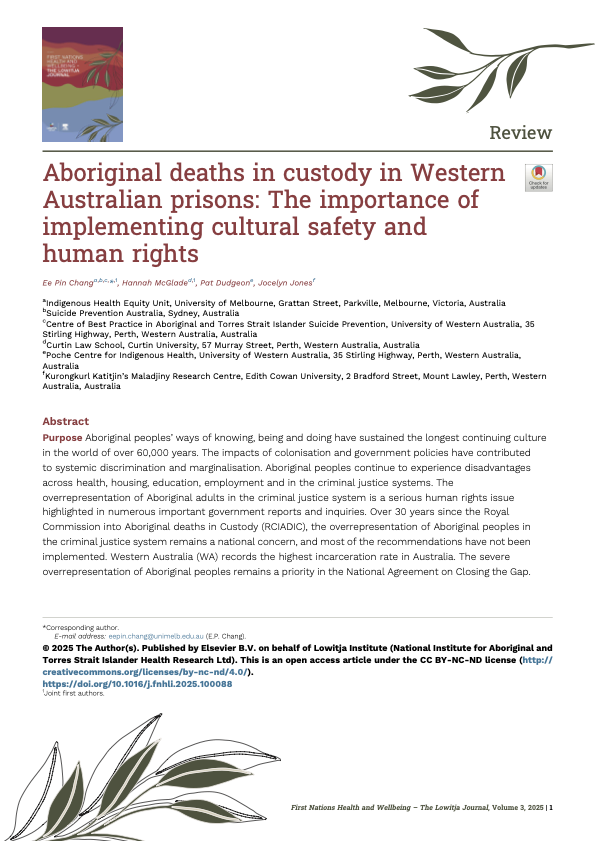
Aboriginal deaths in custody in Western Australian prisons. The importance of implementing cultural safety and human rights

By Ee Pin Chang, Hannah McGlade, Pat Dudgeon, Jocelyn Jones

This article provides an overview of the nature and adequacy of culturally appropriate health services within Western Australian (WA) prisons based on coroner findings on Aboriginal deaths in custody between 2019 to 2023. It provides a brief overview of the policies and current issues of the health services in WA prisons. 

Three of eight coronial inquests into Aboriginal suicide deaths in custody reviewed reported the sub-standard and unacceptable quality of supervision, treatment and care. The lack of access to culturally safe health services in prisons contravenes the recommendations of the Royal Commission into Aboriginal Deaths in Custody (RCIADIC).

The article calls for implementation of recommendations from Australian government inquiries – RCIADIC, Pathways to justice report – and the government to uphold international human rights obligations especially the Optional Protocol to the Convention Against Torture

Key findings

  • Overrepresentation of Aboriginal peoples in the justice system is a human rights violation.

  • Coroner’s findings of Aboriginal suicide deaths in custody were reviewed.

  • These findings reported substandard quality of supervision, care and treatment.

  • The lack of culturally safe health services in prisons contravenes the recommendations of the RCIADIC.

  • Call for implementation of recommendations from Australian government inquiries.

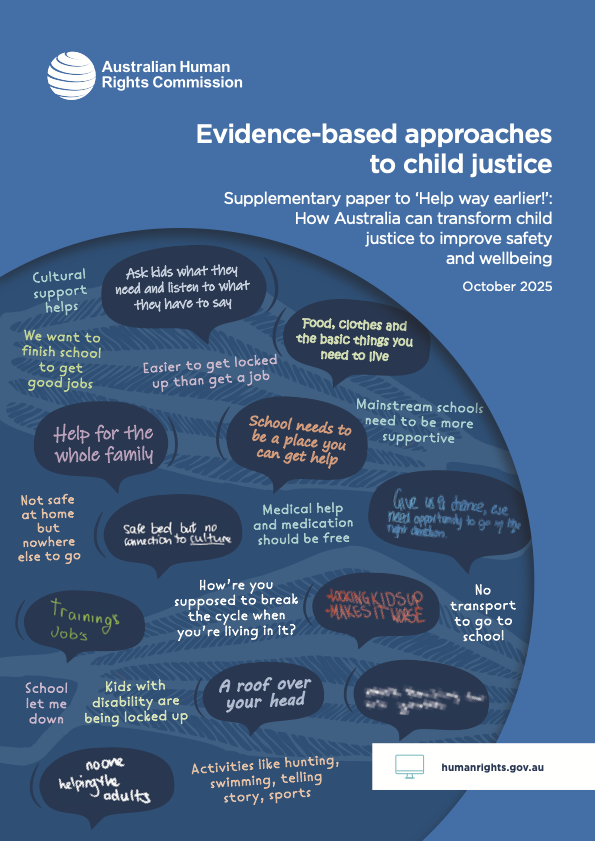
Evidence-based approaches to child justice

By The Australian Human Rights Commission 

This report contains six case studies from Australia and around the world that are examples of evidence-based approaches to reforming child justice systems. It shows how primary prevention, early intervention, integrated services and therapeutic community-based approaches that emphasise family and cultural connections can transform outcomes for children.

Ransomware targeting individuals and small businesses: vulnerabilities and impacts

By Isabella Voce and Anthony Morgan

This study examines the experiences of 331 Australian individuals and small to medium enterprise (SME) owners who were victims of ransomware. We used survey data to understand how they were targeted and the vulnerabilities that were exploited in private and work-related settings.

Most ransomware victims had received multiple ransom messages in the past 12 months. SME owners were more likely to have received multiple messages and to have previously paid a ransom. Strong messaging should dissuade SME owners from making these payments, which increase the chances of repeat victimisation.

SME owners reported impacts on many devices. The affected devices were also more likely to have been a work-issued device or a personal device used for work. SME owners were also more likely than other victims to report that the ransomware had spread to other workplace devices, systems or email accounts. The results highlight both the human element in victimisation and the need for technological solutions to protect business owners from ransomware and its harmful effect

FIVE HUNDRED DELINQUENT WOMEN: Mini-Classic

by Graeme Newman.

by Graeme Newman (Author), Sheldon Glueck (Author), Eleanor Glueck

In 1934, two Harvard criminologists asked the question no one else had bothered to ask: what actually happens to a woman after a reformatory says she's been "reformed"?
Five Hundred Delinquent Women is Sheldon and Eleanor Glueck's landmark — and largely forgotten — study of five hundred women released from the Massachusetts Reformatory for Women at Framingham, once hailed as a model institution for the entire country. Rather than taking the state's word for it, the Gluecks tracked these women for years after their sentences ended, through court records, social-agency files, and hundreds of personal interviews, to find out what "rehabilitation" actually looked like once no one was watching anymore.
What they found was neither the triumph the reformers promised nor the failure the cynics predicted, but something far more human and far more troubling: real improvement, tangled up with real relapse; institutional success stories that quietly came apart; and a system that too often mistook a woman's arrest record for the whole of who she was.
Running through the statistics is a gallery of unforgettable case histories — Marie, Alice, Fleur, Margaret, Angelina, Dora, Louisa, and others — whose own words and fates give this pioneering work of criminology the pull of a novel.

This Read-Me.Org Mini-Classic edition brings a five-hundred-page academic monograph back into print in a compact, accessible form, condensed and adapted for the modern reader while preserving the Gluecks' argument, their most vivid case histories, and the voice of Jessie D. Hodder, the reformatory superintendent whose own unanswered questions about her life's work set this whole study in motion.

Inside this edition:

• A new introduction placing the Gluecks' work in the history of criminology and the women's reformatory movement
• Roscoe Pound's original 1934 introduction, condensed
• The complete "Gallery of Women" case histories
• All eighteen original chapters, following the book's three-part structure
• An afterword connecting the book's prognostic tables and its picture of criminalized women to present-day debates over risk assessment and criminal justice reform
• Discussion questions for readers, students, and reading groups

Essential reading for students of criminology, sociology, women's history, and the history of American criminal justice — and for anyone who has ever wondered whether the institutions built to save people ever stopped to ask if they were actually working.

Part of the Read-Me.Org Mini-Classics series, bringing landmark out-of-print scholarship back to readers in accessible, affordable editions.

Read-Me.Org Inc. New York-Philadelphia-Australia. 2026. p.70.

Toolkit for Access to Justice and People‑Centred Justice Systems

By Organisation for Economic Co-operation and Development (OECD)

Access to justice is a cornerstone of democratic resilience and trust in public institutions. The OECD has long supported its Members and Partners in strengthening justice systems so that they better serve people, societies and economies. This Toolkit responds to countries’ demand for practical guidance on how to turn the 2023 OECD Recommendation of the Council on Access to Justice and People-Centred Justice Systems into concrete action. The Toolkit is part of the OECD’s broader programme of work on Public Governance, including the Building Trust and Reinforcing Democracy Initiative. It complements the OECD’s efforts to promote effective, transparent and accountable institutions, including work on trust in government, digital transformation of the public sector and evidence-based policymaking. Developed in consultation with OECD Members, Partners, experts and stakeholders from across the justice chain, the Toolkit provides a structured approach to support reforms that make justice more accessible, affordable and responsive. By organising guidance around five components – purpose and culture; the design and delivery of services; governance infrastructure; people empowerment; and planning, monitoring and evaluation – the Toolkit offers countries a practical resource for assessing their systems, identifying good practices and implementing reforms. It also highlights innovative approaches from across the world to address persistent justice gaps, promote equality and empower people to manage their legal and justice needs. This publication underlines the OECD’s commitment to advancing access to justice, and to supporting countries in building justice systems that work for everyone.

Links between childhood sexual abuse victimisation and adolescent offending

By Lisa Thomsen, Carleen Thompson, Amanda Robertson, Amanda Bodker, Yolonda Adams, John Rynne and James Ogilvie  

Child sexual abuse (CSA) victimisation has been linked to a greater risk of engaging in juvenile offending broadly, and sexual offending specifically, for male youth. This study used both administrative youth justice data (n=7,800 youth) and clinical information from a specialised service providing interventions to youth who perpetrate sexual offences (n=377 youth) to examine the links between CSA victimisation experiences and sexual offending. CSA victimisation was more prominent among young people who sexually offended than those with non-sexual offences. CSA typically co-occurred with other forms of maltreatment and adverse developmental experiences. Findings highlight the need for early intervention to prevent the emergence of sexual harm.

Responding to criminal violence in Mexico: The role of civil society amid subnational democratisation

By Yael Anahí López Torres

Mexico is grappling with a crisis of insecurity after over 30 years since its transition to democracy. Its top-down and frequently militarised policies have been ineffective, leading to calls by scholars to alter the state’s security paradigm that has not been able to fulfil the basic right of citizens to live in a secure country. As a response to these calls, this thesis goes beyond the common state-centric perspectives on security policies and instead it focuses on the often-overlooked subnational responses to criminal violence. In particular, I perform an analysis of bottom-up responses, considering the local dynamics of institutions and civil society. My research questions are: What is the role of bottom-up approaches in responding to criminal violence? And as an extension, what are the factors that enable or constrain their responses? To achieve these objectives, I conducted micro-level analyses and comparisons of two different case studies: Ciudad Juárez, Chihuahua and Monterrey, Nuevo León. These analyses explore variations in bottom-up responses, drawing on fieldwork in the form of 57 interviews with key state and societal actors and complementary documentary resources. The analysis emphasises Mexico’s subnational democratisation processes, considering its effects on the (un)rule of law and violence. My findings reveal that uneven democratisation hinders state capacity to address the security crisis, requiring organised society to intervene. In both cases, this contributed to countering and shaping the patterns of criminal violence. Local organised society pursued broader democratic goals by promoting the means for the rule of law, while high-risk collective mobilisation was fundamental in increasing political participation. The pre-existing institutions, the local actors and the alliances thatenabled these changes varied between cases, and followed waves of political urgency and electoral periods that both provided opportunities for change, but also disrupted ongoing projects. This contributes to the scholarship of criminal politics by bridging the literature of democratisation and state capacity.

VIOLENT AND VIBRANT: MEXICO’S AVOCADO BOOM AND ORGANIZED CRIME

By Romain Le Cour Grandmaison and Paul Frissard Martinez

The contemporary boom of global avocado consumption has drawn attention to Mexico’s industry and the expanding criminal networks that surround it. In fact, avocado production and exports – both to the United States and the European Union − display worrying signs of criminal organizations being involved in the market, human rights violations, and environmental and health impacts.

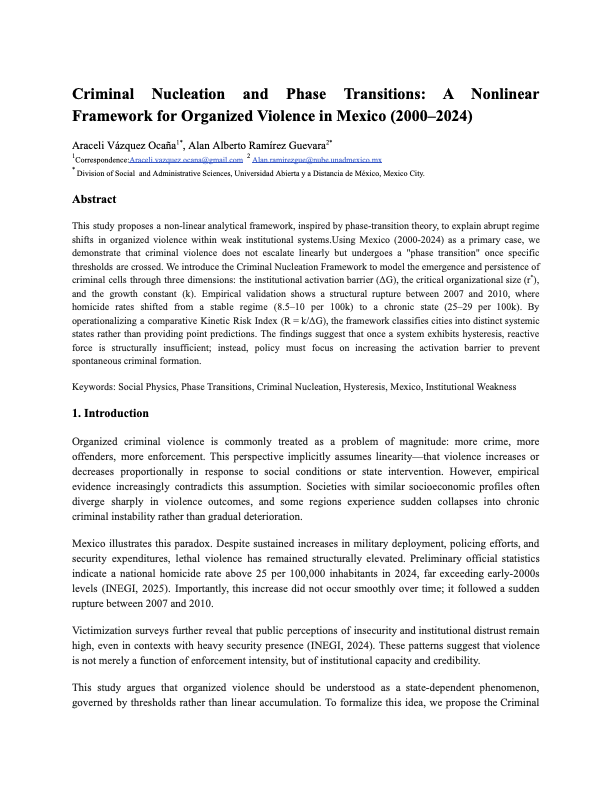
Criminal Nucleation and Phase Transitions: A Nonlinear Framework for Organized Violence in Mexico (2000–2024)

By Araceli Vázquez-Ocaña and Alan Alberto Ramírez-Guevara

This study proposes a non-linear analytical framework, inspired by phase-transition theory, to explain abrupt regime shifts in organized violence within weak institutional systems.Using Mexico (2000-2024) as a primary case, we demonstrate that criminal violence does not escalate linearly but undergoes a "phase transition" once specific thresholds are crossed. We introduce the Criminal Nucleation Framework to model the emergence and persistence of criminal cells through three dimensions: the institutional activation barrier (ΔG), the critical organizational size (r*), and the growth constant (k). Empirical validation shows a structural rupture between 2007 and 2010, where homicide rates shifted from a stable regime (8.5–10 per 100k) to a chronic state (25–29 per 100k). By operationalizing a comparative Kinetic Risk Index (R = k/ΔG), the framework classifies cities into distinct systemic states rather than providing point predictions. The findings suggest that once a system exhibits hysteresis, reactive force is structurally insufficient; instead, policy must focus on increasing the activation barrier to prevent spontaneous criminal formation.

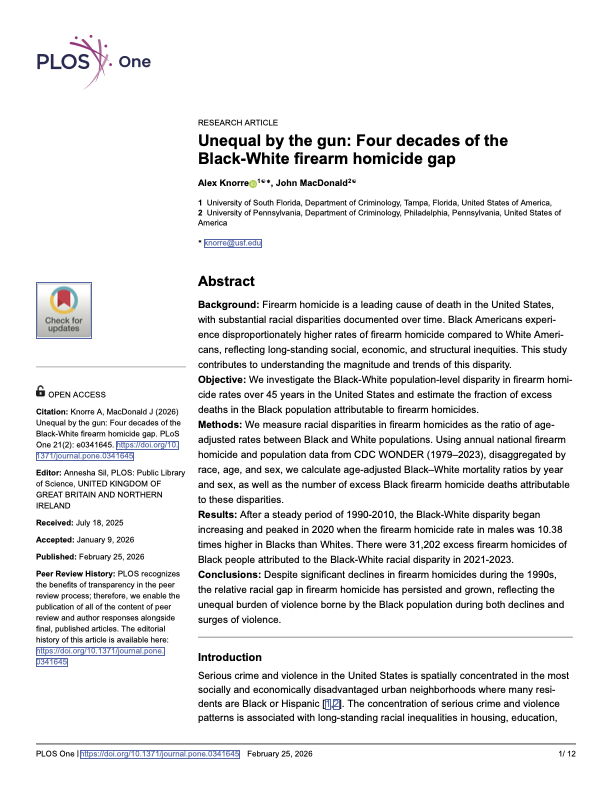
Unequal by the gun: Four decades of the Black-White firearm homicide gap 

By Alex Knorre , John MacDonald 

 Background: Firearm homicide is a leading cause of death in the United States, with substantial racial disparities documented over time. Black Americans experience disproportionately higher rates of firearm homicide compared to White Americans, reflecting long-standing social, economic, and structural inequities. This study contributes to understanding the magnitude and trends of this disparity. Objective: We investigate the Black-White population-level disparity in firearm homicide rates over 45 years in the United States and estimate the fraction of excess deaths in the Black population attributable to firearm homicides. Methods: We measure racial disparities in firearm homicides as the ratio of ageadjusted rates between Black and White populations. Using annual national firearm homicide and population data from CDC WONDER (1979–2023), disaggregated by race, age, and sex, we calculate age-adjusted Black–White mortality ratios by year and sex, as well as the number of excess Black firearm homicide deaths attributable to these disparities. Results: After a steady period of 1990-2010, the Black-White disparity began increasing and peaked in 2020 when the firearm homicide rate in males was 10.38 times higher in Blacks than Whites. There were 31,202 excess firearm homicides of Black people attributed to the Black-White racial disparity in 2021-2023. Conclusions: Despite significant declines in firearm homicides during the 1990s, the relative racial gap in firearm homicide has persisted and grown, reflecting the unequal burden of violence borne by the Black population during both declines and surges of violence.

The Highest Rates of Gun Homicides Are in Rural Counties

By Chandler Hall

Since gun homicides in America spiked in 2020 and peaked in October 2021, much of the reporting related to gun violence has centered around the nation’s big cities. Forgotten in this conversation is how rural America is similarly dealing with the crisis of gun violence. Gun violence anywhere is unacceptable—whether in our largest cities, suburbs, or smallest communities. And when half of all shootings occur outside of large cities, focusing exclusively on individual cities comes at the expense of achieving meaningful and long-lasting safety for all Americans. Instead of politicizing crime and community violence, we must recognize that gun violence is a uniquely American public health crisis that harms every community, regardless of size or political leanings.

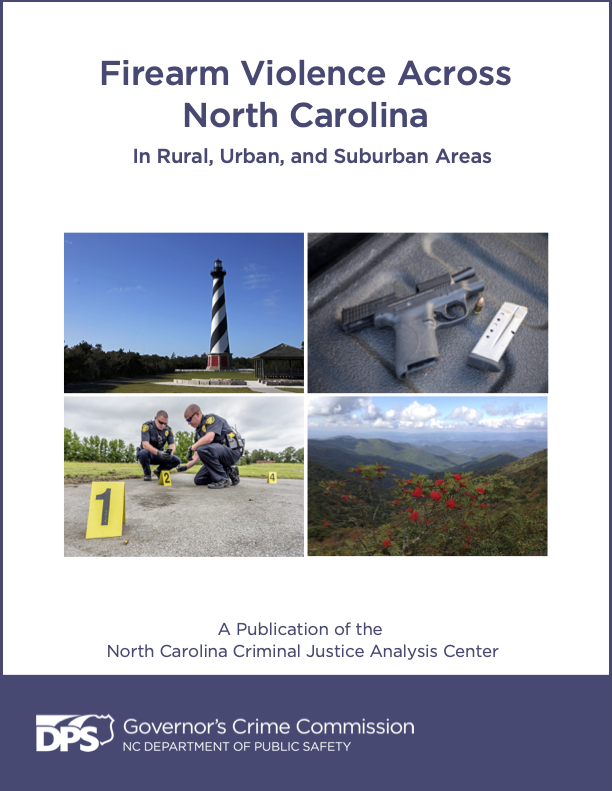
Firearm Violence Across North Carolina In Rural, Urban and Suburban Areas

By North Carolina Criminal Justice Analysis Center

This report examines patterns of firearm violence across North Carolina over the most recent five-year period, with attention to variation across rural, urban, and suburban communities. The analysis identifies clear temporal trends and significant demographic and geographic disparities that can inform targeted prevention and policy responses.

Firearm homicide increased sharply beginning in 2019, rising 72 percent statewide and peaking in 2021. Since that peak, firearm homicides have declined by 29 percent through mid-2025. Non-fatal shootings followed a similar trajectory, indicating a broader surge and subsequent reduction in interpersonal firearm violence.

In contrast, firearm suicide represents a larger and growing share of firearm-related deaths. From 2019 to 2023, firearm suicides exceeded homicides statewide, with consistent annual increases since 2014. Risk is concentrated among older adults, particularly men aged 65 and older in rural areas, aligning with broader national trends.

Young adults face the highest risk of interpersonal firearm violence. Individuals aged 20–24 consistently experience the highest rates across homicide, non-fatal shootings, and other firearm-related crimes, with elevated risk also observed among those aged 15–19 and 25–29. This pattern highlights the transition to adulthood as a critical period for intervention.

Substantial racial and ethnic disparities persist. Black, non-Hispanic individuals experience the highest rates of interpersonal firearm violence statewide, with particularly high rates in rural areas. American Indian and Alaska Native individuals also face disproportionately high victimization relative to their population size. Hispanic individuals experience comparatively higher victimization rates in urban counties.

Geographic differences are pronounced. Rural counties exhibit the highest overall rates across multiple forms of firearm violence, including homicide, suicide, non-fatal shootings, and unintentional deaths, particularly following the 2021 spike. While urban counties have similar cumulative firearm homicide totals over the five-year period, they report substantially higher levels of other firearm-related crime and lower rates of firearm suicide. Suburban counties consistently show the lowest rates of interpersonal firearm violence but have higher firearm suicide rates than urban areas.

Overall, the findings underscore the need for differentiated strategies that address both interpersonal firearm violence and suicide, with targeted approaches for high-risk populations and communities.


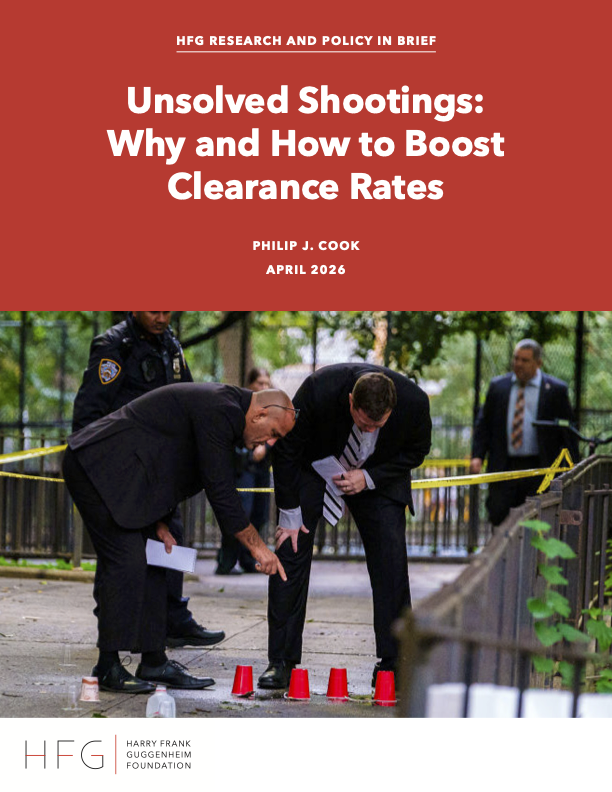
Unsolved Shootings: Why and How to Boost Clearance Rates 

By PHILIP J. COOK

Approximately 75,000 people in the United States were shot by a criminal assailant in 2024, yet most of those shootings did not result in an arrest.

In this HFG Research and Policy in Brief, Philip J. Cook, professor emeritus at Duke University, explores the gap between the minority of shootings that are solved and those that go unsolved.

“There is a strong argument for improving police performance in investigating serious crimes of violence,” Cook writes in Unsolved Shootings: Why and How to Boost Clearance Rates. “What is at stake is public safety and the basic duty of the police to serve the public.”

Cook examines the importance of arresting and prosecuting perpetrators of serious violence, the validity of “clearance rates” as a performance indicator for police departments, and what can be done by police to increase the success rate for criminal investigations—citing examples from Chicago, Denver, and other cities.

Studies in Forensic Psychiatry

By Bernard Glueck. Designed and Edited with an Introduction by Graeme R. Newman and Claude.

In 1916, psychiatrist Bernard Glueck made a case that was still radical for its time: that prisons and asylums needed trained psychiatrists on staff, not as outside consultants, but as clinicians embedded in the institution itself. Writing from the criminal department of the Government Hospital for the Insane in Washington, D.C., Glueck laid out five detailed case studies that argued, one patient at a time, for a new way of understanding the criminal mind.

Inside, you'll find:

  • A clinical study of psychogenic psychosis in prisoners — the theory that mental breakdown behind bars is often a meaningful reaction to arrest, trial, and confinement, not simply organic illness

  • An extended case-by-case analysis of malingering, and the difficult problem of separating feigned symptoms from genuine mental illness

  • A study of "litigious paranoia" — the compulsive, self-representing plaintiff who turns the courtroom into an extension of his delusion

  • A landmark early psychoanalytic case history of kleptomania

Glueck went on to found the first psychiatric clinic ever established inside an American prison, at Sing Sing, and later served as a psychiatric expert in the Leopold and Loeb trial. He was also the elder brother of criminologist Sheldon Glueck — making this book a companion volume to Read-Me.Org's editions of War Criminals and Probation and Criminal Justice.

This new edition includes a substantial original introduction by Graeme R. Newman, assessing Glueck's century-old argument against the present day: what holds up in modern correctional psychiatry, what doesn't, and a hard look at whether American prisons have actually delivered on the promise Glueck was making in 1916 — including current data on the ongoing shortage of psychiatric staffing across U.S. correctional systems.

A Read-Me.Org Classic Reprint. This is a corrected and reformatted edition of the 1916 first edition (Little, Brown, and Company), prepared from a public domain source text under a Creative Commons Attribution 4.0 International License. AI-assisted tools were used in the production of this edition, as disclosed on our website.

Read-Me.Org Inc. New York-Philadelphia-Australia. 2026. p.165.

3D printed firearmsBy 

Colin Murphy

Share this page on FacebookShare this page on XShare this page on LinkedIn3D printing, a technology only a few decades old, has progressed inquality and affordability. It has moved from the realm of industrialprototype, through cutting-edge design and technology, to finally endup in the homes of hobbyists and enthusiasts. This welcome and usefulprocess has delivered new and affordable solutions to a range ofsubjects and fields, and has changed the shape of manufacturing fromlarge factories to small bespoke businesses. However, this innovationhas also developed a darker side and has been adopted by those withcriminal intent, including for the manufacture of firearms. Whileconverted or backstreet guns are not a new phenomenon, the advent of3D printing has extended the range of people able to obtain a firearmto include those with no practical skills or tools or indeed anycriminal connections. In the space of little over a decade, theconcept of homemade guns using 3D printing techniques has evolved froma simple yet effective one-shot pistol to a semi-automatic hybridrifle. These firearms have made their way into the hands of criminalsand extremists with menacing intent. They have also featured inhigh-profile shootings with fatal consequences. It is important toacknowledge that this nascent method of firearm production isdeveloping at a rapid speed. Authorities and law enforcement agenciesare recognising the growing threat that these firearms pose, and areadapting their understanding, approach and expertise. In addition,legislators around the world are beginning to adapt their laws toaddress this emerging threat. In the EU, possession of a 3D-printedfirearm is an offence, but not possession of, publicity for ordistribution of digital blueprints or hard copies.

EPRS | European Parliamentary Research Service , 2025. 6p.

Kevin Pico
Integrated care for people who use alcohol and/or other drugs: A case study analysis of the current landscape in England

By William D. Phillips, Jessica Dawney, Emily Hutton, Avery Adams, Lucy Strang, Katherine I. Morley, Nicola Kalk, Jennifer Bostock, Andrew Jones, Tom Ling, Tim Millar, Joanne Neale, John Strang, Jon Sussex, Jennifer Newbould

This study examined how treatment and recovery services are integrated with physical and mental health services following additional funding from England's drug strategy. Findings show wide variation in the extent and type of integration across local areas. While some progress has been made, more needs to be done to strengthen collaboration and achieve effective, person-centred care.

Key Findings

There is substantial variation in what services are offering across different local areas

  • While certain activities - such as embedding treatment and recovery staff in broader health services to encourage inward referrals - are relatively consistent across local areas, other initiatives are more localised. This is driven by variations in the stage of development of different services, differences in resourcing and local context, and the varying strength of existing relationships and connections.

We identify five models of integration for treatment and recovery services and an optimal example of an integrated care pathway.

  • We conceptualise the following models to help policymakers think about how to monitor, evaluate and communicate about service integration going forward:

  • Model 1 - single point of access

  • Model 2 - embedded workers

  • Model 3 - joint planned care

  • Model 4 - leveraging external support

  • Model 5 - building in-house expertise

  • .

  • Many treatment and recovery services are struggling to meet even basic needs due to high caseloads. Limited, short-term and inconsistent funding compounds these problems, making long-term planning and integration very difficult. Stigma, especially within mental health services, also remains a major barrier.

Recommendations

Central government should:

  • Facilitate the dissemination and implementation of the co-occurring mental health and substance use delivery framework

  • Identify priority interventions for service integration

  • Explore ring fenced, longer-term funding for integrating services

  • Examine ways in which integration efforts could be measured and monitored.

ICPs should:

  • Consider establishing a dedicated role for treatment and recovery services.

Treatment and recovery services should:

  • Provide basic mental health training to screen for and deliver mental health interventions

  • Strengthen relationships with other health services.

ICPs and treatment and recovery services should:

  • Ensure training on substance use is implemented across all healthcare settings, prioritising mental health services.