Open Access Publisher and Free Library
CRIME+CRIMINOLOGY.jpeg

CRIME

Violent-Non-Violent-Cyber-Global-Organized-Environmental-Policing-Crime Prevention-Victimization

Illicit Synthetic Drugs: Trafficking Methods, Money Laundering Practices, and Coordination Efforts

By Michael E. Clements, Triana McNeil et al


What GAO Found Mexican transnational criminal organizations are a major supplier of the top two illicit synthetic drugs involved in overdose deaths in the U.S.—fentanyl and methamphetamine. To supply these drugs to U.S. users, these organizations • source and purchase precursor chemicals primarily from China, using payment methods such as electronic funds transfers and virtual currency; • produce or oversee the production of fentanyl and methamphetamine in clandestine labs in Mexico; and • smuggle the drugs across the U.S.-Mexico border and supply them to U.S.- based drug trafficking groups. Local drug trafficking groups sell these drugs to users through e-commerce platforms, online marketplaces, mobile applications, and social media using payment methods such as cash, peer-to-peer payment applications, and virtual currency, according to Financial Crimes Enforcement Network (FinCEN) and Drug Enforcement Administration (DEA) reports. Transnational criminal organizations launder the illicit proceeds from synthetic drug sales using methods such as • bulk cash smuggling (moving physical currency across international borders), • funnel accounts (bank accounts that collect deposits from members of the criminal network in multiple locations), • trade-based money laundering (using goods in trade transactions to disguise the movement of illicit funds), • virtual currency (exchanging bulk cash for virtual currency), and • Chinese money laundering networks. Chinese money laundering networks are largely decentralized and use both underground-banking mechanisms (which bypass formal banking channels) and other laundering methods within banking systems to convert, move, and obscure illicit proceeds for a fee. Mexican transnational criminal organizations are increasingly using these networks in part because their laundering schemes have lower costs than other organizations, according to law enforcement officials. To combat drug trafficking and related money laundering, federal agencies coordinate and share information with each other and with state, local, and international partners through task forces, working and advisory groups, colocation, and other information-sharing channels. These mechanisms help agencies share resources and expertise, prevent overlapping investigations, and combine unique authorities. In addition, starting on January 20, 2025, the administration began instituting a variety of new policies, including some aimed at combating the flow of synthetic drugs into the U.S. For example, ExecutiveOrder 14159 requires the Departments of Justice and Homeland Security to jointly establish Homeland Security Task Forces in all 50 states to end the presence of cartels and transnational criminal organizations in the U.S. Agencies reported that it is too early to assess the full impact of these policies.

Washington, DC: United States Government Accountability Office; 67pp; 2025. 67p.
Bridging the Immigration Detention Justice Gap

By Jaclyn Kelley-Widmer and  Alisa Whitfield

Immigrants held in United States detention centers experience a de facto denial of their right to access to counsel. The 38,000 immigrants detained each day are largely held in remote facilities, where they experience extremely poor—often abusive—conditions; the inability to contact counsel or prepare their cases; and a legal framework that is stacked against them. Many scholars have studied the overlapping challenges detained immigrants face in a hostile regime and have proposed solutions ranging from ending immigration prison to providing universal representation for all those detained to revising legal rationales for detention. These ideas are good ones. However, as we work towards such goals, tens of thousands remain detained with little recourse. As a partial way to bridge that gap, we argue for a transformative, collaborative model of access to justice that focuses on community empowerment and combines the work of organizers, attorneys, and law students in clinics.

 This article uniquely blends both theory and practical perspectives to advance a theory of abolition-minded provision of legal services in detention. First, we explore the legal right of access to counsel for detained immigrants, with an overview of Constitutional and international human rights models. We then examine the severe barriers to this counsel that immigration detention creates. We then use theories of abolition and legal pedagogy to explore an innovative and critical model for expanding justice in immigration detention. We propose primary goals of increasing access to counsel, empowering communities, and supporting organizing to work towards the end of immigration detention.

 This article was inspired by our experiences representing detained immigrants in a clinical setting, with law students, and in coalition with agencies and organizers working on the ground. Through examples, stories, and even photographs, we weave in insights from this ongoing collaborative project to advance a framework for bridging the immigration detention justice gap.

Cornell Legal Studies Research Paper 25-18, 2024


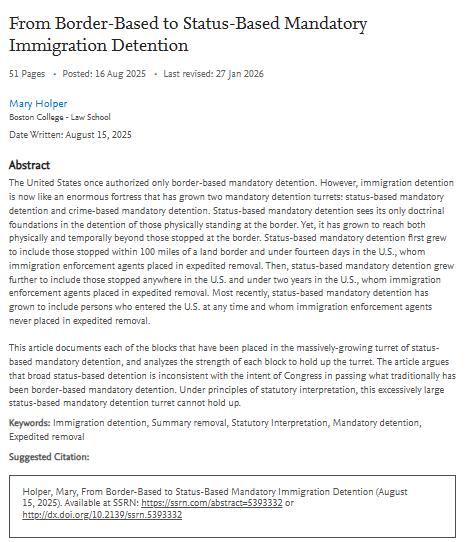
From Border-Based to Status-Based Mandatory Detention

By Mary Holper

The United States once authorized only border-based mandatory detention. However, immigration detention is now like an enormous fortress that has grown two mandatory detention turrets: status-based mandatory detention and crime-based mandatory detention. Status-based mandatory detention sees its only doctrinal foundations in the detention of those physically standing at the border. Yet, it has grown to reach both physically and temporally beyond those stopped at the border. Status-based mandatory detention first grew to include those stopped within 100 miles of a land border and under fourteen days in the U.S., whom immigration enforcement agents placed in expedited removal. Then, status-based mandatory detention grew further to include those stopped anywhere in the U.S. and under two years in the U.S., whom immigration enforcement agents placed in expedited removal. Most recently, status-based mandatory detention has grown to include persons who entered the U.S. at any time and whom immigration enforcement agents never placed in expedited removal. 
This article documents each of the blocks that have been placed in the massively-growing turret of status-based mandatory detention, and analyzes the strength of each block to hold up the turret. The article argues that broad status-based detention is inconsistent with the intent of Congress in passing what traditionally has been border-based mandatory detention. Under principles of statutory interpretation, this excessively large status-based mandatory detention turret cannot hold up.

Boston College Law School Legal Studies Research Paper No. 65653 Fordham Urb. L. J. ___ (forthcoming 2026)44 Pages Posted: 16 Aug 2025 Last revised: 9 Sep 2025

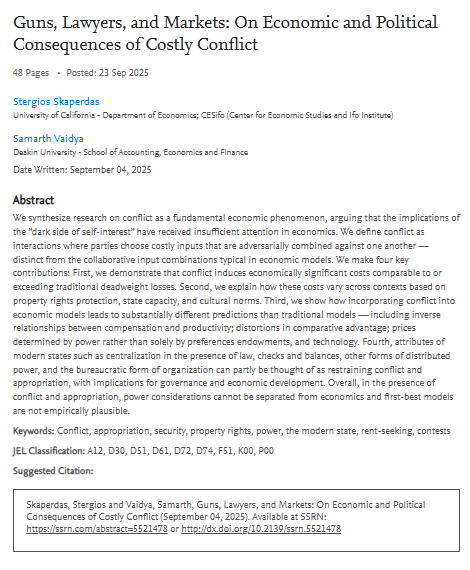
Guns, Lawyers, and Markets: On Economic and Political Consequences of Costly Conflict

By Stergios Skaperdas and Samarth Vaidya

We synthesize research on conflict as a fundamental economic phenomenon, arguing that the implications of the ”dark side of self-interest” have received insufficient attention in economics. We define conflict as interactions where parties choose costly inputs that are adversarially combined against one another — distinct from the collaborative input combinations typical in economic models. We make four key contributions: First, we demonstrate that conflict induces economically significant costs comparable to or exceeding traditional deadweight losses. Second, we explain how these costs vary across contexts based on property rights protection, state capacity, and cultural norms. Third, we show how incorporating conflict into economic models leads to substantially different predictions than traditional models — including inverse relationships between compensation and productivity; distortions in comparative advantage; prices determined by power rather than solely by preferences endowments, and technology. Fourth, attributes of modern states such as centralization in the presence of law, checks and balances, other forms of distributed power, and the bureaucratic form of organization can partly be thought of as restraining conflict and appropriation, with implications for governance and economic development. Overall, in the presence of conflict and appropriation, power considerations cannot be separated from economics and first-best models are not empirically plausible.

 CESifo Working Paper No. 12135, 2025

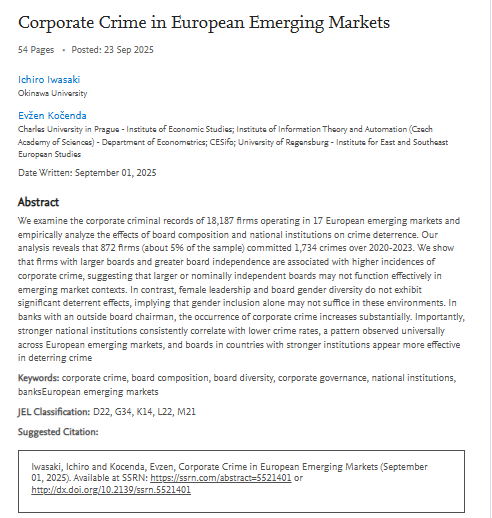
Corporate Crime in European Emerging Markets

By Ichiro Iwasaki and Kocenda, Evzen

We examine the corporate criminal records of 18,187 firms operating in 17 European emerging markets and empirically analyze the effects of board composition and national institutions on crime deterrence. Our analysis reveals that 872 firms (about 5% of the sample) committed 1,734 crimes over 2020-2023. We show that firms with larger boards and greater board independence are associated with higher incidences of corporate crime, suggesting that larger or nominally independent boards may not function effectively in emerging market contexts. In contrast, female leadership and board gender diversity do not exhibit significant deterrent effects, implying that gender inclusion alone may not suffice in these environments. In banks with an outside board chairman, the occurrence of corporate crime increases substantially. Importantly, stronger national institutions consistently correlate with lower crime rates, a pattern observed universally across European emerging markets, and boards in countries with stronger institutions appear more effective in deterring crime

CESifo Working Paper No. 12132 54 Pages Posted: 23 Sep 2025

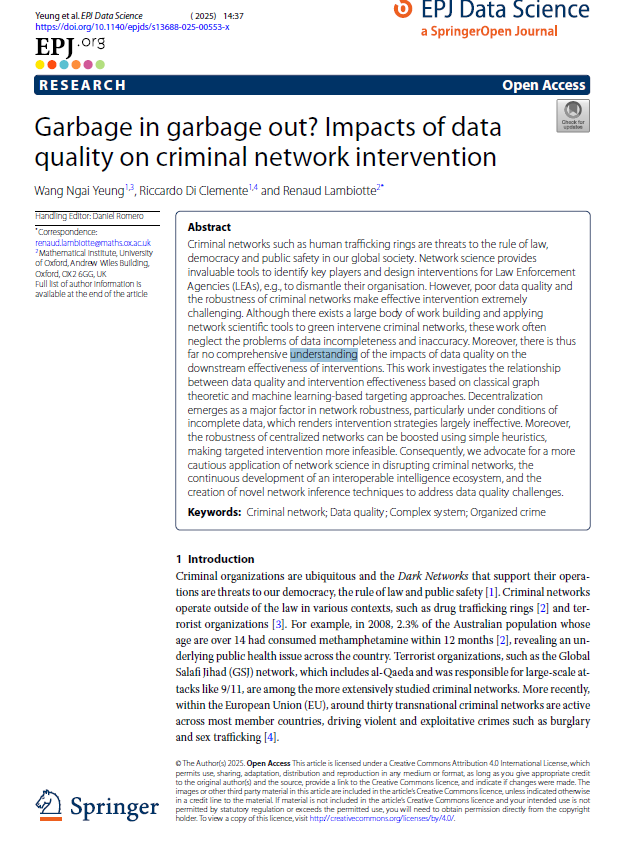
Garbage in garbage out? Impacts of data quality on criminal network intervention

By Wang Ngai Yeung, Riccardo Di Clemente & Renaud Lambiotte

Criminal networks such as human trafficking rings are threats to the rule of law, democracy and public safety in our global society. Network science provides invaluable tools to identify key players and design interventions for Law Enforcement Agencies (LEAs), e.g., to dismantle their organisation. However, poor data quality and the robustness of criminal networks make effective intervention extremely challenging. Although there exists a large body of work building and applying network scientific tools to green intervene criminal networks, these work often neglect the problems of data incompleteness and inaccuracy. Moreover, there is thus far no comprehensive understanding of the impacts of data quality on the downstream effectiveness of interventions. This work investigates the relationship between data quality and intervention effectiveness based on classical graph theoretic and machine learning-based targeting approaches. Decentralization emerges as a major factor in network robustness, particularly under conditions of incomplete data, which renders intervention strategies largely ineffective. Moreover, the robustness of centralized networks can be boosted using simple heuristics, making targeted intervention more infeasible. Consequently, we advocate for a more cautious application of network science in disrupting criminal networks, the continuous development of an interoperable intelligence ecosystem, and the creation of novel network inference techniques to address data quality challenges.

 EPJ Data Sci. 14, 37 (2025)

THE BUSINESS OF EXPLOITATION:  THE ECONOMICS OF CYBER SCAM OPERATIONS IN SOUTHEAST ASIA

By Kristina Amerhauser | Audrey Thill 

  Cyber scam operations in Southeast Asia rely heavily on information and communications technology, financial fraud, trafficking for forced criminality, corruption and elite capture. This creates what can be described as ‘compound crimes’, reflecting how cyber scam operations are both based in physical compounds and involve multiple criminal markets. While estimates vary, the scale of funds defrauded from scam victims each year is in the tens of billions of US dollars and trending upward. In addition, illicit proceeds are generated from exploitation of trafficked persons, illegal gambling and corruption. The scale of illicit financial flows represents a clear threat to national economies, governance and international security. Cyber scam operations and their enabling networks operate at scale across Southeast Asia and beyond. They have reportedly trapped hundreds of thousands of people inside compounds where they are forced to conduct scams. Some operations retain workers through debt bondage, psychological coercion and financial incentives. Significant diversity in operational models – from high-security compounds to thousands of smaller operations located in apartments and other small premises – creates varied patterns of financial flows across jurisdictions. The money laundering process is part of a sophisticated financial service ecosystem. Most concerning is how networks of actors operate at scale and at the intersection of legitimate and illegitimate economies by using licensed crypto exchanges, registered fintech platforms and traditional banking services. Some are ‘crime as a service’ providers, explicitly providing money laundering services to cyber scam operations and doing so with corporate efficiency. This means that moving and laundering money has evolved into a marketplace-type structure where actors remain anonymous to others within the network. Governments, the private sector and civil society actors have sought innovative responses to disrupt the illicit industry. These include initiatives that ‘follow the money’ and disrupt the money laundering networks used by cyber scam operations. While some work has begun to explore illicit financial flows stemming from scam operations, notably related to cryptocurrencies, important gaps persist. Less is known about the wider set of financial flows, the mechanisms used to transfer proceeds in and out of the region and the networks involved. This policy brief seeks to help fill this gap by mapping wider related payments and providing insights into how money is moved and where it ultimately ends up. It concludes by providing actionable policy recommendations for Southeast Asian governments as well as regional and global financial service providers. Crucially, these recommendations identify entry points for disrupting the operations of the transnational organized crime groups that run cyber scam operations. The key findings include: Actors involved in cyber scams and trafficking for forced criminality often use cryptocurrency to move illicit money. They also use cash, fintech – such as peer-to-peer (P2P) payment apps – gaming or gambling platforms, bank transfers, shell and front companies, credit cards and pre-paid cards. The role of the formal banking sector in these financial flows appears significant, as many scam-related transfers are initiated by the victim from their own bank accounts before being converted into cryptocurrencies at different steps of the laundering process. While most financial institutions likely process these transactions unwittingly, evidence suggests they may be enabled by regulatory loopholes such as weak know-your-customer (KYC) requirements and/or excessively high minimum thresholds for reporting suspicious transactions. After being laundered and converted back into fiat currency4 from cryptocurrency, illicit funds are also likely to be moved again through the formal financial system.

Many of the fintech and cryptocurrency platforms that money laundering networks use to convert cryptocurrencies back into fiat are registered companies and hold financial service licences. Some owners of these platforms have close connections to the political and business elites in the countries of registration, suggesting influence over financial regulation and an interest in maintaining a policy environment amenable to the large-scale laundering of criminal proceeds. Transnational organized crime groups in Southeast Asia generate highly lucrative profits. This creates a vicious cycle: greater profits enable these groups to expand their influence, including over public officials and the financial sector, which in turn reduces scrutiny of cyber scam compounds and related suspicious financial transactions. With their growing wealth, these criminal networks invest further into other types of crime and crime-as-a-service infrastructure, generating additional profits that allow them to strengthen their influence and market position   
Geneva: Global Initiative Against Transnational Organized Crime. 2025. 44p.

Cybersecurity: Network Monitoring Program Needs Further Guidance and Actions

By Jennifer Franks

The Department of Homeland Security's Continuous Diagnostics and Mitigation (CDM) program gives agencies cybersecurity tools to strengthen the networks and systems they use to meet their missions.While the program has met two of its goals, it lacks sufficient guidance for managing network security and data protection. The program generally supports government-wide cybersecurity initiatives, but DHS's Cybersecurity and Infrastructure Security Agency hasn't finalized all plans for how CDM can provide support. For example, the agency hasn't fully updated the program's cloud asset management guidance.

We recommended DHS address these issues

Washington, DC: U.S. Government Accountability Office, 2025. 46p.

Artificial Intelligence, Cybersecurity, and National Security:

By Richard Danzig

In this paper, the author warns national security decisionmakers that to accomplish their missions they urgently need to better prepare for the impact of artificial intelligence (AI) on cybersecurity. He analyzes the present failings of the U.S. government in this respect, highlights the consequences of these failings, and makes recommendations for correcting them. He offers this effort as a case study and draws from it ten propositions relevant to those who are more broadly concerned with how AI, other technologies, and human decisions are intertwined and co-evolving.

Santa Monica, CA: RAND, 2025.

Cybercrime and strain theory: An examination of online crime and gender.

By Katalin Parti, Thomas Dearden

Purpose: Historically, cybercrime has been seen as a near exclusively male activity. We were interested to learn whether the relationship between strain and crime holds for both males and females.

Methods: We utilized an online survey instrument to collect data from a national sample of individuals (n=2,121) representing the US population by age, gender, race and ethnicity. We asked offending related questions regarding various cybercrimes. In the current study, we use data from 390 individuals who reported a cybercrime activity within the past 12 months.

Results: We find strong support for prior strains correlating with both specific (e.g., illegal uploading) and general cyber-offending. We further examine whether gender interacts with strain. While general strain theory (GST) correlates with cyber-offending for both males and females, we did find a few important differences. Except for lack of trust in others and receiving unsatisfactory evaluation at school or work, there are different variables responsible for online offending for men and women. Parents’ divorcing, anonymity, and online video gaming increase cybercrime offending in women, whereas falling victim to a crime, breaking up with a significant other, and darkweb activity are correlated with cyber-offending for men.

Conclusion: Although GST functions differently by gender when it comes to engaging in cyber-offending, the theory is indeed gender-specific, as different strain variables are responsible for engaging in cyber-offending in women and men. Components of general strain responsible for cyber-offending need to be further studied concerning gender. According to our results, GST is gender-specific, and these variables need to be further studied.

International Journal of Criminology and Sociology13, 211–226

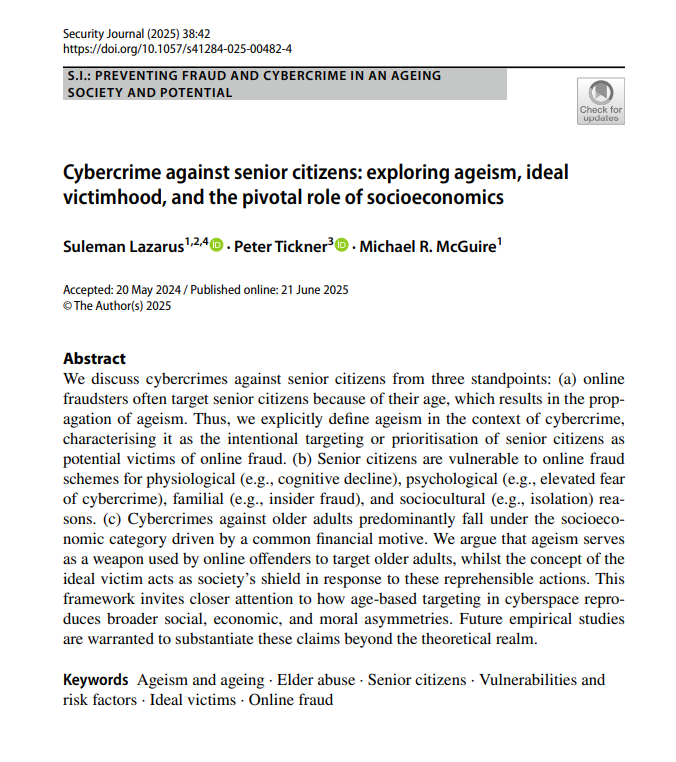
 Cybercrime against senior citizens: exploring ageism, ideal victimhood, and the pivotal role of socioeconomics

By Suleman Lazarus  · Peter Tickner  · Michael R. McGuire1

 We discuss cybercrimes against senior citizens from three standpoints: (a) online fraudsters often target senior citizens because of their age, which results in the propagation of ageism. Thus, we explicitly defne ageism in the context of cybercrime, characterising it as the intentional targeting or prioritisation of senior citizens as potential victims of online fraud. (b) Senior citizens are vulnerable to online fraud schemes for physiological (e.g., cognitive decline), psychological (e.g., elevated fear of cybercrime), familial (e.g., insider fraud), and sociocultural (e.g., isolation) reasons. (c) Cybercrimes against older adults predominantly fall under the socioeconomic category driven by a common fnancial motive. We argue that ageism serves as a weapon used by online offenders to target older adults, whilst the concept of the ideal victim acts as society’s shield in response to these reprehensible actions. This framework invites closer attention to how age-based targeting in cyberspace reproduces broader social, economic, and moral asymmetries.  Future empirical studies are warranted to substantiate these claims beyond the theoretical realm.

Security Journal (2025) 38:42 

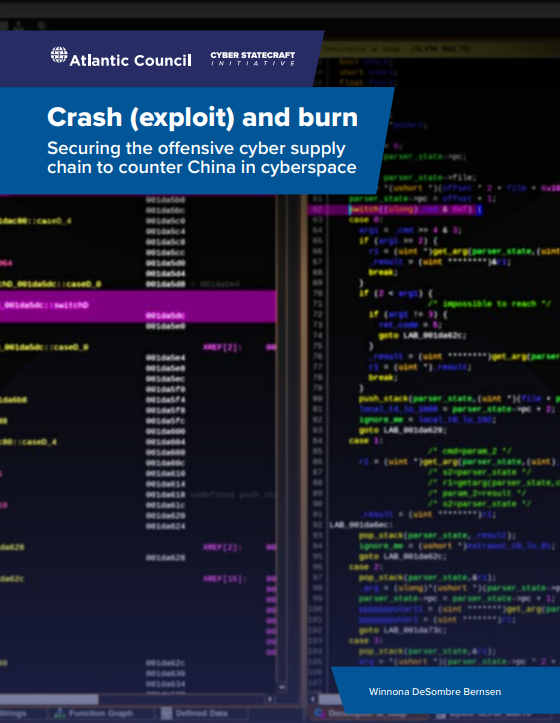
Crash (exploit) and burn: Securing the offensive cyber supply chain to counter China in cyberspace,

By Winnona DeSombre Bernsen

If the United States wants to increasingly use offensive cyber operations internationally, does it have the supply chain and acquisition capabilities to back it up—especially if its adversary is the People’s Republic of China? 

 The Cyber Statecraft Initiative’s new report from CSI nonresident fellow Winnona DeSombre Bernsen, Crash (exploit) and burn: Securing the offensive cyber supply chain to counter China in cyberspace,  is the first to conduct a comparative study within the international offensive cyber supply chain, comparing the United States’ fragmented, risk-averse acquisition model with China’s outsourced and funnel-like approach.

 Strategic competition between the United States and China has long played out in cyberspace, where offensive cyber capabilities, like zero-day vulnerabilities, are a strategic resource. Since 2016, China has been turning the zero-day marketplace in East Asia into a funnel of offensive cyber capabilities for its military and intelligence services, both to ensure it can break into the most secure Western technologies and to deny the United States from obtaining similar capabilities from the region. If the United States wishes to compete in cyberspace, it must compete against China to secure its offensive cyber supply chain.

Washington, DC: Atlantic Council, 2025. 44p

Cybercrime Classification and Measurement

By Hal S. Stern and Daniel L. Cork, Editors

Cybercrime poses serious threats and financial costs to individuals and businesses in the United States and worldwide. Reports of data breaches and ransomware attacks on governments and businesses have become common, as have incidents against individuals (e.g., identity theft, online stalking, and harassment). Concern over cybercrime has increased as the internet has become a ubiquitous part of modern life. However, comprehensive, consistent, and reliable data and metrics on cybercrime still do not exist - a consequence of a shortage of vital information resulting from the decentralized nature of relevant data collection at the national level.

Cybercrime Classification and Measurement addresses the absence credible cybercrime data and metrics. This report provides a taxonomy for the Federal Bureau of Investigation for the purpose of measuring different types of cybercrime, including both cyber-enabled and cyber-dependent crimes faced by individuals and businesses, and considers the needs for its periodic revision. This report was mandated by the 2022 Better Cybercrime Metrics Act (BCMA).

Washington, DC: The National Academies Press., 2025. 160p.

Extended editorial: preventing fraud and cybercrime in an ageing society

By Mark Button  · Vasileios Karagiannopoulos  · Julak Lee  · Joon Bae Suh  · Jeyong Jung

Introduction The nature of crime has been changing globally with technological and other societal developments fuelling a growth in fraud and cybercrime (Button and Cross 2017). The diversity and rapid evolution of a broad range of scams has led to millions across the globe becoming victims of fraud (Federal Trade Commission 2019; ONS 2023a, 2023b). A common belief often promoted in policy circles and some research is that older adults are more vulnerable to fraud (James et al. 2014). This is not so clear cut, however, as in terms of victimisation, the middle aged have been most at risk (see Fig. 1 later). This is changing and there is evidence older adults (65+) are fast becoming the one of the most at risk categories and that they also tend to lose much more than other age groups (see Table 1 later). Indeed, there are a variety of trends fuelling a potential explosion in fraud and cybercrime among older adults unless serious action is taken to reduce the risks that we will shortly explore. It is for this reason we conceived this special edition and the research project that underpins it. To set the context for this edition, it is important to examine the factors fuelling the growth in fraud and cybercrime victimisation among older age groups. We will do this using data from the UK and South Korea. The reason for the selection of these countries is simple. The funding for the project stimulating this edition came from ESRC funding aimed at developing relationships with these two countries 

  Security Journal (2025) 38:40

Cyber‑enabled imposter scams against older adults in the United States

By Lauren R. Shapiro 

This paper evaluated three cyber-enabled imposter scams against older adults using Lifestyle Routine Activity Theory. The frst section examined the motivated ofender’s tools for manipulating older adult targets (social engineering and persuasion) and explained how Artifcial Intelligence could increase exposure and susceptibility of imposter victims. The next section focused on the suitable victim by examining how heuristics and impaired cognitive, physical, and psychosocial abilities contributed to the older adult target’s susceptibility to imposter scam by interfering with the process of rational decision-making. The third section examined ways in which capable guardians, in the form of agencies and laws, protected and helped older adult targets from imposter scams. Recommendations regarding the creation of educational programs that teach older adults how to be safer online (i.e., less suitable victims) through evaluating risks, identifying potential imposter scams, and becoming efcient self-advocators were provided.   

  Security Journal (2025) 38:43

Fear of fraud amongst older adults: a hidden epidemic? 

By Mark Button  · David Shepherd  · Chloe Hawkins  · Jacki Tapley

This paper explores older adults who are largely over 75 and their experience of fraud, based upon research with the clients of a UK charity working with this age group. The researchers used a postal questionnaire yielding almost 2000 responses, supplemented with interviews with clients and key staf. The research found higher rates of fraud victimisation than national rates for this age group as well regular attempted frauds, largely through the telephone. The experience of fraud and attempted fraud has a devastating impact on some of the lives of older adults, causing fear, anxiety, and related issues, which afects their quality of life. This is the frst study to illustrate that fear of fraud is a major problem amongst older adults, particularly females living alone.  

Security Journal (2025) 38:44

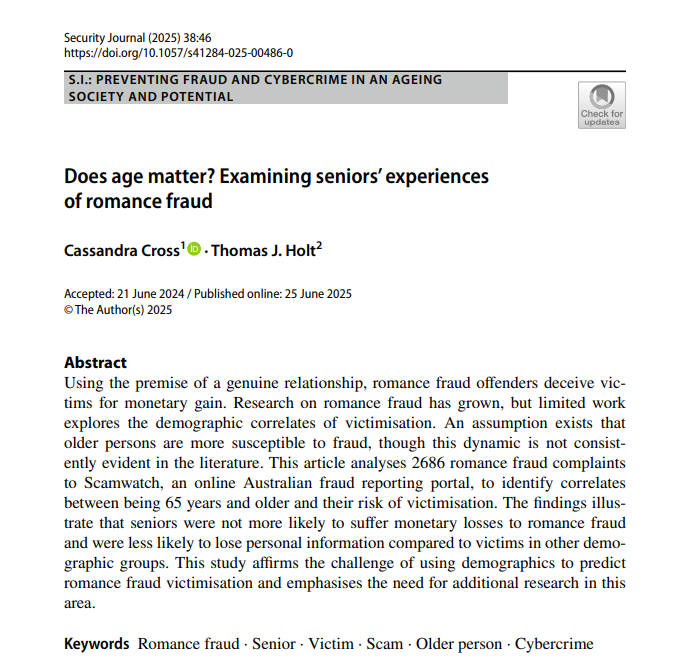
  Does age matter? Examining seniors’ experiences of romance fraud

By Cassandra Cross  · Thomas J. Holt 

Using the premise of a genuine relationship, romance fraud ofenders deceive victims for monetary gain. Research on romance fraud has grown, but limited work explores the demographic correlates of victimisation. An assumption exists that older persons are more susceptible to fraud, though this dynamic is not consistently evident in the literature. This article analyses 2686 romance fraud complaints to Scamwatch, an online Australian fraud reporting portal, to identify correlates between being 65 years and older and their risk of victimisation. The fndings illustrate that seniors were not more likely to sufer monetary losses to romance fraud and were less likely to lose personal information compared to victims in other demographic groups. This study afrms the challenge of using demographics to predict romance fraud victimisation and emphasises the need for additional research in this area 

  Security Journal (2025) 38:46

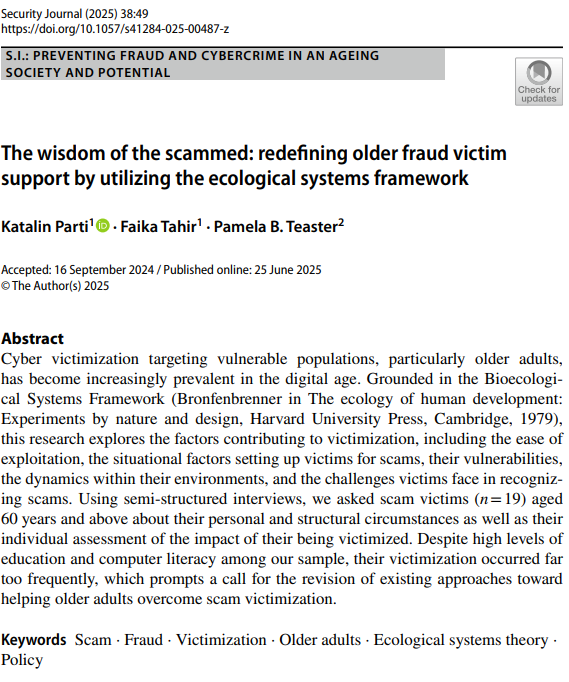
The wisdom of the scammed: redefning older fraud victim support by utilizing the ecological systems framework

By Katalin Parti  · Faika Tahir  · Pamela B. Teaster 

Cyber victimization targeting vulnerable populations, particularly older adults, has become increasingly prevalent in the digital age. Grounded in the Bioecological Systems Framework (Bronfenbrenner in The ecology of human development: Experiments by nature and design, Harvard University Press, Cambridge, 1979), this research explores the factors contributing to victimization, including the ease of exploitation, the situational factors setting up victims for scams, their vulnerabilities, the dynamics within their environments, and the challenges victims face in recognizing scams. Using semi-structured interviews, we asked scam victims (n=19) aged 60 years and above about their personal and structural circumstances as well as their individual assessment of the impact of their being victimized. Despite high levels of education and computer literacy among our sample, their victimization occurred far too frequently, which prompts a call for the revision of existing approaches toward helping older adults overcome scam victimization.  

  Security Journal (2025) 38:49

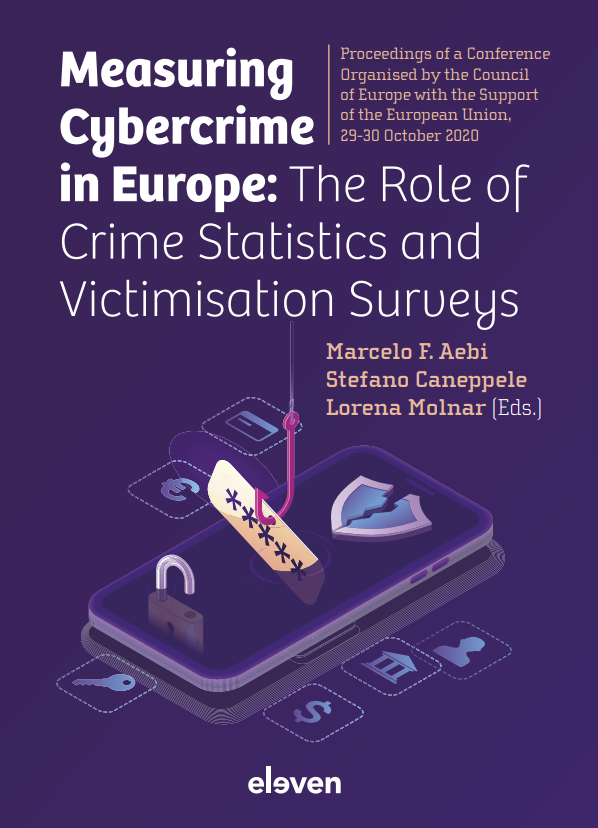
Measuring cybercrime in Europe

By Marcelo F. Aebi Stefano Caneppele Lorena Molnar (Eds.)

  Cybercrime has become part of everyday life. We live in hybrid societies, fl uctuating between the material and the virtual world, and we are hence confronted with online, offl ine and hybrid offences. However, the few victimisation surveys conducted in Europe reveal that victims of online crimes seldom report them to the police. Consequently, cybercrimes – which according to the best estimates represent between one third and more than half of all attempted and completed crimes in Europe – seldom appear in national criminal statistics. The State seems powerless to prevent them and private security companies fl ourish. During two days, experts from all over the continent gathered together in the framework of a virtual conference organized by the Council of Europe and the European Union to discuss what we know, what we do not know, and what we could do to improve our knowledge of crime in our contemporary hybrid societies, develop evidence-based criminal policies, provide assistance to crime victims, and implement realistic programs in the fi eld of crime prevention and offender treatment. This book presents their experiences, refl exions, and proposals  

The Hague: Eleven Publishing, 2022. 150p.  

Safeguarding Singapore: Addressing the Impact of Transnational Scamming Operations in Southeast Asia

By Yen Zhi Yi
SYNOPSIS
In recent months, heightened media scrutiny has drawn attention to the proliferation of scam centres along Myanmar’s border towns and the subsequent crackdowns on them. Concurrently, Singapore has also witnessed a significant increase in scam-related incidents, with the government urging vigilance and taking precautionary measures to safeguard its citizens. Against this backdrop, it is imperative for ASEAN countries to work collaboratively to tackle this growing cross-border scourge. Doing so calls for stepped-up action at home to enhance awareness and enforcement collaboration abroad among regional partners to check this transnational security challenge.
 
S. Rajaratnam School of International Studies, NTU Singapore, 2025. 6p.