Open Access Free Library
CRIME+CRIMINOLOGY.jpeg

CRIME

Violent-Non-Violent-Cyber-Global-Organized-Environmental-Policing-Crime Prevention-Victimization

Preventing Crime: A Reader's Guide

by Graeme R. Newman with the assistance of Claude.

Can you stop crime before it starts, without fully knowing what causes it? A reader's guide to the 1936 symposium that gathered twenty-four programs trying to find out.

Preventing Crime: A Symposium, edited by Sheldon and Eleanor Glueck, brought together the directors of coordinated community councils, school bureaus, police prevention units, residential homes, child guidance clinics, a parent school, and boys' clubs, and asked each the same questions: what evidence shows the need for your program, how does it work, and how do you know whether it succeeds? The editors were candid from the start. Their title, they admitted in the preface, was optimistic, and a more accurate one would have been "Promising Efforts to Prevent Delinquency and Criminality." Only time and real evaluation, they wrote, could say whether these programs actually prevented anything.

The book is a portrait of what serious people believed about crime prevention in the depths of the Depression, and a case study in the gap between good intentions and good evidence. This Reader's Guide makes it accessible without replacing it. It explains what each program did, sets out the twelve principles the Gluecks drew from the contributions, and shows exactly what counted as proof of success in 1936, and how little of it would count today.

INSIDE THIS GUIDE

  • A reading plan and a chapter-by-chapter map of the original, with all twenty-five contributors

  • The Gluecks' opening argument: can crime be prevented without knowing its causes?

  • Twelve principles distilled from the programs, from starting early to using trained personnel

  • Community councils, school programs, police prevention bureaus, residential homes, clinics, and boys' clubs, program by program

  • A close look at "the audit problem": what each contributor offered as evidence, and what it actually showed

  • A worked example that tests one program's before-and-after numbers against six hard questions

  • What has changed since 1936, including the Cambridge-Somerville Youth Study's sobering results and decades of research on what works, what doesn't, and what's promising

  • Five common misreadings, a primer of evaluation terms, a glossary, an annotated reading list, an FAQ, 26 discussion questions and classroom activities

WHO IT'S FOR: Students of criminology, social work, education, public policy and program evaluation; practitioners designing youth programs; teachers and reading groups; and general readers curious about where crime prevention came from and why proving it works is so hard.

PLEASE NOTE: This is an independent guide, not an abridgment or edition of the original symposium. It does not reproduce the original's text and is not endorsed by the editors', or contributors', heirs. It is meant to be read alongside the original, which is in the public domain in the United States.

Written by Graeme R. Newman with the assistance of Claude, an AI model made by Anthropic. The AI-generated content is disclosed in accordance with Read-Me.Org policy.

Read-Me.Org Inc. New York-Philadelphia-Australia. 2026. p.54p.

Five Hundred Criminal Careers: A Reader's Guide

by Graeme Newman (Author), Sheldon Glueck (Author), Eleanor Glueck

Did the reformatories really reform? In 1930, two Harvard researchers went and checked.

For decades, American reformatories reported that most of their graduates went straight. Estimates ran from 60 to 85 percent, and they were repeated in textbooks and legislatures. In Five Hundred Criminal Careers, Sheldon and Eleanor Glueck tested the claim. They took every man whose parole from the Massachusetts Reformatory expired in 1921 or 1922, 510 in all, and traced what happened to each over the next five years. Their answer reversed the figures: almost four in five of the men they could trace had committed offenses after parole.

This Reader's Guide explains how the study was done, what it found, and how far its evidence can be trusted. It also shows why the book still matters. It is the model for later follow-up studies, an early account of how to find ex-prisoners without harming them, and the origin of the prognostic tables that became today's risk assessments.

INSIDE THIS GUIDE

  • A reading plan and a chapter-by-chapter map of the original

  • How 510 men were traced through fingerprint files, police letters, and hundreds of interviews

  • What "success" and "failure" meant, and a worked example showing how the 79 percent headline changes under other definitions

  • The men, their families, the Reformatory and parole, and what the community did for them

  • How the authors tried to separate the institution's effect from the men's own history

  • The prognostic tables, their strengths, and their limits

  • What the ex-prisoners themselves said, and the authors' program of reform

  • What has changed since 1930, including modern recidivism research and risk assessment, and what has not

  • Five common misreadings, a statistics primer, a glossary, an annotated reading list, an FAQ, 26 discussion questions and classroom activities

WHO IT'S FOR: Students of criminology, criminal justice, sociology, social work and law; teachers and reading groups; and general readers who want to know how anyone can tell whether a prison or a program works.

PLEASE NOTE: This is an independent guide, not an abridgment or edition of the Gluecks' book. It does not reproduce the original's text or tables and is not endorsed by the authors' heirs or the original publisher. It is meant to be read alongside the original.

Written by Graeme R. Newman with the assistance of Claude, an AI model made by Anthropic. The AI-generated content is disclosed in accordance with Read-Me.Org policy.

Read-Me.Org Inc. New York-Philadelphia-Australia. 2026. p.80.

LAW AND PSYCHIATRY: Cold War or Entente Cordiale? Reader's Guide

by Graeme Newman (Author), Sheldon Glueck (Author)

If a man kills because he is certain his victim is plotting against him, and he knows killing is against the law, is he responsible?

In 1962, Sheldon Glueck of the Harvard Law School gave four lectures at Tulane University on one of the hardest questions in criminal law: where to draw the line between the wicked and the ill. Law and Psychiatry: Cold War or Entente Cordiale? reviews the tests of legal insanity, says what is wrong with each, proposes a new one, and argues that lawyers and psychiatrists are quarreling over too small a prize.

This Reader's Guide explains his arguments in plain language, supplies the legal background, and shows what has changed since. Inside are a lecture map, a worked example applying six tests to three imaginary defendants, common misreadings, and discussion questions.

A companion to the original, for students, teachers and curious readers.

Read-Me.Org Inc. New York-Philadelphia-Australia. 2026. p.64.

Libya's Kleptocratic Boom

By the Sentry

Despite channelling Libyan public funds into the 2019 assault on Tripoli, flooding the economy with unauthorized dinar banknotes, and orchestrating arms shipments that appear to defy international law, Gadalla has faced no consequences. He lives lavishly in Canada and continues to expand his influence in Libya.

This is not just about one individual. Gadalla’s influence reflects deeper systemic weaknesses in Libya’s governance and financial systems that enable corruption, economic instability, and the continued diversion of national wealth away from ordinary Libyans.

The report calls for:

  • Targeted sanctions on Gadalla, his companies, and associates

  • Investigations into financial institutions linked to his activities

  • Coordinated international action to address these networks and restore accountability

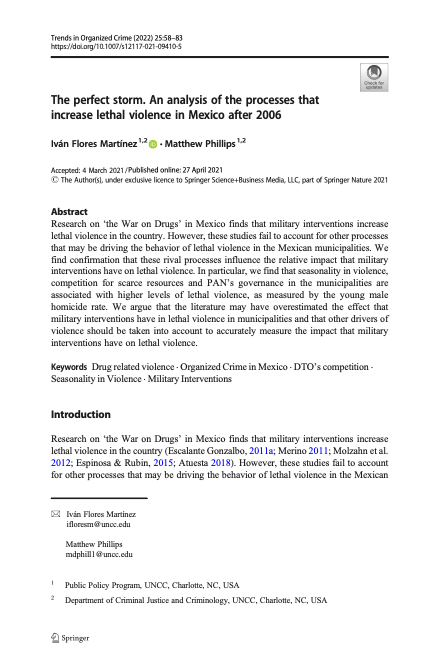
The perfect storm. An analysis of the processes that increase lethal violence in Mexico after 2006 

By Iván Flores Martínez & Matthew Phillips 

Research on ‘the War on Drugs’ in Mexico finds that military interventions increase lethal violence in the country. However, these studies fail to account for other processes that may be driving the behavior of lethal violence in the Mexican municipalities. We find confirmation that these rival processes influence the relative impact that military interventions have on lethal violence. In particular, we find that seasonality in violence, competition for scarce resources and PAN’s governance in the municipalities are associated with higher levels of lethal violence, as measured by the young male homicide rate. We argue that the literature may have overestimated the effect that military interventions have in lethal violence in municipalities and that other drivers of violence should be taken into account to accurately measure the impact that military interventions have on lethal violence.

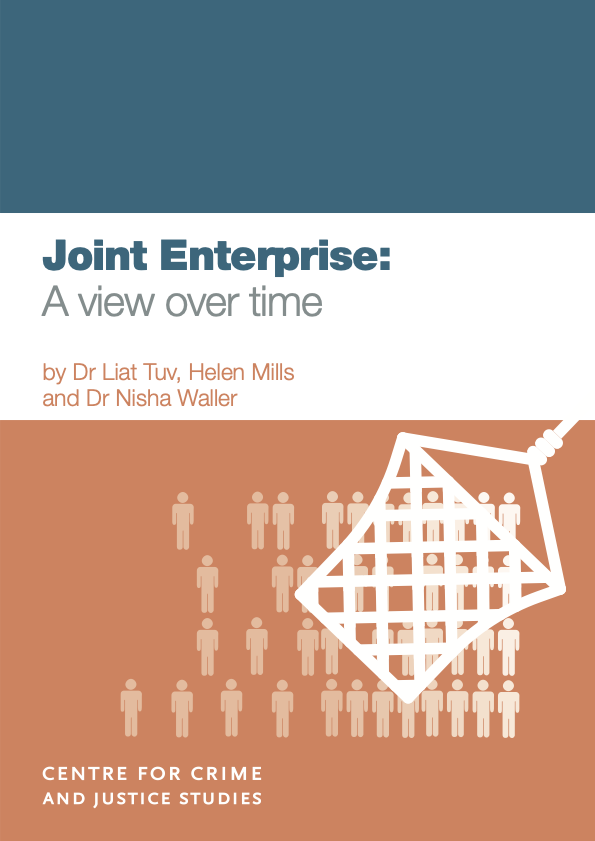
Joint Enterprise: A view over time

By Liat Tuv, Helen Mills, Nisha Waller

The past two decades have seen a sustained rise in multi-defendant homicide prosecutions

This report tracks multi-defendant homicide prosecutions in England and Wales and the concerns they raise around fairness, youth involvement, and racial disproportionality. Drawing on Home Office and CPS data from 2005–2024, it finds that prosecutions involving multiple defendants have become more common, with young people disproportionately represented among those convicted. It also highlights persistent racial disparities and increasingly severe sentencing outcomes for those convicted.

The report situates these findings within wider academic and policy debates on joint enterprise and shared responsibility in serious crime. Authors make the case for government attention and intervention on three key issues: 

  • Narrow the scope of the law: Via a workable test for when someone can be held liable for the crimes of another.

  • Proportionate sentencing: With a separate sentencing framework for secondary parties.

  • Greater transparency and accountability: Requiring prosecutors to state each defendant's individual conduct and intent, and identify possible alternative charging.

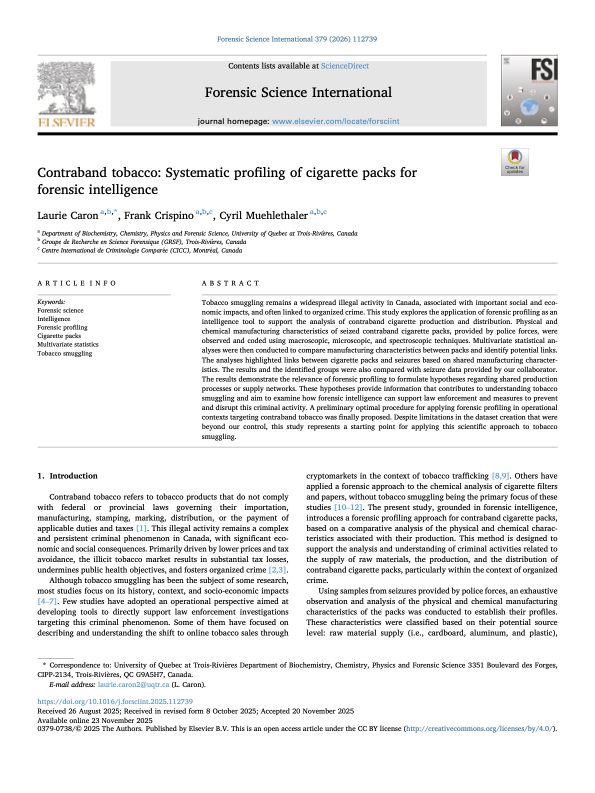
Contraband tobacco: Systematic profiling of cigarette packs for forensic intelligence

By Laurie Caron, Frank Crispino, Cyril Muehlethaler

Tobacco smuggling remains a widespread illegal activity in Canada, associated with important social and economic impacts, and often linked to organized crime. This study explores the application of forensic profiling as an intelligence tool to support the analysis of contraband cigarette production and distribution. Physical and chemical manufacturing characteristics of seized contraband cigarette packs, provided by police forces, were observed and coded using macroscopic, microscopic, and spectroscopic techniques. Multivariate statistical analyses were then conducted to compare manufacturing characteristics between packs and identify potential links. The analyses highlighted links between cigarette packs and seizures based on shared manufacturing characteristics. The results and the identified groups were also compared with seizure data provided by our collaborator. The results demonstrate the relevance of forensic profiling to formulate hypotheses regarding shared production processes or supply networks. These hypotheses provide information that contributes to understanding tobacco smuggling and aim to examine how forensic intelligence can support law enforcement and measures to prevent and disrupt this criminal activity. A preliminary optimal procedure for applying forensic profiling in operational contexts targeting contraband tobacco was finally proposed. Despite limitations in the dataset creation that were beyond our control, this study represents a starting point for applying this scientific approach to tobacco smuggling.

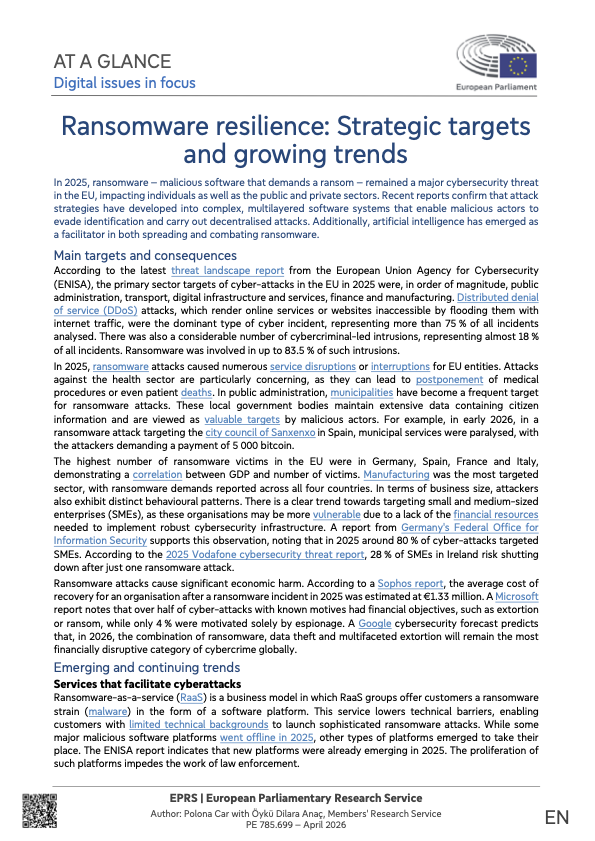
Ransomware resilience: Strategic targets and growing trends

By Polona Car with Öykü Dilara Anaç

In 2025, ransomware – malicious software that demands a ransom – remained a major cybersecurity threat in the EU, impacting individuals as well as the public and private sectors. Recent reports confirm that attack strategies have developed into complex, multilayered software systems that enable malicious actors to evade identification and carry out decentralised attacks. Additionally, artificial intelligence has emerged as a facilitator in both spreading and combating ransomware

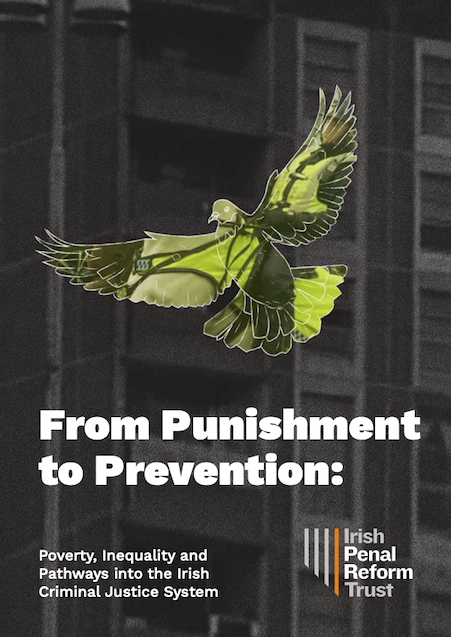
From Punishment to Prevention: Poverty, Inequality and Pathways into the Irish Criminal Justice System

By Clare O’Connor,.et al

In 2012, IPRT published The Vicious Circle of Social Exclusion and Crime: Ireland’s Disproportionate Punishment of the Poor1 setting out how poverty and social exclusion shape exposure to criminalisation, and the case for early intervention and social investment as prevention. In the years since, the effects of austerityera policies have become increasingly visible, particularly in housing, social protection and criminal justice. Ireland faces a deepening housing crisis and cost of living crisis, alongside record levels of prison overcrowding. This report provides an updated evidence base on the overlap between poverty, deprivation and criminalisation in Ireland, examines justice reinvestment approaches, outlines relevant human rights obligations, and identifies evidence-led alternatives to over-reliance on penal sanctions

The availability and purchase of digital firearms products among online Australians

By Alexandra Voce and Anthony Morgan

The Australian Institute of Criminology has released a Statistical Bulletin on the availability and purchase of digital firearms products among online Australians, based on a national survey of 9,951 online Australian adults:

  • More than twice as many respondents (2.4%) had seen digital firearms products for sale on the public internet (clear web) compared with the darknet (0.9%). 

  • Just over one percent (1.1%) of respondents said they or someone they knew had bought or traded digital firearms products online on the public internet (0.7%) or on the darknet (0.8%).

  • Respondents who said they or someone they knew had bought or traded digital firearms products online were more likely than other respondents to have had contact with the criminal justice system, including for violent offences, to own a firearm without a licence, to have intentionally viewed fringe or radical content and to have seen content depicting or calling for violent action.

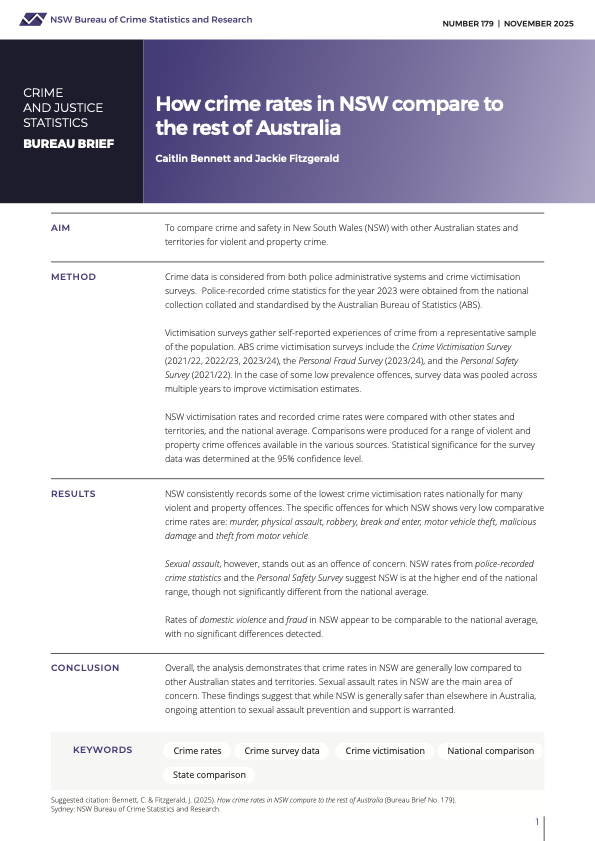
How crime rates in NSW compare to the rest of Australia

By Caitlin Bennett and Jackie Fitzgerald

AIM To compare crime and safety in New South Wales (NSW) with other Australian states and territories for violent and property crime. METHOD Crime data is considered from both police administrative systems and crime victimisation surveys. Police-recorded crime statistics for the year 2023 were obtained from the national collection collated and standardised by the Australian Bureau of Statistics (ABS). Victimisation surveys gather self-reported experiences of crime from a representative sample of the population. ABS crime victimisation surveys include the Crime Victimisation Survey (2021/22, 2022/23, 2023/24), the Personal Fraud Survey (2023/24), and the Personal Safety Survey (2021/22). In the case of some low prevalence offences, survey data was pooled across multiple years to improve victimisation estimates. NSW victimisation rates and recorded crime rates were compared with other states and territories, and the national average. Comparisons were produced for a range of violent and property crime offences available in the various sources. Statistical significance for the survey data was determined at the 95% confidence level. RESULTS NSW consistently records some of the lowest crime victimisation rates nationally for many violent and property offences. The specific offences for which NSW shows very low comparative crime rates are: murder, physical assault, robbery, break and enter, motor vehicle theft, malicious damage and theft from motor vehicle. Sexual assault, however, stands out as an offence of concern. NSW rates from police-recorded crime statistics and the Personal Safety Survey suggest NSW is at the higher end of the national range, though not significantly different from the national average. Rates of domestic violence and fraud in NSW appear to be comparable to the national average, with no significant differences detected. CONCLUSION Overall, the analysis demonstrates that crime rates in NSW are generally low compared to other Australian states and territories. Sexual assault rates in NSW are the main area of concern. These findings suggest that while NSW is generally safer than elsewhere in Australia, ongoing attention to sexual assault prevention and support is warranted.

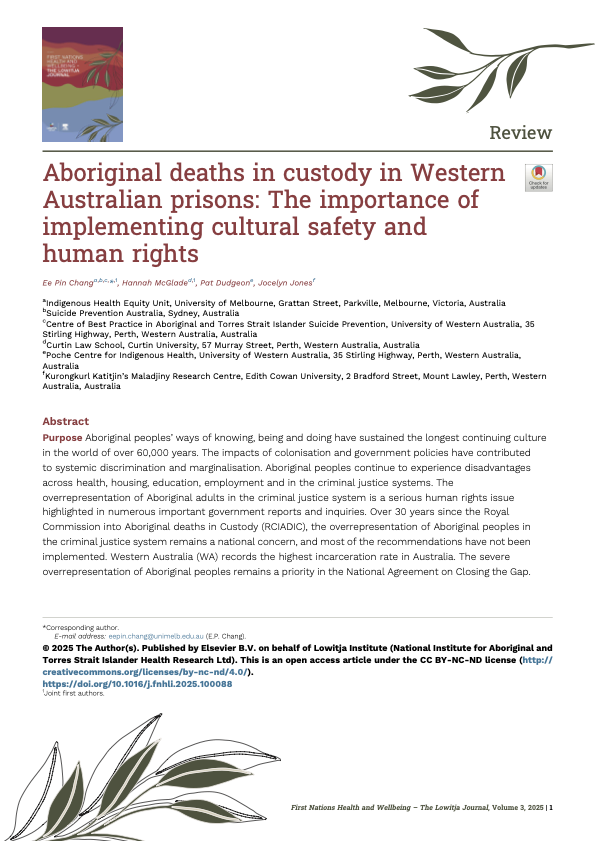
Aboriginal deaths in custody in Western Australian prisons. The importance of implementing cultural safety and human rights

By Ee Pin Chang, Hannah McGlade, Pat Dudgeon, Jocelyn Jones

This article provides an overview of the nature and adequacy of culturally appropriate health services within Western Australian (WA) prisons based on coroner findings on Aboriginal deaths in custody between 2019 to 2023. It provides a brief overview of the policies and current issues of the health services in WA prisons. 

Three of eight coronial inquests into Aboriginal suicide deaths in custody reviewed reported the sub-standard and unacceptable quality of supervision, treatment and care. The lack of access to culturally safe health services in prisons contravenes the recommendations of the Royal Commission into Aboriginal Deaths in Custody (RCIADIC).

The article calls for implementation of recommendations from Australian government inquiries – RCIADIC, Pathways to justice report – and the government to uphold international human rights obligations especially the Optional Protocol to the Convention Against Torture. 

Key findings

  • Overrepresentation of Aboriginal peoples in the justice system is a human rights violation.

  • Coroner’s findings of Aboriginal suicide deaths in custody were reviewed.

  • These findings reported substandard quality of supervision, care and treatment.

  • The lack of culturally safe health services in prisons contravenes the recommendations of the RCIADIC.

  • Call for implementation of recommendations from Australian government inquiries.

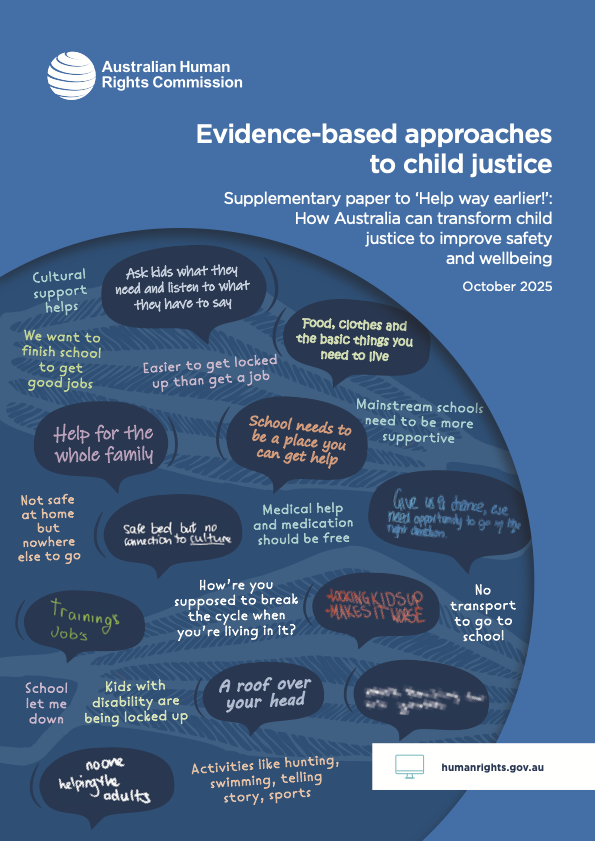
Evidence-based approaches to child justice

By The Australian Human Rights Commission 

This report contains six case studies from Australia and around the world that are examples of evidence-based approaches to reforming child justice systems. It shows how primary prevention, early intervention, integrated services and therapeutic community-based approaches that emphasise family and cultural connections can transform outcomes for children.

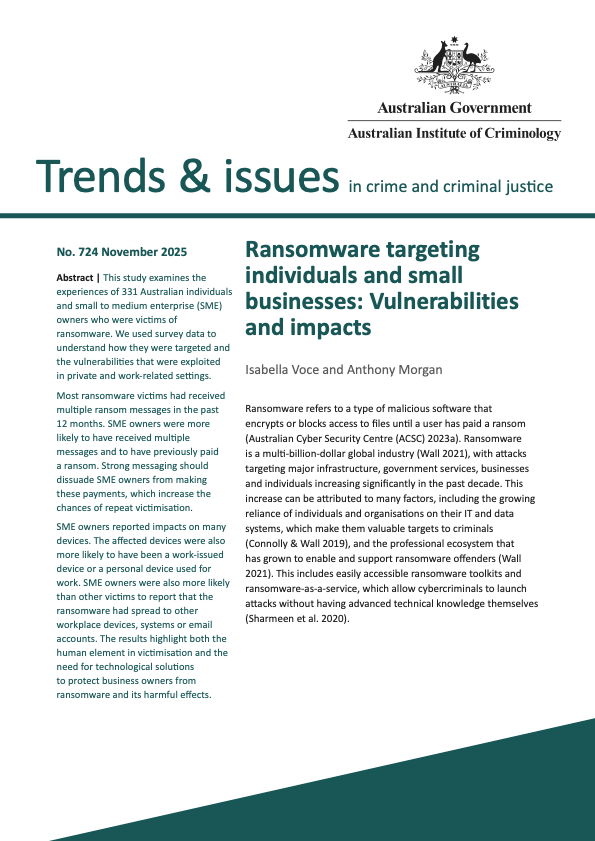
Ransomware targeting individuals and small businesses: vulnerabilities and impacts

By Isabella Voce and Anthony Morgan

This study examines the experiences of 331 Australian individuals and small to medium enterprise (SME) owners who were victims of ransomware. We used survey data to understand how they were targeted and the vulnerabilities that were exploited in private and work-related settings.

Most ransomware victims had received multiple ransom messages in the past 12 months. SME owners were more likely to have received multiple messages and to have previously paid a ransom. Strong messaging should dissuade SME owners from making these payments, which increase the chances of repeat victimisation.

SME owners reported impacts on many devices. The affected devices were also more likely to have been a work-issued device or a personal device used for work. SME owners were also more likely than other victims to report that the ransomware had spread to other workplace devices, systems or email accounts. The results highlight both the human element in victimisation and the need for technological solutions to protect business owners from ransomware and its harmful effect

FIVE HUNDRED DELINQUENT WOMEN: Mini-Classic

by Graeme Newman.

by Graeme Newman (Author), Sheldon Glueck (Author), Eleanor Glueck

In 1934, two Harvard criminologists asked the question no one else had bothered to ask: what actually happens to a woman after a reformatory says she's been "reformed"?
Five Hundred Delinquent Women is Sheldon and Eleanor Glueck's landmark — and largely forgotten — study of five hundred women released from the Massachusetts Reformatory for Women at Framingham, once hailed as a model institution for the entire country. Rather than taking the state's word for it, the Gluecks tracked these women for years after their sentences ended, through court records, social-agency files, and hundreds of personal interviews, to find out what "rehabilitation" actually looked like once no one was watching anymore.
What they found was neither the triumph the reformers promised nor the failure the cynics predicted, but something far more human and far more troubling: real improvement, tangled up with real relapse; institutional success stories that quietly came apart; and a system that too often mistook a woman's arrest record for the whole of who she was.
Running through the statistics is a gallery of unforgettable case histories — Marie, Alice, Fleur, Margaret, Angelina, Dora, Louisa, and others — whose own words and fates give this pioneering work of criminology the pull of a novel.

This Read-Me.Org Mini-Classic edition brings a five-hundred-page academic monograph back into print in a compact, accessible form, condensed and adapted for the modern reader while preserving the Gluecks' argument, their most vivid case histories, and the voice of Jessie D. Hodder, the reformatory superintendent whose own unanswered questions about her life's work set this whole study in motion.

Inside this edition:

• A new introduction placing the Gluecks' work in the history of criminology and the women's reformatory movement
• Roscoe Pound's original 1934 introduction, condensed
• The complete "Gallery of Women" case histories
• All eighteen original chapters, following the book's three-part structure
• An afterword connecting the book's prognostic tables and its picture of criminalized women to present-day debates over risk assessment and criminal justice reform
• Discussion questions for readers, students, and reading groups

Essential reading for students of criminology, sociology, women's history, and the history of American criminal justice — and for anyone who has ever wondered whether the institutions built to save people ever stopped to ask if they were actually working.

Part of the Read-Me.Org Mini-Classics series, bringing landmark out-of-print scholarship back to readers in accessible, affordable editions.

Read-Me.Org Inc. New York-Philadelphia-Australia. 2026. p.70.

Toolkit for Access to Justice and People‑Centred Justice Systems

By Organisation for Economic Co-operation and Development (OECD)

Access to justice is a cornerstone of democratic resilience and trust in public institutions. The OECD has long supported its Members and Partners in strengthening justice systems so that they better serve people, societies and economies. This Toolkit responds to countries’ demand for practical guidance on how to turn the 2023 OECD Recommendation of the Council on Access to Justice and People-Centred Justice Systems into concrete action. The Toolkit is part of the OECD’s broader programme of work on Public Governance, including the Building Trust and Reinforcing Democracy Initiative. It complements the OECD’s efforts to promote effective, transparent and accountable institutions, including work on trust in government, digital transformation of the public sector and evidence-based policymaking. Developed in consultation with OECD Members, Partners, experts and stakeholders from across the justice chain, the Toolkit provides a structured approach to support reforms that make justice more accessible, affordable and responsive. By organising guidance around five components – purpose and culture; the design and delivery of services; governance infrastructure; people empowerment; and planning, monitoring and evaluation – the Toolkit offers countries a practical resource for assessing their systems, identifying good practices and implementing reforms. It also highlights innovative approaches from across the world to address persistent justice gaps, promote equality and empower people to manage their legal and justice needs. This publication underlines the OECD’s commitment to advancing access to justice, and to supporting countries in building justice systems that work for everyone.

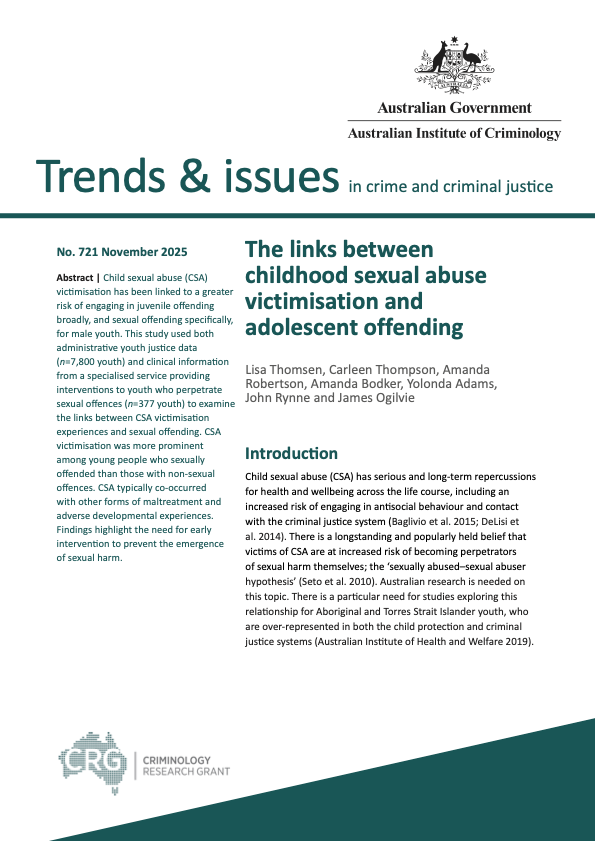
Links between childhood sexual abuse victimisation and adolescent offending

By Lisa Thomsen, Carleen Thompson, Amanda Robertson, Amanda Bodker, Yolonda Adams, John Rynne and James Ogilvie  

Child sexual abuse (CSA) victimisation has been linked to a greater risk of engaging in juvenile offending broadly, and sexual offending specifically, for male youth. This study used both administrative youth justice data (n=7,800 youth) and clinical information from a specialised service providing interventions to youth who perpetrate sexual offences (n=377 youth) to examine the links between CSA victimisation experiences and sexual offending. CSA victimisation was more prominent among young people who sexually offended than those with non-sexual offences. CSA typically co-occurred with other forms of maltreatment and adverse developmental experiences. Findings highlight the need for early intervention to prevent the emergence of sexual harm.

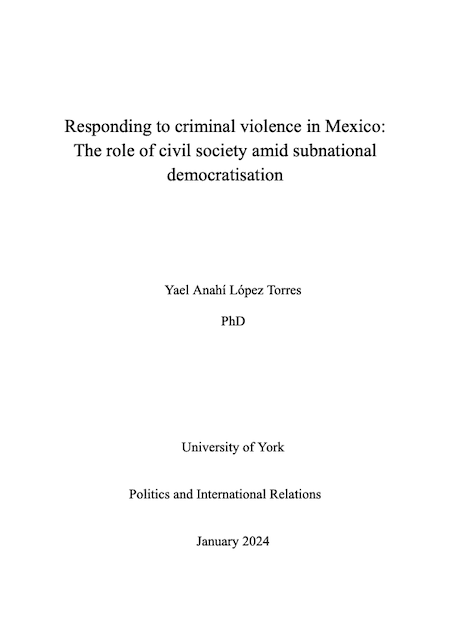
Responding to criminal violence in Mexico: The role of civil society amid subnational democratisation

By Yael Anahí López Torres

Mexico is grappling with a crisis of insecurity after over 30 years since its transition to democracy. Its top-down and frequently militarised policies have been ineffective, leading to calls by scholars to alter the state’s security paradigm that has not been able to fulfil the basic right of citizens to live in a secure country. As a response to these calls, this thesis goes beyond the common state-centric perspectives on security policies and instead it focuses on the often-overlooked subnational responses to criminal violence. In particular, I perform an analysis of bottom-up responses, considering the local dynamics of institutions and civil society. My research questions are: What is the role of bottom-up approaches in responding to criminal violence? And as an extension, what are the factors that enable or constrain their responses? To achieve these objectives, I conducted micro-level analyses and comparisons of two different case studies: Ciudad Juárez, Chihuahua and Monterrey, Nuevo León. These analyses explore variations in bottom-up responses, drawing on fieldwork in the form of 57 interviews with key state and societal actors and complementary documentary resources. The analysis emphasises Mexico’s subnational democratisation processes, considering its effects on the (un)rule of law and violence. My findings reveal that uneven democratisation hinders state capacity to address the security crisis, requiring organised society to intervene. In both cases, this contributed to countering and shaping the patterns of criminal violence. Local organised society pursued broader democratic goals by promoting the means for the rule of law, while high-risk collective mobilisation was fundamental in increasing political participation. The pre-existing institutions, the local actors and the alliances thatenabled these changes varied between cases, and followed waves of political urgency and electoral periods that both provided opportunities for change, but also disrupted ongoing projects. This contributes to the scholarship of criminal politics by bridging the literature of democratisation and state capacity.

VIOLENT AND VIBRANT: MEXICO’S AVOCADO BOOM AND ORGANIZED CRIME

By Romain Le Cour Grandmaison and Paul Frissard Martinez

The contemporary boom of global avocado consumption has drawn attention to Mexico’s industry and the expanding criminal networks that surround it. In fact, avocado production and exports – both to the United States and the European Union − display worrying signs of criminal organizations being involved in the market, human rights violations, and environmental and health impacts.

Criminal Nucleation and Phase Transitions: A Nonlinear Framework for Organized Violence in Mexico (2000–2024)

By Araceli Vázquez-Ocaña and Alan Alberto Ramírez-Guevara

This study proposes a non-linear analytical framework, inspired by phase-transition theory, to explain abrupt regime shifts in organized violence within weak institutional systems.Using Mexico (2000-2024) as a primary case, we demonstrate that criminal violence does not escalate linearly but undergoes a "phase transition" once specific thresholds are crossed. We introduce the Criminal Nucleation Framework to model the emergence and persistence of criminal cells through three dimensions: the institutional activation barrier (ΔG), the critical organizational size (r*), and the growth constant (k). Empirical validation shows a structural rupture between 2007 and 2010, where homicide rates shifted from a stable regime (8.5–10 per 100k) to a chronic state (25–29 per 100k). By operationalizing a comparative Kinetic Risk Index (R = k/ΔG), the framework classifies cities into distinct systemic states rather than providing point predictions. The findings suggest that once a system exhibits hysteresis, reactive force is structurally insufficient; instead, policy must focus on increasing the activation barrier to prevent spontaneous criminal formation.