Open Access Publisher and Free Library
CRIME+CRIMINOLOGY.jpeg

CRIME

Violent-Non-Violent-Cyber-Global-Organized-Environmental-Policing-Crime Prevention-Victimization

Posts in Crime
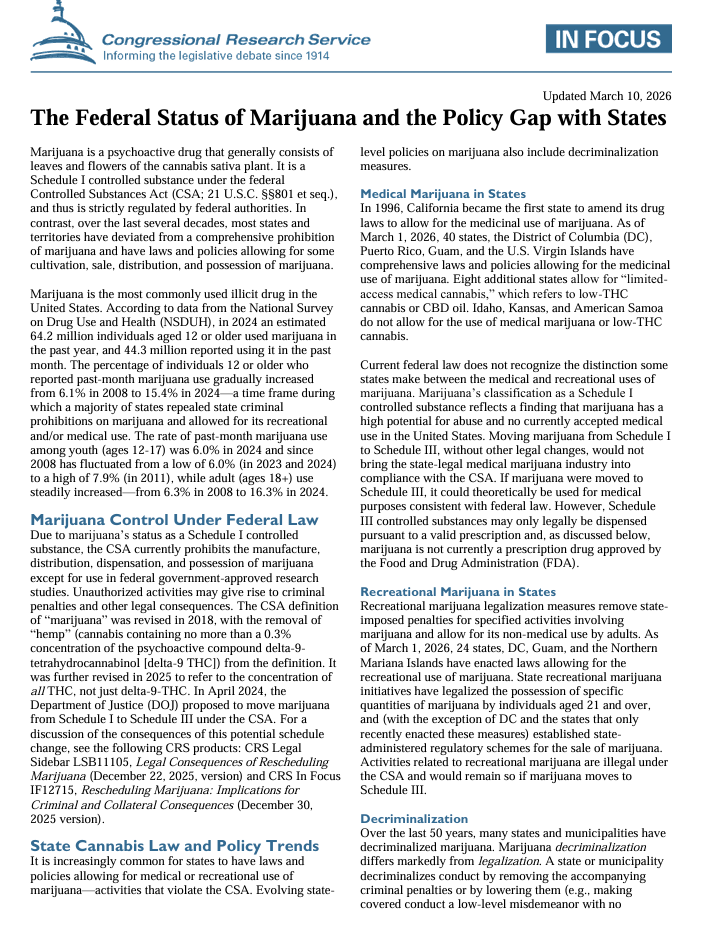
The Federal Status of Marijuana and the Policy Gap with States

By Lisa N. Sacco, Joanna R. Lampe, Hassan Z. Sheikh

Marijuana is a psychoactive drug that generally consists of leaves and flowers of the cannabis sativa plant. It is a Schedule I controlled substance under the federal Controlled Substances Act (CSA; 21 U.S.C. §§801 et seq.), and thus is strictly regulated by federal authorities. In contrast, over the last several decades, most states and territories have deviated from a comprehensive prohibition of marijuana and have laws and policies allowing for some cultivation, sale, distribution, and possession of marijuana.


Marijuana is the most commonly used illicit drug in the United States. According to data from the National Survey on Drug Use and Health (NSDUH), in 2024 an estimated 64.2 million individuals aged 12 or older used marijuana in the past year, and 44.3 million reported using it in the past month. The percentage of individuals 12 or older who reported past-month marijuana use gradually increased from 6.1% in 2008 to 15.4% in 2024—a time frame during which a majority of states repealed state criminal prohibitions on marijuana and allowed for its recreational and/or medical use. The rate of past-month marijuana use among youth (ages 12-17) was 6.0% in 2024 and since 2008 has fluctuated from a low of 6.0% (in 2023 and 2024) to a high of 7.9% (in 2011), while adult (ages 18+) use steadily increased—from 6.3% in 2008 to 16.3% in 2024.


Washington, DC: Congressional Research Service; March 10, 2026.
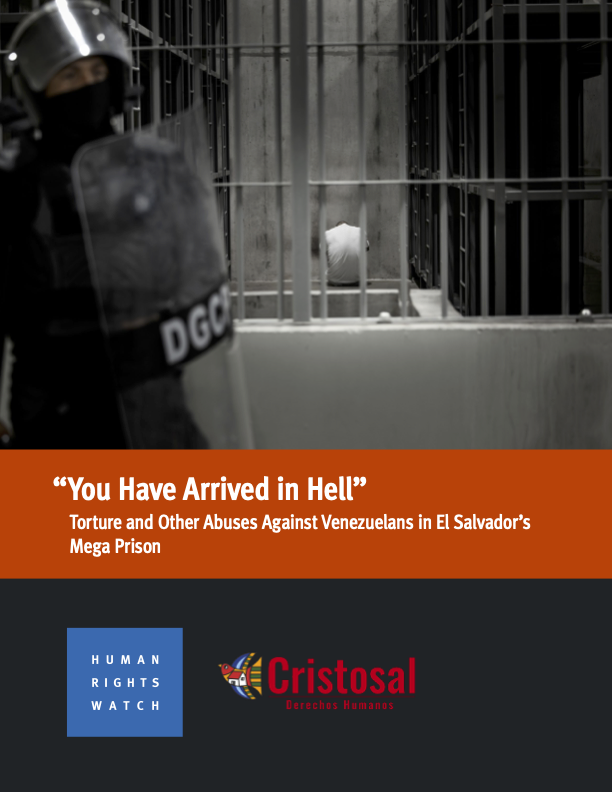
“You Have Arrived in Hell”. Torture and Other Abuses Against Venezuelans in El Salvador’s Mega Prison

By Human Rights Watch

The 81-page report, “‘You Have Arrived in Hell’: Torture and Other Abuses Against Venezuelans in El Salvador’s Mega Prison,” provides a comprehensive account of the treatment of these people in El Salvador. In March and April 2025, the US government sent 252 Venezuelans, including dozens of asylum seekers, to the Center for Terrorism Confinement (Centro de Confinamiento del Terrorismo, CECOT) mega prison in El Salvador, despite credible reports of serious human rights abuses in El Salvador’s prisons. The Venezuelans were subject to refoulement—being sent to where they would face torture or persecution—arbitrary detention, enforced disappearance, torture, inhumane detention conditions and, in some cases, sexual violence.

America’s Incarceration Crossroads: Reversing Progress Amid Record-Low Crime Rates

By Nazgol Ghandnoosh and Sabrina Pearce

The U.S. criminal legal system stands at a crossroads. The United States remains a world leader in incarceration, locking up its citizens at a far higher rate than any other industrialized nation.

Between 1972 and 2009, the number of people imprisoned grew nearly 700%, while crime rates declined dramatically after peaking in 1991. Imprisonment levels slowly scaled back, achieving a 25% decline between 2009 and 2021. Then, the prison population has resumed its growth, according to the most recently available data. The prison population grew in 2022 and in 2023, 39 states increased their prison populations.

The COVID-19 pandemic contributed to a seismic increase in the most serious crime, homicide, which has fortunately declined to pre-pandemic levels. By 2024, homicide rates were 49% lower than their peak level in 1991. Violent and property crime rates overall have reached historic lows: 2024’s violent crime rate was 53% lower than its peak-1991 level and the property crime rate was 66% lower.

While crime rates are at historic lows, Americans deserve greater levels of community safety. A growing number of elected officials at the local, state, and federal levels have moved to overturn successful criminal justice reforms and revert to the failed playbook of mass incarceration, while the federal government has cut funding for important crime-prevention programs. Instead, policymakers should respond to crime upticks with evidence-based responses, while correcting the counterproductive, costly, and cruel responses of the past.

Excessive reliance on imprisonment in the United States is ineffective at addressing crime, diverts resources from effective public safety investments, upends family stability, contributes to trauma, and disproportionately harms communities of color. A vast body of research has established that we can advance community safety while reducing prison admissions as well as scaling back sentences for both those entering prisons and those already there

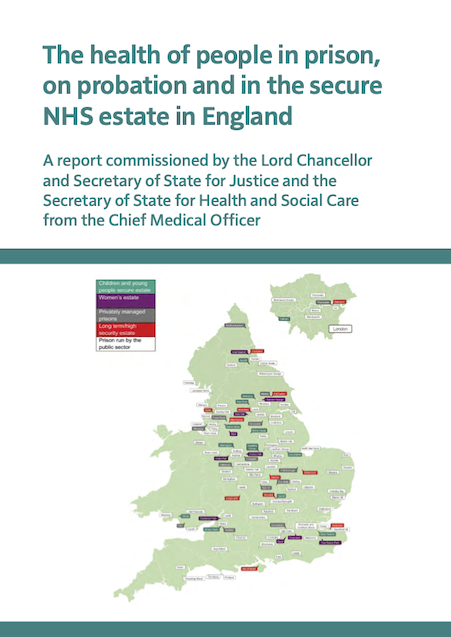
The Health Of People In Prison, On Probation And In The Secure NHS Estate In England

By Chris Whitty,

he aim of this report is to explore the health and healthcare of people in prison and on probation in England and make recommendations to improve these. It combines insights from, and individual chapters authored by: front line professionals working in prisons and the secure estate and in probation; public health professionals; commissioners and policy makers in health and justice; third sector organisations; academics and lived experience experts. These insights were gathered by extensive evidence gathering and stakeholder engagement, albeit by a small team within a defined time frame from September 2024 to July 2025. Regional health and justice teams across prison and probation were invited to share their written experiences and attend roundtables. Additional roundtables and workshops were conducted to explore specific themes such as the health needs and healthcare challenges of people on probation, health workforce and long-term conditions. We are very grateful for the time, enthusiasm and knowledgeable response from prison, probation, NHS and public health staff. Building on previous CMO visits looking at health to the secure estate (including secure mental health hospitals) we visited a further: 15 male and female prisons; 1 young offenders’ institution, 1 secure school and 1 secure children’s home; 1 secure NHS hospital and 4 probation delivery units. These covered all regions of England. During visits we discussed with frontline clinical and operational staff as well as people in prison, prison and probation officers, governors and healthcare leaders and we are very grateful for their time and expertise. In addition to lived experience identified by chapter authors and from group discussions during visits, we worked with the NHS Health and Justice Lived Experience Network and Empowering People: Inspiring Change (EP:IC) lived experience consultancy to bring together themes from existing lived experience engagement relevant to the chapters of this report, including engagement held for the 10 Year Health Plan. This was supplemented with additional lived experience focus groups held with pregnant women currently in prison, with people on probation and recently in prison on topics including the health and care needs of older adults in prison and health improvement in prison. One person with lived experience of the criminal justice system was a member of our steering group and contributed and reviewed all chapters. Lived experience contributions are incorporated throughout chapters in blue panels, practice examples (orange) and case studies (lilac) gathered from engagement are also included to illustrate findings.The development of the report was guided by 2 groups: ■ a stakeholder steering group with representation from UK Health Security Agency, Department of Health and Social Care, HM Prison and Probation Service, Ministry of Justice, NHS England and EP:IC lived experience consultancy ■ a clinical task and finish group chaired by the Royal College of General Practitioners: Secure Environments Group. Attended by front line clinicians and clinical leaders (GPs, nurses, pharmacists, psychologists, psychiatrists, midwives, obstetricians and peer support workers) working in, or with recent experience of, prisons, probation and the secure estateThe ‘children and young people’ chapter was guided by its own steering group with representation from NHS England, Youth Justice Board, Youth Custody Service and clinical advisers. The important challenges of substance misuse in prisons have been extensively explored in the recent independent review by Dame Carol Black published in 2024. For this reason we have not concentrated on this issue in this report and would point people to Dame Carol’s recommendations . Sentencing policy is obviously outside the remit of this report on health, although the implications of long and short sentences on health and healthcare is considered. Any response to the Sentencing Review by the Rt Hon David Gauke 2025 is likely to have an effect on prison and probation health and healthcare2 . While important to this population, it was outside the scope of this review to do an in depth review of social care in prisons. The ongoing independent commission into adult social care should consider the justice population.

TAKING A LIFE. With life sentences, the State of Alabama controls thousands of rehabilitated individuals long past the point of danger, until death. But why?

By Alabama Appleseed

One of Five Incarcerated Alabamians is Serving a Life Sentence

When the Alabama Department of Corrections begins filling up the most expensive prison ever built in the United States, a sprawling $1.2 billion complex in Elmore County, the prison will not come close to housing only the prisoners serving life sentences. This mega prison will have a capacity of 4,000. Yet, more than 6,520 individuals are serving sentences of life with parole, life without parole, or virtual life. Lifers alone could fill the new prison to overflowing, and approximately 15,500 people would remain housed in the violent, dilapidated, understaffed prisons that have the state spending tens of millions in legal fees fighting multiple federal lawsuits while six years of unconstitutional brutality persists.

Alabama relies on long sentences at a higher rate than most of the United States with nearly one in five prisoners serving life sentences. Nationwide, the average is one in seven. A growing body of research shows that incarcerating people for these kinds of extreme sentences is generally unnecessary for public safety because it ignores the irrefutable truth that most people age out of criminality.

Incarcerating older people, many of whom are too feeble to do harm, drains resources that could be devoted to crime prevention or solving crimes, yet laws and parole practices in Alabama have failed to adjust accordingly, as this report will show. 

Extortion: The Backbone of Criminal Activity in Latin America

By Lucia Dammert

Extortion is a phenomenon that can be understood from various disciplines, such as economics, criminology, the political sciences, and sociology. Each of these fields of knowledge emphasizes either the system or economic models under which extortionists and victims operate, the short- or long-term relationship sought by establishing simple or complex extortion mechanisms, the political relationship between extortionists and victims, or citizens’ perceptions of the institutional framework, which can serve as a gateway for criminal groups to create ties of protection through extortion. The complexity of extortion, given the different forms it can take and the ease with which it can be confused or linked with other crimes, such as kidnapping or corruption, calls for an open discussion and the establishment of research agendas. This report sheds light on the importance of extortive practices in Latin America. It is based on qualitative research since 2019 that includes 36 interviews of academics, public officials, police, professionals, and victims of extortion in 10 countries,5 along with a review of all official public information and newspapers in five countries during 2019.6 The research also focuses on working groups and reviews official and civil society documents related to extortion as a criminal phenomenon throughout Latin America. The report is part of a long-term research project that focuses on the importance of this criminal activity, its possible links to organized crime organizations, and the policies designed to tackle its impact on businesses and citizens alike.

The report shows that extortive practices are a regionwide trend, albeit with national, specific characteristics. Although it is primarily a non-violent crime, an increasing tendency— specifically linked to practices against women—should make it a priority for the public security agenda. Furthermore, extortion could be depicted as the “perfect crime” since it is hardly reported, let alone investigated. High levels of impunity have allowed for this practice to move into criminal organizations, prisons, and street gangs; also, state officials and even business partners use extortive practices to finance their activities. There is a clear impact on democracy since corruption, fear of crime, and a general sense of freedom from punishment corroborate the idea that there is no rule of law. Efforts toward understanding extortion remain limited and need to take a central role in most national and regional public security policies. 

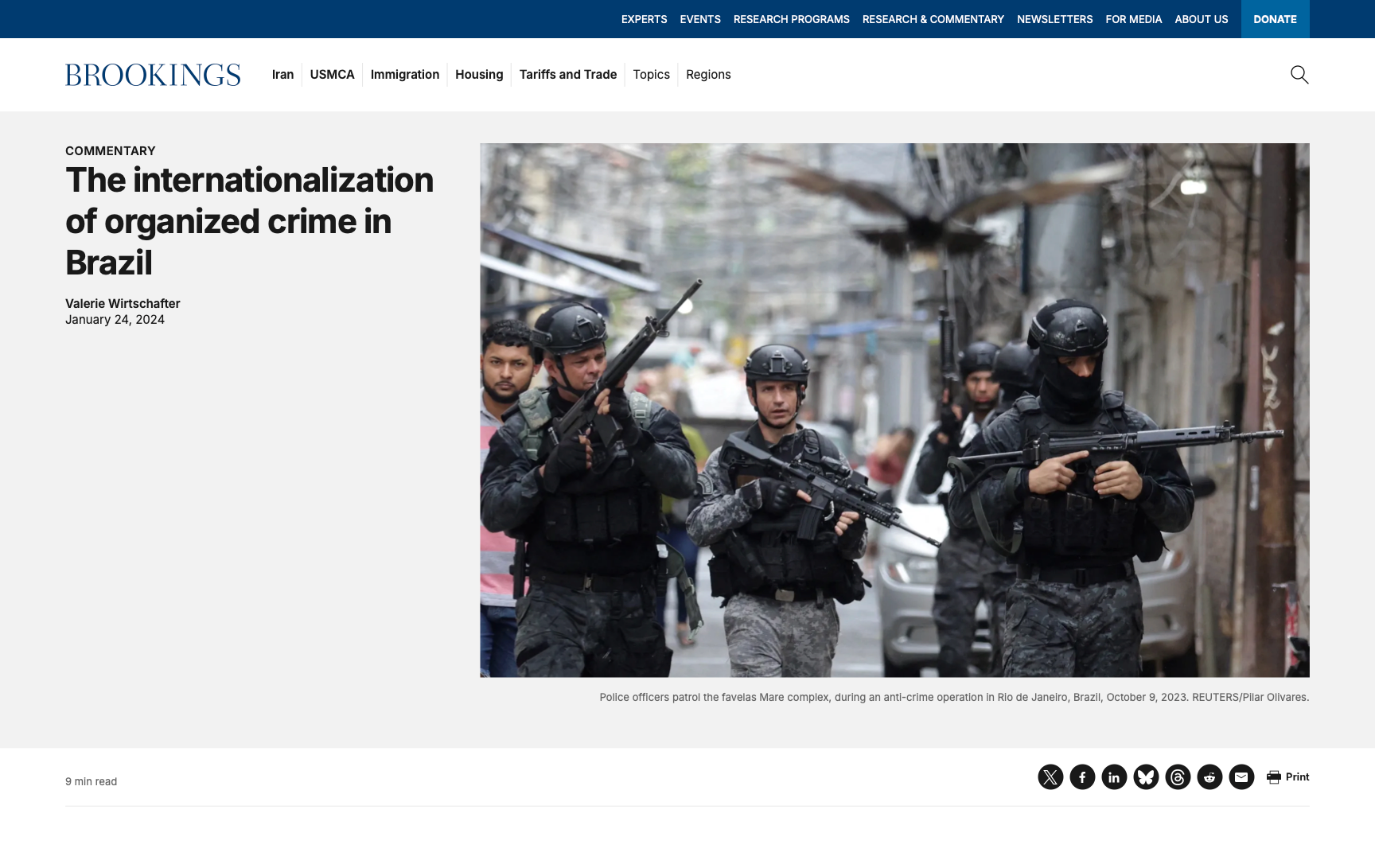
The Internationalization Of Organized Crime In Brazil

By Valerie Wirtschafter

Over the past three decades, the Primeiro Comando da Capital (PCC) has transformed from a prison gang founded in São Paulo into a transnational criminal “leviathan,” with a presence throughout South America, Africa, and Europe. In response to this growing threat, in 2021 the U.S. government cited the PCC as “the most powerful organized crime group in Brazil and among the most powerful in the world.” What can we expect from the PCC moving forward? And how might policymakers stall this international expansion?In the coming year, the PCC will likely continue to vie for dominance in strategic areas of contested control throughout Brazil and look for opportunities to consolidate gains abroad. Confrontation with rival groups, including the Comando Vermelho (CV), born in the Rio de Janeiro prisons, and its allies in areas such as the Amazon, is also likely to continue. This is particularly the case due to the region’s importance for drug smuggling

The New Art Forgers

By Katrina Geddes

The “substantial similarity” between a copyrighted work and an unauthorized derivative has formed the bedrock of copyright infringement jurisprudence since the mid-nineteenth century. Recent technological developments, however, are destabilizing these conceptual foundations. In May, the Copyright Office suggested that the use of copyrighted works to train AI models may constitute infringement even if model outputs are not “substantially similar” to model inputs if they nevertheless “dilute the market” for similar works. One month later, Judge Chhabria of the Northern District of California argued that AI outputs do not have to be “substantially similar” to copyrighted training data in order to be infringing. The plaintiff’s incentives are sufficiently harmed, Judge Chhabria argued, when the market is flooded with “similar enough” AI-generated works.

These developments should be read as early warning signs of a disturbing doctrinal shift from “substantial similarity” to a new and dubious threshold for actionable infringement: “substitutive similarity”, where the substitutability of the defendant’s work, rather than the similarity of protected expression, provides the cause of action. This novel theory of harm, if widely adopted, would impose dangerous restrictions on downstream creativity. Any new work that was “similar enough” to existing works would be treated as potentially infringing, despite the absence of substantially similar expression. This would corrupt what is essentially a question of fact – whether the defendant copied “enough” of the plaintiff’s work to constitute unlawful appropriation – with deontic considerations of the wrongfulness of free-riding.

At the same time, artists are understandably rattled by the speed and scale of AI generation. AI models can produce “new” works in the style of established artists in a matter of seconds, dramatically undercutting the market for their work. AI style mimicry makes it difficult for artists to control their personal brands and for consumers to locate authentic works by their favorite artists. Copyright is responsible for protecting artists’ creative incentives, but its legal tests were not designed to handle the scale of imitation enabled by AI.

This Article offers a way out of this jurisprudential morass. Instead of lowering the burden of proof for infringement, Congress should strengthen the attribution rights of existing creators. Low-protectionists have long advocated for attribution rights as a way of protecting authors’ interests without expanding the scope of their economic entitlements. Proper attribution allows creators to capture the full reputational benefits of their labor without stifling downstream creativity. For example, Congress could enact an AI-specific attribution right that requires the disclosure of copyrighted training data in output metadata. This would mitigate the labor-displacing effects of generative AI by directing consumers to the original creators of a popular style or aesthetic.

Generative AI places copyright jurisprudence at a critical crossroads. Indulging Judge Chhabria’s novel theory of harm would effectively inaugurate a new standard for infringement – “substitutive similarity” – that would stifle not just AI innovation but human creativity more broadly. The stakes for protecting free expression through careful guardianship of longstanding doctrine could not be higher. This Article guides readers through this critical inflection point with new terminology for the jurisprudential lexicon as well as practical proposals for reform.

The right to be free of corruption: A new frontier in anti-corruption approaches through national courts

By Naomi Roht-Arriaza

Courts in several jurisdictions have recognised corruption as a direct human rights violation, enabling broader legal standing, integrating international law and focusing on victims. Case studies, predominantly from Latin America, illustrate different legal theories used to hold officials accountable and expand access to justice in anti-corruption proceedings. Consequently, the formulation of a stand-alone right has merit despite limitations.

Female Empowerment and Intimate Partner Violence

By Elisabetta Calabresi and Núria Rodríguez-Planas

The chapter reviews the economic literature on intimate partner violence (IPV), a widespread human rights violation affecting nearly one in three women globally and generating significant societal costs. It focuses on the relationship between various dimensions of female empowerment and IPV. The chapter begins by outlining key theoretical frameworks—including household bargaining, instrumental violence, male backlash, and exposure theories—as well as the main data sources used to study IPV. It then reviews empirical evidence on how factors shaping female empowerment at the individual, relationship, community, and societal levels influence IPV outcomes. Central themes include labor market dynamics, education, income shocks, family formation, legal frameworks, institutional access, and gender norms. The chapter also considers how these factors interact across levels and discusses additional drivers of IPV not directly linked to female empowerment. The goal is to provide an overview of causal evidence from the economic literature on IPV while emphasizing its complexity and the importance of a context-specific, intersectional approach to both its analysis and prevention.

The study of culture, law, and crisis

By Matthew Clair

Abstract: This paper reviews cultural sociological approaches to the study of law and how they may be applied to future research on law-related social crises. As the world faces myriad social crises, such as rising authoritarianism and police violence, the study of culture and the law has become an even more urgent intellectual and practical endeavor. Over the last decade, five concepts have dominated the cultural study of law: rules, norms, frames, cultural capital, and legal consciousness. While past research has provided generative insight, future research would benefit from more precise considerations of rules and norms in this unsettled moment. Moreover, future research could leverage the five cultural concepts to sharpen understandings of inequality and social control in understudied legal organizations, along understudied axes of social stratification, and with respect to the infusion of new technologies into the legal system.

Property and Violent Crime Rates in Colorado’s Largest Cities

By D.J. Summers

in the past five years, Colorado’s largest cities have had very different experiences of crime.

Colorado’s violent and property crime rates rose sharply in the early 2020s, prompting varying responses from leaders at state and local levels. Some have been more successful than others, according to the most recently available Colorado Bureau of Investigation data.

CSI analyzed the violent and property crime trends of Colorado’s ten largest cities: Denver, Colorado Springs, Aurora, Fort Collins, Lakewood, Thornton, Arvada, Westminster, Pueblo, and Centennial. These ten cities represent just under half the state’s total population, with a combined population of roughly 2.3 million residents. CSI analyzed the average violent and property crime rates per 100,000 people through the first two quarters of each year between 2016 and 2025. Pueblo’s police data is not current and could not be included in the analysis.

Property and violent crime cost the state $27 billion in economic losses in 2022 between the tangible and intangible effects of reported and unreported crime. It is imperative that public leaders continually examine and understand which policies best address crime rates.

Key Findings

Denver’s violent crime rate is the highest among Colorado’s largest cities, with 235 violent crimes per 100,000 people.

 Aurora’s is second highest, with 203 violent crimes per 100,000 people.

Aurora’s violent crime has remained beneath Denver’s for three years, breaking the trend of the late 2010s and early 2020s in which Aurora’s rates were higher.

Only Colorado Springs saw an increase in the violent crime rate between 2022 and 2025.

Among the largest cities, Aurora saw the sharpest decrease in violent crime rate.

Aurora saw the second highest decrease in violent crime rate, with a 36% decrease.

Denver has the highest property crime rate of Colorado’s largest cities, with 1,122 property crimes per 100,000 people.

Lakewood has the second highest rate, with 1,099 per 100,000 people.

Aurora and Centennial had the sharpest decreases in property crime rate since 2021, at 56%, 49%, and 44%, respectively. 


Entering the Void: Chinese illicit networks in Mexico

By Barbara Kelemen | Ján Slobodník

This CEIAS paper aims to shed light on cooperation between Chinese businesses and Mexican criminal groups. It specifically analyzes cases related to drug trafficking and the exploitation of natural resources in three states in Mexico. The topic is particularly relevant for countries in Latin America that have been expanding their commercial ties with China. This research suggests that the lack of state supervision in some of these countries could allow alternative structures—such as criminal groups and Chinese organized networks—to thrive and fill the security and economic void if not regulated properly.

Summary

Mexico’s macroeconomic stability and abundant natural resources have made the country into an attractive destination for Chinese businesses.

The country still suffers from a lack of internal security, most of it stemming from the Mexican Drug War, an ongoing multilateral low-intensity conflict between the Mexican government and a large number of criminal organizations.

In some of Mexico’s states, pervasive violence and instability have resulted in a power vacuum. With the government being unable to guarantee security, non-state actors such as criminal organizations and/or civilian militias seize the opportunity to establish their own rule.

When foreign companies operate in such troubled areas, they inevitably run into problems caused by Mexico’s security issues.

Within this trend of foreign companies operating in Mexico, some level of tacit cooperation has been observed between Chinese businesses and non-state actors. This cooperation is often an outcome of localized security vacuums that are exploited by alternative security providers, such as criminal organizations, that can fill them and provide operational safety for local businesses.

A growing body of research has identified the existence of Chinese illicit networks and their involvement in the trafficking of people, narcotics, and contraband goods, as well as money laundering and illegal arms trade in Mexico.

Concealed under the guise of legal commercial activity, networks of Mexican criminal organizations and their Chinese business partners exploit the dire security situation in some areas of Mexico.

Despite attempts by the Chinese and the Mexican governments to regulate certain sectors that contribute to the existence of the illicit networks in Mexico, there are still substantial opportunities that are ripe for exploitation by the criminal group-legitimate business partnerships

Cross-cultural service learning in a juvenile correctional school: a qualitative analysis of international medical students’ reflections

By Hsiang-Chin Hsu & Tzu-Ching Sung 

This study investigates the impact of a service-learning activity on the personal and professional development of 28 international medical students at I-Shou University, focusing on their participation in a service-learning project at a juvenile correctional school in Taiwan. Through the collection and thematic analysis of written reflections, four key themes were identified: cultural competence, empathy development, medical professionalism, and personal and professional growth. The service-learning experience significantly enhanced students’ cultural competence by exposing them to cross-cultural challenges, deepening their understanding of the social determinants of health, and reinforcing the importance of communication skills in overcoming language and cultural barriers. This is particularly relevant in diverse healthcare settings where effective communication is essential for patient-centered care. A notable outcome of the activity was the development of empathy, as students reflected on the emotional needs of the juveniles they encountered, highlighting the critical role of non-judgmental, compassionate care in healthcare practice. Furthermore, the experience fostered medical professionalism by confronting students with ethical dilemmas, such as equitable access to healthcare for marginalized populations, thus emphasizing the responsibility of future physicians to advocate for social justice and address healthcare disparities. Personal and professional growth emerged as another significant outcome, with students reporting increased self-awareness and emotional intelligence. The service-learning activity challenged their preconceived notions about marginalized populations, enabling them to recognize and mitigate personal biases, ultimately contributing to more compassionate and ethical patient care. Overall, the study underscores the transformative role of service-learning in medical education, fostering cultural competence, empathy, ethical awareness, and social responsibility—qualities essential for preparing socially responsible physicians to navigate healthcare. These findings collectively bridge theory and practice, illustrating how transformative learning and professional identity formation manifest through experiential service-learning. Accordingly, this study emphasizes integrating service-learning into medical education curricula to bridge theory and practice and equip students for ethical, cultural, and professional challenges. Future research should explore its long-term impact on professional development and broader curricular integration.

Recidivism, Service Characteristics, and Changes in Risk and Protective Scores in Juvenile Probation

By D. Michael Applegarth, JoAnn S. Lee

This study examines changes in risk and protective factors among youth on probation (N=6,997) and how services received relate to these changes and subsequent recidivism. Using standardized risk assessments at intake and exit, logistic regression models assessed changes in risk and protective subscales, the relationship between specific services and observed changes, and associations with rearrest and reconviction. Overall, youth showed reduced risk and increased protective scores during probation. Increases in treatment, restitution, and assessments were linked to risk reductions, while treatment, assessments, and skill-building services were associated with gains in protective factors. Notably, more treatment services corresponded with increased risk in the school domain. Youth of color were less likely to experience a decrease in risk and an increase in protective scores. Increases in protective school scores and treatment services were linked to lower odds of rearrest and reconviction. In comparison, more monitoring services and increased legal history were associated with higher odds of recidivism. Findings highlight the potential of rehabilitative services to support youth success and suggest compliance based approaches, such as increased monitoring, may undermine outcomes. The study underscores the need for equitable, developmentally appropriate, and supportive interventions in juvenile probation.


Birthright Citizenship and Youth Crime

By Leander Andres, Stefan Bauernschuster, Gordon B. Dahl, Helmut Rainer, Simone Schüller

This paper studies the impact of birthright citizenship on youth crime. We leverage a reform which automatically granted birthright citizenship to eligible immigrant children born in Germany after January 1, 2000 and administrative crime data from three federal states. Immigrant youth who acquired citizenship at birth are substantially less likely to engage in criminal activity, with estimates indicating a 70% reduction. These results are particularly relevant in light of ongoing debates in the U.S. about abolishing birthright citizenship. Our findings suggest that inclusive citizenship policies can reduce crime and its associated costs, which in turn could strengthen social cohesion.

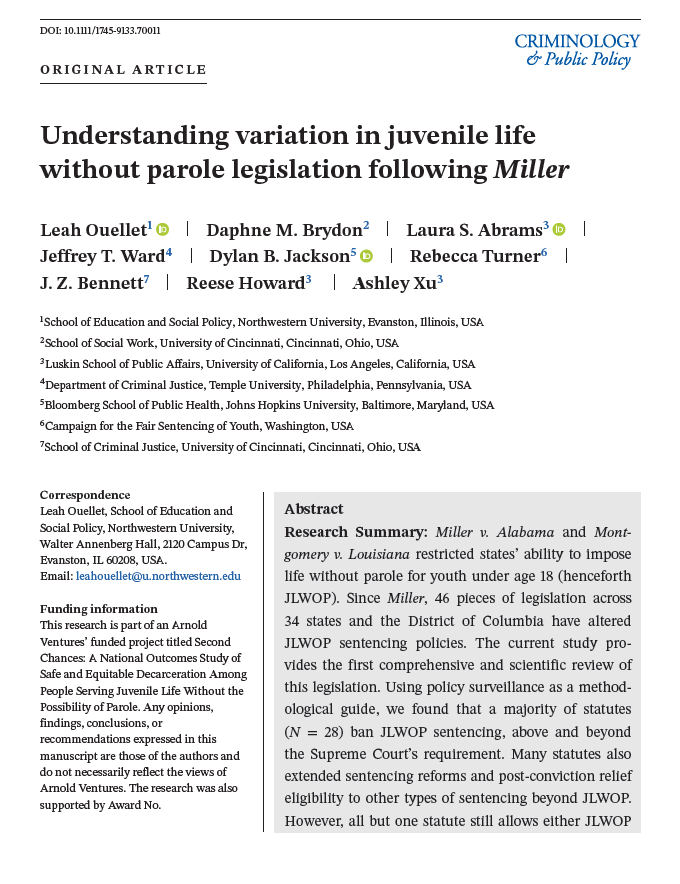
Understanding variation in juvenile life without parole legislation following Miller

By Leah Ouellet, Daphne M. Brydon, Laura S. Abrams, Jeffrey T. Ward, Dylan B. Jackson, Rebecca Turner, J. Z. Bennett, Reese Howard, Ashley Xu


Miller v. Alabama and Montgomery v. Louisiana restricted states’ ability to impose life without parole for youth under age 18 (henceforth JLWOP). Since Miller, 46 pieces of legislation across 34 states and the District of Columbia have altered JLWOP sentencing policies. The current study provides the first comprehensive and scientific review of this legislation. Using policy surveillance as a methodological guide, we found that a majority of statutes (N = 28) ban JLWOP sentencing, above and beyond the Supreme Court's requirement. Many statutes also extended sentencing reforms and post-conviction relief eligibility to other types of sentencing beyond JLWOP. However, all but one statute still allows either JLWOP or life with parole as a sentencing option for minors convicted of homicide crimes and requires between 15 and 40 years, at minimum, to be served before being eligible for release. Grounding our analysis in institutional theory, we argue that the relative punitivity of the JLWOP reforms enacted was associated with measures of JLWOP institutionalization across states (i.e., pre-Miller JLWOP population and pre-Miller sentencing schema), suggesting that states where JLWOP was more routinely used were more resistant to policy reform.

Policy Implications

The current study provides implications for future decarceration efforts. Findings suggest that state legislatures are willing to enact post-conviction relief measures (e.g., judicial review or “second look” measures) for individuals convicted of violent crimes to address over-incarceration, deviating from previous decarceration efforts focused on non-violent, low-level offenses. In spite of the promising window for juvenile justice reform that Miller provided, however, these reforms have taken a relatively modest, incremental approach toward altering extreme youth sentencing practices in the United States. Policy makers and advocates seeking to promote sentencing reform efforts should factor in how highly institutionalized a sentencing practice is in each state, as this might inform effective strategies for policy change.

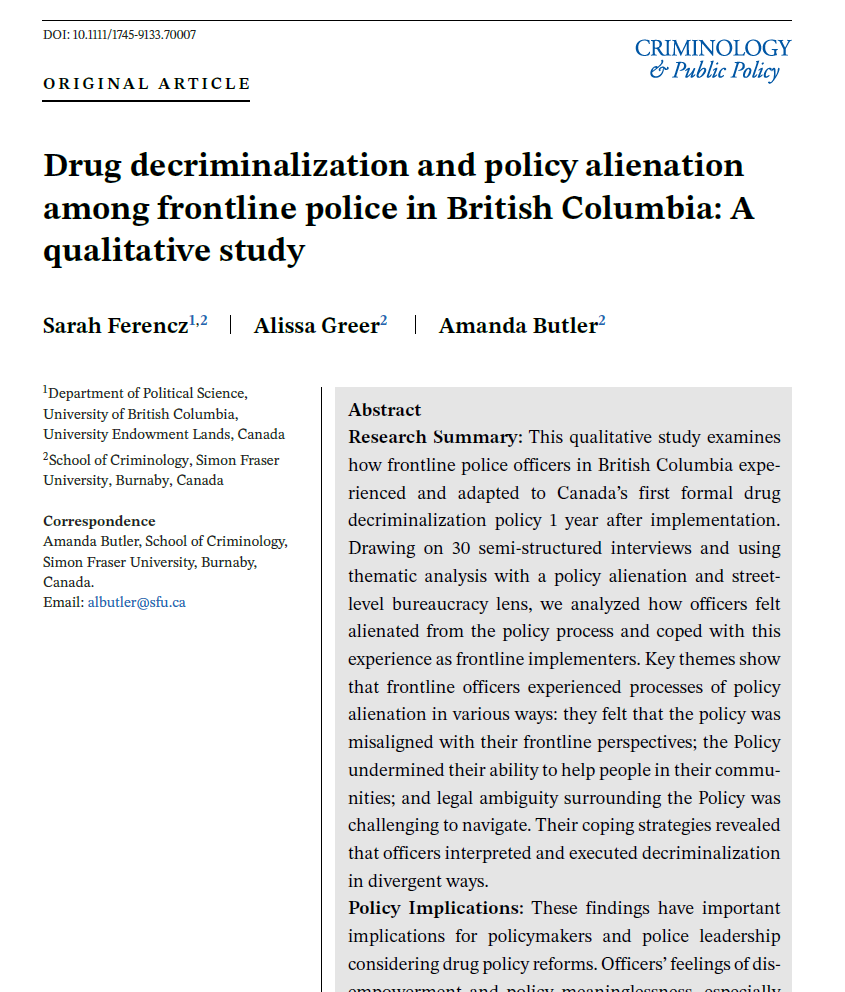
Drug decriminalization and policy alienation among frontline police in British Columbia: A qualitative study

By Sarah Ferencz, Alissa Greer, Amanda Butler

This qualitative study examines how frontline police officers in British Columbia experienced and adapted to Canada's first formal drug decriminalization policy 1 year after implementation. Drawing on 30 semi-structured interviews and using thematic analysis with a policy alienation and street-level bureaucracy lens, we analyzed how officers felt alienated from the policy process and coped with this experience as frontline implementers. Key themes show that frontline officers experienced processes of policy alienation in various ways: they felt that the policy was misaligned with their frontline perspectives; the Policy undermined their ability to help people in their communities; and legal ambiguity surrounding the Policy was challenging to navigate. Their coping strategies revealed that officers interpreted and executed decriminalization in divergent ways.

Policy Implications

These findings have important implications for policymakers and police leadership considering drug policy reforms. Officers’ feelings of disempowerment and policy meaninglessness, especially in contexts of legal ambiguity, may lead to inconsistent or inequitable enforcement. Strengthening communication across police ranks is critical. Middle managers may help translate reform goals, identify resource gaps, and support effective coping strategies. Legal clarity should extend beyond policy updates to help officers reconcile overlapping laws and reduce liability concerns. While there are limits to policy consultation with frontline officers within the hierarchical structure of police institutions, reform efforts should still engage with frontline officers’ working logics. Training should address harmful attitudes and misunderstandings of drug use, clarify legal boundaries, and mitigate unintended harms of enforcement. Ultimately, effective drug policy reform in a multi-jurisdictional system requires acknowledging how frontline officers interpret and shape 

 policy within institutional constraints.

Climate Chains: Mapping the Relationship between Climate, Trafficking in Persons and Building Resilience in the Philippines

By The International Organization for Migration

This report, Climate Chains: Mapping the Relationship between Climate, Trafficking in Persons and Building Resilience in the Philippines, explores the complex links between climate change, livelihood, vulnerability, migration and human trafficking in the Philippines. Commissioned by IOM under the Climate Resilience Against Trafficking and Exploitation (CREATE) project, this study forms part of a broader research focusing on Ethiopia and the Philippines – two countries facing distinct climate challenges: slow-onset droughts and sudden-onset typhoons, respectively.  

The research used a mixed-methods approach including household surveys, interviews and focus group discussions. The report puts forward a conceptual model that links climate events and trafficking through a series of intertwined steps. It identifies a causal chain where climate events disrupt livelihood, increase vulnerability and heighten migration intentions, which can lead to exploitation and trafficking. The research explores how factors linking climate and trafficking operate in the Philippines. 

This study provides critical insights and recommendations for policymakers, donors and organizations in the Philippines and internationally that are working to combat human trafficking and exploitation, while strengthening resilience to climate change

Climate Chains: Mapping the Relationship between Climate, Trafficking in Persons and Building Resilience in Ethiopia

By The International Organization for Migration

This report, Climate Chains: Mapping the Relationship between Climate, Trafficking in Persons and Building Resilience in Ethiopia, explores the complex links between climate change, livelihood, vulnerability, migration and human trafficking in Ethiopia. Commissioned by IOM under the Climate Resilience Against Trafficking and Exploitation (CREATE) project, this study forms part of a broader research focusing on Ethiopia and the Philippines – two countries facing distinct climate challenges: slow-onset droughts and sudden-onset typhoons, respectively.  

The research used a mixed-methods approach including household surveys, interviews and focus group discussions. The report puts forward a conceptual model that links climate events and trafficking through a series of intertwined steps. It identifies a causal chain where climate events disrupt livelihood, increase vulnerability and heighten migration intentions, which can lead to exploitation and trafficking. The research explores how factors linking climate and trafficking operate in Ethiopia. 

This study provides critical insights and recommendations for policymakers, donors and organizations in Ethiopia and internationally that are working to combat human trafficking and exploitation, while strengthening resilience to climate change.