Open Access Publisher and Free Library
CRIME+CRIMINOLOGY.jpeg

CRIME

Violent-Non-Violent-Cyber-Global-Organized-Environmental-Policing-Crime Prevention-Victimization

Posts in Data Analysis
THE MUSLIM BROTHERHOOD’S STRATEGIC ENTRYISM INTO THE UNITED STATES: A SYSTEMIC ANALYSIS

By The Institute for the Study of Global Antisemitism and Policy (ISGAP)

This study investigates the Muslim Brotherhood’s strategy of “civilizational struggle” (jihad) in Western society, with a specific focus on the United States. By analyzing primary documents, including the “Explanatory Memorandum” (1991) and “The Project” (1982), along with comparative historical analysis, it traces the development of the Brotherhood’s doctrine of tamkeen (institutional entrenchment) from its theoretical roots in early twentieth-century Egypt to its more advanced practical application in the United States. The study identifies and thoroughly analyzes four strategic domains of influence: policy impact through government entryism and coalition-building; manipulation of the legal framework via lawfare and the redefinition of core concepts; institutional infiltration across educational and civil society organizations; and the establishment of narrative control through media influence and discourse shaping. Multiple detailed case studies within each domain show how Brotherhoodaligned groups have executed these strategies across different countries and historical periods. The analysis in this study, supported by extensive documentary evidence and organizational network assessments, demonstrates that the Muslim Brotherhood’s long-term strategy is a deliberate, multigenerational effort that closely aligns with its founders’ vision of gradually transforming Western society from within, primarily through nonviolent means. Ideologically speaking, it is also fundamentally opposed to Western democratic values and governance systems. This study offers an important assessment of the key strategic objectives of Islamist extremism and ideological entryism within democratic systems by the Muslim Brotherhood, as well as the intersection of Islamist extremism with religious identity politics that exploit democratic principles, multicultural respect for diversity, and transnational movements in an era of globalization and information warfare. The study concludes with an assessment of the challenges faced by policymakers, security professionals, and civil society leaders who aim to protect democratic values while respecting religious freedoms. In a nutshell, it states that effective responses need to balance security concerns with civil liberties, differentiate between genuine religious practice and ideological extremism, and create more sophisticated frameworks for understanding and addressing radical Islamism.
Maritime Security in the Southern Philippines: Building Upon Gains Amid Evolving Threats

By John Bradford and Aaron Jed Rabena

Key Takeaways

The maritime security situation in the southern Philippines and neighbouring areas of Malaysia and Indonesia has greatly improved in recent years, thanks to coordinated government action.

The threats from terrorism and kidnapping have been reduced, but other forms of maritime criminal activity have become even more prominent, with smuggling and human trafficking emerging as the foremost concerns.

The Philippines, its neighbours, and its partners should leverage the positive momentum to build upon the gains, rather than shifting resources away.

The Bangsamoro peace process in the southern Philippines has travelled a rocky road in the decade since the agreement was signed between the national government and the area’s largest armed group, the Moro Islamic Liberation Front (MILF), in 2014. In October 2025, a series of court cases that derailed the first elections in the Bangsamoro Autonomous Region in Muslim Mindanao presented the latest bump – possibly a very consequential one. However, in the same decade, the maritime security situation has significantly improved in this area’s seas, which, as a matter of geography, history, and culture, are directly linked to the larger Philippines–Malaysia–Indonesia tri-border area (TBA).

A decade ago, the waters around the TBA were awash with banditry. The kidnapping of mariners and coastal residents was one of the most lucrative forms of crime. When eleven kidnapping incidents (nine successful) were documented over a nine-month period during 2016, alarm bells rang in the shipping community.

The cresting waves of maritime violence prompted Indonesia, Malaysia and the Philippines to begin coordinating air and maritime patrols under the auspices of the 2017 Trilateral Cooperative Arrangement. Since then, the Philippine government has arrested hundreds of suspects and engaged in clashes with members of maritime-savvy armed organisations, while also focusing on the region’s economic development. There have been no incidents of kidnapping at sea since January 2020.

Given the range of intense challenges the three nations face – especially in the maritime domain – it is both natural and appropriate that they may reorient resources towards other priorities. However, it would be a mistake to rest on their laurels. While the violence may have lessened, the TBA waters are still plagued by crime. It would be wiser to continue building on this success rather than easing the pressure, thereby allowing the criminals to reconstitute. 


Recidivism, Service Characteristics, and Changes in Risk and Protective Scores in Juvenile Probation

By D. Michael Applegarth, JoAnn S. Lee

This study examines changes in risk and protective factors among youth on probation (N=6,997) and how services received relate to these changes and subsequent recidivism. Using standardized risk assessments at intake and exit, logistic regression models assessed changes in risk and protective subscales, the relationship between specific services and observed changes, and associations with rearrest and reconviction. Overall, youth showed reduced risk and increased protective scores during probation. Increases in treatment, restitution, and assessments were linked to risk reductions, while treatment, assessments, and skill-building services were associated with gains in protective factors. Notably, more treatment services corresponded with increased risk in the school domain. Youth of color were less likely to experience a decrease in risk and an increase in protective scores. Increases in protective school scores and treatment services were linked to lower odds of rearrest and reconviction. In comparison, more monitoring services and increased legal history were associated with higher odds of recidivism. Findings highlight the potential of rehabilitative services to support youth success and suggest compliance based approaches, such as increased monitoring, may undermine outcomes. The study underscores the need for equitable, developmentally appropriate, and supportive interventions in juvenile probation.


Birthright Citizenship and Youth Crime

By Leander Andres, Stefan Bauernschuster, Gordon B. Dahl, Helmut Rainer, Simone Schüller

This paper studies the impact of birthright citizenship on youth crime. We leverage a reform which automatically granted birthright citizenship to eligible immigrant children born in Germany after January 1, 2000 and administrative crime data from three federal states. Immigrant youth who acquired citizenship at birth are substantially less likely to engage in criminal activity, with estimates indicating a 70% reduction. These results are particularly relevant in light of ongoing debates in the U.S. about abolishing birthright citizenship. Our findings suggest that inclusive citizenship policies can reduce crime and its associated costs, which in turn could strengthen social cohesion.

Nobody ever spoke to me like that before.” Improving Interactions Within the Justice System. Recommended practices from national clinical experts convened by the NYC Mayor’s

Nobody ever spoke to me like that before.” Improving Interactions Within the Justice System. Recommended practices from national clinical experts convened by the NYC Mayor’s Office of Criminal Justice & Center for Justice Innovation

By The New York City Mayor's Office of Criminal Justice

Most people who are arrested in New York City are not rearrested while they wait for a decision about the outcome of their case. However, a small group are rearrested at substantially elevated rates. And despite their clear need for supportive services, most of this group never receive intensive mental health, emotional health, or behavioral health interventions at any point during their time in the justice system. Instead, most interactions people experience as they journey through the justice system are limited to a series of brief mandated encounters—check-ins, needs assessments, reminders, hearings. Despite their brevity, these encounters represent key intervention points1 with the potential to change individuals’ future well-being and behavior, either negatively or positively, through inevitable influences on their emotional and psychological well-being. As New York City grapples with how to adequately serve people at highest need and highest risk of justice involvement, the New York City Mayor’s Office of Criminal Justice and the Center for Justice Innovation convened a national roundtable of clinical experts in Manhattan on October 12, 2023. Participants were asked to distill their expertise and apply it to the range of processes that practitioners most frequently navigate within the criminal court system context. The goal was to identify key opportunities for making these processes as therapeutic and impactful as possible under the constraints of system-based practice—in New York City and across the country. This roundtable focused on the interactions most system-involved people actually have on a daily basis. Specifically, intake screenings, routine monitoring appointments, and other brief mandated interventions are critical opportunities for providing trauma-informed care, which recognizes and responds to the high rates of trauma that people involved in the justice system experience.2 Often, this trauma is experienced both prior to3 and as a result of their involvement in the system.4 Making use of these opportunities could go a long way toward increasing court appearances, reducing rearrests, and increasing engagement in longer-term supportive and therapeutic services. As the city continues to wrestle with the twin challenges of reducing crime and incarceration and improving behavioral health care in the city, this roundtable could not come at a more critical moment. The roundtable sought to connect overall principles to concrete practices. While practitioners often refer to principles such as being trauma-informed, meeting people where they’re at, strengths based, and non-judgmental, what does that actually look like in practice? And how can staff reconcile these most effectively with accountability? What specific words or actions generate increased engagement and connection with people who do not trust systems of any kind, much less the justice system? This brief provides a list of concrete recommendations for providers, distilled from the roundtable discussion. It should be noted that none of these recommendations should be taken as conclusive or unequivocally endorsed by the Mayor’s Office of Criminal Justice. Instead, MOCJ is providing a summary of the recommendations provided by experts based on their experiences in the field.

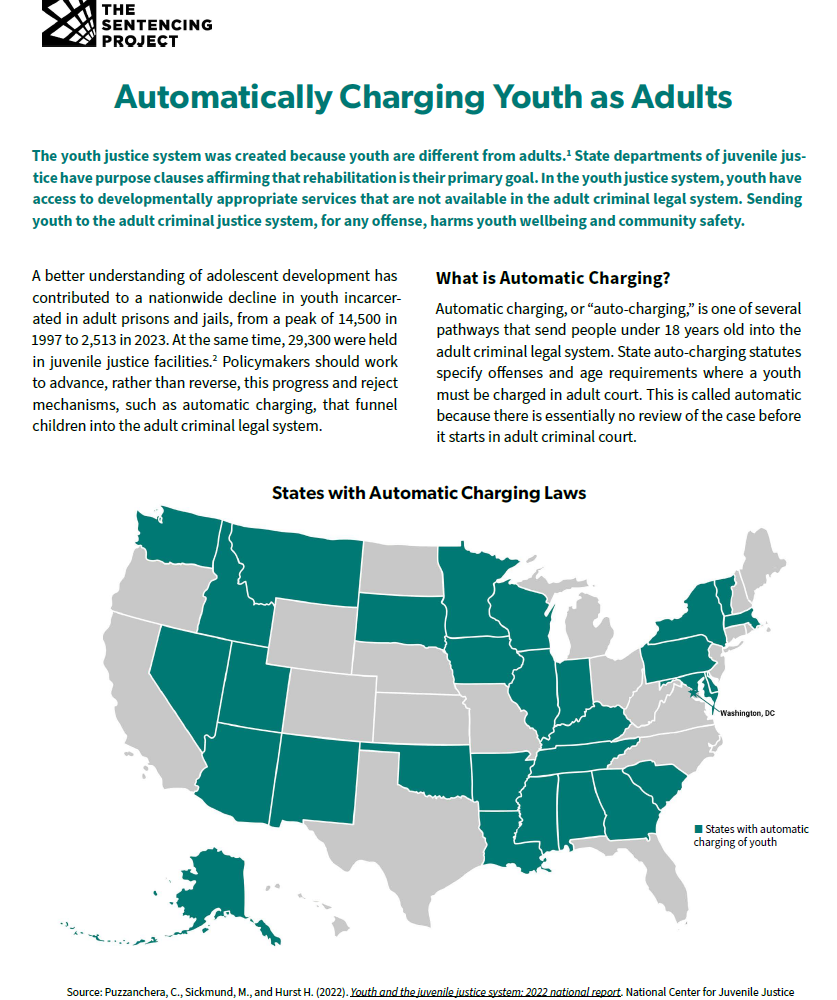
Automatically Charging Youth as Adults

By Olivia Naugle

The youth justice system was created because youth are different from adults.1 State departments of juvenile justice have purpose clauses affirming that rehabilitation is their primary goal. In the youth justice system, youth have access to developmentally appropriate services that are not available in the adult criminal legal system. Sending youth to the adult criminal justice system, for any offense, harms youth wellbeing and community safety.

How Mexican judicial reforms may have fueled crime: Arrest trends and trust erosion

By Catalina Amuedo-Dorantes, Marilyn Ibarra-Caton

Background

Mexico rolled out state-led criminal justice reforms between 2000 and 2017 to modernize procedures and improve rule of law. Whether these changes reduced violent crime—especially in cartel-affected areas—remains uncertain.

Aims

Estimate the impact of reform implementation on homicides and arrests, and assess mechanisms related to enforcement capacity and public cooperation with law enforcement.

Materials & Methods

We build a municipality–year panel (2000–2017) from death certificates (homicides) and administrative records (arrests). Because states adopted reforms at different times, we use difference-in-differences estimators designed for staggered adoption and heterogeneous treatment effects, with rich fixed effects and controls. To probe mechanisms, we analyze nationally representative survey measures of crime reporting, institutional trust, and perceived police/prosecutorial integrity.

Results

Reform implementation is associated with a ~25% increase in homicide rates. Over the same horizon, arrest rates fall by >50%. As homicides are less prone to underreporting than other crimes, the homicide increase is unlikely to be a reporting artifact. Survey evidence shows reduced crime reporting, declining trust in institutions, and more negative views of police and prosecutors; effects are strongest in cartel-affected regions.

Discussion

The pattern is consistent with an erosion of effective enforcement capacity at rollout: fewer arrests and lower public cooperation raise expected returns to violent crime. In high-violence settings, reforms that change procedures without parallel boosts to investigative and prosecutorial capacity—and without safeguards for witnesses—can weaken deterrence.

Conclusion

Mexico’s staggered judicial reforms coincided with higher homicides and sharply lower arrests. Successful reform in violent contexts likely requires coordinated institutional strengthening (policing, prosecution, witness protection), phased implementation with measurable benchmarks, and strategies to sustain public trust and reporting.

Climate Chains: Mapping the Relationship between Climate, Trafficking in Persons and Building Resilience in Ethiopia

By The International Organization for Migration

This report, Climate Chains: Mapping the Relationship between Climate, Trafficking in Persons and Building Resilience in Ethiopia, explores the complex links between climate change, livelihood, vulnerability, migration and human trafficking in Ethiopia. Commissioned by IOM under the Climate Resilience Against Trafficking and Exploitation (CREATE) project, this study forms part of a broader research focusing on Ethiopia and the Philippines – two countries facing distinct climate challenges: slow-onset droughts and sudden-onset typhoons, respectively.  

The research used a mixed-methods approach including household surveys, interviews and focus group discussions. The report puts forward a conceptual model that links climate events and trafficking through a series of intertwined steps. It identifies a causal chain where climate events disrupt livelihood, increase vulnerability and heighten migration intentions, which can lead to exploitation and trafficking. The research explores how factors linking climate and trafficking operate in Ethiopia. 

This study provides critical insights and recommendations for policymakers, donors and organizations in Ethiopia and internationally that are working to combat human trafficking and exploitation, while strengthening resilience to climate change.

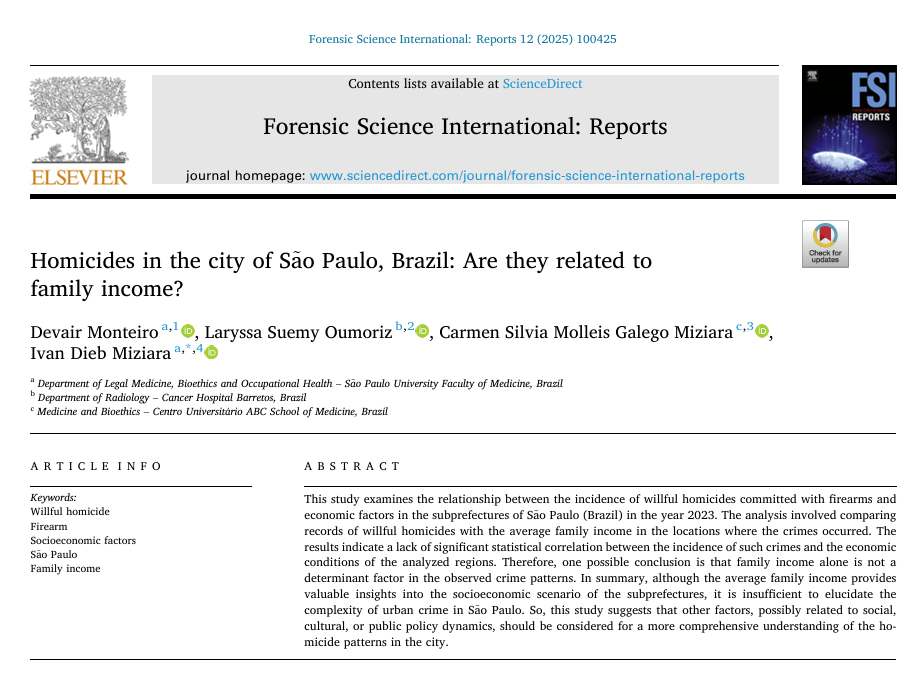
Homicides in the city of Sao ˜ Paulo, Brazil: Are they related to family income?

By Devair Monteiro, Laryssa Suemy Oumoriz , Carmen Silvia Molleis Galego Miziara , Ivan Dieb Miziara

This study examines the relationship between the incidence of willful homicides committed with firearms and economic factors in the subprefectures of São Paulo (Brazil) in the year 2023. The analysis involved comparing records of willful homicides with the average family income in the locations where the crimes occurred. The results indicate a lack of significant statistical correlation between the incidence of such crimes and the economic conditions of the analyzed regions. Therefore, one possible conclusion is that family income alone is not a determinant factor in the observed crime patterns. In summary, although the average family income provides valuable insights into the socioeconomic scenario of the subprefectures, it is insufficient to elucidate the complexity of urban crime in São Paulo. So, this study suggests that other factors, possibly related to social, cultural, or public policy dynamics, should be considered for a more comprehensive understanding of the homicide patterns in the city.

Forensic Science International: Reports, Dec. 2025

Report from the Crime Prevention Research Center.  Concealed Carry Permit Holders Across the United States: 2025

By John R. Lott, et al.

After peaking in 2022, the number of Concealed Carry Permit holders across the United States has declined for the third year in a row. The total now sits at 20.88 million, representing a 2.7% drop from last year. A major factor behind this ongoing decrease is the widespread adoption of Constitutional Carry laws. Following Louisiana’s implementation of permitless carry on July 4, 2024, 29 states now allow residents to carry without a permit. As a result, 46.8% of Americans (157.6 million) now live in Constitutional Carry States, with 67.7% of the land in the country (2.57 million square miles). Although no additional states enacted such laws this year, the broader trend remains unchanged. Unlike gun ownership surveys that may be affected by people’s unwillingness to answer personal questions, concealed handgun permit data is the only really “hard data” that we have, but it becomes a less accurate measure as more states become Constitutional Carry states.

Salt Lake City UK: Crime Prevention Research Center, 2025

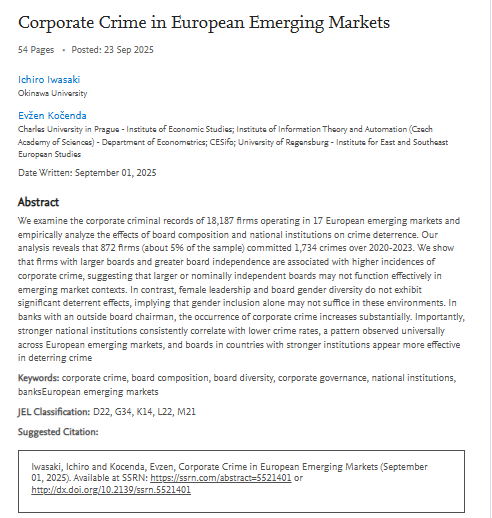
Corporate Crime in European Emerging Markets

By Ichiro Iwasaki and Kocenda, Evzen

We examine the corporate criminal records of 18,187 firms operating in 17 European emerging markets and empirically analyze the effects of board composition and national institutions on crime deterrence. Our analysis reveals that 872 firms (about 5% of the sample) committed 1,734 crimes over 2020-2023. We show that firms with larger boards and greater board independence are associated with higher incidences of corporate crime, suggesting that larger or nominally independent boards may not function effectively in emerging market contexts. In contrast, female leadership and board gender diversity do not exhibit significant deterrent effects, implying that gender inclusion alone may not suffice in these environments. In banks with an outside board chairman, the occurrence of corporate crime increases substantially. Importantly, stronger national institutions consistently correlate with lower crime rates, a pattern observed universally across European emerging markets, and boards in countries with stronger institutions appear more effective in deterring crime

CESifo Working Paper No. 12132 54 Pages Posted: 23 Sep 2025

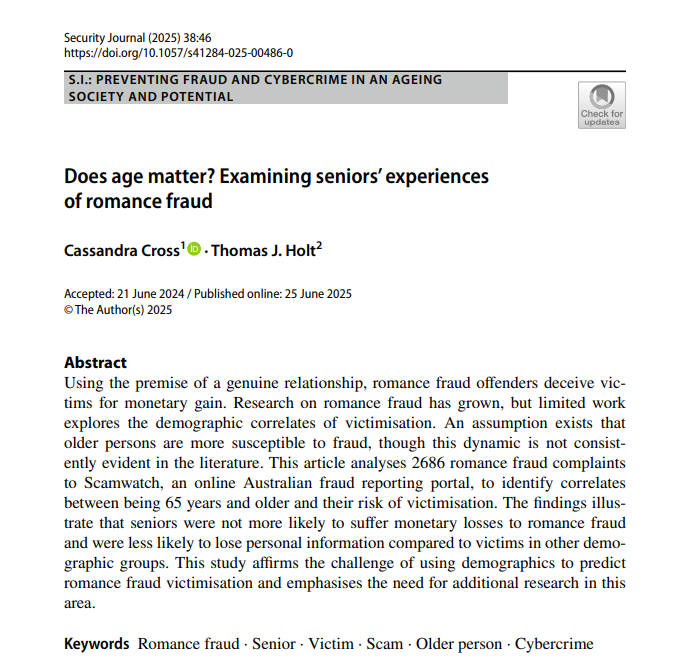
  Does age matter? Examining seniors’ experiences of romance fraud

By Cassandra Cross  · Thomas J. Holt 

Using the premise of a genuine relationship, romance fraud ofenders deceive victims for monetary gain. Research on romance fraud has grown, but limited work explores the demographic correlates of victimisation. An assumption exists that older persons are more susceptible to fraud, though this dynamic is not consistently evident in the literature. This article analyses 2686 romance fraud complaints to Scamwatch, an online Australian fraud reporting portal, to identify correlates between being 65 years and older and their risk of victimisation. The fndings illustrate that seniors were not more likely to sufer monetary losses to romance fraud and were less likely to lose personal information compared to victims in other demographic groups. This study afrms the challenge of using demographics to predict romance fraud victimisation and emphasises the need for additional research in this area 

  Security Journal (2025) 38:46

Safeguarding Singapore: Addressing the Impact of Transnational Scamming Operations in Southeast Asia

By Yen Zhi Yi
SYNOPSIS
In recent months, heightened media scrutiny has drawn attention to the proliferation of scam centres along Myanmar’s border towns and the subsequent crackdowns on them. Concurrently, Singapore has also witnessed a significant increase in scam-related incidents, with the government urging vigilance and taking precautionary measures to safeguard its citizens. Against this backdrop, it is imperative for ASEAN countries to work collaboratively to tackle this growing cross-border scourge. Doing so calls for stepped-up action at home to enhance awareness and enforcement collaboration abroad among regional partners to check this transnational security challenge.
 
S. Rajaratnam School of International Studies, NTU Singapore, 2025. 6p.

Internet Organised Crime Threat Assessment (IOCTA) 2024

Europol; European Union. Publications Office

From the document: "This edition marks 10 years since the release of Europol's first IOCTA [Internet Organised Crime Threat Assessment]. Throughout this time, the threats posed by cybercrime have evolved dynamically in terms of volume, intensity and harm potential. The number of cybercriminals entering the market continued to grow steadily, thanks to the adoption of new technologies as well as the increasing complexity of digital infrastructures, which expands the potential attack surface. In 2023, millions of victims across the EU were attacked and exploited online on a daily basis. Small and medium businesses were increasingly popular targets for cyber-attacks, while e-merchants experienced the most digital skimming attacks. Adults were victimised through phishing, investment and romance frauds, and more and more minors were targeted by child sexual exploitation offenders and online sexual extorters. In parallel, a number of worldwide law enforcement actions shook the cybercriminal underground through continued arrests of ransomware affiliates and operators. Law enforcement also carried out coordinated disruption operations against cybercriminals' digital infrastructures. Notwithstanding the growing presence of law enforcement in the dark web, this environment continues to function as an enabler for cybercrime, allowing offenders to share knowledge, tools and services in a more concealed way. In addition, the use of cryptocurrencies in a wider variety of crime areas has become more noticeable in 2023, alongside the growing number of requests for investigative support in cryptocurrency tracing received by Europol. Cybercriminals are keen to leverage Artificial Intelligence, which is already becoming a common component in their toolbox and is very likely to see even wider application. Law enforcement agencies are expected to build a robust capacity to counter the growing threats stemming from this, both in terms of human resources and technical skills."

Europol; European Union. Publications Office . 2024. 38p.

Soviet Criminology Update

By United Nations Interregional Crime and Justice Research Institute

Historical Context: The document outlines the evolution of Sovietcriminology through three stages: the 1920s, the 1960s "thaw," and the period of perestroika and glasnost in the 1980s.

Crime Trends: There was a significant increase in crime rates,particularly serious crimes, from the 1970s to the 1980s. The Document highlights issues like recidivism, professionalization of economic crime, and the rise in crimes among students and rural inhabitants.

Criminal Legislation: The document discusses the need for reforms inSoviet criminal law, emphasizing the importance of clear and logical legal language to reduce errors in the justice system.

Social and Psychological Factors: It explores the socio-psychological mechanisms behind criminal behavior, including the influence of social environment, personal traits, and the process of socialization.

UNICRI, 1990, 179 pages

InSight Crime’s 2023 Homicide Round-Up

By Insight Crime

  At least 117,492 people were murdered in Latin America and the Caribbean during 2023, putting the median homicide rate around 20 per 100,000 people. But homicide data in many countries is missing or unreliable, so the actual number is likely higher. Here, InSight Crime dives into our yearly round-up, analyzing the organized crime dynamics behind the violence in each country of the region.

Washington, DC: Insight Crime, 2024. 52p.  

World Drug Report 2024

UNITED NATIONS OFFICE ON DRUGS AND CRIME

From the webpage description: "A global reference on drug markets, trends and policy developments, the World Drug Report offers a wealth of data and analysis and in 2024 comprises several elements tailored to different audiences. The web-based Drug market patterns and trends [hyperlink] module contains the latest analysis of global, regional and subregional estimates of and trends in drug demand and supply in a user-friendly, interactive format supported by graphs, infographics and maps. The Key findings and conclusions booklet [hyperlink] provides an overview of selected findings from the analysis presented in the Drug market patterns and trends module and the thematic Contemporary issues on drugs booklet, while the Special points of interest [hyperlink] fascicle offers a framework for the main takeaways and policy implications that can be drawn from those findings. As well as providing an in-depth analysis of key developments and emerging trends in selected drug markets, the Contemporary issues on drugs booklet [hyperlink] looks at several other developments of policy relevance. [...] The World Drug Report 2024 is aimed not only at fostering greater international cooperation to counter the impact of the world drug problem on health, governance and security, but also at assisting Member States in anticipating and addressing threats posed by drug markets and mitigating their consequences."

UNITED NATIONS OFFICE ON DRUGS AND CRIME. 2024

The political economy of illicit drug crops: forum introduction

By Frances Thomson, Patrick Meehan & Jonathan Goodhand (02 Apr 2024):

his article and the forum it introduces examine illicit drug crop (IDC) economies from agrarian perspectives. Examining IDCs as a group implies analysing how prohibition distinguishes them from other (licit) crops. We identify seven mechanisms through which prohibition shapes the agrarian political economy of IDCs and explore how these mechanisms and their effects generate distinctive patterns of development and political action amongst ‘illicit peasantries’. We also examine connections between illicit and licit crops, including how licit crop crises and illicit crop booms intertwine. We argue that IDC economies provide a bulwark for smallholders but are by no means peasant idylls.

The Journal of Peasant Studies. 2024. 39p.

A Framework for Countering Organised Crime: Strategy, Planning, and the Lessons of Irregular Warfare

By David H. Ucko and Thomas A. Marks

Organised crime is not going well. According to the 2021 Global Organized Crime index, ‘the global illicit economy simply continue[s] along the upward trajectory it has followed over the past 20 years, posing an ever-increasing threat to security, development and justice – the pillars of democracy’ (Global Initiative, 2021, p. 8). Wherever governments seek to draw the line, criminal actors find profitable ways of crossing it; wherever governments fail to deliver on human need, criminal actors capitalise on citizens’ desire or despair. As of now, more than three-quarters of the world’s population ‘live in countries with high levels of criminality, and in countries with low resilience to organized crime’ (Global Initiative, 2021, p. 12). On aggregate, the associated activity amounts to an illicit form of governance, furnishing alternative services to a wide range of clients, be they the vulnerable and weak or a covetous elite. The breadth of organised crime, its clandestine nature, and its blending of creative and destructive effects make it difficult to counter. In past SOC ACE research, we argued that the response to organised crime often shares certain pitfalls with counterterrorism, at least since 9/11 (Ucko & Marks, 2022c). Both efforts have been stymied by 1) conceptual uncertainty of the problem at hand; 2) an urge to address the scourge head on (be it violence or crime), without acknowledging its socioeconomic-political context; and, therefore, 3) unquestioned pursuit of strategies that miss the point, whose progress is difficult to measure, and which may even be counterproductive. This convergence is based on the common features of the two phenomena, which are both concerned with i) collective actors, who ii) use violence and coercion among other methods; and who have iii) corrupting, or outright destructive effects on society. Though organised crime is not consciously political in its ideological motivation, it is – like terrorism – deeply political in its origins, activities, and effects. Given the conceptual overlap, and the common pathologies that undermine response, the lessons from countering terrorism are relevant also to the countering of organised crime. Focusing on the concept of ‘irregular warfare’, our past research identified six key lessons, touching upon 1) the socio-political embeddedness of the problem, 2) the tendency to militarise the response, 3) the mirror-imaging of state assistance programmes, 4) the invaluable role of community mobilisation, 5) the dearth of strategy, and 6) the need to engage more closely with questions of political will. As argued elsewhere, these challenges point to a need for greater strategic competence both in assessing the problem of organised crime and in designing a response (Ucko & Marks, 2022c).

To generate this strategic competence, this follow-on report sets out an analytical toolkit to assist planners and policymakers with the crafting of strategy. This ‘Framework of Analysis and Action’ builds upon lessons – negative and positive – learned via years of experience with irregular warfare, defined by the Department of Defense as ‘a violent struggle among state and non-state actors for legitimacy and influence over the relevant population(s)’ (U.S. Department of Defense, 2007, p. 1).1 It is a framework that finds its origins within the U.S. National Defense University’s College of International Security Affairs (CISA), where for two decades it has been used to teach strategic planning for complex and intensely political challenges (Ucko & Marks, 2022a). The framework consists of two parts: the Strategic Estimate of the Situation (which maps the problem, explores its drivers, frames, and methods, and critiques the current response) and the Course of Action (which uses the strategic estimate to design an appropriate strategy, guided by a theory of success). The framework is in this report adapted for organised crime, to enable the mapping of relevant actors and the crafting, thereby, of a viable response. By design, the framework responds to the six key lessons identified in our earlier work. This report goes through the framework and explains its adaptation to organised crime. Appendix A provides a summation of the toolkit, a ‘user’s guide’, that will facilitate application of the framework. Testing to date suggests great potential and we look forward to sustaining a dialogue with those engaged with countering organised crime to further evolve this toolkit. Indeed, since the beginning, this framework has been a living product, enriched by theoretical application in the classroom and practical use in the field.

SOC ACE Research Paper No. 19. Birmingham, UK: University of Birmingham, 2023. 45p.

Crime in Louisiana: Analyzing the Date

By The Pelican Institute

This year, disturbing reports of increased crime have dominated the news, both in Louisiana and nationally.

Crime is a serious issue that demands thoughtful solutions to deter criminal behavior and promote public safety. They should be guided by data and evidence, not anecdotes. That’s why Pelican set out to review and better understand the underlying data from the Federal Bureau of Investigation’s Uniform Crime Report and Bureau of Justice Statistics.

Comparing Louisiana’s crime data with other states paints a complete picture of the scale of the problem and its potential causes.

New Orleans LA: Pelican Institute. 2022, 12pg